
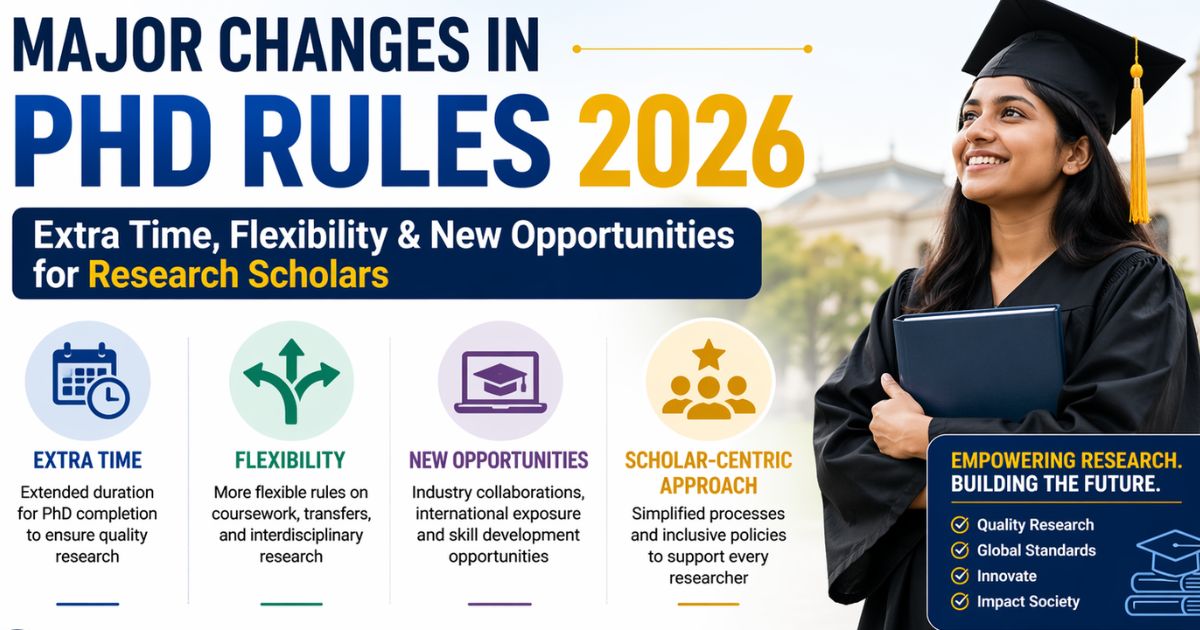
In this blog, we break down the latest PhD rule changes in 2026, their impact, and how you can benefit from them.
Overview of New PhD Regulations 2026
The updated PhD rules are largely based on the revised guidelines introduced by regulatory bodies and universities across India. The key objective is to make doctoral education:
- More flexible
- More inclusive
- More research-oriented
- Less stressful for scholars
One of the biggest highlights is the extension in PhD completion timelines, giving scholars more breathing room to finish their research.
1. Extended Time to Complete PhD
Earlier, PhD scholars were required to complete their degree within a strict timeframe. However, under the new rules:
- Standard duration: 3 to 6 years
- Extension allowed: Up to 1–2 additional years (based on university approval)
- Special cases: Even longer extensions for eligible candidates
This means students now get extra time to complete their thesis without pressure, improving research quality and reducing incomplete PhDs.
Why This Matters
Many students previously struggled due to:
- Data collection delays
- Job commitments
- Personal challenges
- Publication pressure
The new timeline ensures that scholars can focus on quality research instead of rushing deadlines.
2. Additional Relaxation for Women & Special Categories
The updated rules are more inclusive and supportive. Special provisions include:
- Extra extension for women scholars
- Additional time for Persons with Disabilities (PwD)
- Maternity/childcare leave benefits
In some cases, scholars may get up to 7–8 years to complete their PhD.
This is a major step toward gender equality and inclusive education.
3. Re-Registration Option for Expired PhD
Previously, if a student failed to complete their PhD within the given time, their registration would be cancelled permanently.
Now:
- Scholars can re-register
- They may get additional time (e.g., 2 years) to complete their thesis
- No need to restart from scratch in some cases
However, there is usually a maximum limit (around 9–10 years) beyond which continuation is not allowed.
Benefit
This rule helps students who had to drop out due to:
- Financial issues
- Job opportunities
- Health problems
4. Part-Time PhD Flexibility for Working Professionals
One of the most important updates is the introduction and expansion of part-time PhD programs.
Key Features:
- Working professionals can pursue PhD
- Full-time scholars can switch to part-time
- Job + research balance is now possible
In many universities:
- Minimum 1 year of coursework completion required before switching
- Approval needed from university authorities
This reform ensures that students don’t have to leave their careers to complete a PhD.
5. Direct PhD After 4-Year Bachelor’s Degree
A revolutionary change under the new system:
Students can now pursue PhD directly after a 4-year undergraduate degree with research.
Eligibility:
- Minimum 75% marks (or equivalent grade)
- Research component in final year
This aligns with the NEP 2020 framework, allowing faster entry into research careers.
6. Removal of M.Phil Program
Another major change:
- M.Phil has been discontinued
- Direct pathway: Master’s → PhD
- Existing M.Phil degrees remain valid
This simplifies the academic journey and reduces the time required to start doctoral research.
7. No Mandatory Research Publication Requirement
Earlier, PhD scholars had to publish research papers before submitting their thesis.
Now:
- Publication is not mandatory
- Focus is on quality of research instead of quantity
This change reduces stress and prevents scholars from publishing in low-quality or predatory journals.
8. Improved Work-Life Balance for Scholars
Modern PhD regulations emphasize mental well-being and flexibility:
- Leave policies improved
- Reduced academic pressure
- Focus on research output instead of attendance
This creates a more student-friendly research environment.
9. Increased Focus on Research Quality & Innovation
With relaxed timelines and flexible rules, universities are now focusing on:
- High-quality thesis work
- Interdisciplinary research
- Industry collaboration
- Real-world problem solving
This aligns Indian PhD programs with global standards.
Impact of New PhD Rules on Students
Positive Impact
✔ More time to complete research
✔ Reduced stress and dropout rates
✔ Better opportunities for working professionals
✔ Inclusive policies for women and special categories
✔ Faster entry into PhD programs
Challenges
❗ Longer duration may delay career entry
❗ Need for self-discipline without strict deadlines
❗ Increased competition due to easier access
How Thesislikho.com Can Help You
With changing PhD rules, students need expert guidance more than ever.
At Thesislikho.com, we provide:
- PhD thesis writing support
- Research proposal development
- Plagiarism-free content
- Data analysis assistance
- Publication guidance
Whether you are starting your PhD or nearing submission, our experts help you complete your research on time and with quality.
Tips to Complete Your PhD Faster (Even With Extended Time)
- Set monthly research goals
- Stay connected with your supervisor
- Start writing early
- Use professional research support
- Avoid unnecessary delays
Remember: Extra time is an advantage, not an excuse.
FAQs on New PhD Rules 2026
1. What is the new duration of a PhD in India?
The standard duration is 3 to 6 years, with possible extensions up to 7–8 years in special cases.
2. Can I get extra time to complete my PhD?
Yes, universities now allow extensions based on valid reasons, subject to approval.
3. Is M.Phil still required for PhD?
No, M.Phil has been discontinued. You can directly apply for a PhD after a master’s degree or a 4-year bachelor’s degree with research.
4. Can I do a PhD while working?
Yes, part-time PhD options are now available for working professionals.
5. Is publication mandatory for PhD submission?
No, research publication is no longer mandatory, but it is still recommended for academic growth.
6. Can I do PhD after a 4-year graduation?
Yes, if you have 75% marks and a research-based degree, you can apply directly.
7. What happens if I fail to complete my PhD on time?
You may get an extension or re-registration option, depending on university rules.
8. Are there special benefits for female researchers?
Yes, women scholars can get extra time, maternity leave, and flexibility.
9. What is the biggest benefit of new PhD rules?
The biggest advantage is flexibility and reduced pressure, allowing better research quality.
10. How can I complete my PhD successfully?
With proper planning, guidance, and expert support from platforms like Thesislikho.com, you can complete your PhD efficiently.
Final Thoughts
The new PhD regulations in 2026 mark a major shift toward student-friendly and flexible research education in India.
With extended timelines, part-time options, and simplified eligibility, pursuing a PhD is now more accessible than ever. However, success still depends on discipline, planning, and expert guidance.
If you want to complete your PhD faster, smarter, and stress-free, professional support can make a huge difference.
Need Help With Your PhD Thesis?
Get expert assistance from Thesislikho.com today and take your research to the next level.