
Introduction
In the pursuit of scientific advancement, empirical truth is not merely discovered; it is systematically constructed. Whether investigating quantum phenomena, molecular biology, structural engineering, or climate modeling, the rigor of your research methodology serves as the bedrock of academic credibility. A well-structured methodology transforms raw observations into actionable scientific knowledge, ensuring that findings are reproducible, statistically valid, and resilient under peer review.
For early-career researchers, STEM postgraduates, and doctoral candidates, constructing an airtight scientific methodology is often the most challenging phase of the thesis journey. This comprehensive guide explores the structural core of scientific research methodology, detailing experimental design, variable control, data analytics, and the integration of professional academic support systems like ThesisLikho.com.
1. Fundamentals of Scientific Research Design
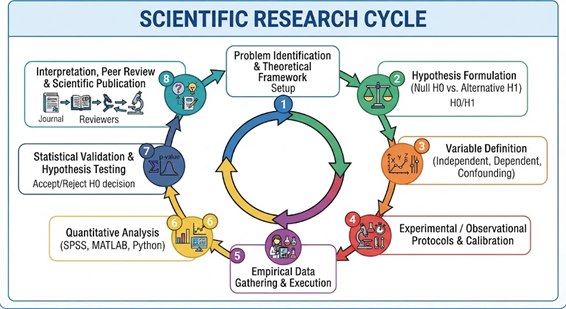
Scientific research design operates on the principles of hypothetico-deductive reasoning. Unlike subjective inquiry, scientific methodology requires explicit operationalization of concepts into measurable parameters.
Formulating Testable Hypotheses
A scientific hypothesis must be both testable and falsifiable. It establishes a directional or non-directional relationship between variables:
- Null Hypothesis (H0): Assumes no significant difference or effect exists between variables.
- Alternative Hypothesis (H1): Posits that a statistically significant relationship, treatment effect, or variance exists.
Defining and Isolating Variables
To establish causality in natural and applied sciences, variables must be categorized with precision:
- Independent Variables (IV): The conditions manipulated or categorized by the researcher (e.g., drug dosage, temperature, algorithmic parameters).
- Dependent Variables (DV): The outcome metrics measured to evaluate the impact of the IV (e.g., cell viability, tensile strength, processing efficiency).
- Control Variables: Factors held constant to prevent extraneous influence from distorting outcomes.
- Confounding Variables: Uncontrolled extraneous variables that correlate with both the independent and dependent variables, potentially introducing bias.
2. Scientific Methodological Frameworks
Choosing the appropriate methodological framework depends on your research questions, available resources, and the nature of the phenomenon under investigation.
1. True Experimental Design
Characterized by random assignment, control groups, and active manipulation of independent variables. True experimental designs represent the gold standard for establishing causal relationships in fields like chemistry, pharmacology, and material sciences.
2. Quasi-Experimental Design
Utilized when complete random assignment is ethically or logistically unfeasible (e.g., testing clinical protocols across pre-existing patient cohorts or agricultural plots). While lacking full random assignment, robust statistical controls are applied to account for baseline differences.
3. Observational and Epidemiological Studies
Essential when experimental manipulation is impossible or unethical (e.g., astronomical observations, ecological tracking, long-term environmental exposure studies). Common formats include:
- Cohort Studies: Tracking groups over time to assess outcome incidence.
- Case-Control Studies: Retrospective analysis comparing subjects with an outcome to those without.
- Cross-Sectional Studies: Single-point data snapshots evaluating prevalence.
4. Computational and Simulation-Based Methodology
In contemporary STEM research—such as bioinformatics, computational fluid dynamics (CFD), and artificial intelligence—in silico modeling serves as the primary methodology. These frameworks rely on algorithmic simulation, mathematical modeling, and high-performance computing to simulate real-world phenomena.
3. Sampling Strategies and Measurement Precision
The validity of scientific conclusions hinges on sampling accuracy and measurement reliability.
Sampling Techniques in STEM
- Probability Sampling:
- Simple Random Sampling: Every unit in the target population has an equal probability of selection.
- Stratified Random Sampling: Subgroups (strata) are defined (e.g., soil depth levels, age brackets), and samples are randomly drawn from each stratum to ensure representation.
- Systematic Sampling: Selecting subjects at fixed periodic intervals after a random start point.
Ensuring Instrument Validity and Reliability
- Calibration: Standardizing laboratory equipment against certified benchmark standards to minimize systematic error.
- Internal Consistency & Reliability: Verifying that instruments yield stable results across repeated trials under identical environmental conditions (test-retest reliability).
- Measurement Accuracy vs. Precision:
- Accuracy refers to how close a measured value is to the true value.
- Precision measures the repeatability of measurements under unchanging conditions.
4. Quantitative Data Analysis & Statistical Modeling
Data collection is only half the battle; rigorous quantitative analysis transforms raw data into meaningful scientific evidence.
Parametric vs. Non-Parametric Testing
- Parametric Tests: Used when data meets normality assumptions (e.g., Student’s t-test, ANOVA, Pearson correlation, Linear Regression).
- Non-Parametric Tests: Applied when data violates normality or consists of ordinal/nominal measurements (e.g., Mann-Whitney U, Kruskal-Wallis, Spearman rank correlation).
Interpreting Statistical Significance
- p-Value Threshold: Typically set at α=0.05 or α=0.01. p<0.05 indicates that the probability of obtaining the observed results by chance alone is under 5%.
- Effect Size: Quantifies the magnitude of an experimental effect (e.g., Cohen's d, Eta-squared), providing critical context beyond binary statistical significance.
- Confidence Intervals (CI): Typically reported at the 95% level to estimate the range within which the population parameter lies.
5. Structuring the Science Research Methodology Chapter
When writing your dissertation or manuscript methodology section, clarity and precision are paramount. Academic evaluators look for a clear structure:
Thesis Likho
- Methodological Overview: Restate the research objectives, core hypothesis, and chosen design framework.
- Materials, Reagents & Equipment: Detail exact model numbers, chemical purity levels, software versions, and environmental controls.
- Experimental / Data Collection Procedures: Document protocols step-by-step to enable exact replication by independent researchers.
- Data Pre-processing & Quality Control: Describe methods for outlier detection, missing data imputation, and signal filtering.
- Statistical and Analytical Pipeline: Specify software tools (e.g., SPSS v28, MATLAB R2023b, Python 3.11), statistical models, and significance thresholds.
- Ethical Compliance & Safety Declarations: Outline institutional bioethics approvals, animal welfare guidelines, or hazardous waste safety protocols.
6. How ThesisLikho.com Empowers Scientific Researchers
Navigating complex statistical models, computational scripts, and experimental validation often presents significant hurdles for scholars. ThesisLikho.com provides comprehensive, PhD-level academic research support tailored to the exact requirements of STEM disciplines.
Specialized Scientific Research Assistance from ThesisLikho.com
- Data Analysis & Computational Modeling: ThesisLikho offers direct assistance from domain experts in executing complex statistical tests in SPSS, developing custom algorithms in Python, and performing simulations in MATLAB.
- PRISMA Systematic Reviews: For scholars undertaking systematic literature reviews and meta-analyses, ThesisLikho guides the formulation of PRISMA flow diagrams, inclusion/exclusion criteria, and risk-of-bias assessments.
- Methodology Design Validation: Experienced PhD advisors review experimental setups, sample size calculations (power analysis), and variable operationalization to prevent methodological flaws before data collection.
- Plagiarism Auditing & Formatting Compliance: ThesisLikho delivers 100% original, university-compliant research manuscripts backed by verified Turnitin anti-plagiarism reports, precise citation formatting (IEEE, APA, ACS, Vancouver), and line-by-line editorial polishing.
Thesis Likho
By bridging the gap between theoretical research design and technical execution, ThesisLikho.com enables scientific researchers to submit methodologically rigorous, publication-ready theses and journal articles.
Thesis Likho
Conclusion
A well-planned research methodology is essential for rigorous scientific inquiry. By carefully formulating hypotheses, selecting appropriate experimental or computational frameworks, maintaining instrument precision, and applying robust statistical models, scientific researchers can produce credible findings that contribute meaningfully to their fields.
📞 WhatsApp: +91 96438 02216
🌐 Website: https://thesislikho.com