
Introduction
In modern academia, the phrase "publish or perish" reflects the high stakes of scientific and scholarly dissemination. However, as the volume of global research output increases, the emphasis has shifted toward "publish with integrity or face retraction." Publication is the primary mechanism through which scientific knowledge is validated, preserved, and communicated. Yet, the pressure to publish in high-impact journals can tempt researchers toward shortcuts, leading to ethical breaches that compromise the scientific record.
Research ethics extends beyond protecting human subjects in clinical trials or laboratory animals in experimental setups. It encompasses the entire lifecycle of scholarship—from data collection and statistical analysis to author attribution, peer review, and post-publication updates. Understanding publication ethics, navigating journal selection, avoiding predatory publishers, and adhering to international standards—such as those defined by the Committee on Publication Ethics (COPE)—are essential skills for every researcher.
This comprehensive guide explores the principles of research publication, common publishing pitfalls, academic integrity standards, and how professional platforms like ThesisLikho.com support scholars throughout the publishing process.
1. The Scholarly Publishing Lifecycle
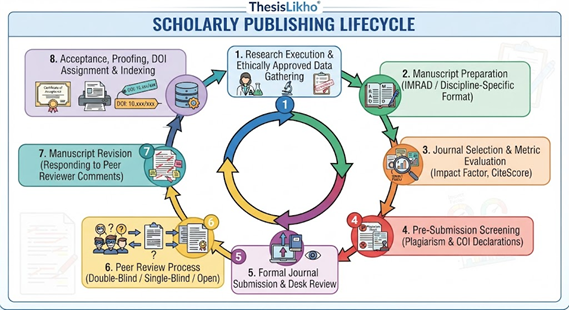
To successfully publish research in indexed journals (Web of Science, Scopus, PubMed, UGC-CARE), authors must understand each stage of the publishing lifecycle.
Key Stages in Detail
- Pre-Submission Preparation: Organizing data, ensuring ethical clearance, and writing the manuscript in accordance with target journal guidelines (Instruction for Authors).
- Desk Review: The Managing Editor evaluates whether the submission fits the journal scope, adheres to word limits, and meets basic quality standards. Manuscripts failing these criteria receive a "Desk Reject."
- Peer Review: The manuscript is evaluated by independent domain experts who assess novelty, methodological rigor, statistical validity, and clarity.
- Editorial Decision: Based on reviewer reports, the editor issues one of four decisions: Accept, Minor Revisions, Major Revisions, or Reject.
2. Core Pillars of Research Ethics
Ethical integrity forms the foundation of academic research. Transgressions can result in paper retractions, institutional disciplinary action, loss of research funding, and permanent damage to professional reputation.
1. Avoiding Scientific Misconduct (FFP)
The standard definition of research misconduct includes three major violations:
- Fabrication: Making up data, experimental results, or research findings and recording or reporting them as real.
- Falsification: Manipulating research materials, equipment, processes, or altering data/images such that the research is not accurately represented in the published record.
- Plagiarism: Appropriating another person’s ideas, processes, results, or text without giving appropriate credit.
2. Understanding Plagiarism Variants
Plagiarism manifests in several forms, all of which compromise academic integrity:
- Direct (Verbatim) Plagiarism: Copying text word-for-word from a source without quotation marks or proper attribution.
- Mosaic / Patchwork Plagiarism: Interspersing phrases from source material into one's own text without citing original authors.
- Paraphrasing Plagiarism: Rephrasing an author's ideas or logical flow without citing the source.
- Self-Plagiarism & Duplicate Publication: Reusing substantial portions of one’s own previously published text, data, or figures without citation or permissions.
3. Ethical Authorship and Attribution
Determining who qualifies as an author is a frequent source of academic dispute. The International Committee of Medical Journal Editors (ICMJE) provides standard criteria for authorship. An author must meet all four requirements:
- Substantial contributions to the conception or design of the work, or the acquisition, analysis, or interpretation of data.
- Drafting the work or revising it critically for important intellectual content.
- Final approval of the version to be published.
- Agreement to be accountable for all aspects of the work in ensuring that questions related to accuracy or integrity are appropriately investigated and resolved.
Misconduct in Authorship
- Ghost Authorship: Omitting an individual who made substantial contributions to the manuscript.
- Gift / Guest Authorship: Adding senior scholars or colleagues who made no intellectual contribution to increase publication chances.
- Coercive Authorship: Senior personnel forcing inclusion on papers due to institutional authority.
3. Navigating Predatory Publishing and Journal Metrics
The rise of open-access publishing created opportunities for predatory publishers—entities that charge Article Processing Charges (APCs) without providing legitimate peer review or editorial oversight.
Identifying Predatory Journals
Researchers should check for red flags before submitting work:
- Unrealistic review turnarounds (e.g., "Peer reviewed and published in 48 hours").
- Unsolicited email invitations targeting authors.
- Lack of transparent editorial board details or unverified physical addresses.
- Misleading or fake metric claims (e.g., "Global Impact Factor", "Universal Impact Factor").
- Absence from verified academic indexes such as Directory of Open Access Journals (DOAJ), Scopus, or Web of Science.
Essential Journal Metrics
Evaluating journal prestige requires familiarity with standard bibliometric indicators:
- Journal Impact Factor (JIF): Calculated by Clarivate (Web of Science), measuring average citations received by recent articles.
- CiteScore: Elsevier's metric measuring average citations per document over a four-year window in Scopus.
- $h$-index: Measures both the productivity and citation impact of a researcher or publication channel.
- SJR (SCImago Journal Rank): Weighs citations based on the prestige of the citing journal.
4. Handling Conflicts of Interest and Data Transparency
Modern academic journals require complete transparency regarding funding sources, potential conflicts, and raw data availability.
1. Conflict of Interest (COI) Declarations
Authors must disclose any financial, personal, or professional relationships that could bias their work (e.g., employment, consultancies, stock ownership, honoraria, expert testimony).
2. Data Availability and Open Science
Many high-impact publishers enforce Open Science Framework (OSF) directives, requiring researchers to make anonymized raw data sets accessible in public repositories (e.g., Figshare, Zenodo, Dryad) alongside a formal Data Availability Statement (DAS).
5. How ThesisLikho.com Supports Ethical Publication
Preparing a manuscript that meets international publishing standards can be challenging for scholars navigating strict journal guidelines, peer review feedback, and anti-plagiarism checks. ThesisLikho.com offers research and editing support to help scholars publish their work ethically and effectively.
How ThesisLikho.com Assists Researchers
- Journal Selection Guidance: ThesisLikho helps scholars identify suitable, peer-reviewed journals indexed in Scopus, Web of Science, or UGC-CARE, protecting researchers from predatory platforms.
- Plagiarism Auditing & Originality Verification: Utilizing advanced similarity detection tools like Turnitin, ThesisLikho provides detailed similarity reports and editing assistance to ensure text originality.
- Manuscript Formatting & Style Compliance: Academic editors format manuscripts according to target journal guidelines, including citation styles (APA, IEEE, Vancouver, Nature, ACS) and figure/table presentation.
- Peer Review Response Assistance: ThesisLikho guides authors through structural revisions and helps draft clear point-by-point rebuttal letters to address reviewer critiques effectively.
By combining ethical standards with expert editing and journal selection support, ThesisLikho.com helps researchers publish high-quality, peer-reviewed work in reputable academic journals.
Conclusion
Ethical research and publication practices are essential for preserving the integrity of academic scholarship. By adhering to international ethical standards, declaring conflicts of interest, selecting reputable journals, and avoiding misconduct, researchers ensure their work makes a reliable contribution to their fields.
📞 WhatsApp: +91 96438 02216
🌐 Website: https://thesislikho.com