
Introduction
An MBA dissertation is an academic project where students apply management ideas, research methods, analysis techniques and business knowledge to a specific problem. Unlike an assignment an MBA dissertation needs proper research analysis based on evidence and a clear academic structure.
Picking the topic is just the start. Students also need to create research goals look at existing studies choose the methods, gather or find relevant data do the analysis explain what was found and present conclusions and ideas.
For MBA students handling all these steps can be hard especially when deadlines are near.
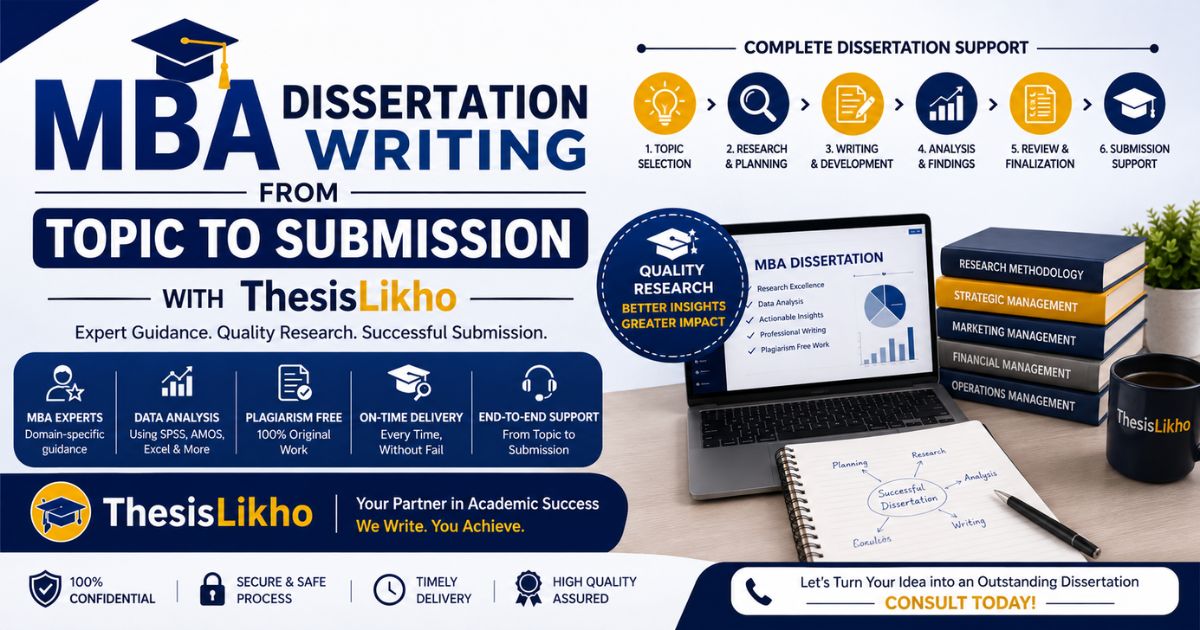
ThesisLikho gives organized help to students working on MBA dissertations and research projects helping them understand and manage the different parts of writing a dissertation.
The full process can be seen as:
Topic Selection → Research Problem → Objectives → Literature Review → Methodology → Data Collection → Data Analysis → Findings → Discussion → Recommendations → Editing → Formatting → Submission
What Is an MBA Dissertation?
An MBA dissertation is an academic study focused on a specific business or management issue.
Depending on the MBA area a dissertation might focus on:
Finance
Marketing
Human Resource Management
Operations Management
International Business
Entrepreneurship
Strategic Management
Business Analytics
Supply Chain Management
Organizational Behaviour
Digital Marketing
Banking and Financial Services
The dissertation should look at a defined problem and use the right research method to study it.
A strong MBA dissertation does more than just talk about a business topic. It looks at a research question. Uses evidence to find something meaningful.
Why Choosing the Right MBA Research Topic Matters
The research topic sets the direction for the dissertation.
A good topic should be:
Relevant to the MBA area
enough to study
Supported by existing studies
Practical within the time available
Suitable for collecting data or using secondary research
Linked to a clear research problem
Able to produce useful results
For instance instead of picking a general topic like:
“Digital Marketing"
A better topic could look at:
“The Influence of Social Media Marketing on Consumer Purchase Intention among Online Retail Customers."
The second topic gives a research area, variables and group to study.
Step 1: Identify the Research Problem
Once a topic is chosen the next step is to find the research problem.
A research problem explains what needs to be studied and why the study is important.
For example companies may spend a lot on marketing but how customers respond to different social media strategies can be different.
This gives a chance to study how social media marketing affects purchase intention.
A strong problem statement can help set:
Research background
Existing business issue
Knowledge gap
Research need
Research direction
Step 2: Develop Research Objectives
Research objectives explain what the dissertation wants to achieve.
For example an MBA Marketing dissertation might have objectives like:
1. To examine the influence of social media marketing on consumer purchase intention.
2. To identify the media factors affecting customer engagement.
3. To analyze the relationship between social media engagement and purchase intention.
4. To give suggestions for improving media marketing effectiveness.
Clear objectives help decide what data to collect and what methods to use.
Step 3: Develop Research Questions
Research questions turn the objectives into questions.
For example:
Does social media marketing influence purchase intention?
Which social media factors influence customer engagement?
Is customer engagement connected to purchase intention?
What marketing strategies can companies use to improve customer engagement?
The research questions should stay aligned with the objectives throughout the dissertation.
Step 4: Conduct the Literature Review
The literature review builds the base of an MBA dissertation.
It involves looking at:
Books
Journal articles
Research papers
Industry studies
Reports
Academic databases
dissertations where relevant
But a literature review should not just list one study after another.
A strong literature review. Evaluates past research.
It can look at:
Existing theories
ideas
Previous results
Research methods
Contradictory findings
Limitations
Areas not studied well
What Is a Research Gap?
A research gap is an area where existing studies do not fully answer a question.
A gap might happen because:
Previous studies had results.
A specific group got little attention.
A certain industry was not studied enough.
The link between variables is not clear.
Previous studies used contexts or methods.
The research gap should be supported by the studies not just mentioned without proof.
Step 5: Develop the Conceptual Framework
A conceptual framework shows how the main research variables are connected.
For example:
Social Media Marketing
↓
Customer Engagement
↓
Purchase Intention
social media marketing could be the independent variable customer engagement the possible middle variable and purchase intention the dependent variable.
The framework should be based on theories and past studies.
Step 6: Select the Research Methodology
The research methodology explains how the MBA dissertation will be done.
It may include:
Research approach
Research design
Population
Sampling method
Sample size
Data sources
Data collection method
Research tool
Measurement
Data analysis
Ethical issues
The method should match the research questions and goals.
Quantitative Research for MBA Dissertations
research uses numbers to study relationships, differences, patterns or predictions.
For example an MBA student might use a survey to get responses from customers.
Quantitative analysis could include:
Frequency
Percentage
Mean
Standard deviation
Correlation
Regression
t-test
ANOVA
Factor analysis
The chosen method should fit the research plan and the data.
Qualitative Research for MBA Dissertations
Qualitative research is helpful when the study is, about experiences, opinions or company processes.
Methods can include:
Interviews
Focus groups
Case studies
Observation
Document analysis
For example an MBA HR dissertation could look at how employees feel about work policies through interviews.
The researcher should explain how participants were chosen, how data was collected and how qualitative data was looked at.
Mixed-Methods Research
Some MBA dissertations use both qualitative methods.
For example:
Survey → Statistical Findings → Interviews → Deeper Explanation
A survey might show a link between leadership and employee satisfaction while interviews might help explain why employees feel good or bad about leadership styles.
Mixed-methods research should be used when it truly helps answer the research questions.
Step 7: Questionnaire Development
For survey-based MBA research the questionnaire needs to match the framework.
A questionnaire may have:
Section A. Demographic Information
Age
Gender
Education
Work experience
Occupation
Section B. Independent Variables
Questions that measure the factors being studied.
Section C.. Moderating Variables
If needed.
Section D. Dependent Variable
Questions that measure the outcome being studied.
Questionnaire items should be clear and related to the concepts being measured.
Step 8: Sampling and Data Collection
The dissertation should explain how people were chosen to take part.
Possible sampling methods include:
Probability Sampling
random sampling
Stratified sampling
Systematic sampling
Cluster sampling
Non-Probability Sampling
Convenience sampling
Purposive sampling
Snowball sampling
The sampling method should make sense for the group being studied and the research goals. Students must also follow their schools rules for getting permission and collecting data.
Step 9: Data Preparation
Before doing analysis the data may need some work.
This can include:
Checking for answers
Finding duplicate entries
Coding variables
Reviewing missing information
Checking for consistency
Looking for unusual data points
Good preparation helps make the analysis more accurate and clear.
Step 10: Data Analysis
Data analysis turns information into research results.
For MBA research students can use statistical tools like:
Descriptive statistics
Reliability analysis
Correlation
Regression
Factor analysis
ANOVA
Mediation
Moderation
The analysis must directly answer the research questions.
The goal is not to use many techniques as possible. The goal is to use the method for the research problem and data.
Using SPSS for MBA Research
SPSS can be useful for quantitative MBA research tasks.
Depending on the study it can help with:
Data screening
Frequency analysis
statistics
Reliability analysis
Correlation
Regression
t-tests
ANOVA
Factor analysis
For example if an MBA student wants to look at whether employee engagement predicts retention intention regression analysis may be a choice if it fits the research design.
Step 11: Interpret the Findings
Statistical results should not just be copied into the dissertation.
Students need to explain what the results mean.
For example:
Result
The analysis shows a positive connection between employee engagement and retention intention.
Interpretation
The result suggests that higher employee engagement is linked to intention to stay among the people studied.
The explanation should match the research design. Should not claim cause and effect unless the method supports it.
Step 12: Write the Results Chapter
The results chapter shows the findings clearly.
A possible structure is:
4.1 Introduction
Overview of the chapter.
4.2 Respondent Profile
Demographic details.
4.3 Descriptive Statistics
Summary of the research variables.
4.4 Reliability Analysis
Check of how consistent the measurementsre
4.5 Correlation Analysis
Relationships between variables.
4.6 Regression Analysis
Predictive or explanatory relationships where needed.
4.7 Hypothesis Testing
Summary of the evidence.
4.8 Chapter Summary
Main findings.
The exact structure should follow the universitys rules.
Step 13: Write the Discussion
The discussion explains the importance of the results.
A good way to do this is:
Finding → Literature → Explanation → Implication
For example if the study finds that leadership is connected to employee engagement the student can compare this with research explain why the link might exist connect it with the theory and talk about how it applies to real-world management.
The discussion should not just repeat the results.
Step 14: Develop Recommendations
Suggestions should come from the findings.
For example if the study shows a link between employee engagement and retention intention an organization might think about:
Recognizing employees
Providing career growth
Improving communication from managers
Getting employee feedback
Offering training
Recommendations should be realistic, clear and connected to the research.
Step 15: Write the MBA Dissertation Conclusion
The conclusion brings everything together.
It may include:
Research problem
Objectives
results
Important implications
Suggestions
Shortcomings
Future work
The conclusion should not add new information not discussed before.
Step 16: Address Research Limitations
Every study has some limits.
Possible issues can include:
number of participants
Only one location
Short time frame
Limited access to people
Responses from participants themselves
Study done at one point in time
Only some data available
Acknowledging limits shows honesty.
Limitations should be honest not used to weaken the study.
Step 17: MBA Dissertation Editing
After finishing the version editing is important.
Editing can help with:
Grammar
Sentence structure
Academic tone
Flow of the chapters
Clarity
Repetition
Language
Transitions
References to tables. Figures
The goal is to make the dissertation easier to read without changing the original meaning.
Step 18: Proofreading and Formatting
Before handing it in students should check:
Spelling
Grammar
Headings
Page numbers
Tables
Figures
References
Citations
Margins
Font
Line spacing
Appendices
Formatting rules differ between universities so students should follow their schools rules.
Step 19: Referencing and Academic Integrity
Correct referencing is a part of research.
Students should make sure:
Sources are cited correctly.
In-text citations match the reference list.
Quotes are clearly marked.
Paraphrased ideas are properly cited.
Original results are clearly different from research.
Students should also keep honesty by avoiding false data, fake results, copying and making claims without proof.
A similarity report can find parts to review. It is not a substitute, for real academic writing.
MBA Dissertation Chapter Structure
A typical MBA dissertation may follow this structure:
Chapter 1. Introduction
Background
Research problem
Research gap
Objectives
Research questions
Scope
Significance
Chapter 2. Literature Review
Concepts
Theories
Previous studies
Critical analysis
Research gap
Conceptual framework
Chapter 3. Research Methodology
Research design
Population
Sampling
Data collection
Research instrument
Measurement
Data analysis
Ethics
Chapter 4. Results
Respondent profile
Descriptive statistics
Reliability
Statistical analysis
Hypothesis testing
Chapter 5. Discussion
Interpretation
Literature comparison
implications
Practical implications
Chapter 6. Conclusion
Major findings
Recommendations
Limitations
Future research
Final conclusion
The exact chapter structure may differ according to the university, specialization and research methodology.
Common MBA Dissertation Challenges
Choosing a Topic That Is Too Broad
A topic can make the research difficult to complete within the available time.
Weak Research Objectives
Unclear objectives can create problems later during data collection and analysis.
Poor Literature Review
Simply summarizing studies does not demonstrate critical analysis.
Misaligned Methodology
The methodology must correspond with the research questions and objectives.
Using Inappropriate Statistical Tests
Statistical techniques should be selected according to the type of data and research question.
Describing Results Without Interpretation
A dissertation should explain what the findings mean.
Weak Recommendations
Recommendations should be based on the research findings than generic business advice.
Last-Minute Formatting
Formatting should be checked before the submission rather than at the very end.
How ThesisLikho Supports MBA Dissertation Development
ThesisLikho provides academic guidance for MBA students working through different stages of dissertation development.
Support may include:
MBA research topic selection
Research problem development
Research objectives
Research questions
Literature review guidance
Research gap identification
Conceptual framework
Research methodology
Questionnaire guidance
Sampling guidance
Data analysis guidance
SPSS analysis guidance
Results interpretation
Discussion development
Recommendations
Dissertation chapter structuring
Academic editing
Proofreading
Referencing
Formatting
Submission preparation
The purpose is to help students understand and organize their research while maintaining responsibility for their data, academic decisions, analysis, findings and final submission.
MBA Dissertation Roadmap: From Topic to Submission
1. Topic Selection
↓
2. Research Problem
↓
3. Research Gap
↓
4.. Research Questions
↓
5. Literature Review
↓
6. Conceptual Framework
↓
7. Research Methodology
↓
8. Data Collection
↓
9. Data Preparation
↓
10. Data Analysis
↓
11. Results
↓
12. Discussion
↓
13. Recommendations
↓
14. Conclusion
↓
15. Editing & Proofreading
↓
16.. Formatting
↓
17. Final Review
↓
18. Submission
Frequently Asked Questions
What is MBA dissertation writing?
MBA dissertation writing involves developing a research project that investigates a specific business or management problem using appropriate academic research methods.
How do I choose an MBA dissertation topic?
Choose a topic that's relevant to your specialization researchable within your available time and resources supported by literature and focused enough to investigate effectively.
What should an MBA dissertation include?
A typical dissertation includes an introduction, literature review, methodology, results, discussion and conclusion although the exact structure varies by institution.
Is SPSS necessary for every MBA dissertation?
No. SPSS is useful for quantitative studies but the appropriate analytical method depends on the research design, research questions, variables and type of data.
How important is the literature review?
The literature review establishes the foundation of the dissertation and helps identify theories, previous findings, limitations and the research gap.
How should MBA dissertation recommendations be written?
Recommendations should be specific, realistic and directly connected to the research findings. Generic recommendations without evidence should be avoided.
Can dissertation editing improve the submission?
Editing and proofreading can improve clarity, grammar, structure, consistency, referencing and presentation while preserving the researchers academic meaning.
Conclusion
An MBA dissertation is a research journey that requires much more, than writing individual chapters. The topic, research problem, objectives, literature review, methodology, data analysis, results, discussion and recommendations should work together as one research project.
The complete process can be summarized as:
Topic → Problem → Gap → Objectives → Literature → Methodology → Data → Analysis → Results → Discussion → Recommendations → Editing → Formatting → Submission
A planned dissertation can help MBA students demonstrate their ability to apply management concepts and research methods to real-world business questions.
ThesisLikho provides guidance across the MBA dissertation journey, including research topic development, literature review, methodology, data analysis, chapter organization, editing, proofreading, referencing, formatting and submission preparation.
Take the Next Step with ThesisLikho
Website: www.thesislikho.com
Call / WhatsApp:+91 96438 02216
Working on your MBA dissertation and need structured guidance from topic selection to final submission? Connect with ThesisLikho for academic guidance throughout your dissertation journey.