
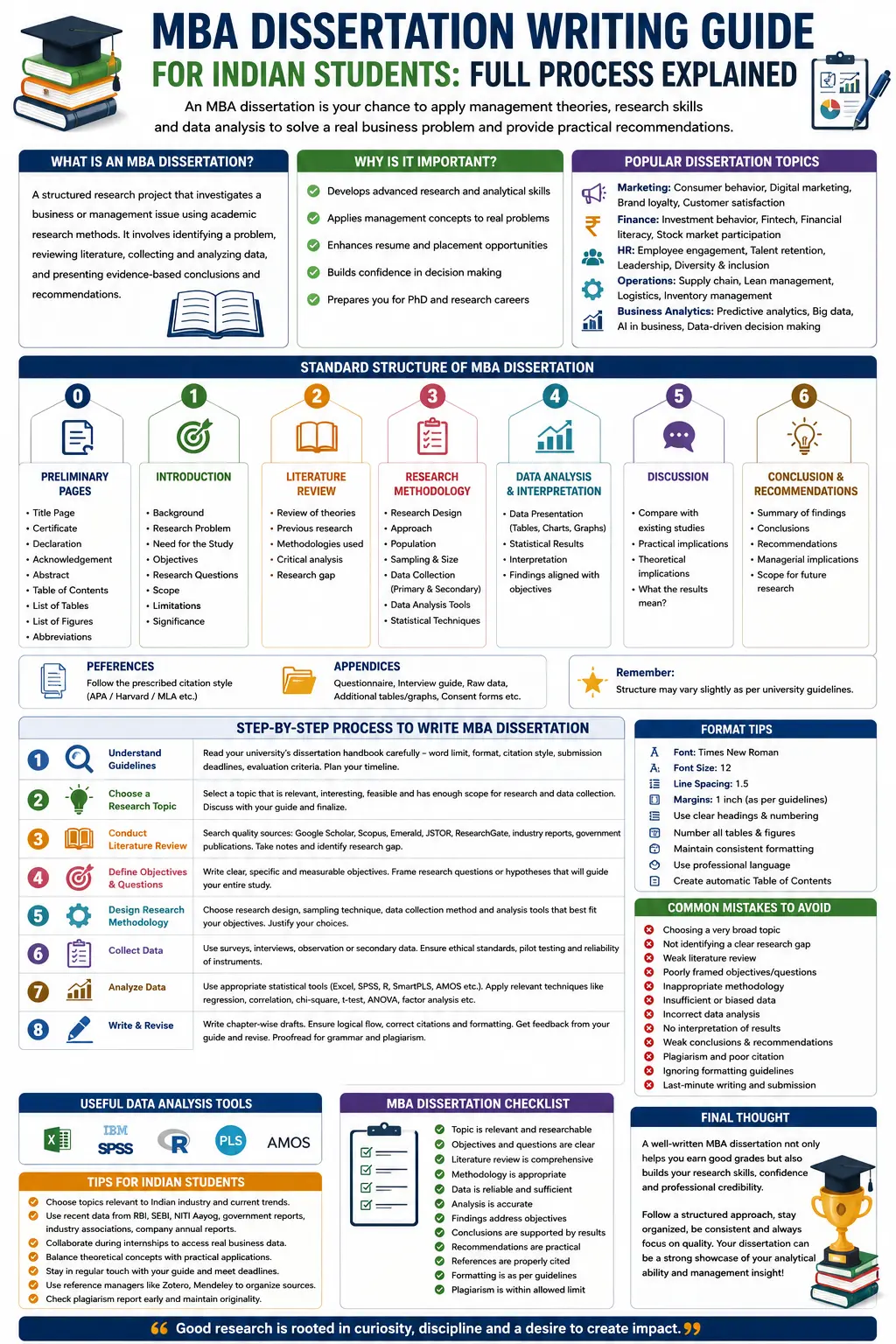
An MBA dissertation is one of the most important academic projects in a Master of Business Administration program. It allows students to apply management theories, research skills, and analytical thinking to solve real-world business problems. Whether you are pursuing an MBA from an Indian university, an autonomous institution, or an international business school, your dissertation demonstrates your ability to conduct independent research and provide practical business recommendations.
However, many MBA students find dissertation writing overwhelming. Choosing a suitable topic, conducting a literature review, designing a research methodology, collecting data, analyzing results, and writing the final report can seem like a daunting task—especially when balancing internships, placements, and coursework.
This comprehensive guide explains the complete MBA dissertation writing process for Indian students. From selecting a research topic to submitting a polished dissertation, you'll learn the essential steps, best practices, and common mistakes to avoid.
What Is an MBA Dissertation?
An MBA dissertation is a structured research project that investigates a business or management issue using academic research methods. Unlike regular assignments, a dissertation requires you to identify a research problem, review existing literature, collect and analyze data, and present evidence-based conclusions.
The dissertation demonstrates your ability to:
- Apply management concepts to real business challenges.
- Conduct systematic research.
- Analyze quantitative or qualitative data.
- Develop practical recommendations.
- Communicate findings in a professional academic format.
Many Indian universities require students to complete a dissertation during the final semester as part of their MBA curriculum.
Why Is an MBA Dissertation Important?
A well-written dissertation offers several academic and professional benefits.
It helps you:
- Develop advanced research skills.
- Improve critical thinking and problem-solving abilities.
- Gain expertise in a specific management area.
- Enhance your resume and placement opportunities.
- Build confidence in business decision-making.
- Prepare for doctoral studies such as a PhD in Management.
For students aiming for careers in consulting, finance, marketing, human resources, operations, or entrepreneurship, a strong dissertation can showcase practical knowledge and analytical capability.
Choosing the Right MBA Dissertation Topic
Selecting the right topic is the foundation of a successful dissertation. Your topic should align with your specialization, interests, available data, and career goals.
Characteristics of a Good Dissertation Topic
A strong topic should be:
- Relevant to your MBA specialization.
- Focused and manageable.
- Researchable using available data.
- Current and industry-oriented.
- Original enough to contribute meaningful insights.
Popular MBA Dissertation Topics in India
Marketing
- Impact of influencer marketing on consumer purchase decisions.
- Effectiveness of digital marketing strategies for SMEs.
- Customer satisfaction in e-commerce platforms.
- Consumer behavior toward sustainable products.
- Brand loyalty in the Indian FMCG sector.
Human Resource Management
- Employee engagement in hybrid work environments.
- Impact of leadership style on employee performance.
- Talent retention strategies in IT companies.
- Employee well-being and organizational productivity.
- Diversity and inclusion practices in Indian organizations.
Finance
- Digital payment adoption among Indian consumers.
- Investment behavior of millennials.
- Financial literacy among college students.
- ESG investing trends in India.
- Factors affecting stock market participation.
Operations Management
- Supply chain resilience after COVID-19.
- Lean manufacturing practices in Indian industries.
- Inventory management in retail businesses.
- Logistics optimization using AI.
- Green supply chain management.
Business Analytics
- Predictive analytics for customer retention.
- AI-driven decision-making in businesses.
- Big data applications in retail.
- Business intelligence tools in SMEs.
- Data analytics for operational efficiency.
Choose a topic that genuinely interests you, as you will spend several months researching and writing about it.
Understanding the Structure of an MBA Dissertation
Although formatting requirements vary across universities, most MBA dissertations follow a standard structure.
Preliminary Pages
These typically include:
- Title page
- Certificate
- Declaration
- Acknowledgments
- Abstract
- Table of contents
- List of figures
- List of tables
- List of abbreviations
Chapter 1: Introduction
The introduction sets the stage for your research.
Include:
- Background of the study
- Industry context
- Research problem
- Need for the study
- Research objectives
- Research questions
- Scope of the study
- Limitations
- Significance of the research
This chapter should clearly explain why the research matters.
Chapter 2: Literature Review
The literature review examines previous research related to your topic.
Rather than summarizing studies individually, organize the review by themes.
Include:
- Major theories
- Previous research findings
- Research methodologies used
- Critical analysis
- Research gap
Use recent peer-reviewed journal articles, books, industry reports, and government publications.
Chapter 3: Research Methodology
This chapter explains how the study was conducted.
Include:
Research Design
- Quantitative
- Qualitative
- Mixed methods
Research Approach
- Descriptive
- Exploratory
- Explanatory
Population
Define the target population.
Example:
Customers of online grocery delivery platforms in India.
Sampling Technique
Common methods include:
- Random sampling
- Convenience sampling
- Purposive sampling
- Stratified sampling
Sample Size
State the number of participants and justify your choice.
Data Collection
Primary data:
- Questionnaires
- Interviews
- Focus groups
Secondary data:
- Company reports
- Annual reports
- Government statistics
- Research articles
Data Analysis
Common software includes:
- SPSS
- R
- Python
- Excel
- SmartPLS
- AMOS
Statistical techniques may include descriptive statistics, correlation, regression, ANOVA, chi-square tests, factor analysis, or thematic analysis for qualitative data.
Chapter 4: Data Analysis and Interpretation
This chapter presents your findings.
Use:
- Tables
- Charts
- Graphs
- Statistical summaries
Interpret the results rather than merely presenting numbers.
Example:
If regression analysis shows a significant positive relationship between customer service quality and customer satisfaction, explain what this means for businesses.
Chapter 5: Discussion
Compare your findings with previous studies.
Discuss:
- Similarities
- Differences
- Possible reasons for the results
- Practical implications
- Theoretical implications
Demonstrate how your research contributes to existing knowledge.
Chapter 6: Conclusion and Recommendations
Summarize the major findings without introducing new information.
Include:
- Key conclusions
- Practical recommendations
- Policy implications
- Suggestions for managers
- Future research directions
Recommendations should be based directly on your findings.
References
Follow the citation style prescribed by your university, such as APA, Harvard, MLA, or Chicago.
Ensure all in-text citations appear in the reference list.
Appendices
Include supporting materials such as:
- Survey questionnaire
- Interview guide
- Ethical approval (if applicable)
- Consent forms
- Raw data summaries
- Additional statistical outputs
Step-by-Step MBA Dissertation Writing Process
Step 1: Understand the Dissertation Guidelines
Before writing, carefully review your university's dissertation handbook.
Pay attention to:
- Word count
- Formatting
- Submission deadlines
- Citation style
- Assessment criteria
Understanding the requirements early can save significant time later.
Step 2: Conduct a Thorough Literature Review
Search academic databases such as:
- Google Scholar
- Scopus
- Web of Science
- Emerald Insight
- ScienceDirect
- JSTOR
Focus on high-quality, peer-reviewed sources.
Take organized notes and categorize studies by themes, methodologies, and findings.
Step 3: Identify the Research Gap
The research gap explains why your study is necessary.
Common gaps include:
- Limited Indian studies.
- Outdated data.
- Small sample sizes.
- Underexplored variables.
- Contradictory findings.
Your dissertation should address a genuine gap in the literature.
Step 4: Develop Research Objectives and Questions
Research objectives define what the study intends to achieve.
Example:
General Objective
To examine the impact of digital marketing strategies on customer purchase decisions in Indian retail businesses.
Specific Objectives
- To identify commonly used digital marketing channels.
- To evaluate customer perceptions.
- To analyze the relationship between digital marketing and purchase intention.
Research questions should align with these objectives.
Step 5: Design the Research Methodology
Choose methods that best answer your research questions.
If studying customer preferences, a quantitative survey may be appropriate.
If exploring managerial experiences, qualitative interviews may be more suitable.
Clearly justify your methodological choices.
Step 6: Collect Reliable Data
Ensure data collection follows ethical standards.
For surveys:
- Use clear, unbiased questions.
- Pilot-test the questionnaire.
- Obtain informed consent.
For interviews:
- Prepare open-ended questions.
- Record responses (with permission).
- Maintain confidentiality.
Step 7: Analyze the Data
Analyze your data using appropriate techniques.
Examples include:
- Descriptive statistics
- Correlation analysis
- Multiple regression
- T-tests
- ANOVA
- Factor analysis
- Structural Equation Modeling (SEM)
Qualitative studies may use thematic analysis or content analysis.
Interpret findings in relation to your objectives.
Step 8: Write and Revise
Do not wait until data collection is complete before writing.
Draft chapters progressively.
After completing the first draft:
- Check logical flow.
- Improve transitions.
- Remove repetition.
- Correct grammar and spelling.
- Verify references.
- Proofread carefully.
Seek feedback from your supervisor before final submission.
MBA Dissertation Formatting Tips
Although universities may have specific requirements, common formatting guidelines include:
- Font: Times New Roman
- Font size: 12 pt
- Line spacing: 1.5
- Margins: 1 inch
- Page numbering throughout the document
- Consistent heading styles
- Proper table and figure numbering
- Automatic table of contents
A professionally formatted dissertation creates a positive impression on evaluators.
Common Mistakes MBA Students Should Avoid
Many dissertations lose marks due to avoidable errors.
Some of the most common mistakes include:
- Selecting a topic that is too broad.
- Failing to identify a clear research gap.
- Writing objectives that do not match the methodology.
- Using outdated references.
- Collecting insufficient data.
- Misinterpreting statistical results.
- Ignoring university formatting requirements.
- Weak conclusions that do not address the research objectives.
- Plagiarism due to improper citation.
- Submitting without proofreading.
Taking time to review your work thoroughly can significantly improve its quality.
Tips for Indian MBA Students
If you are pursuing an MBA in India, these practical suggestions can help you produce a stronger dissertation:
- Choose a topic relevant to current industry trends such as artificial intelligence, sustainability, digital transformation, fintech, or consumer behavior.
- Whenever possible, collaborate with companies during internships to access real business data.
- Use recent reports from organizations like RBI, SEBI, NITI Aayog, Ministry of Commerce, or industry bodies to strengthen your background section.
- Balance academic theory with practical business applications.
- Maintain regular communication with your supervisor to avoid major revisions later.
- Use plagiarism detection software and reference management tools such as Zotero or Mendeley to ensure originality and accurate citations.
- Start writing early rather than waiting until all data has been collected.
MBA Dissertation Writing Checklist
Before submitting your dissertation, ensure that:
- Your title accurately reflects the research.
- The introduction clearly defines the problem and objectives.
- The literature review identifies a meaningful research gap.
- The methodology is appropriate and well justified.
- Data analysis directly addresses the research questions.
- Conclusions are supported by evidence.
- Recommendations are practical and realistic.
- References are complete and correctly formatted.
- Grammar, spelling, and formatting have been thoroughly checked.
- Similarity levels comply with your university's plagiarism policy.
Completing this checklist can improve both the quality of your dissertation and your final evaluation.
Final Thoughts
An MBA dissertation is more than an academic requirement—it is an opportunity to demonstrate your ability to solve real-world business problems using systematic research and evidence-based analysis. A well-planned dissertation reflects your understanding of management concepts, research methodology, and professional communication, all of which are highly valued by employers and academic institutions.
Success begins with selecting a focused, relevant topic and continues through careful literature review, sound methodology, ethical data collection, thoughtful analysis, and clear presentation of findings. By following a structured approach, staying organized, and seeking regular guidance from your supervisor, you can transform a complex research project into a rewarding learning experience.
For Indian MBA students, choosing research topics aligned with emerging business trends and industry needs can make your dissertation even more impactful. Whether your goal is campus placement, career advancement, entrepreneurship, or future doctoral studies, a high-quality MBA dissertation can serve as a valuable showcase of your analytical skills, research expertise, and ability to generate meaningful business insights.
Website: www.thesislikho.com
Call / WhatsApp: +91-96438 02216