
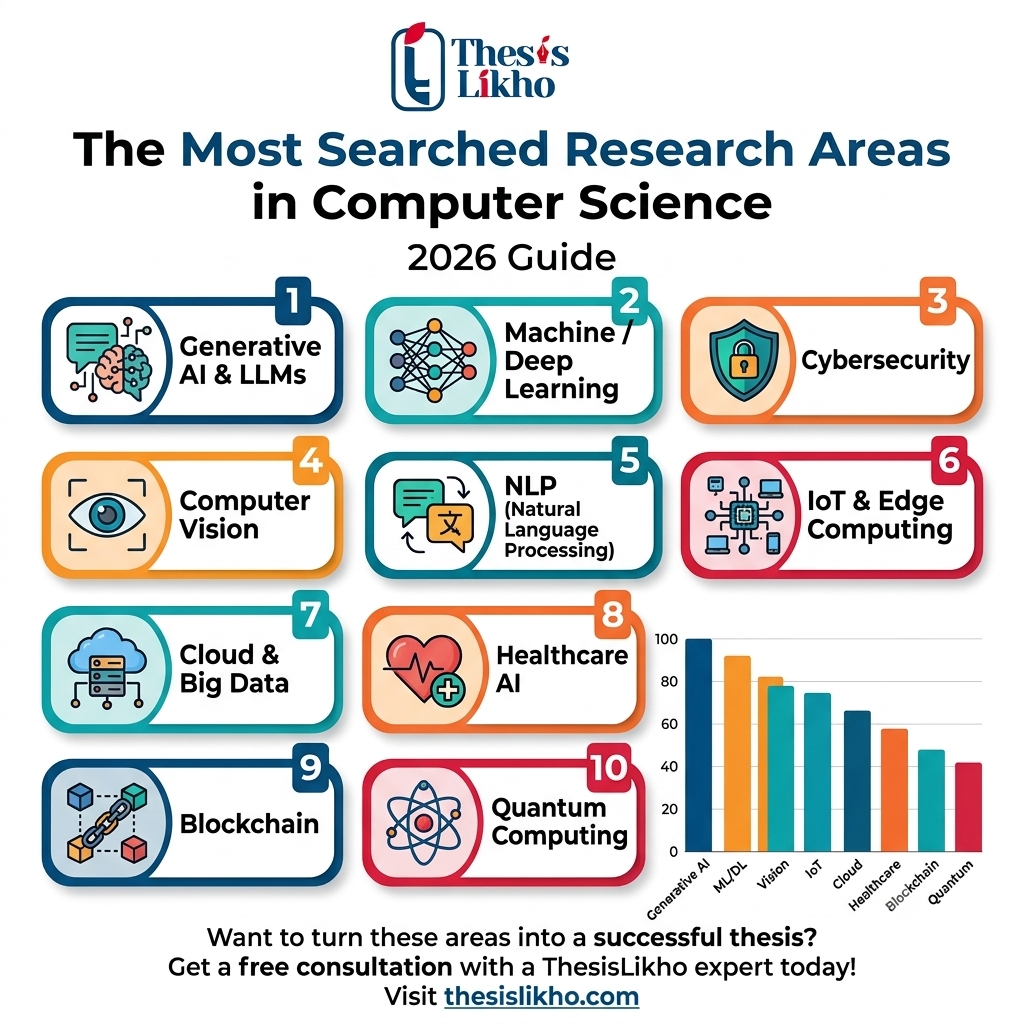
Find the topics that researchers, universities and industry are watching most, and learn how to turn them into a strong thesis.
Choosing a research area is the most important decision in your M.Tech or PhD. A good topic keeps you motivated for years, gets you published in good journals and helps your career. A weak one leads to stalled experiments, rejected papers and a lot of frustration. Every year, thousands of computer science scholars in India and around the world search the same questions: "What are the latest research topics in computer science?", "Which area is best for a PhD?" and "Which topic has enough scope for publication?"
In this guide, we look at the most searched and most active research areas in computer science today. For each one we explain what it is, why it is popular, sample thesis topics, and the tools and datasets you will need. At the end, we explain how ThesisLikho.com can support you from topic selection to final submission.
1. Why Choosing the Right Research Area Matters
Computer science moves faster than almost any other discipline. A topic that was new five years ago may be crowded today, while new areas such as large language models and agentic AI appeared almost overnight. When you pick an area, you are betting on three things:
- Publication potential: Can you produce new results that journals and conferences (IEEE, Springer, Elsevier, ACM, Scopus-indexed outlets) will accept?
- Feasibility: Do you have the data, computing power and skills to finish the work within your program's timeline?
- Career value: Will the skills you build be useful in academia, industry or startups once you graduate?
The most searched areas are popular because they score well on all three. Popularity also has a downside, though: more competition. The trick is to choose a popular area but a specific, under-explored problem within it.
2. The Research Landscape at a Glance
Most modern computer science research sits in a few connected clusters. Artificial intelligence is at the centre and connects to nearly every other area, from security to healthcare to networking. The diagram below shows how these areas relate.
The next figure shows a rough ranking of how much interest each area attracts from scholars, based on what students commonly search for and the volume of recent publications. Treat it as a guide to trends, not exact data.
3. Top 10 Most Searched Research Areas in Computer Science
3.1 Generative AI and Large Language Models (LLMs)
Generative AI is the most searched research area in computer science right now. Since ChatGPT and other chat assistants arrived, LLMs have moved from labs into everyday products. Research questions now go well beyond "make the model bigger". Scholars work on making models smaller, cheaper, more accurate, safer and better at local languages.
Sample thesis topics:
- Retrieval-Augmented Generation (RAG) for reducing hallucination in domain-specific question answering
- Parameter-efficient fine-tuning (LoRA/QLoRA) of LLMs for Indian languages such as Hindi, Tamil or Bengali
- Detecting AI-generated text in academic writing
- Multi-agent LLM systems for automated software testing
Tools: Python, PyTorch, Hugging Face Transformers, LangChain, vector databases.
3.2 Machine Learning and Deep Learning
Machine learning is the base of modern AI and remains one of the safest choices for a thesis. It is flexible: you can apply ML to agriculture, finance, education, healthcare or any domain you know. Current interest is shifting towards explainable AI (XAI), federated learning (training without sharing private data) and green AI (cutting energy use).
- Explainable deep learning models for credit risk prediction
- Federated learning for privacy-preserving medical diagnosis across hospitals
- Hybrid CNN-LSTM models for crop yield forecasting
3.3 Cybersecurity and Privacy
As more of life moves online, attacks are growing in scale and sophistication. Cybersecurity research is in demand from governments, banks and tech companies alike. Using AI for both defence and attack is a major theme, and so is privacy law (such as India's Digital Personal Data Protection Act).
- Deep learning-based intrusion detection systems (IDS) using the CICIDS or UNSW-NB15 datasets
- Phishing website and URL detection using ensemble learning
- Adversarial attacks and defences for machine learning models
- Post-quantum cryptography for IoT devices
3.4 Computer Vision
Computer vision teaches machines to understand images and video. Applications range from self-driving cars and face recognition to plant disease detection and medical imaging. Vision Transformers (ViT) and newer object-detection models such as the YOLO family have opened many new research directions.
- Lightweight YOLO-based models for real-time traffic violation detection
- Deepfake image and video detection
- Plant leaf disease classification using transfer learning
3.5 Natural Language Processing (NLP)
NLP overlaps heavily with LLMs but also covers classic tasks such as sentiment analysis, machine translation, summarisation and speech processing. For Indian scholars, low-resource and code-mixed languages (such as Hinglish) are a big opportunity, because large public datasets are still limited.
- Sentiment analysis of code-mixed Hindi-English social media text
- Fake news detection using transformer models
- Multimodal depression detection from text, audio and video
3.6 Internet of Things (IoT) and Edge Computing
Billions of connected devices produce data every second. Sending all of it to the cloud is slow and expensive, so edge computing processes data close to where it is produced. Research focuses on energy efficiency, security and running AI on tiny devices ("TinyML").
- Energy-efficient routing protocols for wireless sensor networks
- Smart agriculture monitoring using IoT and machine learning
- Task offloading in edge–cloud environments using reinforcement learning
3.7 Cloud Computing and Big Data
Cloud platforms support almost every digital service. Research questions include scheduling tasks efficiently, balancing load, cutting energy use in data centres and securing data stored on shared infrastructure. Big data analytics with tools such as Spark is also a strong area for applied research.
- Metaheuristic (e.g., whale or grey wolf optimisation) task scheduling in cloud computing
- Serverless computing performance optimisation
- Secure data deduplication in cloud storage
3.8 Healthcare Informatics and Medical AI
AI in healthcare is one of the most socially meaningful areas. Scholars build models for early disease prediction, medical image analysis and electronic health record mining. Interdisciplinary topics like these often get strong reviewer interest.
- Early prediction of diabetes or heart disease using ensemble machine learning
- Brain tumour segmentation from MRI using U-Net variants
- Mental health monitoring using wearable sensor data
3.9 Blockchain and Distributed Ledger Technology
Beyond cryptocurrency, blockchain is used for supply-chain tracking, digital identity, land records, academic certificates and secure voting. Scalability, energy consumption and smart-contract security are the main open problems.
- Blockchain-based secure sharing of electronic health records
- Smart contract vulnerability detection using deep learning
- Lightweight consensus mechanisms for IoT networks
3.10 Quantum Computing and Quantum Machine Learning
Quantum computing is still early, but interest is rising quickly, including through India's National Quantum Mission. Because real quantum hardware is limited, most thesis work uses simulators. This area suits scholars with strong mathematics who want to work at the frontier.
- Quantum machine learning classifiers using Qiskit or PennyLane
- Quantum-resistant encryption schemes
- Quantum algorithms for optimisation problems
4. Comparison Table: Difficulty, Scope and Tools
| Research Area | Difficulty | Publication Scope | Common Tools | Hardware Needs |
|---|---|---|---|---|
| Generative AI & LLMs | High | Very High | PyTorch, Hugging Face, LangChain | GPU essential |
| Machine / Deep Learning | Medium | Very High | Python, scikit-learn, TensorFlow | GPU helpful |
| Cybersecurity | Medium–High | High | Python, Wireshark, Kali, NS-3 | Moderate |
| Computer Vision | Medium | High | OpenCV, YOLO, PyTorch | GPU helpful |
| NLP | Medium | High | NLTK, spaCy, Transformers | GPU helpful |
| IoT & Edge | Medium | High | NS-3, Contiki/Cooja, Arduino | Low–Moderate |
| Cloud & Big Data | Medium | Medium–High | CloudSim, Spark, Hadoop | Low |
| Healthcare AI | Medium | High | Python, MONAI, Keras | GPU helpful |
| Blockchain | Medium–High | Medium | Ethereum, Solidity, Hyperledger | Low |
| Quantum Computing | Very High | Growing | Qiskit, PennyLane, Cirq | Simulators / cloud |
5. How to Choose the Right Research Topic
Knowing which areas are popular is only the first step. Use the following framework to narrow your choice down to a specific, workable topic:
- Start with your interest and strengths. If you enjoy mathematics, quantum computing or cryptography may suit you. If you like building applications, IoT or applied ML may be a better fit.
- Read recent review papers. Survey articles from the last two to three years summarise what has been done and usually list "open challenges" at the end. These are goldmines for research gaps.
- Identify the research gap. Look for limitations in existing work: low accuracy, high computational cost, lack of testing on real data, or no support for a particular language or region.
- Check data availability. Before committing, make sure a public dataset exists (Kaggle, UCI, IEEE DataPort, PhysioNet) or that you can collect your own.
- Discuss with your supervisor. Your guide's expertise and lab resources should match your topic.
- Write a one-line problem statement. If you cannot explain your problem in one clear sentence, the topic is not yet focused enough.
6. The Research Workflow: From Idea to Thesis
Whatever area you pick, a computer science thesis usually follows the same path. Understanding it early helps you plan your semesters and avoid last-minute panic before your progress seminars or final viva.
Many scholars get stuck at stages 2, 4 and 7: the literature review, the implementation and the writing. A literature review needs careful reading and synthesis. Implementation needs programming skill and debugging time. Writing needs clear academic English, correct citation style and strict formatting to university guidelines. This is where the right support makes a real difference.
Common mistakes to avoid
- Picking a topic only because it is "trending", without checking data or feasibility.
- Copying the methodology of one paper with tiny changes; reviewers spot this quickly.
- Ignoring evaluation metrics: always compare your results with recent baseline methods.
- Leaving the writing until the end instead of drafting chapters as you go.
- Not checking similarity reports (Turnitin, iThenticate, DrillBit) before submission.
7. Want to Work in These Areas? Connect with ThesisLikho.com
If you want to do research in any of the areas above but are unsure where to start, or you are stuck midway, ThesisLikho.com is here to help. Our team of experienced computer science researchers, developers and academic writers works with M.Tech, MCA and PhD scholars across India. We provide research guidance and mentoring, so that you understand your work and can confidently present and defend it before your supervisor and committee.
What we help with
- Topic selection & gap identification: We suggest topics from current literature that fit your interest, your timeline and your university's requirements.
- Literature review support: Help finding, organising and critically summarising relevant recent papers.
- Synopsis & proposal guidance: Clear objectives, problem statement and methodology.
- Implementation mentoring: Guidance in Python, MATLAB, NS-3, CloudSim, Qiskit and more, with explanations of every step.
- Results & analysis: Help preparing graphs, tables and comparisons with baseline methods.
- Paper publication guidance: Help choosing suitable, genuine journals and formatting manuscripts.
- Thesis editing & formatting: Language polishing, referencing (IEEE/APA) and formatting to your university's template.
- Presentation & viva preparation: Progress seminar slides, RAC presentations and mock viva sessions.
How it works
Getting started with ThesisLikho is simple. The process is designed to be transparent, so you know exactly what is happening at each step.
- Contact us: Reach out through the enquiry form on thesislikho.com, by phone or on WhatsApp. Share your course, university, research area and current stage.
- Free consultation: A subject expert from your area (AI, security, IoT, etc.) discusses your goals, your supervisor's expectations and your deadlines.
- Customised plan: You receive a clear plan with milestones, deliverables and a transparent quote. There are no hidden charges.
- Guided execution: We work with you stage by stage, sharing drafts, code and explanations so you understand and own your research.
- Review & ongoing support: We revise based on your supervisor's feedback and help you prepare for seminars, publication and your final viva.
Why scholars choose ThesisLikho
- Subject experts with computer science research backgrounds
- Original work, with a focus on academic integrity and low similarity
- Confidential handling of your data and research
- On-time delivery aligned with university deadlines
- Support in clear English and Hindi
Conclusion
Computer science offers a wide range of exciting research areas, from generative AI and cybersecurity to IoT, blockchain and quantum computing. The most searched areas are popular for good reason: strong publication scope, real-world impact and excellent career prospects. Success, however, comes from choosing a focused, feasible and original problem within these areas and carrying it through with discipline.
Whether you are just starting your PhD, preparing a synopsis, or struggling to finish implementation before your next progress seminar, the right guidance can save you months of effort. Start by exploring the topics above, read the latest review papers, and when you are ready, let the experts at ThesisLikho help you turn your idea into a successful thesis.
Ready to Start Your Computer Science Research?
Get a free consultation with a ThesisLikho subject expert today and find the right topic for your M.Tech or PhD.
Visit ThesisLikho.com Book Free Consultation