
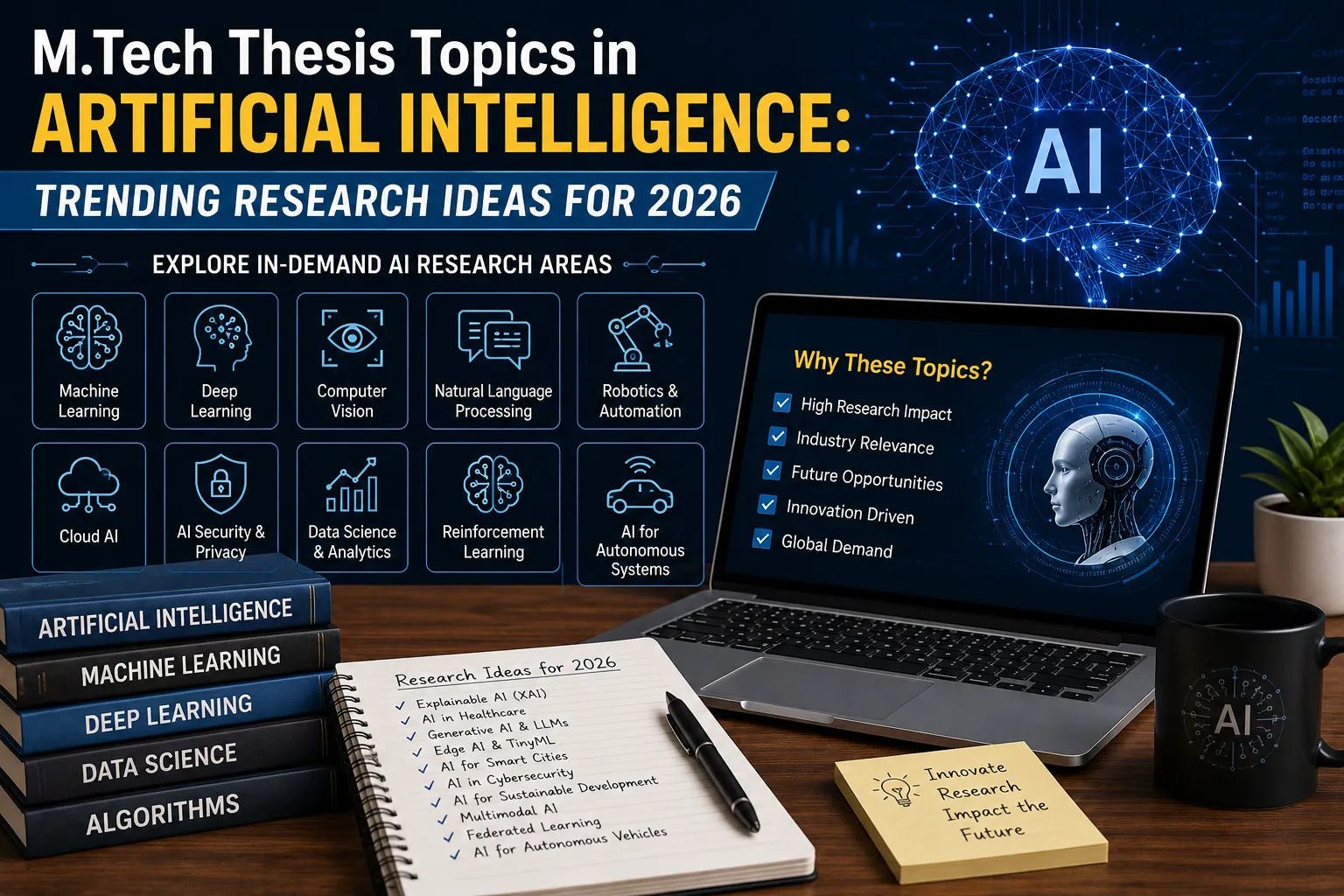
If you're staring down your final semester trying to lock in M.Tech thesis topics in artificial intelligence that are current, implementable, and won't fall apart in front of your review panel, you're dealing with a genuinely different challenge than a PhD scholar faces. A PhD topic can afford to be theoretical and open-ended across several years; an M.Tech thesis has to be a working, demonstrable contribution built within one or two semesters, using tools and data you can realistically access right now. This guide walks through trending, genuinely implementable AI research directions for 2026, organized so you can match a topic to your timeline, tools, and interests rather than picking something that sounds impressive but can't actually be finished on schedule.
What Makes a Strong M.Tech AI Topic Different From a PhD Topic
The single most important thing to understand before picking a topic is that M.Tech and PhD theses are judged by different standards. A PhD thesis needs to make an original theoretical or empirical contribution to a field, sustained across three to six years of registration. An M.Tech dissertation, by contrast, is typically completed within one to two semesters of a 24-month program, and reviewers generally expect a working, demonstrable system — a trained model, a functioning pipeline, a measurable performance improvement on a defined task — rather than a purely conceptual argument.
This changes how you should think about "trending" topics. A PhD scholar can chase a genuinely open, unsettled research question and spend years building the methodology to answer it. An M.Tech student needs a topic that's current and relevant, but also scoped tightly enough to produce a complete, working implementation using accessible datasets, pretrained models, and standard tools like Python, TensorFlow, PyTorch, or MATLAB — without needing to invent new infrastructure from scratch.
A useful shift to keep in mind: AI research broadly has moved from simply asking "does the model work" toward "how well, how fairly, and how efficiently." A basic classification or prediction model trained on a standard dataset is no longer enough to stand out on its own — review panels increasingly expect some added angle, like explainability, fairness, computational efficiency, or a genuine real-world deployment constraint, layered onto the core machine-learning problem.
This has a practical upside for M.Tech students specifically: it's genuinely easier to satisfy this "added angle" expectation at M.Tech scale than it sounds. You don't need to invent a new evaluation framework from scratch — applying an existing, well-established fairness metric or explainability technique to a new domain or dataset is itself a legitimate, defensible contribution, provided you're rigorous about how you measure and report it. The goal isn't novelty for its own sake; it's demonstrating that you understand the current standards your field is being held to, and that your implementation meets them.
How to Use This List
None of the directions below should be copied directly into your synopsis. Each is a starting point that still needs narrowing into a specific, testable problem statement — a defined dataset, a specific performance metric, and a clear comparison against existing approaches.
Generative AI and Retrieval-Augmented Applications
Generative AI remains the single most active area for implementable student projects in 2026, precisely because pretrained models and open-source tooling have made sophisticated systems buildable without training a model from scratch — a realistic constraint for most M.Tech students.
Strong, scoped directions include:
- A retrieval-augmented generation (RAG) system for a specific domain (legal documents, medical literature, regional-language educational content) evaluated against a clearly defined accuracy and hallucination-rate benchmark, rather than a generic chatbot with no measurable evaluation criteria.
- Comparative evaluation of RAG architectures (different retrieval strategies, chunking methods, or embedding models) on a fixed dataset — a genuinely useful, implementable contribution that doesn't require training a foundation model.
- Automated document summarization or fake-news detection systems for Indian-language content, an area where existing tools are comparatively less mature than for English.
- Prompt-engineering and fine-tuning comparison studies for a specific applied task, systematically measuring how different prompting strategies or lightweight fine-tuning approaches (like LoRA) affect output quality on a fixed evaluation set — a genuinely useful, well-scoped contribution that avoids the cost of full model retraining.
Agentic and Multi-Agent AI Systems
Agentic AI — systems where an AI model plans and executes multi-step tasks with some autonomy — has moved from a research curiosity to a mainstream deployment pattern, and it offers M.Tech-scale project opportunities that don't require building new model architectures.
- A task-automation agent for a specific workflow (customer support ticket triage, academic literature screening, code-review assistance) with a clearly measured task-completion and error rate.
- Evaluation frameworks for agent reliability on a narrow, well-defined task set — comparing how consistently an agent completes a task correctly across repeated runs, a genuinely under-studied area even in current literature.
- Human-in-the-loop oversight mechanisms for agentic systems handling sensitive decisions, examining how much human review meaningfully improves outcomes versus adding friction without benefit.
- Cost-and-latency benchmarking of agentic workflows against simpler, non-agentic automation approaches for the same task — a practically useful comparison that many organizations genuinely need but few published studies address directly.
Edge AI and On-Device Intelligence
Deploying AI models on resource-constrained devices — smartphones, microcontrollers, IoT sensors — remains a strong, implementation-heavy area well suited to M.Tech-level engineering skills.
- Model compression and quantization techniques for deploying a specific deep-learning model on low-power hardware, measuring the accuracy-versus-efficiency tradeoff directly.
- Real-time on-device anomaly detection for industrial or agricultural sensor data, where cloud connectivity can't be assumed.
- Comparative benchmarking of lightweight model architectures (MobileNet-style, TinyML frameworks) for a specific edge deployment scenario, a well-defined, measurable project with abundant open tooling support.
- Battery-life and thermal-impact analysis of on-device AI inference for a specific wearable or embedded use case, an angle that pairs strong engineering rigor with genuine practical relevance.
Explainable and Fair AI
As AI systems move into higher-stakes decisions, explainability and fairness have become genuinely active, well-funded research areas rather than niche add-ons — and they pair naturally with almost any core prediction or classification project, giving your thesis the "added angle" reviewers increasingly expect.
- Comparative evaluation of explainability techniques (SHAP, LIME, attention visualization) applied to a specific model and domain, assessing which method produces the most actionable, human-interpretable explanations.
- Bias detection and mitigation in a specific classification task (loan approval, hiring screening, medical risk scoring), using a defined fairness metric rather than a vague claim of "improving fairness."
- Explainability requirements for a domain-specific deployment, examining what level of interpretability different stakeholders (clinicians, loan officers, end users) actually need versus what current tools provide.
- User-study-based evaluation of explanation quality, testing whether non-technical stakeholders can actually act on a model's explanation, rather than only measuring explanation quality through technical proxy metrics.
Healthcare and Agricultural AI Applications
Domain-specific applied AI remains a durable, high-relevance area for Indian M.Tech students, since both sectors offer genuine data access opportunities through institutional or government partnerships.
- Early disease-detection models using medical imaging or sensor data, evaluated against clinically meaningful accuracy and false-negative-rate benchmarks rather than raw accuracy alone.
- Crop-disease or yield-prediction models using satellite or drone imagery, an area with strong data availability through Indian agricultural research bodies and genuine practical impact.
- AI-assisted diagnostic support tools for low-resource clinical settings, focusing specifically on models that work reliably on limited or noisy data, since that's the realistic deployment condition in many parts of India.
- Livestock health-monitoring systems using sensor and image data, an under-explored applied area relative to crop-focused agricultural AI, with genuine relevance to India's dairy and animal-husbandry sector.
Cybersecurity Meets AI
AI-driven cybersecurity continues to be one of the most consistently in-demand M.Tech thesis areas, combining strong industry relevance with genuinely open research questions.
- AI-based intrusion detection systems benchmarked against a current, realistic attack dataset rather than an outdated or synthetic one.
- Adversarial robustness testing for a specific deployed model type, examining how vulnerable it is to input manipulation and what defenses meaningfully improve resilience.
- AI-driven phishing and deepfake detection systems, an area with rapidly evolving attack patterns and correspondingly active demand for updated detection approaches.
- Automated log-analysis systems for anomaly and intrusion detection in enterprise network environments, comparing AI-driven approaches against traditional rule-based detection on a shared dataset.
Federated and Privacy-Preserving Learning
Federated learning — training models across distributed data sources without centralizing sensitive data — remains a genuinely active, implementable research area, particularly relevant for healthcare and finance applications where data-sharing restrictions are real and well documented.
- A federated learning simulation across multiple simulated institutional nodes, comparing model performance and communication efficiency against a centralized baseline.
- Privacy-preserving techniques (differential privacy, secure aggregation) applied to a federated learning pipeline, measuring the tradeoff between privacy guarantees and model accuracy.
- Federated learning for a specific low-resource deployment scenario, examining how well it performs when institutional nodes have unequal data quality or volume — a realistic constraint in many Indian multi-hospital or multi-branch settings.
- Communication-efficiency optimization for federated learning over limited-bandwidth networks, directly relevant to rural or infrastructure-constrained deployment contexts common across India.
Tools and Simulation Platforms Worth Knowing Before You Choose
Before you commit to a direction, it's worth matching your topic to tools you can realistically get comfortable with in the time you have. Python remains the default language across almost every direction above, with TensorFlow and PyTorch as the two dominant deep-learning frameworks — PyTorch tends to be favored in current research code and tutorials, while TensorFlow (especially TensorFlow Lite) remains strong for edge and mobile deployment work specifically. For classical machine-learning comparisons or smaller-scale statistical modeling, scikit-learn and Weka remain widely used and well documented. MATLAB and Simulink retain a strong footing in signal-processing-heavy AI applications (biomedical signal analysis, control-system-integrated AI) and remain the default in many Indian engineering departments' existing lab infrastructure, which matters if your department already has licenses and prior student work built on it. For federated learning specifically, frameworks like Flower and TensorFlow Federated let you simulate multi-node training on a single machine, which is what makes that whole research direction realistic without needing genuine multi-institution infrastructure. For RAG and agentic-AI projects, frameworks like LangChain and LlamaIndex have become close to a de facto standard, since they handle much of the retrieval and orchestration plumbing so your actual contribution can focus on the comparison or evaluation angle rather than infrastructure-building.
Picking a topic where your department already has the relevant tooling and licenses set up — rather than one requiring you to independently source and learn an entirely new platform from scratch — is one of the most underrated ways to protect your timeline.
Choosing Among These Areas for Your Timeline
With seven clusters and over twenty directions above, a few practical filters help you choose faster:
Check what pretrained models and datasets are already available for your area. Generative AI, edge AI, and cybersecurity topics generally have strong open-source tooling and public datasets, which makes them realistic even on a tight M.Tech timeline. Healthcare and agriculture topics can be equally strong but may require securing institutional data access first — confirm this before committing, since data-access delays are one of the most common reasons M.Tech projects fall behind schedule.
Match ambition to your actual compute access. Federated learning simulations, agentic-system evaluation, and model-compression work can generally be done on modest, department-level compute. Training large generative models from scratch is not realistic at M.Tech scale — if a direction seems to require that, look for a way to reframe it around evaluation, fine-tuning, or comparison of existing models instead.
Consider what your department already has expertise in. A topic in an area your guide has supervised before (or has existing lab equipment and tooling for) tends to move faster and get more useful feedback than a topic requiring your supervisor to learn a new subfield alongside you.
Think about where you want this to lead after your M.Tech. If you're aiming for a research-oriented career or a PhD afterward, leaning into a more open, evaluation-heavy area (agentic-system reliability, explainability methods, federated learning) builds skills and a publication record that transfer well. If you're aiming for industry roles immediately after graduating, a strongly applied, deployment-focused project (edge AI, cybersecurity, domain-specific healthcare or agriculture applications) often demonstrates more directly relevant, portfolio-ready engineering skills to prospective employers.
A Real Example: Scoping an Ambitious Idea Into a Finishable Thesis
A student interested broadly in "building better chatbots using generative AI" initially proposed training a custom large language model from scratch for a regional-language customer-support use case — a proposal that would have required far more compute and time than a single M.Tech dissertation timeline allows. Working with his guide, he narrowed the idea into a specific, implementable contribution: building and evaluating a retrieval-augmented generation pipeline on top of an existing open-source language model, specifically measuring how retrieval-chunking strategy affected answer accuracy and hallucination rate for regional-language customer queries. The core interest — better chatbots for regional-language support — stayed intact, but the scope shifted from "build a new model" to "rigorously evaluate and improve an existing pipeline," which was fully achievable within his two-semester window and still produced a genuinely useful, publishable comparison.
The lesson generalizes well: almost any broad AI interest can be reframed from "build something new from scratch" into "rigorously evaluate, adapt, or improve an existing approach" without losing what made the original idea compelling. That reframing is usually what separates a topic your committee approves quickly from one that gets sent back with "scope down."
What the M.Tech Thesis Process Actually Involves
M.Tech programs in India are typically full-time, AICTE-recognized courses spanning 24 months across four semesters, with dissertation or major project work usually concentrated in the final one to two semesters. Admission commonly requires a valid GATE score or a defined period of relevant professional experience alongside your bachelor's degree. Universities have been tightening originality requirements even at this level — AKTU's recent circular for M.Tech and other postgraduate dissertations, for instance, made Turnitin similarity checking mandatory as part of formal submission, alongside a standardized format and mandatory supervisor sign-off before upload. This is a useful signal for any M.Tech student: originality checks are no longer treated as a PhD-only concern, and building your literature review and implementation work from your own analysis, rather than closely following an existing project's structure, matters at this level too.
If you'd like guidance scoping an AI topic to fit your specific timeline and available tools, our M.Tech thesis assistance service works specifically with students at this proposal and implementation stage.
In practical terms, most M.Tech students spend their third semester finalizing a topic, completing a literature review, and building an initial implementation, with the fourth and final semester dedicated to refining the model or system, running full evaluations, and writing the dissertation itself. Many universities also expect at least one conference paper or technical report drawn from the work, which is worth planning for early — submitting a preliminary version of your results to a student or regional conference partway through your implementation can double as useful early feedback before your final submission and viva.
Common Mistakes Specific to M.Tech AI Topics
- Choosing a PhD-scale topic for an M.Tech timeline. Training foundation models from scratch, building entirely new architectures, or attempting multi-year longitudinal studies are not realistic within a two-semester project window — reframe ambitious interests around evaluation, fine-tuning, or applied deployment of existing approaches instead.
- Picking a topic with no clear evaluation metric. "Building a chatbot" or "using AI for healthcare" aren't testable claims on their own — a strong M.Tech thesis needs a specific, measurable comparison (accuracy, latency, fairness metric, error rate) against a defined baseline.
- Underestimating dataset access timelines, especially for healthcare, government, or enterprise data — confirm access before finalizing your topic, not after.
- Treating a tutorial-level project as a thesis. Reproducing a well-known Kaggle notebook or a widely available tutorial project without a genuine added angle (efficiency, fairness, domain adaptation, comparative evaluation) reads as a class assignment rather than a dissertation-level contribution.
- Choosing tools your department doesn't already support. A topic requiring a specialized GPU cluster, a licensed simulation tool your lab doesn't have, or a framework nobody in your department has used before adds avoidable risk on top of the research risk you're already taking on.
- Skipping a baseline comparison entirely. A model that "achieves 92% accuracy" means very little without a clearly stated baseline it's being compared against — always design your evaluation around a specific existing approach or published benchmark, not just a standalone number.
FAQs
What are trending M.Tech thesis topics in artificial intelligence for 2026?
Strong, currently active directions include retrieval-augmented generation systems, agentic AI task-automation and evaluation, edge AI model compression, explainable and fair AI applied to a specific domain, healthcare and agricultural AI applications, AI-driven cybersecurity, and federated learning — each offering a genuine, implementable project within a typical M.Tech timeline.
Why does topic choice matter so much for an M.Tech AI thesis?
Because unlike a PhD, an M.Tech thesis has to be a working, demonstrable implementation completed within one to two semesters — a topic that's too ambitious for that timeline, or too generic to include a measurable evaluation, is one of the most common reasons a synopsis gets sent back for revision.
How does topic choice affect an M.Tech thesis?
A well-scoped, currently relevant topic with accessible data and tools lets you complete a genuine, demonstrable contribution on schedule; an overly ambitious or vaguely defined topic often causes rework partway through, since the gap between the proposal and what's actually achievable only becomes clear once implementation begins.
How long does it take to complete an M.Tech thesis using this approach?
M.Tech dissertation work is typically concentrated in the final one to two semesters of the broader 24-month program — a well-scoped, implementable AI topic with accessible data and tools is far more likely to stay within that window than a topic requiring infrastructure or data access you haven't yet confirmed.
Is professional help available for M.Tech thesis topics in artificial intelligence?
Yes. Experienced project mentors can help narrow a broad AI interest into a specific, implementable topic matched to your timeline, tools, and data access — this is a core part of what services like ThesisLikho's M.Tech thesis assistance provide.
Choosing a topic that's current, defensible, and genuinely finishable in your timeline is what makes the rest of your M.Tech dissertation manageable. If you'd like expert input on scoping any of the directions above into a project-ready topic, Get M.Tech Thesis Guidance →