
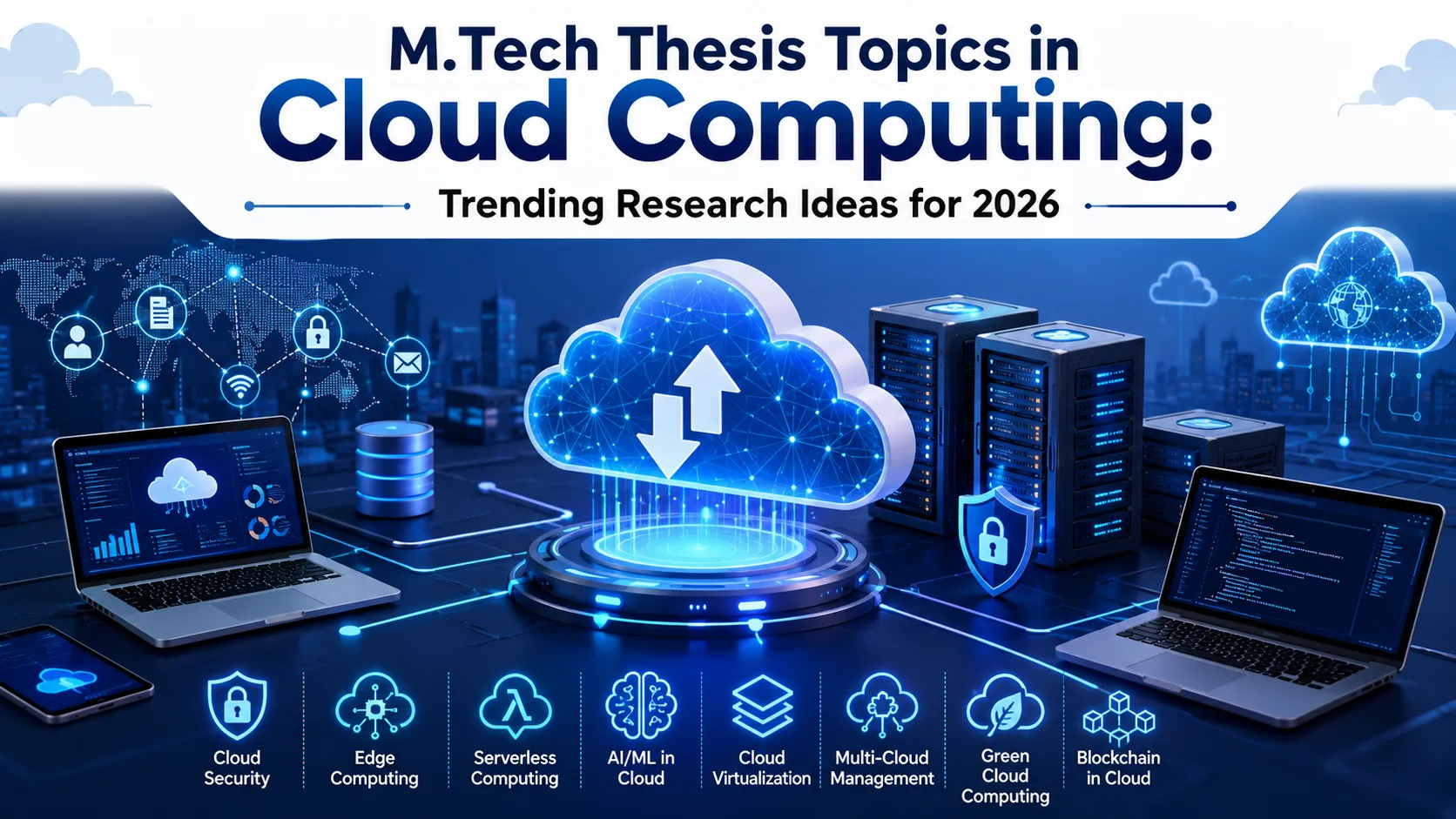
Cloud computing as a thesis area is deceptively broad — "cloud computing" itself isn't a topic, it's an entire technology stack spanning infrastructure, platforms, and applications. Picking a genuinely researchable M.Tech thesis topic in cloud computing means narrowing down to a specific layer, a specific problem, and a specific measurable outcome. This guide walks through trending, research-ready cloud computing thesis topics for 2026, organized by where they sit in the stack, along with how to narrow a broad theme into something your supervisor will actually approve.
Understanding the Cloud Computing Research Stack
Cloud computing research spans three distinct layers, and knowing which layer your interest sits in is the first step toward a defensible thesis topic:
- Infrastructure layer — virtualization efficiency, hardware-software co-design for data center workloads, and the sustainability of large-scale power consumption
- Platform layer — container orchestration, serverless execution models, distributed storage systems, and resource scheduling algorithms
- Application layer — cloud-native software architectures, multi-cloud and hybrid cloud strategies, and cloud pricing economics
Most strong M.Tech thesis topics live entirely within one of these layers, narrowed further to a specific mechanism or comparison. Trying to span all three layers in a single thesis is one of the fastest ways to end up with a topic too broad to complete.
The Five Dominant 2026 Research Directions
Current cloud computing research is concentrating heavily around five areas: cloud security, artificial intelligence integration, edge computing, sustainable cloud infrastructure, and faster data processing systems. If you're choosing a thesis direction now, aligning with one of these gives your work both current relevance and a stronger publication pathway.
Trending M.Tech Thesis Areas in Cloud Computing for 2026
1. Serverless Computing Performance and Security
Serverless computing continues to redefine application development, with major providers offering event-driven, pay-per-execution models — AWS Lambda, Azure Functions, and Google Cloud Functions — that reduce operational overhead and appeal to both startups and enterprises. This creates two strong thesis directions: performance evaluation and security analysis.
A well-established, replicable methodology in this space involves comparative evaluation of open-source serverless frameworks — Fission, Kubeless, OpenFaaS, Apache OpenWhisk, Knative — deployed on Kubernetes clusters and evaluated on metrics like response time and success ratio.
Narrowed thesis example: "Comparative Performance Evaluation of OpenFaaS, Knative, and Apache OpenWhisk for Latency-Sensitive Microservice Workloads on a Kubernetes Cluster"
2. Container Orchestration for Microservices
Container orchestration remains a major research area, with AWS ECS/EKS, Azure Kubernetes Service (AKS), and Google Kubernetes Engine (GKE) supporting full lifecycle container management. Comparative analysis of orchestration tools for microservices deployment is a repeatedly cited, genuinely thesis-ready topic — feasible because Kubernetes and its alternatives are open-source and accessible without enterprise infrastructure.
Narrowed thesis example: "Comparative Analysis of Resource Utilization Efficiency Across Kubernetes-Based Container Orchestration Strategies for Microservice-Based Web Applications"
3. Serverless Edge Computing
Serverless edge computing — combining serverless execution models with edge infrastructure to reduce latency — is a rapidly growing, well-documented research area. Two specific open challenges make for genuinely original thesis contributions: heterogeneity (the diverse and widespread nature of edge computing resources) and scalability (accommodating the exponentially rising number of mobile and edge devices without compromising the elasticity that makes serverless valuable).
Narrowed thesis example: "A Heterogeneity-Aware Task Offloading Framework for Serverless Edge Computing in IoT-Based Real-Time Video Analytics"
4. Multi-Cloud and Hybrid Cloud Cost Optimization
Multi-cloud and hybrid cloud adoption is accelerating as enterprises seek to avoid vendor lock-in and enhance resilience, using tools like AWS Outposts, Azure Arc, and Google Anthos to integrate on-premises and cloud environments. Cost optimization strategies for multi-cloud deployment architectures remain an actively studied and practically relevant thesis area, particularly relevant given rising enterprise interest in avoiding single-provider dependency.
Narrowed thesis example: "A Cost-Aware Workload Placement Model for Multi-Cloud Deployment Using AWS and Azure Pricing Data"
5. Edge Computing for Latency-Sensitive Applications
Edge computing-based frameworks for reducing latency in real-time applications — particularly video analytics — and load balancing algorithms for hybrid cloud-edge environments are accessible, well-scoped M.Tech-level topics that combine cloud and edge computing themes without requiring enterprise-scale resources.
Narrowed thesis example: "Design and Evaluation of a Load Balancing Algorithm for Hybrid Cloud-Edge Video Analytics in Smart Surveillance Systems"
6. Data Center Energy Efficiency
At the infrastructure layer, energy proportionality in cloud data centers — hardware and scheduling design specifically aimed at power efficiency — is an active research direction connecting cloud computing to sustainability goals, an increasingly important framing for both academic relevance and practical industry alignment.
Narrowed thesis example: "An Energy-Aware Task Scheduling Algorithm for Reducing Power Consumption in Virtualized Cloud Data Centers"
7. Cloud-Native Database Consistency and Architecture
Object storage consistency models — comparing eventual consistency approaches (like Amazon S3) against strong consistency alternatives and their application-level impact — along with cloud-native database architecture and scalability analysis, represent a technically rich, well-scoped platform-layer research direction.
Narrowed thesis example: "A Comparative Study of Eventual vs. Strong Consistency Models for Cloud-Native Applications Under Variable Network Latency Conditions"
8. Security in Serverless and Fog Computing
Security challenges in serverless computing architectures, along with fog computing frameworks for specific domain applications like smart healthcare monitoring, offer a narrower, security- or application-focused direction within the broader cloud computing space — well suited to students who want a more applied, less purely performance-driven thesis.
Narrowed thesis example: "A Security Framework for Mitigating Function-Level Vulnerabilities in Serverless Healthcare Monitoring Applications"
Feasibility vs. Novelty: How to Weigh the Options
Serverless performance comparisons and container orchestration studies tend to be highly feasible for M.Tech timelines, since the required tools (Kubernetes, OpenFaaS, Knative) are open-source and don't require enterprise-scale budgets or infrastructure — cloud computing research can genuinely be conducted without a large budget, thanks to free-tier cloud services, open-source orchestration tools, and academic-scale simulation platforms. Serverless edge computing and multi-cloud cost optimization tend to offer higher novelty, since these areas are still actively evolving with fewer saturated sub-niches, but may require more setup complexity (edge device simulation, multi-provider account access) to execute well.
Step-by-Step: How to Narrow a Trending Theme Into a Defensible Thesis Topic
- Choose a layer — infrastructure, platform, or application — that matches your genuine interest and available tools
- Pick a specific mechanism or comparison within that layer, not the layer as a whole
- Name the specific tools or frameworks you'll use (Kubernetes, OpenFaaS, specific cloud provider services)
- Define a measurable performance metric — latency, resource utilization, cost, energy consumption, or security vulnerability count
- State the application context — microservices, IoT, healthcare, video analytics, or another specific domain
- Check feasibility against your available infrastructure — free-tier cloud accounts, open-source tools, or simulation platforms your department can support
- Verify the specific narrow niche isn't already comprehensively covered by very recent (2025–2026) publications
Practical Checklist: Is Your Cloud Computing Thesis Topic Ready?
- Topic is scoped to a single stack layer (infrastructure, platform, or application), not the whole field
- Specific tools or frameworks are named, not just general concepts
- A measurable performance metric (latency, cost, energy, resource utilization) is defined
- Application context or domain is stated explicitly
- Required infrastructure is genuinely accessible (open-source tools, free-tier cloud services, or department-supported simulation platforms)
- Supervisor's expertise aligns with the chosen stack layer and tools
- Recent literature (2025–2026) has been checked to confirm the specific niche isn't already saturated
- The topic connects to one of the five dominant 2026 research directions (security, AI integration, edge computing, sustainability, or faster data processing) where relevant
Two Practical Scenarios
Scenario 1 — Narrowing an Overly Broad Serverless Topic A student initially proposed "Serverless Computing for Modern Applications" — far too broad to defend as a single thesis. After applying the narrowing framework, the topic became "Comparative Performance Evaluation of OpenFaaS, Knative, and Apache OpenWhisk for Latency-Sensitive Microservice Workloads on a Kubernetes Cluster," specifying the exact frameworks, the deployment environment, and the performance metric — resulting in a clear, replicable methodology the supervisor approved without revision requests.
Scenario 2 — Choosing Based on Available Infrastructure A student interested in both multi-cloud cost optimization and serverless edge computing evaluated their department's actual resources: limited access to multiple paid cloud provider accounts, but strong access to Raspberry Pi-based edge device simulation equipment already used in other departmental projects. Recognizing this constraint, the student chose the serverless edge computing direction, which better matched available infrastructure, over the multi-cloud direction, which would have required cost data and account access the department couldn't practically support.
Common Mistakes M.Tech Students Make When Choosing a Cloud Computing Topic
- Proposing "cloud computing" as a topic itself, without narrowing to a specific stack layer and mechanism.
- Choosing a topic requiring enterprise-scale infrastructure the department can't realistically provide.
- Ignoring the specific tools needed, resulting in vague titles that don't specify frameworks or platforms.
- Not checking recent literature, resulting in a topic already comprehensively covered in 2025–2026 publications.
- Underestimating the setup time for edge device simulation or multi-cloud account configuration before meaningful data collection can even begin.
Frequently Asked Questions
What are trending M.Tech thesis topics in cloud computing for 2026?
Leading areas include serverless computing performance and security, container orchestration for microservices, serverless edge computing, multi-cloud cost optimization, latency-focused edge computing frameworks, data center energy efficiency, cloud-native database consistency models, and security in serverless/fog computing architectures.
Why does topic selection matter for an M.Tech thesis in cloud computing?
Cloud computing spans a genuinely vast technology stack, and a topic that isn't narrowed to a specific layer, tool set, and measurable metric is difficult to complete within a standard M.Tech timeline, regardless of how current or interesting the general area is.
How does trending research area selection affect a thesis's outcomes?
Aligning with an active 2026 research direction — security, AI integration, edge computing, sustainability, or faster data processing — increases both publication potential and relevance, but only if the specific niche within that direction is narrowed enough to remain original.
How long does it take to complete an M.Tech thesis using this approach?
Topics using open-source, accessible tools (Kubernetes, OpenFaaS, free-tier cloud services) generally proceed faster than topics requiring enterprise infrastructure or multiple paid cloud provider accounts, so factoring infrastructure access into topic choice directly affects completion time.
Is professional help available for M.Tech thesis topics in cloud computing?
Yes. ThesisLikho's PhD-qualified experts have guided 10,000+ scholars through topic selection, research methodology, and complete M.Tech thesis writing assistance tailored to cloud computing and other computer science specializations.
Get Expert Guidance on Your M.Tech Cloud Computing Thesis Topic
Narrowing cloud computing's vast technology stack into a feasible, defensible thesis topic takes careful attention to available tools, infrastructure, and current literature gaps. If you'd like expert input on refining your cloud computing thesis topic or planning your research approach, ThesisLikho's PhD-qualified team offers topic selection support, research methodology guidance, and complete M.Tech thesis writing assistance. If you need expert guidance with your thesis topic, research design, or overall project structure, you can explore our M.Tech Thesis Assistance service.
Get M.Tech Thesis Guidance → https://thesislikho.com/writing-services/thesis-assistance-mtech