
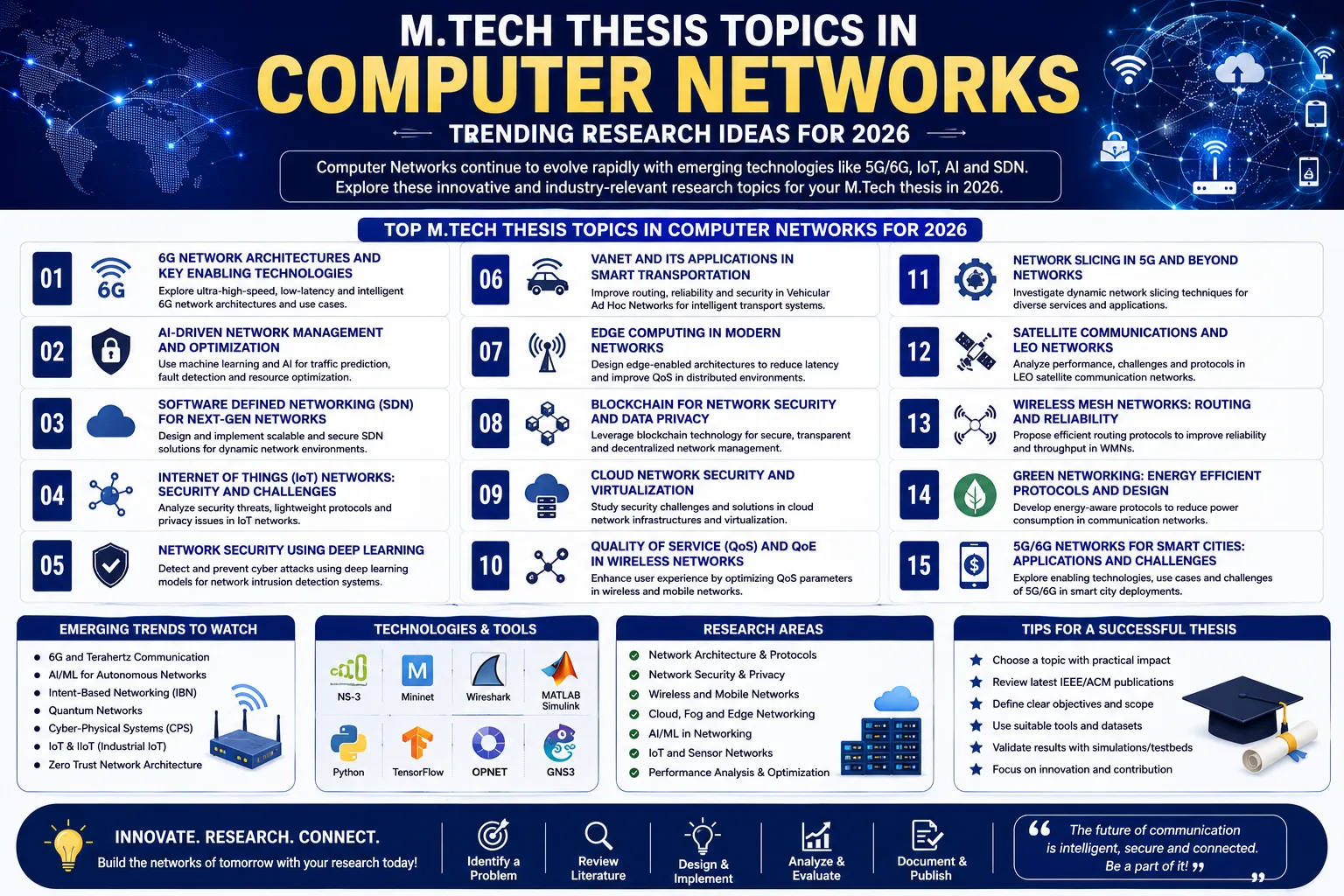
If you're an M.Tech Computer Networks student trying to lock down a thesis topic, you're working in a field that's genuinely being rebuilt in real time — 6G research is moving from theory toward concrete architectures, AI is being woven directly into network management rather than bolted on afterward, and satellite-based connectivity is opening up entirely new research angles for underserved regions. This guide walks through M.Tech thesis topics in computer networks trending research ideas for 2026, organized by category, along with a practical framework for choosing, validating, and defending your final topic.
This guide is written specifically for first-time M.Tech thesis writers in India who want topics that are genuinely current and researchable within a typical M.Tech timeline — not generic networking themes that have already been studied hundreds of times over.
Why Computer Networks Research Is Moving Faster Than It Used To
Computer networks research has always evolved alongside new generations of wireless technology, but the pace right now is genuinely unusual. 6G research has moved well past purely theoretical discussion into AI-native architecture proposals, intent-based networking, and even experiments applying large language models to on-device network reasoning. Meanwhile, the integration of IoT with satellite-based non-terrestrial networks is opening up connectivity research for regions that terrestrial infrastructure simply can't reach economically. Choosing among M.Tech thesis topics in computer networks trending research ideas for 2026 means anchoring your research to developments that are genuinely active right now, not networking themes that were cutting-edge five years ago.
ThesisLikho's research experts, who've guided over 10,000 scholars through thesis writing and topic selection, consistently see the same pattern: many first-time M.Tech scholars default to well-trodden topics like basic routing protocol comparisons or standard SDN controller placement studies, when a well-scoped topic anchored to AI-driven network management, 6G-enabling technologies, or satellite-IoT integration offers far more room for genuine novelty and a stronger literature review.
Trending Research Areas Shaping 2026 Computer Networks Theses
Before browsing the topic list, it's worth understanding which broad trends are actively reshaping computer networks research right now. Fifth-generation networks are fundamentally built on "softwarization" — network slicing, Software Defined Networking, and Network Function Virtualization working together to replace the rigid, hardware-based "one-size-fits-all" model of legacy networks. AI-based resource management for this network slicing remains a genuinely fragmented research area that still lacks a cohesive framework, which means real room exists for original contribution rather than incremental refinement of settled methods.
Sixth-generation network research has moved from purely theoretical discussion toward more concrete architecture proposals, including AI-native designs where intelligence is built into the network from the ground up rather than added afterward, intent-based networking that lets operators specify desired outcomes rather than manual configuration, and even early exploration of large language models for network-level reasoning and semantic communication. The performance targets driving this research are genuinely demanding — proposed 6G specifications include roughly 1 terabit-per-second peak data rates and sub-millisecond end-to-end latency — pushing research into enabling technologies that can realistically support them.
Non-terrestrial networks, particularly Low Earth Orbit satellite constellations integrated with IoT connectivity, represent one of the most genuinely underexplored areas right now. Existing literature is heavily concentrated on urban and smart-city use cases, leaving substantial research gaps in rural and remote connectivity scenarios — exactly the kind of contextual gap that gives an Indian M.Tech scholar's thesis genuine originality, given India's large rural population with limited terrestrial network access. Alongside these, zero-touch, AI-driven autonomous network management continues as a well-established but still actively developing research direction across both 5G and 6G networks.
AI-Native Networking and 6G Trends
AI's role in computer networks research now goes well beyond simple traffic prediction, and understanding exactly where it fits helps you scope a genuinely specific thesis topic rather than a vague "AI in networking" title. In network slicing, AI is being integrated directly into SDN controllers to manage multiple network slices with differing quality-of-service requirements efficiently and cost-effectively — a shift researchers describe as "AI for slicing" alongside a complementary "slicing for AI," where dedicated network slices are constructed specifically to support AI services themselves. Intent-based networking is another active area, where AI interprets high-level operator intent and automatically configures the underlying network to achieve it, reducing manual configuration overhead. Large language models are beginning to be explored for network-level reasoning tasks and semantic communication, where the network transmits meaning rather than raw bits — a genuinely novel and current research direction as of 2026. Zero-touch network management, using machine learning to enable autonomous network operation with minimal human intervention, remains a continuing, well-established research thread across both 5G deployments and emerging 6G proposals.
A genuinely strong AI-networking thesis topic combines a specific AI or ML technique with a specific network function and a specific evaluation context — "AI in networking" alone isn't a real topic; "reinforcement learning-based dynamic resource allocation for 5G network slicing under variable IoT traffic load" is.
Topic Selection Framework
Run any shortlisted topic through these five checks before finalizing it. First, currency: is this genuinely tied to an active 2025–2026 research trend or technology, not something that peaked years ago? Second, specificity: can you state your exact method, network scenario, and evaluation context in one sentence? Third, feasibility: do you have realistic access to the simulation software, hardware testbed, or dataset your topic requires within your M.Tech timeline? Fourth, originality: has this exact combination of method and application already been extensively studied, or is there a genuine, checkable gap? Fifth, supervisor and infrastructure fit: does your department have the simulation licenses, computing resources, or lab equipment this topic actually needs?
A topic that fails the feasibility check — for instance, requiring specialized satellite simulation modules or high-performance computing resources your department doesn't have — is one of the most common reasons M.Tech thesis timelines run over, so confirm this before finalizing, not after.
What Is a Research Gap in Computer Networks Research?
A research gap in computer networks research typically falls into one of a few categories. A methodological gap exists where an established networking problem — say, resource allocation in network slicing — hasn't yet been tested using a newer technique, like a specific reinforcement learning algorithm or a large language model-based approach. A contextual gap exists where a technique validated in dense urban or simulated environments hasn't been tested under different conditions, such as rural connectivity scenarios or resource-constrained IoT deployments typical of Indian conditions. A performance gap exists where a known technology's real-world performance or energy efficiency under specific constraints hasn't been established, which is especially relevant for WSN and IoT research where power consumption is a critical, often under-tested factor. And a scale gap exists where a solution proven in a small simulated network hasn't been validated at a scale relevant to real deployment scenarios.
A quick search of recent, relevant IEEE and Elsevier publications is the fastest way to confirm whether your intended gap is genuine — check how much directly relevant literature already exists for your specific technique-plus-context combination, rather than relying on how novel the topic simply sounds.
100+ M.Tech Computer Networks Thesis Topics by Category
5G Network Slicing and SDN/NFV
- AI-driven resource allocation for 5G network slicing under dynamic traffic load
- Reinforcement learning-based SDN controller placement optimization
- Performance evaluation of network function virtualization for latency-sensitive applications
- Intelligent admission control mechanisms for multi-tenant network slices
- SDN-based load balancing for heterogeneous 5G traffic
- Machine learning-based anomaly detection in SDN-controlled networks
- Energy-efficient NFV orchestration for green 5G networks
- QoS-aware network slicing for industrial IoT applications
- SDN controller resilience and failover strategies for mission-critical networks
- Comparative performance analysis of centralized versus distributed SDN architectures
- Deep learning-based traffic classification for network slice optimization
- Blockchain-integrated SDN for secure multi-domain network slicing
6G and AI-Native Networking
- AI-native architecture design for intent-based 6G network management
- Large language model applications for network-level reasoning in 6G systems
- Semantic communication frameworks for bandwidth-efficient 6G networks
- THz communication channel modeling for 6G high-frequency links
- Zero-touch network management using reinforcement learning for 6G
- Digital twin-based network simulation for 6G performance prediction
- Federated learning approaches for privacy-preserving 6G network optimization
- AI-driven spectrum sharing mechanisms for 6G coexistence scenarios
- Explainable AI models for trust-aware 6G network slicing
- Energy-efficient AI model deployment for edge-based 6G intelligence
- Agentic AI frameworks for autonomous 6G network orchestration
IoT and Non-Terrestrial Networks
- LoRa-based IoT connectivity through LEO satellite gateways for rural agricultural monitoring
- Performance evaluation of NB-IoT versus LoRaWAN for large-scale rural IoT deployment
- Satellite-IoT integration for disaster-resilient emergency communication networks
- Energy-efficient routing protocols for satellite-connected IoT sensor networks
- Hybrid terrestrial-satellite network architecture for remote healthcare monitoring
- Coverage and latency analysis of LEO satellite constellations for IoT backhaul
- Scalability analysis of LPWAN networks under dense rural IoT deployment
- Handover management strategies for IoT devices in integrated terrestrial-satellite networks
- Machine learning-based traffic prediction for satellite-IoT gateway optimization
- Low-power protocol design for battery-constrained satellite-connected sensors
- Interference mitigation techniques for coexisting LPWAN and satellite IoT systems
Wireless Sensor Networks
- Energy-efficient clustering algorithms for large-scale wireless sensor networks
- Comparative performance analysis of WSN routing protocols under node mobility
- Machine learning-based fault detection in industrial wireless sensor networks
- Secure data aggregation techniques for WSN in precision agriculture
- Energy harvesting-based WSN design for sustainable environmental monitoring
- QoS-aware data transmission scheduling for real-time WSN applications
- Fault-tolerant topology control for WSN in disaster monitoring
- Lightweight authentication protocols for resource-constrained WSN nodes
- Comparative evaluation of AODV and DSR routing under WSN mobility scenarios
- Cross-layer optimization for energy-efficient WSN communication
Edge Computing and Network Optimization
- AI-driven task offloading strategies for mobile edge computing networks
- Latency-aware edge server placement optimization for smart city networks
- Energy-efficient edge computing architectures for IoT-driven applications
- Federated learning frameworks for distributed edge network intelligence
- Edge caching strategies for content delivery optimization in 5G networks
- Resource allocation optimization for multi-access edge computing under variable load
- Comparative analysis of cloud versus edge computing for latency-critical IoT applications
- Edge-based network slicing for industrial automation applications
- Security-aware edge computing architecture for sensitive IoT data processing
- Mobility-aware service migration strategies for edge computing networks
Network Security and Trust Management
- Trust-based intrusion detection frameworks for SDN-controlled networks
- Blockchain-based trust management for IoT device authentication
- Machine learning-based DDoS detection in software-defined networks
- Secure routing protocol design for resource-constrained WSN environments
- Anomaly-based intrusion detection for 5G network slicing environments
- Lightweight cryptographic protocols for constrained IoT network security
- Trust-aware AI models for securing 6G network slicing
- Privacy-preserving federated learning for collaborative network threat detection
- Secure handover mechanisms for mobility in heterogeneous wireless networks
- Zero-trust architecture design for enterprise SDN environments
Vehicular and Ad-Hoc Networks
- Machine learning-based traffic prediction for vehicular ad-hoc networks
- Energy-efficient routing protocols for flying ad-hoc networks (drone networks)
- Reliability analysis of V2X communication under high mobility scenarios
- SDN-based architecture for intelligent transportation network management
- Blockchain-based trust management for vehicular ad-hoc networks
- Latency-optimized handover strategies for connected vehicle networks
- Congestion-aware routing for dense urban vehicular networks
- Machine learning-based misbehavior detection in VANET environments
- Resource allocation optimization for platoon-based autonomous vehicle communication
Network Performance Analysis and QoS
- Comparative performance analysis of TCP variants under high-latency satellite links
- Machine learning-based network congestion prediction and mitigation
- QoS-aware scheduling algorithms for multimedia traffic over 5G networks
- Performance benchmarking of network slicing under realistic traffic models
- Adaptive bitrate streaming optimization for congested wireless networks
- Cross-layer QoS optimization for heterogeneous wireless network integration
- Network performance evaluation under emerging IoT traffic patterns
- Latency and jitter analysis for real-time applications over SDN-controlled networks
- Bandwidth allocation optimization for multi-service 5G network slices
Cloud-Native and Virtualized Network Infrastructure
- Performance evaluation of containerized network functions in cloud-native 5G architectures
- Energy-efficient virtual network function placement optimization
- Comparative analysis of Kubernetes-based orchestration for network function virtualization
- Scalability analysis of cloud-native core network architectures for 5G
- Microservices-based network management architecture for dynamic scaling
- Latency analysis of containerized versus VM-based network function deployment
- Multi-cloud network orchestration strategies for distributed 5G core networks
- Resource optimization for network function virtualization under variable load conditions
- Security considerations for containerized network functions in production environments
Simulation Tools You'll Actually Use
Most M.Tech computer networks theses rely on simulation rather than physical hardware testbeds, so it's worth knowing your options before committing to a topic. NS-3 is the dominant open-source, discrete-event network simulator used in academic networking research, with strong native support for SDN, NFV, and network slicing scenarios, and it scales well to model realistic network sizes across cellular, ad-hoc, mesh, and IoT scenarios. For satellite and non-terrestrial network research specifically, NS-3 has dedicated extensions, including modules for LEO satellite mobility modeling and integration with LPWAN technologies like LoRa — genuinely useful if your topic touches the satellite-IoT integration space covered above.
OMNeT++ is a modular, C++-based simulation framework and a common alternative or complement to NS-3, particularly recognized for its wide range of model libraries — the INET framework supports general internet-based simulations, while SimuLTE handles LTE-specific scenarios. For wireless sensor network research specifically, comparative studies commonly evaluate both NS-3 and OMNeT++ (often paired with the Castalia module for WSN-specific features) against each other on metrics like energy efficiency, packet reception ratio, and network load under standard routing protocols.
For satellite-specific link budget and orbital modeling, MATLAB is commonly used alongside a dedicated network simulator, sometimes through scripted automation of tools like Systems Tool Kit for Monte Carlo simulation of satellite constellation performance. Whichever tool you choose, confirm your department's specific licensing and computing resource access before finalizing a topic that depends heavily on it — this is exactly the kind of feasibility check that prevents mid-thesis delays.
Two Realistic Case Studies
Case Study 1 — AI-Driven Resource Allocation for Network Slicing
Ananya, an M.Tech scholar, developed a reinforcement learning-based resource allocation scheme for 5G network slicing, aimed at optimizing service quality across slices with differing latency and bandwidth requirements under variable IoT traffic load. Rather than working with the vague framing of "AI in 5G networks," she scoped her topic specifically around a defined RL algorithm, applied to a specific slicing scenario, evaluated through NS-3 simulation using realistic traffic models rather than synthetic ones. This specificity meant her supervisor could clearly evaluate both feasibility and originality at the proposal stage, and because NS-3 was already available and well-supported in her department, her simulation phase stayed on schedule without any late-stage tooling surprises.
Case Study 2 — Satellite-IoT Connectivity for Rural Agricultural Monitoring
Rohit's thesis explored LoRa-based IoT connectivity through LEO satellite gateways specifically for precision agriculture monitoring in regions of India with limited terrestrial network infrastructure. He anchored his research gap around the observation that existing literature on satellite-IoT integration is heavily concentrated on urban and smart-city scenarios, leaving rural agricultural connectivity genuinely underexplored — a contextual gap directly relevant to India's large rural population. Using NS-3's satellite and LoRa extension modules, he simulated coverage and data throughput under realistic rural deployment conditions rather than idealized ones, giving his results genuine practical relevance beyond a purely theoretical exercise.
Both cases illustrate the same principle: the strongest computer networks thesis topics combine a genuinely current technique or technology with a specific, feasible evaluation context — not a broad trend name alone.
Citation and Documentation Standards for Networking Theses
Most Indian M.Tech computer networks programs expect IEEE citation style, given how heavily the field's literature is published through IEEE journals, transactions, and conferences. In-text citations are numbered in square brackets in the order they first appear, not alphabetically by author, and the reference list follows the same citation-order numbering rather than alphabetical sorting. Reference entries typically include author initials and surname, the paper title in quotation marks, the journal or conference name, volume and page range where applicable, and the month and year of publication.
If your thesis includes a structured literature review — increasingly common for scholars working in fast-moving areas like AI-native networking or 6G, where synthesizing a large, rapidly growing body of recent literature systematically strengthens your contribution — the PRISMA Statement's structured approach to documenting how sources were identified, screened, and included offers a transferable framework for demonstrating a systematic, non-arbitrary review process. And whatever methodology section you're drafting, keeping it detailed enough that another researcher could realistically replicate your simulation setup and parameters is a standard worth holding yourself to from the start, since replicability is increasingly emphasized across academic publishing more broadly.
Getting Supervisor Approval
Supervisors approve computer networks thesis topics faster when scholars demonstrate they've already confirmed feasibility, not just technical interest. Bring two or three shortlisted topics, each with your intended simulation tool or dataset already identified. Reference a specific, current development — a recent 6G architecture proposal, a specific satellite-IoT integration study, or a particular AI technique applied to network slicing — to show real groundwork rather than a general trend name. Be upfront about simulation software licenses, computing resources, or specialized modules (like satellite simulation extensions) you'll need, and confirm your department can realistically support them. If your topic requires access to real network traffic data or hardware testbeds, have a realistic access plan ready to discuss.
Common Mistakes When Choosing a Computer Networks Thesis Topic
- Choosing a topic that's already outdated, referencing pre-2023 routing protocol comparisons or SDN architectures that have since been significantly refined or superseded
- Confusing a trend name with a researchable topic — "AI in networking" or "6G" alone aren't topics; a specific technique, network function, and evaluation context is
- Ignoring simulation software feasibility, picking a topic that requires specialized modules (like satellite-network extensions) your department hasn't set up or licensed
- Overloading a topic with multiple unrelated technologies — trying to combine AI, blockchain, and satellite networking all in one thesis
- Skipping the literature scan before finalizing, which often leads to a topic that turns out to already be extensively covered internationally
- Getting IEEE citation formatting wrong, using author-date citations in a field that expects numbered references — a small but easily avoidable error caught late in review
Topic Validation Checklist
Before finalizing any topic, confirm the following:
- It's tied to a specific, current 2025–2026 networking trend or technology
- Your method, network scenario, and evaluation context are stated clearly in one sentence
- Your required simulation tool, dataset, or hardware access is confirmed available
- A preliminary literature scan confirms a genuine gap rather than an oversaturated area
- Your research methodology and simulation tools match your topic category
- Your topic aligns with your supervisor's expertise or your department's available infrastructure
- You can write a clear two-to-three sentence problem statement directly from the topic as stated
How Long Does an M.Tech Thesis Take Using This Approach?
Topic finalization for an M.Tech computer networks thesis typically takes two to four weeks when approached systematically — shortlisting options, checking simulation tool feasibility, and confirming supervisor alignment. From there, most M.Tech computer networks theses take eight to twelve months from topic finalization to submission. Simulation-heavy topics using well-established tools like NS-3 or OMNeT++ generally move faster through the implementation phase, while topics requiring specialized modules, real hardware testbeds, or novel simulation extensions can take somewhat longer given the additional setup and validation work involved.
If you need expert guidance with topic selection, research methodology, or thesis development, you can explore our M.Tech Thesis Assistance service, where our research experts help scholars validate topics, plan feasible methodologies, and stay on track from proposal to final submission.
FAQs
What is m.tech thesis topics in computer networks trending research ideas for 2026?
It refers to current, researchable M.Tech thesis topic ideas across computer networks sub-disciplines — including 5G/6G network slicing, AI-native networking, satellite-IoT integration, wireless sensor networks, edge computing, and network security — that reflect genuinely active 2025–2026 technological developments rather than outdated or oversaturated areas.
Why does m.tech thesis topics in computer networks trending research ideas for 2026 matter?
Computer networks research is genuinely moving faster than it used to — 6G research has moved from theory toward concrete AI-native architectures, and satellite-IoT integration is opening up entirely new connectivity research angles. A current, well-scoped topic gives your literature review genuine originality and makes supervisor approval faster.
How does m.tech thesis topics in computer networks trending research ideas for 2026 affect a M.Tech thesis?
Your topic choice shapes your literature review's originality, your required simulation infrastructure, and your overall thesis timeline — a topic chosen without checking simulation tool or dataset feasibility often forces a mid-thesis pivot that costs significant time.
How long does it take to complete a M.Tech thesis using this approach?
Most M.Tech computer networks theses take eight to twelve months from topic finalization to submission, with topic selection itself typically taking two to four weeks when approached systematically using a feasibility-first framework.
Is professional help available for m.tech thesis topics in computer networks trending research ideas for 2026?
Yes. Many M.Tech scholars work with experienced research mentors to validate topic feasibility, confirm simulation tool and dataset access, and align their chosen topic with current computer networks trends — this is exactly the kind of support ThesisLikho's research experts provide.
Get M.Tech Thesis Guidance: If you're weighing a few computer networks topic ideas or want expert input on feasibility before committing months of work to one direction, ThesisLikho's research experts can help you validate your topic and plan your methodology. Get Your Guidance →