
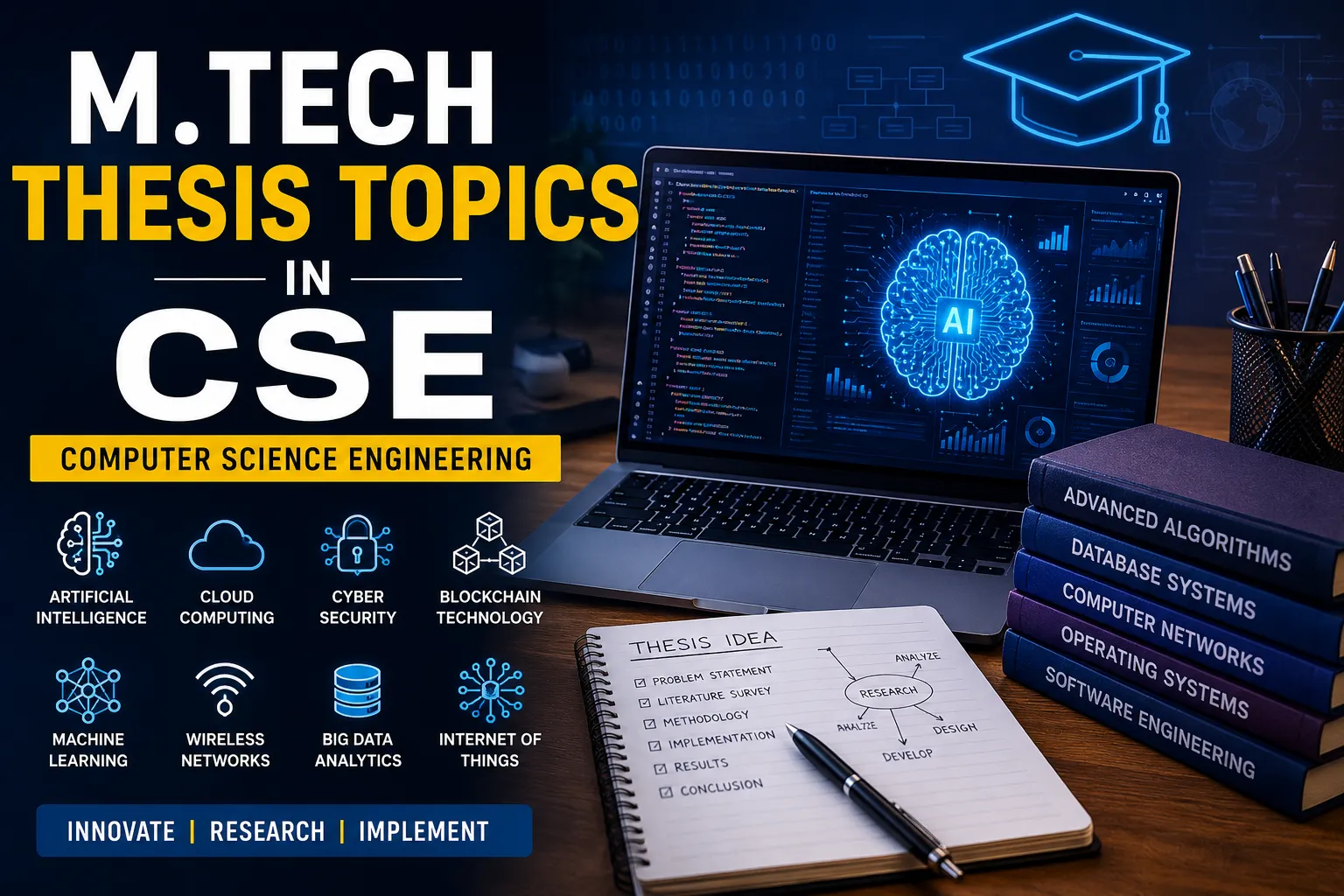
If you're an M.Tech CSE student trying to lock down a thesis topic, you've probably already noticed the problem: there's no shortage of ideas online, but most of them are either too generic to defend in front of a review panel, or too ambitious to finish within your semester timeline. This guide walks through M.Tech thesis topics in Computer Science & Engineering trending research ideas for 2026, organized by domain and difficulty, so you can pick something that's current, genuinely researchable, and realistic given the tools and data you actually have access to.
We've written this the way an experienced M.Tech project guide would talk you through it — because that's essentially the role ThesisLikho's technical mentoring team plays for the thousands of engineering scholars we've supported through topic selection, literature surveys, and final submission.
Why Topic Selection Matters More Than Students Expect
An M.Tech thesis in CSE isn't judged only on the final implementation — it's judged on whether you picked a problem worth solving, understood the existing landscape well enough to identify a genuine gap, and executed a method appropriate to that gap. A topic that's too broad ("A Study of Machine Learning Algorithms") leaves you with no clear research question. A topic that's too niche or resource-heavy (say, training a large language model from scratch) can stall your entire timeline waiting on compute you don't have access to.
The sweet spot for most M.Tech CSE theses is a topic that's specific enough to defend, backed by enough existing literature to support a proper survey chapter, and buildable using tools and datasets you can realistically access within one or two semesters.
If you'd like a parallel resource for a more specialized subfield, see our companion guides: M.Tech Thesis Topics in Computer Vision: Trending Research Ideas for 2026 and, for a completely different engineering branch, M.Tech Thesis Topics in Civil Engineering: Trending Research Ideas for 2026.
Trending CSE Research Areas for 2026
A few shifts are shaping what counts as a strong, defensible CSE thesis topic this year:
AI research has moved from "does it work" to "how well, how fairly, and how efficiently." Basic classification or prediction models are no longer novel on their own — reviewers increasingly expect some angle on explainability, fairness, or computational efficiency layered onto the core ML problem.
Cybersecurity research is leaning heavily into AI-driven detection. Phishing detection using deep learning, ransomware behavior analysis, and deepfake/synthetic-media detection are all active, well-supported areas with strong IEEE and Scopus publication pipelines.
Blockchain has matured past cryptocurrency-only applications. Supply chain traceability, digital identity verification, and smart contract security are now the more academically interesting angles, since the "blockchain for payments" space is heavily saturated.
Green/sustainable computing is an emerging 2026 frontier, covering energy-efficient algorithms, data center cooling optimization, and carbon-aware computing — a genuinely under-researched niche for students who want less competition on their topic.
Agentic AI — systems designed to take autonomous action rather than just respond to prompts — is one of the fastest-growing 2026 research conversations, though it's still new enough that a well-scoped M.Tech-level contribution (rather than a full autonomous system) is the realistic ambition here.
Quantum computing security and large-scale NLP/LLM research remain exciting but demanding — they typically require stronger mathematical or infrastructure backing than most single-semester M.Tech theses can support, so approach these with a narrower, well-defined sub-problem rather than the full frontier topic.
M.Tech CSE Thesis Topics by Domain
Below are 100+ starting-point topics across the domains most relevant to Indian M.Tech CSE programs. Treat each as a draft title — a strong thesis topic is usually a narrowed, localized version of one of these, refined with your guide's input.
Artificial Intelligence & Machine Learning Topics
- Explainable AI (XAI) techniques for interpreting deep learning model predictions in healthcare diagnosis
- A comparative study of transfer learning approaches for low-resource image classification
- Federated learning for privacy-preserving model training across distributed hospital datasets
- Lightweight deep learning models for real-time object detection on edge devices
- Bias detection and mitigation techniques in machine learning-based hiring/recommendation systems
- Sentiment analysis of regional Indian language social media content using deep learning
- Reinforcement learning approaches for traffic signal optimization in smart cities
- Predictive maintenance in industrial IoT using LSTM-based time-series forecasting
- Comparative analysis of ensemble learning methods for credit risk prediction
- AI-based crop disease detection using convolutional neural networks
- Energy-efficient neural network architectures for mobile and embedded systems
- Multimodal deep learning for fake news detection combining text and image analysis
- AI-driven early warning systems for student dropout prediction in higher education
- Comparative study of pre-trained language models for automated question answering
- Anomaly detection in network traffic using unsupervised deep learning
Cybersecurity Topics
- Deep learning-based phishing website detection using URL and content features
- Ransomware behavior analysis and early detection using machine learning
- Deepfake video detection using convolutional neural networks
- Intrusion detection systems for IoT networks using lightweight machine learning models
- Blockchain-based secure authentication framework for cloud-based applications
- Security vulnerability analysis of open-source software dependencies
- AI-driven malware classification using static and dynamic analysis features
- Privacy-preserving data sharing techniques using homomorphic encryption
- Post-quantum cryptography readiness assessment for existing security protocols
- Behavioral biometrics for continuous user authentication on mobile devices
Blockchain Topics
- Blockchain-based supply chain traceability system for agricultural produce
- Smart contract vulnerability detection using static analysis tools
- Blockchain-enabled digital identity verification framework for government services
- Decentralized voting system using blockchain and zero-knowledge proofs
- Performance comparison of consensus algorithms in permissioned blockchain networks
- Blockchain-based framework for secure academic credential verification
- Interoperability challenges between blockchain networks: a comparative study
Cloud Computing & Edge Computing Topics
- Energy-efficient resource allocation algorithms for cloud data centers
- Comparative analysis of container orchestration tools for microservices deployment
- Edge computing-based framework for reducing latency in real-time video analytics
- Cost optimization strategies for multi-cloud deployment architectures
- Load balancing algorithms for hybrid cloud-edge computing environments
- Security challenges in serverless computing architectures
- Fog computing framework for smart healthcare monitoring systems
Internet of Things (IoT) Topics
- IoT-based smart irrigation system using soil moisture and weather data
- Energy-efficient routing protocols for wireless sensor networks in IoT
- IoT-based air quality monitoring system for urban environments
- Security framework for IoT devices in smart home networks
- IoT-enabled predictive maintenance system for industrial machinery
- Low-power wide-area network (LPWAN) protocol comparison for rural IoT deployment
- IoT-based patient health monitoring system with real-time alert generation
Data Science & Big Data Topics
- Big data analytics framework for customer churn prediction in telecom
- Real-time stream processing architecture for fraud detection in financial transactions
- Comparative study of data warehousing versus data lake architectures for analytics
- Predictive analytics framework for demand forecasting in e-commerce supply chains
- Data quality assessment framework for large-scale healthcare datasets
- Graph-based analytics for detecting fraudulent transaction networks
Software Engineering Topics
- Automated test case generation using machine learning techniques
- Comparative study of agile methodology adoption challenges in Indian software firms
- Code smell detection using static analysis and machine learning
- Microservices architecture migration strategies for legacy monolithic systems
- Automated bug prediction models using software repository mining
- DevOps pipeline optimization for continuous integration/continuous deployment (CI/CD)
Networking Topics
- Performance evaluation of 5G network slicing for IoT applications
- Software-defined networking (SDN) based traffic engineering for congestion control
- Comparative analysis of routing protocols in mobile ad-hoc networks (MANETs)
- Network function virtualization (NFV) for scalable telecom infrastructure
- QoS-aware routing algorithms for wireless mesh networks
Beginner-Friendly Topics
For students who want a well-established literature base, accessible datasets, and a manageable scope for a first technical thesis:
- Comparative analysis of machine learning algorithms for email spam detection
- A study of recommendation system techniques using collaborative filtering
- Web application vulnerability scanner using open-source security tools
- Comparative study of database indexing techniques for query performance optimization
- Image compression technique comparison for storage optimization
- Chatbot development using rule-based versus machine learning approaches
- Comparative study of hashing algorithms for password security
- A study of load testing techniques for web application performance
- Plagiarism detection system using text similarity algorithms
- Comparative analysis of clustering algorithms for customer segmentation
Simulation & Implementation Tools You'll Likely Use
Most M.Tech theses require one or more simulation and implementation tools depending on the research domain. Selecting the right platform early helps streamline development, testing, and result validation.
Python (scikit-learn, TensorFlow, PyTorch)
Python is the most widely used platform for Artificial Intelligence (AI), Machine Learning (ML), and Deep Learning (DL) research. Libraries such as scikit-learn, TensorFlow, and PyTorch provide everything needed for data preprocessing, model training, evaluation, and visualization. It is the preferred choice for most AI/ML thesis projects.
MATLAB/Simulink
MATLAB and Simulink are commonly used for signal processing, communication systems, control engineering, and networking simulations. Many universities continue to use MATLAB because of its powerful simulation environment and extensive engineering toolboxes.
NS-2 / NS-3
NS-2 and NS-3 are specialized network simulation tools used to evaluate routing protocols, wireless sensor networks (WSN), Mobile Ad Hoc Networks (MANETs), and other communication network scenarios. They remain a standard choice for networking-related M.Tech research.
Solidity with Ganache or Truffle
Students working on blockchain-based thesis topics typically use Solidity for smart contract development, along with Ganache or Truffle for testing and deployment. These tools allow researchers to build decentralized applications and evaluate blockchain implementations in a controlled environment.
Docker and Kubernetes
Docker and Kubernetes are valuable for cloud computing, distributed systems, containerization, and microservices-based research. They help create reproducible experimental environments and simplify deployment across different systems, making them especially useful for DevOps and cloud-focused thesis projects.
Zotero and Mendeley
Zotero and Mendeley are reference management tools that help organize research papers, generate citations, and automatically format bibliographies in IEEE, ACM, APA, and other citation styles. Using these tools saves significant time during thesis writing and reduces citation errors.
Practical Tip: Software frameworks and libraries—especially in AI and Machine Learning—evolve rapidly. Before starting your implementation, verify which software versions, libraries, and hardware resources are available in your university or research lab. This helps avoid compatibility issues and ensures your thesis implementation matches your institution's supported environment.
Where to Find Datasets for Your Thesis
Dataset availability is one of the most common reasons M.Tech topics stall mid-semester, so it's worth planning this before you finalize a title, not after.
- Public repositories — Kaggle, UCI Machine Learning Repository, and IEEE DataPort are standard starting points for AI/ML and data science topics, with the advantage of being pre-cleaned and widely cited, which makes it easier to benchmark your results against existing published work.
- Government open data portals — data.gov.in is useful for topics involving Indian public infrastructure, agriculture, or health data, particularly for rural IoT or smart-city adjacent research.
- Institutional/industry access — if you have an internship or faculty project connection, anonymized organizational data (network logs, sensor readings, transaction records) can support a stronger, more original contribution than a heavily-used public dataset, though it usually requires an ethics/consent clearance from your department.
- Synthetic/simulated data — for networking or IoT topics where real-world data collection isn't feasible within your timeline, simulation tools like NS-3 or IoT testbed simulators can generate usable data, provided you're transparent about this limitation in your methodology chapter.
Whichever route you choose, confirm the dataset's exact size, format, and any usage restrictions before committing to a topic that depends on it.
Understanding Plagiarism and Similarity Standards
Since an M.Tech thesis involves both narrative chapters and implementation code, plagiarism checks apply to both — and the rules are stricter than many students expect.
Under the UGC's 2018 Academic Integrity Regulations, similarity up to 10% is treated as acceptable with no penalty, 10–40% requires a revised resubmission, and anything above 40% carries progressively steeper consequences. These bands apply across degree levels, including M.Tech. That said, many individual institutes set stricter internal targets — for instance, some IIT thesis processing cells treat 10% as the practical ceiling for final submission, with properly cited references and quoted text typically excluded from that count.
More important than the number itself: as guidance from IIT Delhi's CSE department puts it, the real test isn't hitting a specific percentage — it's making sure no text, figure, or table is presented as your own work without clear attribution, since a Turnitin score requires manual review of context, not a blind pass/fail cutoff. This matters especially for M.Tech CSE students who reuse standard code snippets, mathematical formulas, or dataset descriptions from open-source repositories — these need clear citation even when the code itself is technically "your own implementation" of a published method.
Check your specific institute's applied threshold directly rather than assuming a single universal number, since practice genuinely varies by institution and department.
Identifying a Genuine Research Gap
A topic only becomes a thesis when it addresses something existing research hasn't fully answered. According to Elsevier Researcher Academy's guidance on topic selection, a strong research contribution goes beyond simply picking an interesting subject and gathering recent references — it takes a position on where current trends in the field are heading (Source: Elsevier Researcher Academy).
For M.Tech CSE students, practical ways to spot a gap include:
- Dataset/context gap — applying a well-studied technique (like federated learning) to an under-tested domain, such as regional-language healthcare data
- Efficiency gap — most published models optimize for accuracy; testing the same problem for energy efficiency or low-resource deployment is often under-explored
- Comparative gap — running a head-to-head comparison of two or more existing techniques on a new, realistic dataset, rather than proposing something entirely new
- Security/robustness gap — testing whether an existing well-performing model holds up under adversarial conditions or real-world noise
If this is your first time formally identifying one, our detailed walkthrough — What Is a Research Gap and How to Identify One for Your Thesis — breaks this into a repeatable process.
Tips for Choosing a High-Impact Topic
- Check dataset availability before finalizing your topic. A brilliant idea with no accessible dataset (public or otherwise) will stall your entire semester.
- Match your topic to your available compute. If you don't have GPU access, avoid topics that assume training large deep learning models from scratch — consider transfer learning or lightweight architectures instead.
- Do a quick literature scan first. Fifteen minutes on Google Scholar or IEEE Xplore will tell you whether your topic already has too much competing work, or too little supporting literature.
- Keep your scope narrow and specific. "Federated learning for privacy-preserving diabetic retinopathy detection across three hospital datasets" is defendable; "Federated learning in healthcare" is not.
- Pick a topic your guide has some familiarity with. This usually means faster, more useful feedback cycles during your literature survey and implementation phases.
- Consider your career direction. A topic aligned with the specialization you want to work in post-M.Tech doubles as a strong interview talking point later.
For a more detailed framework on weighing your shortlisted options, see our companion guide: How to Choose a Strong Thesis Topic Your Supervisor Will Approve.
Thesis vs. Project-Based M.Tech Tracks
Not every M.Tech program treats "thesis" the same way. Some universities run a research-oriented thesis track (closer to a mini-PhD, with a strong literature review and a defensible research question), while others run a project-based track that's closer to an applied engineering build, evaluated more on implementation quality and less on formal research contribution.
If you're unsure which track your program follows, this matters for topic selection: a thesis-track student should lean toward topics with a clear, citable research gap (comparative studies, novel architecture tweaks, efficiency improvements), while a project-track student has more room to pick an applied, product-style build (a working IoT prototype, a functional recommendation engine) where the "research" component is lighter and the working system matters more. Check your specific university's evaluation rubric before assuming either format — this single distinction changes how much time you should budget for literature survey versus implementation.
Common Mistakes M.Tech Students Make
- Choosing an oversaturated topic without a fresh angle. "Spam detection using Naive Bayes" alone has been done thousands of times — without a new dataset, comparison, or efficiency angle, it won't pass review.
- Underestimating implementation time. Students often budget time for the literature survey and writing but underestimate how long debugging and model tuning actually takes — leaving the thesis writing rushed at the end.
- Copy-pasting standard definitions from textbooks or other theses. Explaining core concepts (like "what is federated learning") by lightly rewording an existing source is a common, avoidable plagiarism flag — always paraphrase in your own words with proper citation.
- Ignoring reproducibility. Not documenting hyperparameters, preprocessing steps, or the exact dataset version used makes it difficult to defend your results convincingly during viva.
- Skipping a baseline comparison. Presenting only your proposed model's results without comparing against at least one established baseline method weakens your entire results chapter.
- Assuming code originality means textual originality. Writing your own implementation of a published algorithm still requires citing the original paper and any code/library you adapted from.
A Realistic Example Scenario
Scenario — Ananya, an M.Tech CSE student in Hyderabad
Ananya initially wanted to work on "deep learning for medical image analysis" — a topic so broad that her guide sent the proposal back twice. After a focused literature scan and a conversation with her mentor, she narrowed it to "A lightweight CNN architecture for detecting diabetic retinopathy on low-resource edge devices using a publicly available retinal image dataset." This version had a clear dataset, a specific technical contribution (model efficiency, not just accuracy), and a scope she could realistically complete and defend within two semesters.
This is a pattern we see constantly in our mentoring work: the students who struggle most aren't short on ideas — they're short on a narrow, defensible framing of a good idea. If you'd like a second opinion on your shortlisted topics before committing, our M.Tech Thesis Assistance service offers exactly this kind of structured topic and methodology review from technically qualified mentors.
Scenario — Rohan, an M.Tech CSE student with a networking background in Pune
Rohan wanted to work on blockchain because it was trending, but he had no prior exposure to smart contract development, and his department had limited GPU resources for the more compute-heavy AI topics his classmates were choosing. Instead of forcing a fit, his mentor helped him combine his existing networking background with a blockchain angle: "Performance comparison of consensus algorithms in permissioned blockchain networks for supply chain applications." This let him lean on his networking coursework (throughput, latency, fault tolerance concepts translate directly), while still working in a currently active research area. The lesson here is one we repeat often: your strongest thesis topic usually sits at the intersection of a current trend and your own existing technical background — not just the trend alone.
A Practical Chapter Structure for Your Thesis Proposal
Once you've shortlisted a topic, most Indian M.Tech CSE programs expect your initial proposal (and eventually your full thesis) to follow a structure close to this:
- Introduction — problem statement, motivation, and objectives
- Literature Survey — organized by sub-theme (not just a list of summarized papers), ending with a clearly stated research gap
- Proposed Methodology — your approach, architecture/model design, and tools/dataset to be used
- Expected Contribution — what specifically is novel or improved compared to existing work
- Implementation Plan and Timeline — realistic milestones across your remaining semesters
- Preliminary Results (if available) — early testing, even on a subset of data, strengthens your proposal significantly
A well-organized literature survey chapter, in particular, is where many students lose the most time. Mendeley's guidance on managing references recommends grouping annotated papers by recurring theme as you read them, rather than trying to sort everything at the end — this makes it far easier to spot where the genuine gaps sit once you've read twenty or thirty papers .
Frequently Asked Questions
What is "M.Tech thesis topics in Computer Science & Engineering trending research ideas for 2026"?
It refers to a curated, current shortlist of researchable M.Tech CSE thesis topics for the 2026 academic cycle — spanning AI/ML, cybersecurity, blockchain, cloud computing, and IoT — filtered for available datasets and realistic implementation scope.
How long does it take to complete an M.Tech thesis using this approach?
Most M.Tech CSE theses in India run 6–12 months, often structured as a preliminary project in one semester followed by the main thesis work in the next, depending on your university's specific program structure.
Is professional help available for M.Tech CSE thesis topic selection?
Yes — structured mentoring on topic selection, literature survey organization, and methodology validation is a normal part of many M.Tech programs. ThesisLikho's technically qualified mentors offer this kind of guided support specifically for CSE research scholars.
Why does topic selection matter for an M.Tech CSE thesis?
Your topic determines your entire research path — the literature you'll survey, the dataset and tools you'll need, and how convincingly you can defend your results. A poorly scoped topic is the single biggest cause of thesis delays and review-panel pushback.
How does topic selection affect an M.Tech thesis overall?
A well-chosen, appropriately scoped topic makes your literature survey, implementation, and viva defense significantly smoother — because your research question stays focused and your technical claims stay realistic and testable from the start.
Get M.Tech Thesis Guidance
If you're weighing a few shortlisted topics or want a technically qualified mentor to sanity-check your proposal before you submit it to your guide, ThesisLikho's team is here to help.