
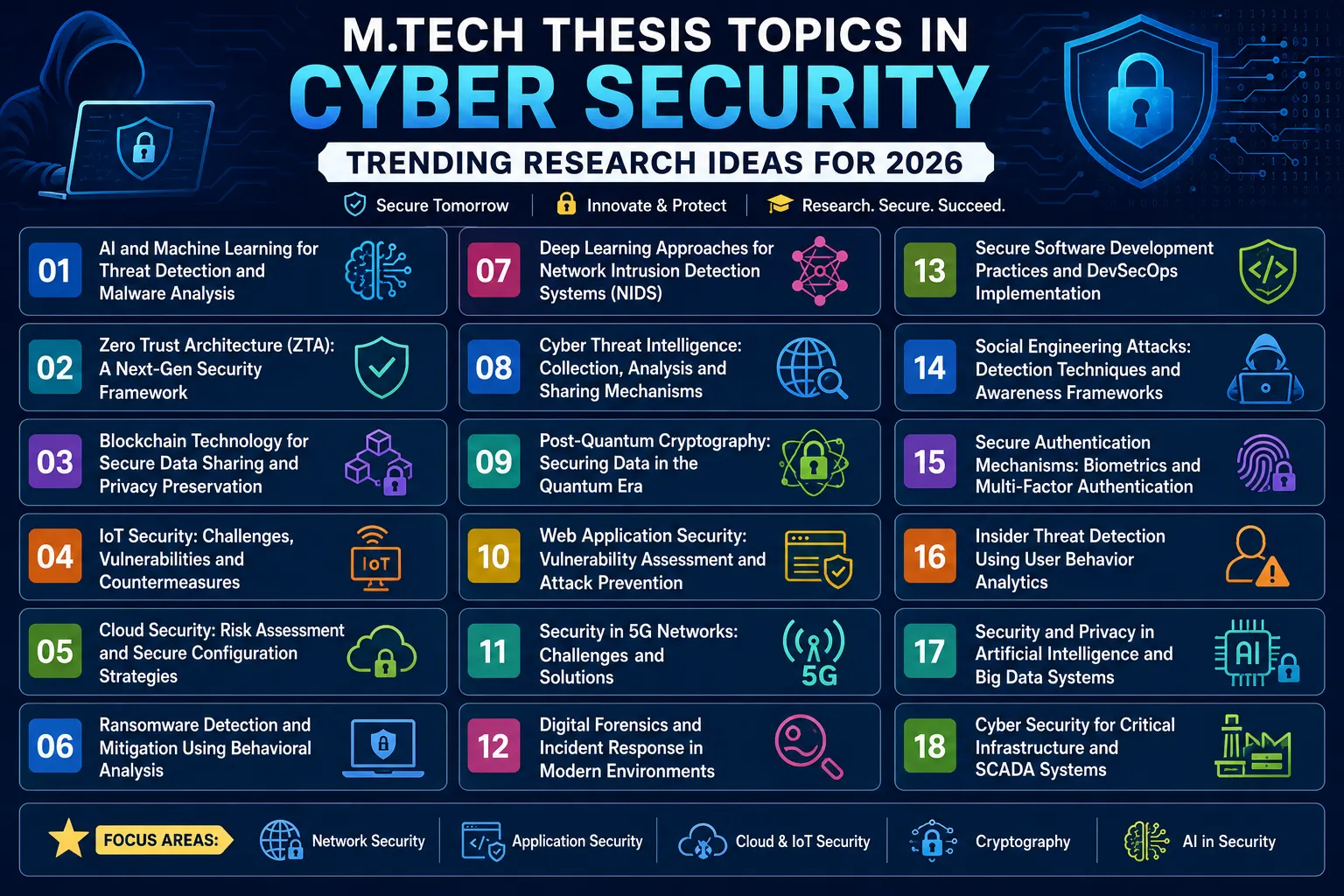
Finding M.Tech thesis topics in cyber security that are current, implementable, and genuinely useful — rather than a rehash of well-worn intrusion-detection benchmarks — means paying attention to where the threat landscape and the defense landscape are actually moving right now. Heading into 2026, that's a genuinely active moment: a documented surge in global cyberattack volume has pushed research priorities firmly toward proactive, AI-assisted defense, post-quantum cryptographic readiness, and zero-trust implementation, while attackers are simultaneously weaponizing the same AI tools defenders are adopting. This guide walks through research-ready directions across the areas seeing the most real momentum, along with how to scope any of them to a realistic M.Tech timeline rather than an enterprise security operations budget.
Why Cyber Security Research Looks Different Heading Into 2026
The single most important shift to understand before picking a topic is that cybersecurity research has moved decisively from reactive to proactive framing. Rather than only asking "how do we detect an attack that's already happening," current research priorities increasingly center on predicting and preventing attacks before they occur, verifying identity and device posture continuously rather than once at login, and preparing cryptographic infrastructure for threats (like quantum computing) that haven't fully materialized yet but are close enough to require action now. This has a direct, practical implication for topic selection: a topic framed purely around detecting a known, well-studied attack pattern is less distinctive right now than one that addresses proactive defense, continuous verification, or forward-looking cryptographic resilience.
There's also a genuinely interesting dual-use tension worth building into your topic if it fits: the same AI techniques powering automated threat detection and SOC automation are simultaneously being used by attackers for AI-generated phishing and automated malware creation. A thesis that explicitly engages with this adversarial dynamic — rather than treating AI purely as a defensive tool — tends to read as more sophisticated and current than one that doesn't.
It's also worth understanding why this proactive shift matters for topic selection specifically: a topic framed only around a known, well-documented attack signature tends to compete against a large existing body of published work using the same well-worn benchmark datasets. Topics framed around prediction, continuous verification, or forward-looking cryptographic resilience are working in genuinely less saturated territory, which both improves your realistic chances of a distinctive contribution and tends to align better with what reviewers are currently prioritizing.
How to Use This List
None of the directions below should be copied directly into a synopsis. Each is a starting point that needs narrowing into a specific, testable contribution — a defined threat model, dataset, or system, and a clear evaluation metric compared against an existing baseline approach.
AI-Driven Threat Detection and Automated Security Operations
AI-powered automated threat detection is consistently named as the leading 2026 cybersecurity research priority, driven by both a rising attack volume that manual analysis can't keep pace with and increasingly sophisticated, AI-assisted attack techniques.
- Comparative evaluation of machine-learning models for network intrusion detection on current, realistic attack datasets rather than older, well-worn benchmark datasets that no longer reflect current attack patterns.
- Predictive attack modeling using historical incident data, testing whether a model can anticipate a specific class of attack before it occurs, rather than only detecting it once underway.
- Adversarial robustness testing for AI-based security tools, examining how vulnerable a given detection model is to attackers deliberately crafting inputs designed to evade it — a genuinely current, well-scoped evaluative contribution.
- False-positive reduction in automated SOC alert triage, a practically valuable but comparatively under-published angle, since alert fatigue from excessive false positives is a widely acknowledged real-world problem in security operations.
- Explainability layers for AI-driven threat detection alerts, testing whether adding plain-language reasoning to a model's flagged alert changes how quickly and accurately a human analyst can triage it.
Post-Quantum and Quantum-Safe Cryptography
With classical asymmetric encryption methods expected to become vulnerable as quantum computing capability advances, 2026 marks a genuine inflection point where organizations are beginning active post-quantum migration planning — making this a well-timed, currently relevant M.Tech research area.
- Performance benchmarking of NIST-standardized post-quantum cryptographic algorithms on resource-constrained devices, measuring computational overhead and energy consumption against classical algorithms.
- Crypto-agility framework design, evaluating how quickly and reliably a system architecture can pivot between cryptographic standards as new post-quantum standards emerge or existing ones are deprecated.
- Hybrid classical/post-quantum cryptographic scheme evaluation, testing transitional approaches that combine both for systems that can't immediately migrate fully.
- Migration-readiness assessment methodology for a specific system category (IoT devices, legacy enterprise systems), identifying which components are most vulnerable to future quantum-based attacks and prioritizing migration effort accordingly.
- Comparative key-exchange latency analysis for post-quantum algorithms in latency-sensitive applications like real-time communications, measuring whether quantum-safe alternatives introduce unacceptable delay for time-critical use cases.
Operationalizing Zero Trust Architecture
Zero Trust research has shifted from justifying the model's value to solving the practical challenges of implementing it — continuous verification, unified visibility, and minimizing the friction it adds to legitimate users.
- Continuous device posture verification mechanisms for a specific hybrid cloud environment, measuring detection speed for compromised or non-compliant devices against a traditional perimeter-based approach.
- Identity verification strategies balancing security and user friction, testing whether more frequent or more contextual verification meaningfully improves security without unacceptably degrading user experience.
- Zero Trust implementation challenges in resource-constrained organizational settings, examining what simplified, lower-cost architectures can still deliver meaningful security improvements for smaller Indian enterprises or educational institutions.
- Micro-segmentation strategies for limiting lateral movement, evaluating how effectively fine-grained network segmentation contains a simulated breach compared to a traditional flat network architecture.
IoT, OT, and Smart Device Security
Smart home and IoT infrastructure risk is specifically named as a leading 2026 research priority, and the broader category of operational technology (OT) security — industrial control systems, critical infrastructure — carries similarly high relevance and comparatively less academic coverage.
- Lightweight intrusion detection for resource-constrained IoT devices, balancing detection accuracy against the limited compute and power budgets typical of consumer or industrial IoT hardware.
- Security vulnerability assessment for a specific class of smart home devices, examining authentication weaknesses and firmware update practices across a defined device category.
- Anomaly detection for industrial control system (ICS/SCADA) network traffic, using public or simulated ICS traffic datasets where genuine industrial access isn't available.
- Secure firmware update mechanisms for constrained IoT deployments, evaluating tradeoffs between update reliability and device resource limitations.
- Authentication protocol design for low-power sensor networks, balancing cryptographic strength against the energy budget of battery-powered agricultural or industrial IoT deployments common in Indian contexts.
Deepfake and Synthetic Identity Fraud Detection
As AI-generated audio, video, and synthetic identities are increasingly used in fraud and identity-theft attacks, detection research targeting manipulated media is a distinctly named, currently active category separate from traditional fraud detection.
- Comparative evaluation of deepfake detection techniques across audio, video, and image modalities, measuring accuracy against increasingly sophisticated generation methods.
- Synthetic identity detection in financial or onboarding systems, examining how well current identity-verification pipelines detect AI-assembled fake identities that combine real and fabricated personal data.
- Robustness testing of deepfake detectors against adversarial evasion, a genuinely open, currently relevant question given how quickly generation techniques are improving relative to detection techniques.
- Voice-cloning detection for phone-based social engineering attacks, an increasingly relevant fraud vector as voice-cloning technology becomes more accessible, with comparatively limited existing detection research specific to this modality.
Cloud Security Posture and Misconfiguration Detection
Cloud misconfiguration is specifically named as a leading cause of enterprise data breaches heading into 2026, making automated, continuous cloud security posture management a well-fundable, currently relevant applied research area.
- Automated misconfiguration detection frameworks for a specific cloud platform, comparing detection coverage and false-positive rates against existing commercial tools.
- Continuous compliance monitoring for multi-cloud environments, examining how consistently security policies can be enforced across different cloud providers' differing configuration models.
- Risk-prioritization models for cloud misconfiguration remediation, addressing the practical problem that security teams often face more flagged misconfigurations than they can realistically fix immediately.
- Comparative security posture analysis across major cloud providers' default configurations, examining how much baseline risk varies simply based on provider defaults before any organization-specific hardening is applied.
Supply Chain Security and Software Bills of Materials
Supply chain security research is moving from periodic vendor assessments toward continuous, real-time monitoring, driven by attackers increasingly targeting upstream software libraries and SaaS platforms rather than organizations directly.
- Automated Software Bill of Materials (SBOM) generation and vulnerability correlation, evaluating how accurately and quickly a given tool can identify vulnerable dependencies across a real or representative codebase.
- Continuous vendor security posture monitoring frameworks, examining what signals can reliably indicate a third-party vendor's security posture is degrading before an incident occurs.
- Open-source dependency risk scoring models, developing and testing a methodology for prioritizing which third-party components in a software supply chain carry the highest genuine risk.
- AI model supply chain security, examining vulnerabilities specific to pretrained model provenance and integrity — a genuinely emerging concern as more organizations depend on third-party AI models rather than training their own.
Ransomware Detection and Recovery Systems
Ransomware targeting healthcare and critical infrastructure remains one of the most consistently damaging attack categories, keeping both detection and recovery research genuinely active and well-funded.
- Behavioral ransomware detection using file-system activity patterns, measuring detection speed and accuracy against signature-based approaches, particularly for novel ransomware variants.
- Automated backup and recovery system design resilient to ransomware-targeted backup destruction, a practically valuable area addressing a known, current attack pattern where ransomware specifically targets backup systems.
- Comparative analysis of ransomware attack patterns in healthcare versus other sectors, using publicly documented incident data to identify sector-specific vulnerabilities and defense priorities.
- Decryption-key recovery feasibility studies for specific ransomware families, drawing on documented case studies to evaluate when recovery without payment is genuinely feasible versus when it isn't.
Tools Worth Knowing Before You Choose
Matching your topic to tools you can realistically get comfortable with matters as much as the topic itself. For network-security and intrusion-detection work, Wireshark for traffic analysis and Snort or Suricata for signature and anomaly-based detection remain the standard, well-documented tools most departments already have some familiarity with. For penetration testing and vulnerability assessment topics, Kali Linux and Metasploit form the default toolkit. For AI-driven detection work, Python with scikit-learn or TensorFlow/PyTorch covers most machine-learning security applications. For post-quantum cryptography evaluation, NIST's reference implementations and libraries like liboqs (Open Quantum Safe) let you benchmark standardized algorithms without needing to implement cryptographic primitives from scratch. For SBOM and supply-chain work, open-source tools like Syft and Grype are widely used for generating and scanning software bills of materials. Picking a direction where your department already has relevant tooling and lab access — rather than one requiring you to independently source and learn an entirely new platform — is one of the most underrated ways to protect your timeline.
Choosing Among These Areas for Your Timeline
With eight clusters and over twenty-five directions above, a few practical filters help you choose faster:
Check what data and lab access you can realistically get. AI-driven detection, post-quantum benchmarking, and SBOM/supply-chain topics can generally be built and evaluated using public datasets and open-source tools. ICS/SCADA and enterprise cloud-posture topics may require institutional or industry data access that takes time to arrange — confirm this before committing.
Match your ambition to your actual infrastructure. A full enterprise-scale zero-trust implementation or a complete post-quantum migration framework sounds impressive but exceeds what a typical M.Tech lab and timeline can support. Look for ways to demonstrate the same underlying contribution at a smaller, reproducible scale.
Consider what your department already has expertise and lab equipment for. A topic in an area your guide has supervised before, or where your department already has relevant tools and datasets, moves faster and gets more useful feedback than one requiring your supervisor to learn an unfamiliar subfield alongside you.
Think about your career direction after the M.Tech. If you're aiming for a SOC analyst or threat-detection role, AI-driven detection or ransomware-focused topics build directly relevant, portfolio-ready skills. If you're aiming for a security architecture or governance role, zero-trust implementation or supply-chain security topics map more directly to those career paths.
A Real Example: Scoping an Enterprise-Scale Idea to M.Tech Reality
A student interested broadly in "preparing organizations for post-quantum threats" initially proposed building a complete post-quantum migration framework capable of assessing and upgrading an entire enterprise's cryptographic infrastructure — a proposal that implicitly assumed access to enterprise systems, data, and a scope well beyond a two-semester M.Tech timeline. Working with his guide, he narrowed the idea into a specific, implementable contribution: benchmarking three NIST-standardized post-quantum algorithms' computational overhead and energy consumption on a defined set of resource-constrained IoT devices, comparing results directly against the classical algorithms those devices currently use. The core interest — quantum-readiness — stayed intact, but the scope shifted from "migrate an entire enterprise" to "rigorously benchmark specific algorithms on a defined, reproducible hardware set," which was fully achievable within his two-semester window and still produced a genuinely useful, citable comparison relevant to real IoT migration decisions.
The narrower scope also meant his results were fully reproducible on standard lab hardware, which made his viva defense considerably more concrete — he could speak confidently to every specific configuration choice and measurement, rather than defending claims about an enterprise-scale system he'd never actually had full access to test end-to-end. The lesson generalizes well: almost any broad security interest can be reframed from "solve this for an entire organization" into "rigorously benchmark or evaluate this specific mechanism under controlled, reproducible conditions" without losing the core relevance that made the topic compelling in the first place.
What the M.Tech Thesis Process Actually Involves
M.Tech programs in India are typically full-time, AICTE-recognized courses spanning 24 months across four semesters, with dissertation work usually concentrated in the final one to two semesters. Admission commonly requires a valid GATE score or a defined period of relevant professional experience alongside your bachelor's degree. Universities have been tightening originality requirements even at this level — AKTU's recent circular for M.Tech and other postgraduate dissertations, for instance, made Turnitin similarity checking mandatory as part of formal submission, alongside a standardized format and mandatory supervisor sign-off before upload. Most students spend their third semester finalizing a topic, completing their literature review, and building an initial implementation, with the fourth semester dedicated to full evaluation and writing.
If you'd like guidance scoping a cyber security topic to fit your specific timeline and available tools, our M.Tech thesis assistance service works specifically with students at this proposal and implementation stage.
Many universities also expect at least one conference paper or technical report drawn from your dissertation work, and cybersecurity has a particularly active conference and workshop culture worth tapping into — submitting a preliminary version of your evaluation results to a student security conference or regional workshop partway through your fourth semester can double as useful early feedback on your methodology and threat model, well before your final submission and viva.
Common Mistakes Specific to M.Tech Cyber Security Topics
- Assuming enterprise-scale infrastructure or data access that isn't available. A topic that implicitly requires production enterprise systems or classified threat data rarely survives contact with an actual M.Tech timeline and lab budget — look for ways to demonstrate the same contribution at a smaller, reproducible scale using public datasets.
- Using outdated benchmark datasets. Several widely used intrusion-detection datasets no longer reflect current attack patterns; check whether your chosen dataset is still considered representative by recent published work before building your entire evaluation around it.
- Treating a tool comparison as the entire contribution. Comparing existing security tools is a reasonable starting point, but a strong thesis adds genuine analytical depth on top — why differences occur, under what conditions they reverse, or what a practitioner should actually choose and when.
- Underestimating the ethics and access process for real attack or vulnerability data. Working with real vulnerability data, live network traffic, or actual incident data often requires institutional ethics clearance and data-handling agreements — confirm this timeline early rather than assuming access will be straightforward.
- Ignoring the adversarial angle. A detection or defense system proposed without any consideration of how an adversary might evade it reads as less rigorous than one that explicitly tests and addresses evasion attempts.
- Choosing a topic tied to a single vendor's proprietary tool. Building your entire evaluation around one commercial product's specific behavior can limit your ability to publish or generalize your findings — favor open standards and open-source tools where possible, using commercial products only as one point of comparison.
- Underestimating the legal and ethical boundaries of security research. Testing techniques on systems you don't have explicit permission to test, even for academic purposes, carries real legal risk — always confirm your research design stays within clearly authorized, ethically approved boundaries (your own lab setup, permitted test environments, or synthetic/public datasets) before finalizing your methodology.
FAQs
What are trending M.Tech thesis topics in cyber security for 2026?
Strong, currently active directions include AI-driven threat detection and SOC automation, post-quantum cryptography benchmarking, zero-trust implementation, IoT and OT security, deepfake and synthetic identity detection, cloud security posture management, supply chain security, and ransomware detection and recovery — each offering a genuine, implementable project within a typical M.Tech timeline.
Why does topic choice matter so much for an M.Tech cyber security thesis?
Because cybersecurity topics can easily be scoped at an enterprise infrastructure or classified-data-access scale that a two-semester M.Tech timeline simply can't support — choosing a topic that demonstrates the same underlying contribution at a smaller, reproducible scale is what keeps the project realistic and defensible.
How does topic choice affect an M.Tech thesis in cyber security?
A well-scoped topic with accessible data, current benchmark datasets, and appropriate lab tools lets you complete a genuine, demonstrable contribution on schedule; a topic relying on outdated datasets, unrealistic data access, or infrastructure your department doesn't have often causes significant rework partway through implementation.
How long does it take to complete an M.Tech thesis using this approach?
M.Tech dissertation work is typically concentrated in the final one to two semesters of the broader 24-month program — a well-scoped, appropriately resourced cyber security topic is far more likely to stay within that window than one assuming infrastructure or data access you haven't confirmed.
Is professional help available for M.Tech thesis topics in cyber security?
Yes. Experienced project mentors can help narrow a broad cyber security interest into a specific, implementable topic matched to your timeline, tools, and data access — this is a core part of what services like ThesisLikho's M.Tech thesis assistance provide.
Choosing a topic that's current, well-scoped, and genuinely finishable in your timeline is what makes the rest of your M.Tech dissertation manageable. If you'd like expert input on scoping any of the directions above into a project-ready topic, Get M.Tech Thesis Guidance →