
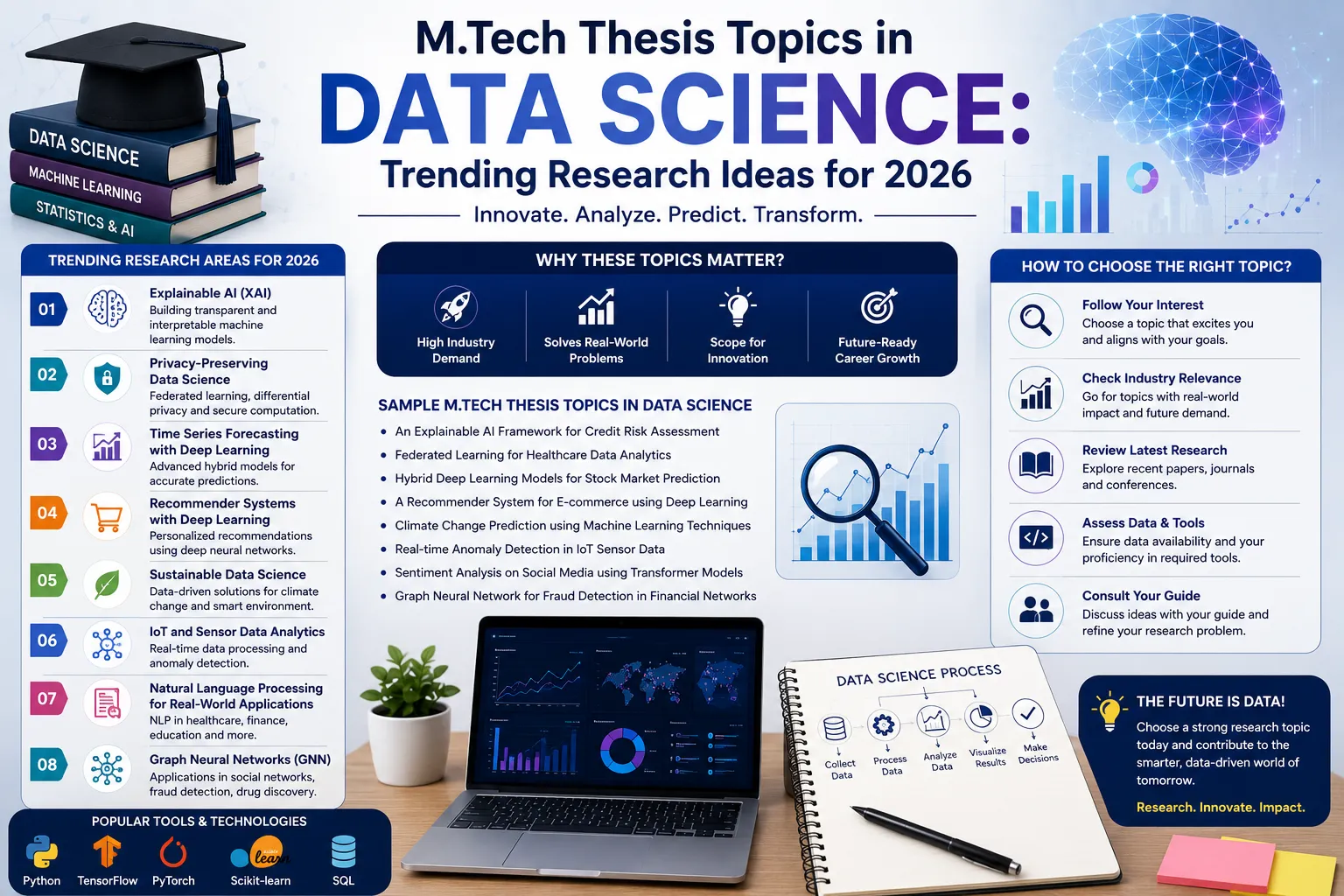
Finding M.Tech thesis topics in data science that are current, implementable, and genuinely distinct from a basic classroom project is harder than it looks, mainly because data science sits at the intersection of statistics, engineering, and business analytics — which means "trending" can mean very different things depending on which corner of the field you're drawn to. This guide walks through research-ready directions across the areas seeing the most real momentum heading into 2026, from big data engineering to MLOps to responsible data governance, along with how to scope any of them to fit a realistic M.Tech timeline rather than an enterprise research budget.
What Makes M.Tech Data Science Different From an M.Tech AI Thesis
It's easy to conflate data science and artificial intelligence topics, since they share tools and often overlap in practice, but they emphasize genuinely different things at the thesis level. An AI-focused thesis typically centers on a specific model or algorithm and how well it performs on a task. A data-science-focused thesis is more often centered on the full pipeline around that model — how data is collected, cleaned, stored, moved, governed, visualized, and operationalized — with the modeling step being just one part of a larger, end-to-end system. This distinction matters when you're scoping a topic: a strong data science thesis doesn't need a groundbreaking new algorithm to be valuable; a rigorous, well-evaluated contribution to how data is engineered, governed, or operationalized is a completely legitimate and often more implementable direction for an M.Tech timeline.
There's also a genuine, well-documented skills gap worth knowing about, since it directly shapes which thesis directions carry the most practical relevance right now: current industry analysis reports that a majority of professionals identify a lack of data science expertise — specifically around production-grade engineering and operational reliability, not just modeling — as a primary barrier to organizations fully realizing the value of their data investments. This means a thesis that rigorously addresses a genuine engineering or operational gap (reliable pipelines, monitored production systems, well-governed data) can be just as valuable, and sometimes more distinctive, than another incremental modeling-accuracy paper.
How to Use This List
None of the directions below should be copied directly into a synopsis. Each is a starting point that needs narrowing into a specific, testable contribution — a defined dataset, a specific evaluation metric, and a clear comparison against an existing baseline or approach. If you're not confident your topic will pass committee review as scoped, our companion guides, [Link: How to Choose a Strong Thesis Topic Your Supervisor Will Approve] and [Link: What Is a Research Gap and How to Identify One for Your Thesis], walk through that narrowing process directly.
Big Data Engineering and Real-Time Analytics Pipelines
The era of "big data" as a buzzword has passed, but the underlying engineering challenge hasn't gone anywhere — by 2026, organizations aren't just collecting more data, they're expecting real-time or near-real-time insight from it, which has made streaming and low-latency pipeline design a genuinely active, well-scoped M.Tech research area.
- A comparative evaluation of streaming-data architectures (batch versus micro-batch versus true streaming approaches) for a specific real-time analytics use case, measuring latency, throughput, and resource consumption directly.
- Data pipeline reliability and failure-recovery mechanisms for a defined streaming workload, an area with strong engineering rigor and clear, measurable evaluation criteria.
- Schema evolution and data quality monitoring in evolving data pipelines, a genuinely under-studied practical problem relative to how common it is in real deployments.
- Cost-versus-performance tradeoffs across cloud-based streaming services, a practically useful comparison for organizations weighing managed services against self-hosted infrastructure, and a well-defined, measurable M.Tech-scale project.
AutoML and Augmented Analytics
AutoML — automating preprocessing, model selection, and hyperparameter tuning — and augmented analytics — embedding AI directly into analysis tools to surface patterns with less manual intervention — are two of the most consistently cited emerging themes heading into 2026, and both offer genuinely implementable M.Tech-scale evaluation projects without requiring you to build new modeling infrastructure from scratch.
- Comparative benchmarking of open-source AutoML frameworks across a specific domain dataset, measuring not just accuracy but time-to-result and interpretability of the automatically selected pipeline.
- Evaluating augmented-analytics tools for non-technical business users, examining whether AI-suggested insights actually match what a trained analyst would independently identify from the same dataset.
- AutoML fairness and bias auditing, testing whether automated pipeline selection introduces or masks fairness issues compared to a manually designed pipeline — a well-scoped, currently relevant angle that pairs a trending tool category with a genuine evaluative contribution.
- Cost and compute-efficiency comparison of AutoML platforms against manually tuned baseline models, measuring whether automation's convenience comes at a meaningful performance or resource cost for a specific task type.
MLOps and Production-Grade Data Pipelines
Current industry guidance is consistent and blunt on this point: MLOps is no longer optional for data science work heading into 2026, and the ability to take a model from a working notebook to a reliable, monitored production pipeline is treated as a core, expected skill rather than a specialization. This makes MLOps a genuinely strong M.Tech thesis area, since it rewards rigorous engineering work over flashy modeling novelty.
- Model drift detection and automated retraining pipelines for a specific deployed model type, measuring how quickly and reliably drift is detected against a defined ground truth.
- Comparative evaluation of MLOps orchestration tools (Airflow, Kubeflow, MLflow) for a specific pipeline complexity level, assessing setup overhead against operational reliability.
- Reproducibility and versioning practices for data pipelines, examining how well different tooling approaches support tracing a specific production output back to the exact data and model version that generated it.
- Automated testing frameworks for data pipeline correctness, adapting software-testing practices to catch data-quality regressions before they reach a production model, an area with strong practical relevance and comparatively limited academic literature.
Data Governance, Privacy, and Ethical Analytics
As data-driven decision-making has become embedded in more consequential business and governmental processes, data governance and privacy-preserving analytics have moved from a compliance afterthought to an active, well-funded research area.
- Privacy-preserving analytics techniques (differential privacy, k-anonymity) applied to a specific domain dataset, measuring the tradeoff between privacy guarantees and analytical utility.
- Data lineage and auditability frameworks for multi-source analytics pipelines, an area with growing regulatory relevance as data-protection enforcement tightens.
- Bias detection in large-scale analytics dashboards, examining whether standard business-intelligence tools surface or obscure demographic skew in underlying data.
- Consent-aware data pipeline design, examining how analytics systems can respect granular user consent preferences without fragmenting datasets into unusable pieces — directly relevant given India's evolving data protection regulatory landscape.
Edge Analytics and TinyML for Data Pipelines
Bringing data reduction and lightweight inference directly to low-power microcontrollers, sensors, and IoT devices — rather than depending on constant cloud connectivity — is a specifically named, growing area with genuine engineering depth well suited to M.Tech-level implementation work.
- On-device data aggregation and filtering strategies for sensor networks with limited bandwidth, measuring how much cloud transmission can be reduced without meaningfully degrading downstream analytics quality.
- Comparative energy-consumption analysis of edge-analytics approaches for a specific IoT deployment scenario, directly measuring the efficiency-versus-accuracy tradeoff.
- Federated analytics for distributed sensor networks, aggregating insights across multiple edge nodes without centralizing raw data — a natural fit for agricultural, industrial, or environmental monitoring contexts common in Indian deployments.
- Adaptive sampling strategies for battery-constrained sensor deployments, examining how intelligently reducing data collection frequency affects downstream analytics accuracy versus device lifespan.
Time Series and Predictive Analytics
Predictive analytics remains a durable, high-relevance area, particularly where it intersects with sectors that have strong public data availability in India.
- Comparative evaluation of time-series forecasting approaches (classical statistical methods versus modern deep-learning approaches) for a specific domain — energy demand, retail inventory, or public health indicators — with a clearly defined accuracy benchmark.
- Anomaly detection in high-frequency sensor or transaction data, measuring detection accuracy and false-positive rate against a labeled ground-truth dataset.
- Predictive maintenance analytics for industrial equipment, using public or simulated sensor datasets where genuine institutional access isn't available.
- Comparative robustness testing of forecasting models under data-quality degradation, examining how different approaches handle missing values, sensor noise, or irregular sampling intervals — a realistic condition in most Indian deployment contexts that published benchmarks often assume away.
Data Visualization and Explainable Analytics
As analytics outputs increasingly inform decisions made by non-technical stakeholders, how results are communicated has become as research-worthy as how they're generated.
- Comparative usability evaluation of dashboard design approaches for a specific stakeholder group (clinicians, policy analysts, small-business owners), measuring how accurately users interpret the underlying data from different visualization choices.
- Explainability layers for automated analytics recommendations, testing whether adding a plain-language explanation to an AI-generated insight changes how much users trust and act on it.
- Accessibility of data visualization tools for users with visual impairments, an area with real social relevance and comparatively limited existing research specifically in the Indian context.
- Comparative evaluation of narrative-driven versus exploratory dashboard designs, testing which approach leads to faster, more accurate decision-making for a specific class of business or policy question.
Tools Worth Knowing Before You Choose
Matching your topic to tools you can realistically get comfortable with in your timeline matters as much as the topic itself. Python remains the default language across nearly every direction above, with pandas and NumPy for data manipulation, and scikit-learn for classical modeling comparisons. For big data and streaming pipeline work, Apache Spark and Kafka remain the standard tools most departments already have some familiarity with, while Apache Airflow is the most widely used orchestration tool for MLOps-focused topics specifically. For visualization work, Tableau and Power BI dominate industry practice, while Python-based libraries like Plotly and Streamlit are often faster to prototype with academically. For privacy-preserving analytics, libraries implementing differential privacy (like Google's open-source differential privacy library) let you build a credible evaluation without needing to implement cryptographic primitives from scratch. Picking a direction where your department already has relevant tooling and licenses in place — rather than one requiring you to independently source and learn an entirely new platform — is one of the most underrated ways to protect your timeline.
Managing Your Literature Review With Reference Software
A data-science-focused thesis typically means reading across a wider, faster-moving body of literature than a narrower theoretical topic would require — industry trend reports, conference papers, and rapidly published preprints all need to be tracked simultaneously. A free reference manager like Mendeley is worth setting up early rather than partway through your literature review: it lets you organize papers into topic-based collections, annotate PDFs directly as you read, and automatically generate citations and a bibliography in your required format, which removes a genuinely tedious source of errors and lost time later in your writing process. Setting this up in your first month, rather than trying to reconstruct a clean reference list retroactively before submission, is a small habit that pays off disproportionately by the time you're finalizing your dissertation.
Choosing Among These Areas for Your Timeline
With seven clusters and over twenty directions above, a few practical filters help you choose faster:
Check what data you can realistically access. Big data engineering, MLOps, and edge analytics topics can generally be built and evaluated using public datasets and locally deployable tools. Healthcare or enterprise-specific predictive analytics topics may require institutional data access that takes time to arrange — confirm this before committing.
Match your ambition to your actual infrastructure. Enterprise-scale streaming pipeline topics sound impressive but can require infrastructure well beyond what a typical M.Tech lab provides. Look for ways to demonstrate the same underlying engineering contribution at a smaller, locally reproducible scale rather than assuming you need production-grade infrastructure to make a genuine contribution.
Consider what your department already has expertise and licenses for. A topic in an area your guide has supervised before, or where your department already has relevant software licenses and lab equipment, moves faster and gets more useful feedback than one requiring your supervisor to learn an unfamiliar toolchain alongside you.
Think about your career direction after the M.Tech. If you're aiming for a data engineering or MLOps-focused industry role, leaning into pipeline reliability, orchestration, or governance topics builds directly portfolio-relevant skills. If you're aiming for a more analytics or applied-research career, predictive analytics, visualization, or augmented-analytics topics demonstrate skills that map more directly to those roles.
Weigh how well-documented the underlying tools and datasets already are. Well-established tools like Spark, Airflow, and standard AutoML libraries have extensive documentation and active community support, which meaningfully reduces the time you'll spend troubleshooting rather than doing actual research. Newer or more niche tools may offer a more distinctive angle but come with a steeper, less-documented learning curve — worth weighing honestly against how much of your limited timeline you can afford to spend on tooling friction rather than your actual research question.
A Real Example: Scoping an Enterprise-Scale Idea to M.Tech Reality
A student interested broadly in "real-time big data analytics for e-commerce" initially proposed building a full-scale streaming analytics platform capable of processing enterprise volumes of live transaction data — a proposal that implicitly assumed infrastructure and data volumes well beyond anything available in a university lab. Working with her guide, she narrowed the idea into a specific, implementable contribution: building a smaller-scale streaming pipeline using a public e-commerce transaction dataset, replayed at a controlled rate to simulate real-time conditions, and rigorously comparing three different streaming-architecture approaches on latency and resource consumption at that reproducible scale. The core interest — real-time e-commerce analytics — stayed intact, but the scope shifted from "build an enterprise platform" to "rigorously benchmark architectural choices under controlled, reproducible conditions," which was fully achievable within her two-semester window and still produced a genuinely useful, generalizable comparison.
The reframing also had an unexpected benefit at her viva: because her experimental setup was fully reproducible on standard lab hardware rather than dependent on borrowed enterprise infrastructure, her examiners could ask detailed, specific questions about her exact configuration choices and trust that her reported numbers reflected a genuinely controlled comparison — something that would have been much harder to defend confidently if her original enterprise-scale proposal had gone ahead with results drawn from infrastructure she didn't fully control or understand end-to-end.
What the M.Tech Thesis Process Actually Involves
M.Tech programs in India are typically full-time, AICTE-recognized courses spanning 24 months across four semesters, with dissertation work usually concentrated in the final one to two semesters. Admission commonly requires a valid GATE score or a defined period of relevant professional experience alongside your bachelor's degree. Universities have been tightening originality requirements even at this level — AKTU's recent circular for M.Tech and other postgraduate dissertations, for instance, made Turnitin similarity checking mandatory as part of formal submission, alongside a standardized format and mandatory supervisor sign-off before upload. Most students spend their third semester finalizing a topic, completing their literature review, and building an initial implementation, with the fourth semester dedicated to full evaluation and writing.
If you'd like guidance scoping a data science topic to fit your specific timeline and available tools, our M.Tech thesis assistance service works specifically with students at this proposal and implementation stage.
Many universities also expect at least one conference paper or technical report drawn from your dissertation work, which is worth planning for early rather than treating as an afterthought once your implementation is complete. Submitting a preliminary version of your evaluation results to a student conference or regional workshop partway through your fourth semester can double as useful early feedback on your methodology, well before your final submission and viva — and gives you a concrete deliverable to point to if your department expects publication evidence alongside your dissertation itself.
Common Mistakes Specific to M.Tech Data Science Topics
- Assuming enterprise-scale infrastructure that isn't available. A topic that implicitly requires production-grade data volumes or distributed compute clusters rarely survives contact with an actual M.Tech timeline and lab budget — look for ways to demonstrate the same contribution at a smaller, reproducible scale.
- Confusing a dashboard with a research contribution. Building a visualization tool is a legitimate project, but a thesis needs a stated evaluation question — does it improve decision accuracy, comprehension speed, or trust — not just a description of features built.
- Treating data cleaning as invisible, unreportable work. In a data-focused thesis, your data preparation and quality-handling decisions are often part of the actual contribution and deserve rigorous documentation, not a brief throwaway paragraph.
- Underestimating how much literature a fast-moving area generates. Data science trend areas like AutoML and augmented analytics produce new papers and tools constantly — set up a systematic way to track and organize this literature early rather than trying to catch up right before writing your review chapter.
- Choosing a metric that doesn't match the stakeholder's actual concern. A pipeline optimized purely for raw processing speed may be a poor fit for a use case where reliability or interpretability matters more — always tie your evaluation metric back to what the specific application genuinely needs, not just what's easiest to measure.
- Treating an off-the-shelf tool comparison as the entire contribution. Comparing existing frameworks (which AutoML tool is fastest, which orchestration platform is easiest) is a reasonable starting point, but a strong thesis adds a genuine analytical layer on top — why the differences occur, under what conditions they reverse, or what a practitioner should actually choose and when.
FAQs
What are trending M.Tech thesis topics in data science for 2026?
Strong, currently active directions include real-time big data pipeline architecture, AutoML and augmented analytics evaluation, MLOps and model-drift monitoring, privacy-preserving and governance-focused analytics, edge analytics and TinyML for sensor data, predictive analytics, and data visualization usability — each offering a genuine, implementable project within a typical M.Tech timeline.
Why does topic choice matter so much for an M.Tech data science thesis?
Because data science topics can easily be scoped at an enterprise infrastructure scale that a two-semester M.Tech timeline and university lab simply can't support — choosing a topic that demonstrates the same underlying contribution at a smaller, reproducible scale is what keeps the project realistic.
How does topic choice affect an M.Tech thesis in data science?
A well-scoped topic with accessible data and appropriate infrastructure lets you complete a genuine, demonstrable contribution on schedule; an infrastructure-mismatched or vaguely defined topic often causes significant rework partway through implementation.
How long does it take to complete an M.Tech thesis using this approach?
M.Tech dissertation work is typically concentrated in the final one to two semesters of the broader 24-month program — a well-scoped, appropriately resourced data science topic is far more likely to stay within that window than one assuming infrastructure or data access you haven't confirmed.
Is professional help available for M.Tech thesis topics in data science?
Yes. Experienced project mentors can help narrow a broad data science interest into a specific, implementable topic matched to your timeline, tools, and data access — this is a core part of what services like ThesisLikho's M.Tech thesis assistance provide.
Choosing a topic that's current, well-scoped, and genuinely finishable in your timeline is what makes the rest of your M.Tech dissertation manageable. If you'd like expert input on scoping any of the directions above into a project-ready topic, Get M.Tech Thesis Guidance →