
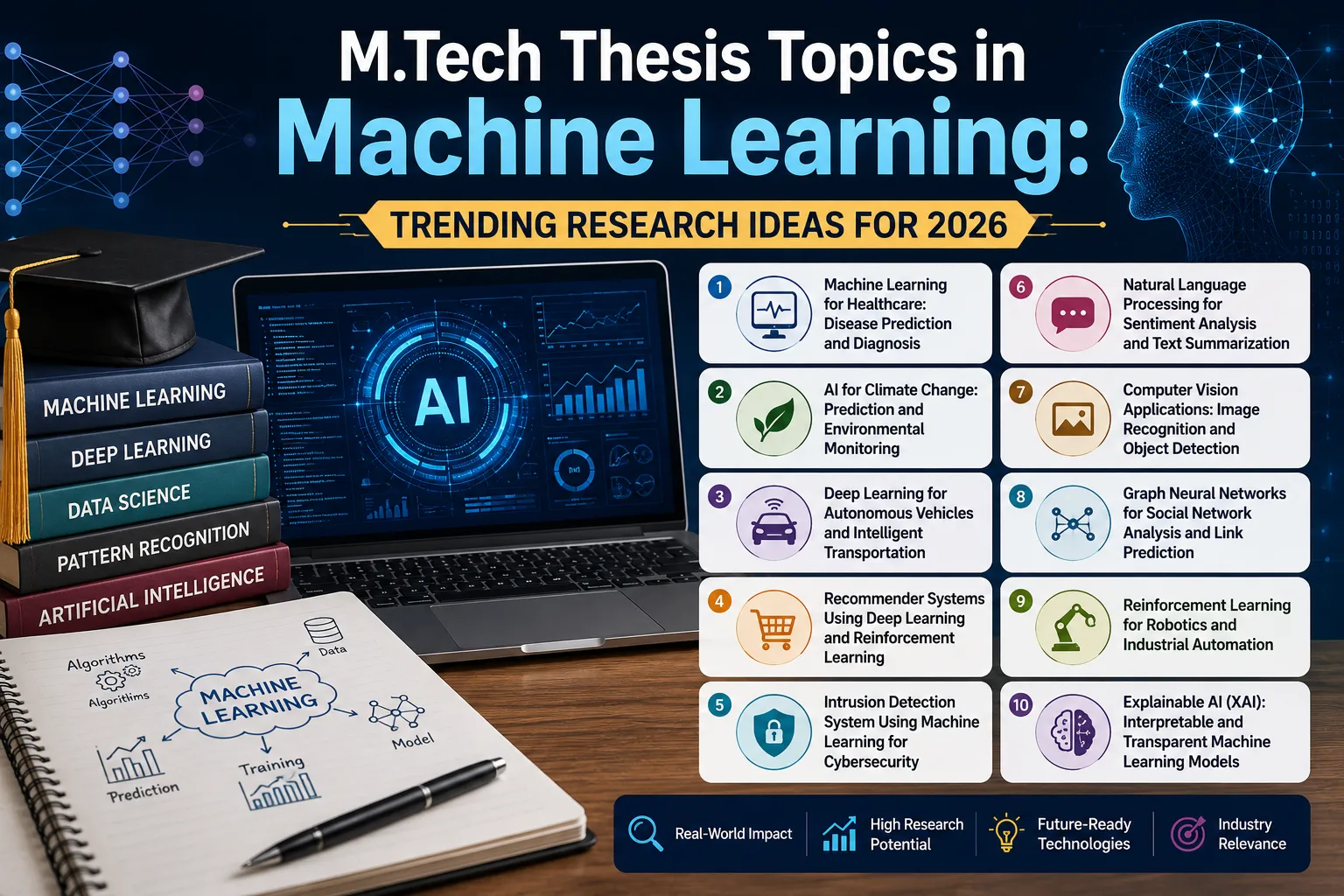
If you're staring at a blank proposal document trying to pick a topic your supervisor won't send back for revision, you're at the exact stage this guide is built for. Finding solid M.Tech thesis topics in machine learning trending research ideas for 2026 isn't about grabbing whatever sounds impressive — it's about matching a genuinely current research direction to the data, compute, and time you actually have as an M.Tech scholar.
This guide walks through the machine learning sub-areas seeing real research momentum this year, how to judge whether a trending topic is actually feasible for a two-year M.Tech program, and the structural and citation details that keep a technical thesis credible once you start writing it.
Why "Trending" Isn't the Same as "Right for You"
Every year, a fresh batch of "top thesis topics" lists circulates among M.Tech scholars, and every year, a share of students pick the flashiest-sounding one without asking whether they can actually execute it. A trending area only becomes a good thesis topic when it's paired with a dataset you can access, a computing setup you actually have, and a research question narrow enough to answer within your program's timeline.
The domains getting real attention in 2026 make this tension especially visible. Generative AI, large language models, and federated learning are consistently named among the most in-demand machine learning research areas this year, and topics that combine ML with healthcare, cybersecurity, or climate science are considered especially valuable for their real-world relevance. But "in-demand" and "in-demand for an M.Tech scholar with limited compute and an 18-month runway" are two different filters, and this guide treats both seriously.
What's Actually Trending in Machine Learning Research for 2026
Before narrowing into a specific topic, it helps to see the shape of where the field is actually moving this year, rather than picking from a static list that hasn't updated in three years. A few real shifts stand out:
AI research broadly has moved past simply proving a model works, toward questions of how well, how fairly, and how efficiently it works — meaning a plain classification or prediction model is no longer novel on its own; reviewers increasingly expect an additional angle layered onto the core ML problem, such as explainability, fairness, or computational efficiency. Beyond the flagship generative AI and LLM areas, model evaluation, efficient inference, graph neural networks, and multimodal AI are also seeing real research attention, particularly for students looking for a topic that's specific and evidence-based rather than simply following the biggest headline.
The sections below break down six of the strongest 2026 directions specifically through the lens of what's realistic for an M.Tech-level contribution.
Generative AI and Large Language Models
Generative AI, LLMs, and federated learning are named as the three most in-demand machine learning research areas of 2026. For an M.Tech scholar, though, "build a new LLM" is not a feasible thesis — that's an industrial-scale undertaking requiring resources no university lab has. The realistic, defensible version of this trend is narrower: fine-tuning an existing open-source LLM for a specific domain task, evaluating LLM output reliability or hallucination rates in a constrained use case, or building a retrieval-augmented generation (RAG) system for a specific document type (legal, medical, or regional-language content, for instance).
The India-specific angle worth considering here is regional-language capability — most large models are still weaker on Indian languages than on English, which leaves real room for a well-scoped thesis evaluating or improving LLM performance on a specific regional language task.
Federated Learning and Privacy-Preserving ML
Federated learning — training models across decentralized devices or servers without moving the underlying data to a central location — sits at the intersection of two things reviewers currently reward: real-world applicability and a privacy angle that gives the thesis practical, not just academic, weight. It pairs naturally with healthcare or finance use cases, where data-sharing restrictions make federated approaches genuinely necessary rather than just a novelty.
The feasibility catch: federated learning experiments typically require simulating multiple clients/nodes, which is compute-intensive even in simulation. Scope this down to a manageable number of simulated clients and a well-defined, smaller dataset rather than attempting a large-scale federated system.
Explainable AI (XAI) and Model Fairness
As noted above, explainability and fairness have shifted from "nice to have" to something reviewers actively expect layered onto core ML work. This makes XAI one of the most accessible ways to make an otherwise ordinary classification or prediction thesis feel current: instead of just building a model that predicts loan default or disease risk, add a genuine explainability component — using established techniques to show which features drove specific predictions, and critically evaluating whether those explanations are actually trustworthy.
This direction is particularly well-suited to first-time researchers because it doesn't require inventing a new architecture — it requires rigorously applying and evaluating existing explainability methods on a problem you already understand, which is a far more achievable M.Tech-level contribution than novel architecture design.
Machine Learning in Healthcare
Healthcare remains one of the most consistently cited application domains for ML thesis work, covering disease and patient-risk prediction from electronic health records, medical imaging analysis, and treatment-outcome modeling. It's also one of the highest-impact areas reviewers cite, alongside cybersecurity and climate science, precisely because of its real-world relevance.
The feasibility question here is almost always about data access. Genuine clinical datasets often require institutional access or ethics clearance that an M.Tech timeline can't accommodate — which is why most feasible student theses in this space use public, de-identified datasets (several are openly available for specific conditions and imaging types) rather than attempting to source original patient data.
ML-Driven Cybersecurity and Fraud Detection
Cybersecurity research is leaning heavily into AI-driven detection, with phishing detection using deep learning as one specific, actively researched sub-area. Financial fraud detection — building systems that flag suspicious transactions using ML — is a closely related, similarly well-supported direction, and both benefit from a genuine industry-relevance angle that strengthens a thesis's practical contribution.
This area tends to be more feasible than healthcare from a data-access standpoint, since several fraud-detection and network-intrusion datasets are publicly available specifically for research use — but the well-known ones are also heavily used, so a defensible thesis usually needs a specific angle (a particular attack type, a specific detection technique, or a fairness/efficiency evaluation) rather than a generic "fraud detection using ML" framing.
Efficient and Edge Machine Learning
Not every trending area is about making models smarter — a growing share of 2026 research attention is going toward making models smaller, faster, and cheaper to run, covering topics like efficient inference and model compression. This direction suits scholars with limited access to high-end GPUs particularly well, since the entire research question is about achieving good performance under resource constraints — which is often closer to your actual lab setup than a large-model research direction would be.
A well-scoped version of this: taking an existing, resource-heavy model architecture and evaluating a specific compression or optimization technique's impact on accuracy versus inference speed for a defined task and device (e.g., a mobile or IoT deployment scenario).
How to Test a Trending Topic for M.Tech-Level Feasibility
Once you've shortlisted a direction from the sections above, run it through this checklist before committing:
- Dataset availability — is there a real, accessible dataset for your specific angle, not just for the broad topic area? Quality data is essential, and its accessibility should be verified before a topic is finalized, not assumed.
- Compute requirements — does your university lab, or a free-tier cloud option, realistically support the model size and training time your topic implies?
- Timeline fit — a typical M.Tech thesis timeline doesn't accommodate months of data collection; if your topic requires gathering data from scratch, budget for that explicitly or choose a public-dataset alternative.
- Publication pathway — most Indian M.Tech and research-oriented programs encourage or require at least one paper submission to a Scopus- or IEEE-indexed venue alongside the thesis, so a topic broad enough to yield a publishable interim result is worth prioritizing over one that only produces a result at the very end.
A Real Example: Narrowing a Broad Healthcare-ML Idea Into a Defensible Thesis
One M.Tech scholar we worked with arrived with the topic "Machine Learning for Disease Prediction Using Patient Data" — a direction squarely inside one of 2026's most cited application areas, but far too broad to defend. It didn't specify which disease, which patient population, which data type, or what would count as a meaningful improvement over existing approaches.
Here's exactly what made the original framing weak: "patient data" could mean structured EHR records, imaging data, wearable-sensor streams, or genomic data — each requiring a completely different pipeline, and the committee had no way to tell which one the scholar actually intended to build. A topic this broad also has no natural comparison point, meaning there's no way to demonstrate the thesis added something beyond restating what dozens of existing papers already show.
After scoping, the topic became: "Explainable Machine Learning for Early-Stage Diabetic Retinopathy Detection Using Retinal Fundus Images, with Grad-CAM-Based Interpretability Analysis." This version named the specific disease, the specific data type (a well-known public retinal imaging dataset), the specific model family, and added the explainability layer that reviewers now expect on top of a core prediction task. It gave the committee something concrete to approve and gave the scholar a realistic, resource-appropriate scope for a two-year program.
If you'd like expert guidance in scoping and developing your M.Tech thesis topic, you can check out our M.Tech Thesis Assistance Service.
Structuring and Citing Your Thesis Correctly
Choosing a strong topic is only the first half of the credibility question — how you cite the work you build on matters just as much, especially in a field where papers and preprints move fast and get revised often.
Most engineering and computer science theses that aren't following IEEE's own citation format use APA style, so a few basics are worth getting right early rather than fixing at the end. In-text citations follow an author-date format — the author's surname and publication year in parentheses, such as (Sharma, 2025) — and every source cited in the body must have a corresponding entry in the reference list, with no source appearing in one place but not the other. Direct quotations should be kept to a genuine minimum in technical writing — paraphrasing a method or finding in your own words is both the stronger academic practice and the safer one for originality checks, and quotations should only be used when the exact wording itself matters. The reference list itself is arranged alphabetically by author surname, with a hanging indent applied from the second line of each entry.
Getting this structural discipline right from your first literature-review draft — rather than retrofitting citations after the fact — saves real time when your university runs its mandatory similarity check before submission.
Common Mistakes Scholars Make When Picking a Trending ML Topic
Mistake 1: Choosing a topic because it's trending, not because it's answerable. "Large language models" or "generative AI" as a standalone thesis title is a research field, not a research question — and a committee reading it can't tell what specific contribution you intend to make.
Mistake 2: Assuming a public dataset exists without checking first. Scholars sometimes finalize a topic assuming data will be "findable later," which routinely turns into weeks of delay once the literature review is already underway.
Mistake 3: Ignoring compute constraints until implementation begins. A federated learning or large-model fine-tuning topic that sounded reasonable on paper can stall for months if the required GPU access was never actually confirmed at the proposal stage.
Mistake 4: Skipping the explainability or efficiency layer on an otherwise standard prediction task. A plain "ML model that predicts X" thesis increasingly reads as under-scoped to reviewers who now expect some additional angle — fairness, interpretability, or efficiency — layered onto the core problem.
Best Practices If You Have No Research Background
If you're approaching your M.Tech thesis without prior research experience, a few adjustments make topic selection far more manageable:
- Read 3–5 recent papers in your shortlisted sub-area before finalizing anything. This tells you faster than any topic list whether the area is over-saturated, whether datasets are genuinely accessible, and what specific angle is still open.
- Confirm dataset access before you fall in love with a topic. It's far easier to pivot a topic idea in week one than after a month of failed dataset searching.
- Talk to your supervisor about compute access early, especially if your shortlisted direction involves large models, federated simulations, or extensive hyperparameter search.
- Pick the narrower version of a broad idea, every time. A tightly scoped topic with a clear, answerable question will almost always defend better than a broad, trend-following title with no specific contribution named.
If any part of this process — narrowing a broad interest into a defensible topic, confirming dataset feasibility, or structuring your literature review and citations correctly — feels unfamiliar, that's exactly where a structured, expert-guided process helps first-time M.Tech scholars move from a vague direction to a topic a committee will actually approve.
FAQs
What is m.tech thesis topics in machine learning trending research ideas for 2026?
It refers to the machine learning research directions currently seeing the strongest academic and industry attention this year — generative AI and LLMs, federated learning, explainable AI, healthcare ML, cybersecurity-focused ML, and efficient/edge ML — scoped down to a level an M.Tech scholar can realistically research, implement, and defend within a typical program timeline.
Why does m.tech thesis topics in machine learning trending research ideas for 2026 matter?
Because a topic that's current and well-scoped is both more likely to be approved by your committee and more likely to yield a publishable interim result, which most Indian M.Tech and research-oriented programs now expect alongside the final thesis.
How does m.tech thesis topics in machine learning trending research ideas for 2026 affect a M.Tech thesis?
The topic you choose determines your entire feasibility profile — the dataset you'll need, the compute you'll require, and the timeline your methodology can realistically support. A trending but poorly scoped topic (a broad field name rather than a specific question) is one of the most common reasons M.Tech theses stall midway through implementation.
How long does it take to complete a M.Tech thesis using this approach?
Most M.Tech programs allow 12–18 months for thesis work including literature review, implementation, and writing. Topics requiring extensive original data collection or large-scale federated/LLM experimentation typically take longer than topics built on well-scoped, publicly available datasets — which is why feasibility-testing your topic early, rather than after the proposal is approved, matters so much.
Is professional help available for m.tech thesis topics in machine learning trending research ideas for 2026?
Yes. Many M.Tech scholars, particularly those new to formal research, work with experienced technical mentors to scope a broad interest area into a specific, defensible, and feasible thesis topic. ThesisLikho's PhD-qualified writers have supported thousands of engineering scholars through exactly this stage — narrowing trending ML directions into topics that are current, researchable, and realistic given the data and tools actually available to the scholar.
If you're weighing a few trending ML directions and aren't sure which one will actually hold up once you start implementation, it helps to get a second, experienced opinion before you commit months to it. Get M.Tech Thesis Guidance to pressure-test your topic's feasibility, data access, and publication potential before you finalize your proposal.