
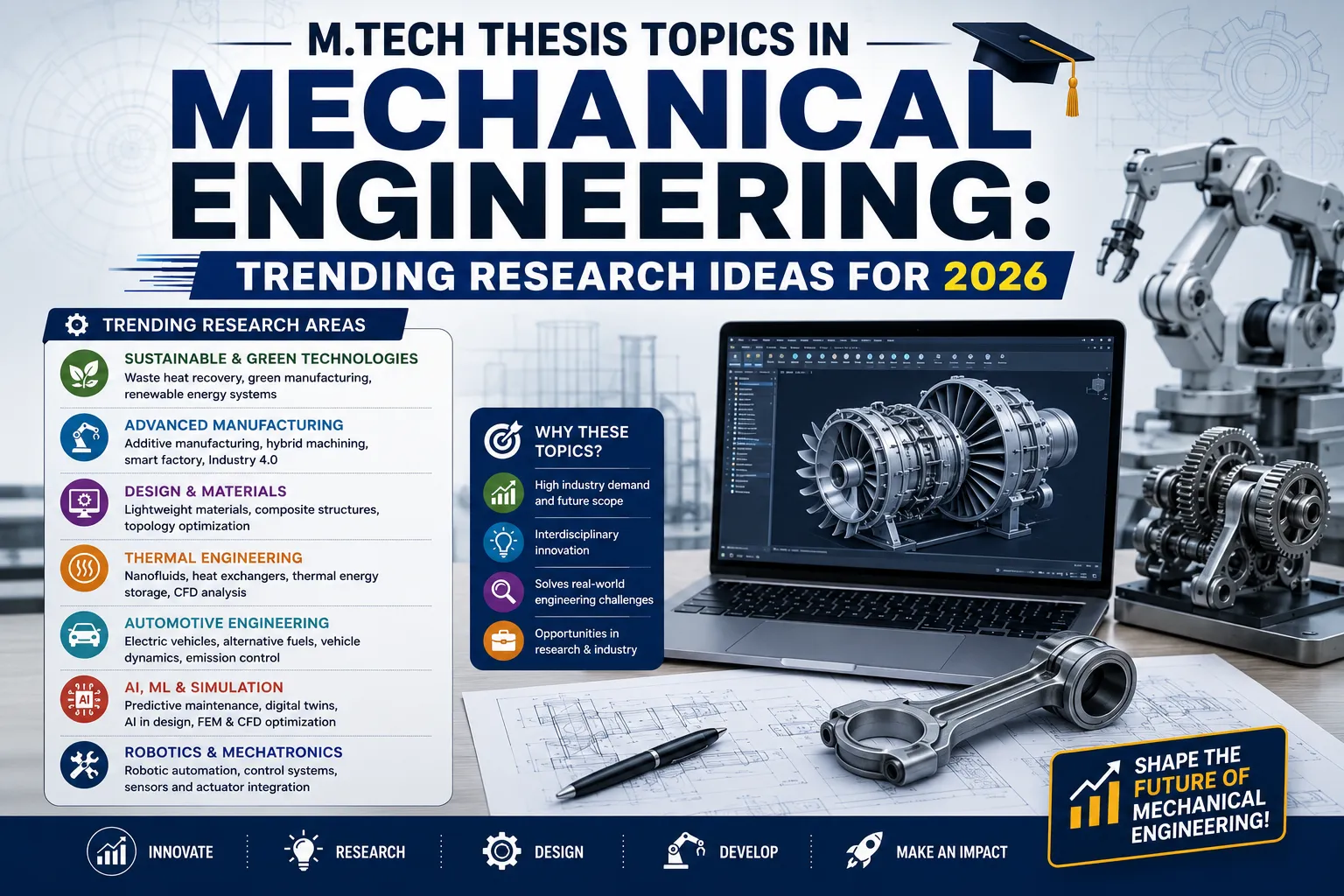
Picking your M.Tech thesis topic is one of those decisions that quietly shapes the next one to two years of your life — get it right, and the research stays engaging even during the difficult months. Get it wrong, and you're stuck defending a topic that never quite fit. This guide walks through trending, genuinely research-ready M.Tech thesis topics in mechanical engineering for 2026, along with how to narrow a broad theme into something your supervisor will actually approve.
The dominant theme in 2026 mechanical engineering research is systems that can sense, reason, move, and adapt — driven by decarbonization pressure, rising healthcare demands, and an accelerating wave of automation across industry. If you're choosing a thesis direction right now, aligning with this shift gives your work both academic depth and industry relevance.
Why Topic Selection Matters More Than It Seems
A strong mechanical engineering thesis topic must be narrow and precisely defined — specifying the machine, system, material, model, performance metric, and application context — rather than a broad title like "robotics in manufacturing," which is considered far too large to defend as a single thesis. Every topic below is presented as a starting theme; your job is to narrow it the same way, using the framework demonstrated in the examples.
Trending M.Tech Thesis Areas in Mechanical Engineering for 2026
1. EV Battery Thermal Management Systems (BTMS)
This is one of the most mature, well-published, and thesis-ready areas available right now. Current techniques span air cooling, single-phase and two-phase liquid cooling, phase-change-material (PCM) passive cooling, heat pipes, and hybrid combinations of these approaches (Source: Heat Transfer Research journal, "A Comprehensive Review on Battery Thermal Management and Modeling"). A well-scoped example: a comparative CFD-based analysis of immersion cooling strategies using different coolant fluids for lithium-ion battery packs in hybrid electric vehicles — narrow enough to be feasible, specific enough to be defensible.
Narrowed thesis example: "CFD-Based Comparative Analysis of Single-Phase Liquid Cooling vs. PCM-Assisted Cooling for a Cylindrical Lithium-Ion Battery Pack Under Fast-Charging Conditions"
2. Digital Twins for Battery and Mechanical Systems
Digital twin technology applied to EV battery systems is a rapidly growing research direction, combining electrochemical, thermal, and structural modeling to predict real-time battery health, thermal runaway risk, and safety failures — typically validated using coupled simulation tools like MATLAB, Python, and COMSOL. Beyond batteries, digital twin methodology is increasingly applicable to rotating machinery, manufacturing lines, and structural health monitoring.
Narrowed thesis example: "Development of a Multi-Physics Digital Twin for Early Detection of Thermal Deviation in a Lithium-Ion NMC Battery Module"
3. Additive Manufacturing (AM) Process Optimization
Additive manufacturing has moved firmly from a prototyping tool into an established production technology. Active research directions include sustainable/eco-friendly printing materials, nanostructured materials for enhanced mechanical, thermal, or electrical properties, and self-healing materials capable of autonomously repairing damage.
Narrowed thesis example: "Optimization of Layer Parameters for Improved Fatigue Resistance in Additively Manufactured Titanium Alloy Components"
4. High-Performance and Biobased Composites
Carbon fiber composites are expanding beyond aerospace into automotive and renewable energy applications, while biobased alternatives — flax, hemp, and jute-based composites — are gaining traction as lighter, lower-cost, and more sustainable options. This dual direction (performance vs. sustainability) offers strong thesis framing either way.
Narrowed thesis example: "Mechanical and Thermal Performance Comparison of Flax-Fiber Reinforced Composites vs. Conventional Glass-Fiber Composites for Automotive Panel Applications"
5. Smart and Adaptive Materials
This area includes structural battery composites (materials that simultaneously bear load and store energy), shape-memory alloys that respond to temperature shifts, and piezoelectric materials that turn structural components into built-in damage sensors.
Narrowed thesis example: "Design and Characterization of a Piezoelectric-Embedded Composite Panel for Real-Time Structural Damage Detection"
6. AI-Based Predictive Maintenance for Rotating Machinery
Machine learning has expanded what's possible in maintenance research — engineers can now predict how materials and components will perform before physical testing, and AI-driven predictive maintenance for rotating machinery is a repeatedly cited trending area for 2026.
Narrowed thesis example: "Machine Learning-Based Vibration Signature Analysis for Early Fault Detection in Induction Motor Bearings"
7. Sustainable and Smart Manufacturing
Traditional manufacturing processes are energy-intensive; current research addresses this through IoT- and AI-enabled smart manufacturing to optimize energy use, low-energy machining techniques such as cryogenic machining, and sustainable materials with improved recyclability.
Narrowed thesis example: "IoT-Enabled Real-Time Energy Optimization Framework for CNC Machining Operations in a Small-Scale Manufacturing Setup"
8. Robotics and Soft Robotics
Enhancing automation in manufacturing — including collaborative robots and AI-driven systems — remains a strong research area, alongside soft robotics, which uses soft and flexible materials to enable safer human-robot interaction and more versatile applications.
Narrowed thesis example: "Design and Force-Feedback Control of a Soft Robotic Gripper for Safe Handling of Fragile Objects in Collaborative Manufacturing"
Feasibility vs. Novelty by Research Area
Selecting a research topic requires balancing feasibility (time, resources, and equipment) with novelty (scope for original research). Below is a quick comparison of common M.Tech research areas.
EV Battery Thermal Management (CFD-Based): This topic is highly feasible because it mainly relies on simulation tools and requires minimal laboratory equipment. The novelty is moderate, as the field is well researched, though niche optimization problems still exist.
Digital Twins (Battery/Machinery): This area has moderate feasibility, requiring access to simulation software and digital modeling tools. Its novelty is high because digital twin applications are rapidly evolving with many unexplored research opportunities.
Additive Manufacturing Optimization: Research in this field has moderate feasibility, as it requires 3D printing and testing facilities. The novelty is high, with numerous material and process parameter combinations still open for investigation.
Smart/Adaptive Materials: This topic has moderate to low feasibility due to the need for specialized fabrication and testing equipment. However, it offers high novelty because it is an emerging research area with significant scope for original contributions.
AI-Based Predictive Maintenance: This is a highly feasible research area since it is largely data-driven and simulation-friendly. The novelty is moderate and depends on the availability of quality datasets and the uniqueness of the AI features or models used.
Sustainable/Smart Manufacturing: This topic has moderate feasibility, depending on access to laboratory facilities or IoT hardware. It offers high novelty, particularly for research focused on sustainability, energy efficiency, and smart manufacturing applications.
Step-by-Step: How to Narrow a Trending Theme Into a Defensible Thesis Topic
- Pick a broad trending area from the list above that genuinely interests you
- Specify the exact system or material — not "batteries" but "cylindrical lithium-ion NMC cells"
- Name the specific method — CFD simulation, experimental testing, machine learning model, or a combination
- Define your performance metric — thermal deviation time, fatigue resistance, energy consumption reduction, classification accuracy
- State the application context — EV fast-charging, aerospace components, small-scale manufacturing
- Check feasibility against your lab, software, and supervisor expertise before finalizing
- Verify the topic isn't already comprehensively covered by very recent (2025–2026) publications in the same narrow niche
Practical Checklist: Is Your Mechanical Engineering Thesis Topic Ready?
- Topic specifies exact machine, material, or system — not a broad category
- A specific method (CFD, experimental, ML-based, etc.) is named
- A measurable performance metric is defined
- Application context is stated explicitly
- Feasibility matches available lab equipment, software, and time
- Supervisor's expertise aligns with the chosen area
- Recent literature (2025–2026) has been checked to confirm the specific niche isn't already saturated
- The topic connects to a genuine industry or sustainability need, not just a trending buzzword
Two Practical Scenarios
Scenario 1 — Narrowing an Overly Broad AM Topic A student initially proposed "Additive Manufacturing for Industrial Applications" — a topic broad enough to cover dozens of different studies. After applying the narrowing framework, the topic became "Optimization of Layer Parameters for Improved Fatigue Resistance in Additively Manufactured Titanium Alloy Components," specifying the exact material, method (layer parameter optimization), and performance metric (fatigue resistance) — resulting in supervisor approval on the first proposal.
Scenario 2 — Choosing Between Two Feasible Directions A student interested in both EV battery cooling and digital twins for batteries used the feasibility-versus-novelty comparison to decide: since their department had strong CFD software access but limited real-time sensor infrastructure, they chose the CFD-based BTMS comparative study over the digital twin direction, recognizing it matched their available resources more closely while still offering a defensible, publishable contribution.
Common Mistakes M.Tech Students Make When Choosing a Topic
- Choosing a trending buzzword topic (e.g., "AI in manufacturing") without narrowing it to a specific system, material, or method.
- Ignoring feasibility — selecting a topic that requires lab equipment or datasets the department doesn't have.
- Not checking recent literature, resulting in a topic that's already been comprehensively addressed in 2025–2026 publications.
- Choosing based on trend popularity alone, rather than genuine interest, since the topic will require sustained engagement for a year or more.
- Underestimating simulation/software learning curves for tools like COMSOL, ANSYS, or MATLAB before committing to a heavily simulation-based topic.
Frequently Asked Questions
What are trending M.Tech thesis topics in mechanical engineering for 2026?
Leading areas include EV battery thermal management, digital twins for batteries and machinery, additive manufacturing process optimization, high-performance and biobased composites, smart/adaptive materials, AI-based predictive maintenance, sustainable/smart manufacturing, and robotics including soft robotics.
Why does topic selection matter for an M.Tech thesis in mechanical engineering?
A well-narrowed, feasible topic determines whether the research can be completed within program timelines, whether it's genuinely original, and whether the student stays motivated through months of sustained work — a poorly scoped topic creates avoidable difficulty at every subsequent stage.
How does trending research area selection affect a thesis's outcomes?
Aligning with an active 2025–2026 research area increases publication potential and industry relevance, but only if the specific niche within that area is narrowed enough to remain original and hasn't already been comprehensively covered.
How long does it take to complete an M.Tech thesis using this approach?
Simulation-based topics (CFD, digital twin, ML-based) often proceed faster than topics requiring extensive physical fabrication or testing, so factoring feasibility into topic choice directly affects overall completion time.
Is professional help available for M.Tech thesis topics in mechanical engineering?
Yes. ThesisLikho's PhD-qualified experts have guided 10,000+ scholars through topic selection, research methodology, and complete M.Tech thesis writing assistance tailored to mechanical engineering and other disciplines.
Get Expert Guidance on Your M.Tech Thesis Topic
Choosing between a trending research area and a feasible, defensible thesis topic takes careful narrowing — matching your interests, your department's resources, and current literature gaps. If you'd like expert input on refining your mechanical engineering thesis topic or planning your research approach, ThesisLikho's PhD-qualified team offers topic selection support, research methodology guidance, and complete M.Tech thesis writing assistance. If you need expert guidance with your thesis topic, research design, or overall project structure, you can explore our M.Tech Thesis Assistance service.
Get M.Tech Thesis Guidance → https://thesislikho.com/writing-services/thesis-assistance-mtech