
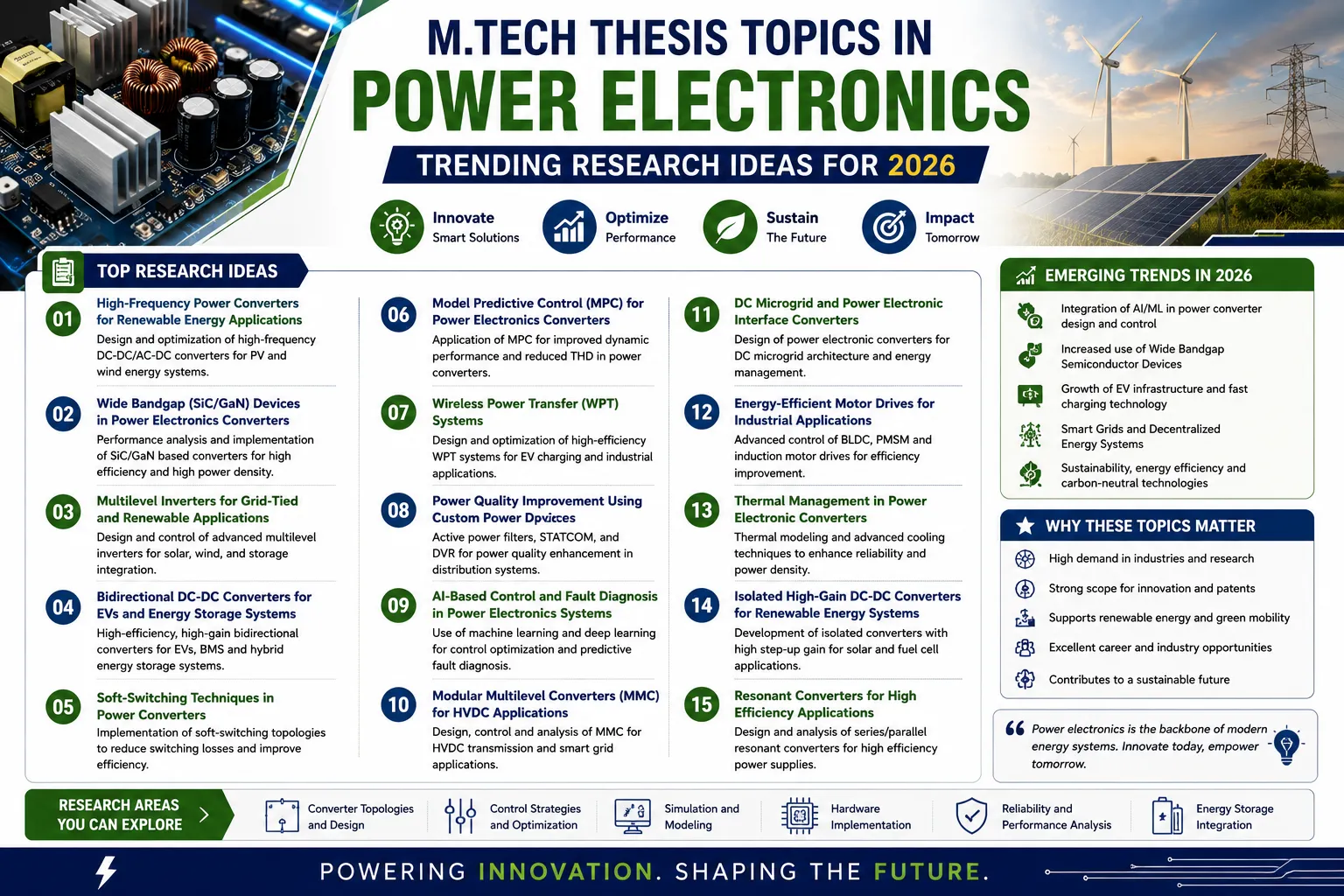
If you're an M.Tech Power Electronics student trying to lock down a thesis topic, you're working in a field going through its most significant material shift in decades — silicon is genuinely being displaced by wide bandgap semiconductors across major application areas, India's own PLI scheme is actively pulling GaN manufacturing toward domestic solar and EV supply chains, and the country's EV power electronics ecosystem still runs heavily import-dependent, creating real, checkable research opportunities. This guide walks through M.Tech thesis topics in power electronics trending research ideas for 2026, organized by category, along with a practical framework for choosing a topic that's both scientifically current and realistically achievable.
This guide is written specifically for first-time M.Tech thesis writers in India who want topics grounded in genuinely current industry direction — not generic power electronics themes that have already been studied hundreds of times over.
Why Power Electronics Research Has Real Momentum Right Now
Power electronics has always been a foundational engineering discipline, but the pace of genuine material and application-level change right now is unusual. Silicon carbide and gallium nitride devices are actively displacing traditional silicon across electric vehicle traction inverters, onboard chargers, and renewable energy systems — not as a future possibility, but as a documented, currently accelerating adoption curve. India's own semiconductor policy is directly shaping this shift domestically, and the country's EV power electronics supply chain remains genuinely import-dependent in ways that create real, current research questions rather than purely theoretical ones. Choosing among M.Tech thesis topics in power electronics trending research ideas for 2026 means anchoring your research to this real momentum, not to converter topologies or control schemes that were novel a decade ago but are now well-established, extensively studied ground.
ThesisLikho's research experts, who've guided over 10,000 scholars through thesis writing and topic selection, consistently see the same pattern: many first-time M.Tech scholars default to basic buck-boost converter or standard PWM control comparisons, when a topic anchored to wide bandgap device characterization, EV power electronics localization, or grid-integration challenges specific to India's renewable energy expansion offers far more room for genuine novelty and a stronger literature review.
The Wide Bandgap Semiconductor Shift
This is the single most important trend to understand before scoping a topic, since it's reshaping nearly every application area within power electronics simultaneously. Wide bandgap semiconductors — primarily silicon carbide and gallium nitride — operate at higher voltages, temperatures, and switching frequencies than traditional silicon devices, enabling smaller, lighter, more efficient power converters across the board. Silicon carbide is generally better suited to high-voltage applications above roughly 1200V, given its high thermal conductivity and voltage-blocking capability, making it the dominant choice for EV traction inverters and high-power industrial converters. Gallium nitride dominates lower-voltage, high-switching-frequency applications below roughly 650V, excelling in compact onboard chargers, DC-DC converters, and increasingly, data center and consumer power supplies.
The adoption curve here is genuinely documented and worth citing precisely in a thesis: silicon carbide's share of the EV traction inverter market grew from under 8% in 2021 to roughly 24% by 2026, with projections reaching 55% by 2030 — a concrete, checkable trajectory rather than a vague claim about "growing adoption." The broader industry is simultaneously transitioning EV electrical architectures from 400V to 800V systems, and wide bandgap devices are expanding well beyond their traditional core markets into AI data center power supplies, grid-scale energy storage, and even robotics applications — meaning "wide bandgap semiconductor research" genuinely spans far more than automotive applications alone.
India's Power Electronics Landscape: PLI Scheme and Import Dependency
Understanding where India's power electronics manufacturing and policy landscape currently stands gives real, concrete grounding for a thesis topic. India's Production-Linked Incentive scheme for semiconductor fabrication is specifically attracting gallium-nitride-on-silicon pilot production lines aimed at serving domestic solar inverter demand — a genuinely current, checkable policy detail directly relevant to a renewable-energy-linked power electronics thesis.
At the same time, India's EV power electronics supply chain remains structurally import-dependent in a way that creates real, current research opportunity rather than a settled, solved problem. Imported semiconductor devices — SiC MOSFETs, GaN transistors, gate drivers — along with specialized high-frequency magnetic components together represent an estimated 65 to 75 percent of module-level bill-of-materials value for Indian EV charger converter modules, with domestic value addition currently concentrated in assembly, testing, and system integration rather than semiconductor fabrication itself. This import-dependency gap is a genuinely researchable angle for an Indian M.Tech thesis — studying design strategies that reduce dependency on imported high-frequency magnetics, evaluating domestic manufacturing feasibility for specific converter subsystems, or benchmarking locally assembled converter performance against imported reference designs.
Trending Research Areas Shaping 2026 Theses
Beyond the wide bandgap shift specifically, several other areas are genuinely active right now. The industry describes a broader move toward what's being called "Power Electronics 2.0" — a shift from simple power conversion toward integrated, high-density systems handling significantly higher voltage ranges than older silicon-based approaches, driven by simultaneous demand from EVs, data centers, and renewable energy integration. Solid-state transformers and multilevel converter topologies remain an active research area for grid-scale power quality and renewable integration applications. Wireless power transfer for EV charging is maturing from a niche research area into a genuinely practical near-term application. And motor drive research increasingly focuses on integrating wide bandgap devices with advanced control algorithms specifically to extract the efficiency gains these newer semiconductor materials make possible, rather than simply swapping device types into legacy control schemes designed around silicon's different switching characteristics.
Topic Selection Framework
Run any shortlisted topic through these five checks before finalizing it. First, currency: is this genuinely tied to an active 2025–2026 research trend or industry direction, not something that peaked years ago? Second, specificity: can you state your exact converter topology, semiconductor technology, and application context in one sentence? Third, feasibility: do you have realistic access to the specific devices, simulation software, or lab equipment your topic requires within your M.Tech timeline? Fourth, originality: has this exact combination already been extensively studied, or is there a genuine, checkable gap? Fifth, supervisor and infrastructure fit: does your department have the specific power electronics lab equipment, wide bandgap device samples, or simulation licenses this topic actually needs?
A topic that fails the feasibility check — for instance, requiring specific SiC or GaN device samples your department's lab doesn't currently stock — is one of the most common reasons M.Tech power electronics thesis timelines run into difficulty, so confirm this before finalizing, not after.
What Is a Research Gap in Power Electronics Research?
A research gap in power electronics research typically falls into a few recognizable categories. A methodological gap exists where an established power electronics problem — say, converter thermal management or control loop design — hasn't yet been tested using a newer approach, like a specific machine learning-based control technique or a novel wide bandgap device topology. A contextual gap exists where a technique validated for one application (grid-scale renewable integration, for instance) hasn't been tested under meaningfully different conditions, such as the specific reliability and cost constraints of Indian rural electrification or two-wheeler EV applications. A performance gap exists where a known device or topology's real-world efficiency, thermal behavior, or reliability under specific Indian operating conditions (higher ambient temperatures, variable grid quality) hasn't been established. And a localization gap exists specifically around India's import-dependency challenge — testing whether domestically feasible design or manufacturing approaches can genuinely reduce reliance on imported components without sacrificing performance.
A quick search of recent IEEE Transactions on Power Electronics and related publications is the fastest way to confirm whether your intended gap is genuine — check how much directly relevant literature already exists for your specific device-plus-application combination, rather than relying on how novel the topic simply sounds.
100+ M.Tech Power Electronics Thesis Topics by Category
Wide Bandgap Semiconductor Devices and Converters
- Comparative thermal performance analysis of SiC versus GaN devices in high-frequency converters
- Gate driver design optimization for reduced switching losses in GaN-based converters
- Reliability assessment of SiC MOSFETs under high-temperature automotive operating conditions
- EMI mitigation strategies for high-frequency GaN-based power converter designs
- Comparative efficiency analysis of SiC versus silicon IGBT-based traction inverters
- Junction temperature estimation methodology for SiC power module health monitoring
- Parasitic inductance minimization techniques for GaN-based converter PCB layout
- Double-pulse test methodology for characterizing wide bandgap device switching behavior
- Ultra-wide bandgap gallium oxide device feasibility assessment for next-generation converters
- Packaging and thermal management innovation for high-power-density SiC modules
- Comparative cost-performance analysis of SiC versus GaN adoption across power ranges
- Aging and degradation modeling for SiC power devices under cyclic thermal stress
Electric Vehicle Power Electronics
- 800V traction inverter design optimization using SiC MOSFETs for extended EV range
- GaN-based onboard charger design for reduced size and improved charging efficiency
- Domestically feasible high-frequency magnetics design for reduced EV converter import dependency
- Bidirectional DC-DC converter design for vehicle-to-grid EV charging applications
- Thermal management system design for high-power-density EV traction inverters
- Fault-tolerant motor drive design for enhanced EV powertrain reliability
- Wireless power transfer system design for dynamic EV charging applications
- Comparative efficiency analysis of two-level versus multilevel EV traction inverters
- Battery management system integration with high-efficiency DC-DC converter design
- Cost-optimized power electronics design for two-wheeler and three-wheeler EV applications in India
Renewable Energy Power Conversion
- GaN-based solar inverter design for improved efficiency in distributed solar applications
- Maximum power point tracking algorithm optimization for partial shading conditions
- Grid-tied inverter control strategy design for power quality improvement in solar installations
- Multilevel converter topology design for utility-scale solar power plants
- Solid-state transformer design for renewable energy grid integration applications
- Hybrid solar-wind power conversion system design for rural electrification
- Islanding detection methodology for grid-connected solar inverter safety
- Reactive power compensation strategy design for renewable-heavy distribution grids
- Battery energy storage system converter design for grid frequency regulation support
- Low-voltage ride-through capability enhancement for grid-connected renewable inverters
Motor Drives and Control
- Model predictive control implementation for high-efficiency permanent magnet motor drives
- Sensorless control algorithm design for cost-reduced electric motor drive systems
- Direct torque control optimization for wide bandgap device-based motor drives
- Fault diagnosis methodology for early detection of motor drive component degradation
- Multi-motor drive coordination strategy for industrial automation applications
- Adaptive control algorithm design for variable-load electric motor drive efficiency
- Switched reluctance motor drive optimization for cost-sensitive EV applications
- AI-based control parameter tuning for improved motor drive dynamic performance
Grid Integration and Power Quality
- Active power filter design for harmonic mitigation in industrial power distribution systems
- Power quality improvement strategy for renewable-heavy microgrid applications
- Dynamic voltage restorer design for enhanced grid disturbance ride-through capability
- Unified power quality conditioner design for combined voltage and current compensation
- Smart inverter control strategy for distributed energy resource grid integration
- Grid-forming inverter control design for renewable-dominant microgrid stability
- Harmonic resonance mitigation strategy for high-penetration renewable distribution grids
- Flexible AC transmission system device optimization for improved grid stability
Multilevel Converters and Topologies
- Modular multilevel converter design for high-voltage direct current transmission applications
- Reduced switch-count multilevel inverter topology design for cost-sensitive applications
- Fault-tolerant multilevel converter design for enhanced industrial drive reliability
- Cascaded H-bridge multilevel inverter optimization for renewable energy applications
- Neutral point clamped converter design for medium-voltage industrial drive applications
- Hybrid multilevel converter topology design combining silicon and wide bandgap devices
- Capacitor voltage balancing strategy optimization for modular multilevel converters
Battery Charging and Energy Storage Systems
- Fast-charging converter design for reduced EV charging time using wide bandgap devices
- Battery state-of-charge estimation integration with intelligent charging converter control
- Modular battery charging system design for scalable EV charging infrastructure
- Second-life battery integration converter design for grid-scale energy storage
- Thermal-aware charging strategy design for extended battery lifespan
- Bidirectional battery charger design for combined charging and grid support functionality
- Wireless charging pad design optimization for stationary EV charging applications
Power Electronics for Data Centers and Computing
- GaN-based power supply unit design for improved data center energy efficiency
- 800VDC power distribution architecture design for next-generation data centers
- High-density power converter design for AI computing infrastructure power delivery
- Point-of-load converter optimization for reduced power distribution losses in servers
- Redundant power supply design for enhanced data center reliability
Control Algorithms and Digital Power Electronics
- Digital control implementation for improved dynamic response in DC-DC converters
- Machine learning-based fault prediction for power converter predictive maintenance
- Real-time embedded control system design for high-frequency power converter applications
- Adaptive digital control algorithm design for variable-load converter efficiency optimization
- FPGA-based control implementation for ultra-fast power converter switching applications
- Digital twin development for power converter performance prediction and optimization
Power Electronics for Industrial Applications
- Variable frequency drive optimization for industrial motor energy efficiency improvement
- Uninterruptible power supply design using wide bandgap devices for improved efficiency
- Induction heating power supply design optimization for industrial applications
- Welding power supply converter design for improved arc stability and efficiency
- Power factor correction converter design for industrial load harmonic reduction
Reliability, Testing, and Standards
- Accelerated life testing methodology development for wide bandgap power device reliability
- Standardized testing protocol development for SiC and GaN device qualification
- Condition monitoring system design for real-time power converter health assessment
- Failure mode analysis methodology for power electronic converter reliability improvement
- Electromagnetic compatibility testing and mitigation strategy for compact power converters
Emerging and Cross-Disciplinary Applications
- Power electronics design for electric aircraft propulsion system applications
- Power converter design for space-constrained electric marine propulsion systems
- Power electronics integration for robotics actuator drive efficiency improvement
- Power supply design optimization for high-power laser and plasma applications
- Power converter design for medical imaging equipment power quality requirements
Simulation, Modeling, and Design Automation
- AI-assisted power converter design optimization using machine learning algorithms
- Digital twin-based power converter design validation before physical prototyping
- Reduced-order thermal modeling methodology for rapid power converter design iteration
- Automated PCB layout optimization for minimized parasitic effects in high-frequency converters
- Co-simulation framework development for combined electrical and thermal converter analysis
Rural and Off-Grid Power Electronics
- Low-cost power converter design for off-grid rural electrification applications
- Solar-powered water pumping system power electronics design for agricultural applications
- Mini-grid power converter design for reliable rural microgrid operation
- Cost-optimized inverter design for decentralized rural solar home systems
Power Electronics Education and Design Methodology
- Comparative evaluation of open-source versus commercial power electronics simulation tools for academic use
- Hardware-in-the-loop testing methodology development for power electronics education
- Low-cost prototyping platform design for academic power electronics research
Simulation Tools You'll Actually Use
Most M.Tech power electronics theses rely heavily on simulation before any physical prototyping, so knowing your realistic options matters for topic feasibility. MATLAB/Simulink remains the dominant academic simulation environment, with dedicated power electronics and Simscape toolboxes supporting converter topology modeling, control algorithm design, and system-level simulation. PLECS is a widely used, purpose-built power electronics simulator known for fast simulation of switching converters specifically, often preferred for thermal and efficiency analysis given its optimized solver for power electronic circuits. PSIM is another common academic choice, particularly for motor drive and control-loop-focused research. For device-level characterization work involving wide bandgap semiconductors specifically, SPICE-based tools with manufacturer-provided SiC and GaN device models are commonly used alongside these system-level simulators.
For hardware validation, double-pulse test setups are the standard method for characterizing actual switching behavior of wide bandgap devices, and confirming your department has access to appropriate high-voltage, high-frequency test equipment before committing to a topic requiring genuine hardware characterization is an important feasibility check. Whichever combination you choose, confirm your department's specific software licenses and available device samples before finalizing a topic that depends heavily on them.
Two Realistic Case Studies
Case Study 1 — GaN-Based Onboard Charger for Reduced Import Dependency
Ananya, an M.Tech scholar, designed a GaN-based onboard EV charger specifically targeting a reduction in high-frequency magnetic component size and cost, directly addressing the documented import-dependency challenge in India's EV converter supply chain. Rather than working with the vague framing of "GaN converter design," she scoped her topic specifically around a defined onboard charger topology, evaluated for both electrical performance in PLECS simulation and a comparative bill-of-materials analysis against a typical imported reference design. This specificity meant her supervisor could clearly evaluate both technical and policy-relevant contribution at the proposal stage, and because PLECS was already available in her department, her simulation phase stayed on schedule.
Case Study 2 — Thermal Reliability of SiC Modules Under Indian Ambient Conditions
Rohit's thesis examined SiC power module thermal reliability specifically under the higher ambient temperature ranges typical of Indian summer conditions, anchoring his research gap around the observation that most existing SiC reliability literature is validated under temperate-climate testing conditions not directly representative of Indian deployment environments. Using accelerated thermal cycling tests combined with condition-monitoring sensor data, he was able to demonstrate measurable differences in degradation rate compared to published temperate-climate benchmarks, giving his results genuine practical relevance for Indian EV and solar inverter manufacturers.
Both cases illustrate the same principle: the strongest power electronics thesis topics combine a genuinely current device or technology trend with a specific, India-relevant application context — not a broad trend name alone.
Getting Supervisor Approval
Supervisors approve power electronics thesis topics faster when scholars demonstrate they've already confirmed feasibility, not just technical interest. Bring two or three shortlisted topics, each with your intended simulation software and device access already identified. Reference a specific, current development — India's PLI scheme for semiconductor localization, a specific SiC or GaN adoption trend, or a particular grid-integration challenge — to show real groundwork rather than a general trend name. Be upfront about the specific devices, lab equipment, or simulation licenses you'll need, and confirm your department can realistically support them. If your topic requires hardware prototyping and testing, have a realistic timeline for equipment access ready to discuss.
Common Mistakes When Choosing a Power Electronics Thesis Topic
- Choosing a topic that's already outdated, referencing pre-2023 converter topologies or silicon-only device comparisons that have since been significantly superseded by wide bandgap adoption
- Confusing a trend name with a researchable topic — "SiC power electronics" or "EV converters" alone aren't topics; a specific topology, device technology, and application context is
- Ignoring device or equipment feasibility, picking a topic requiring specific wide bandgap device samples or high-voltage test equipment your department doesn't have
- Overloading a topic with multiple unrelated technologies — trying to combine wireless power transfer, multilevel converters, and AI-based control all in one thesis
- Skipping the literature scan before finalizing, which often leads to a topic that turns out to already be extensively covered internationally
- Overlooking genuinely current India-specific angles (PLI scheme implications, import-dependency reduction, Indian climate reliability testing) that could meaningfully strengthen a topic's originality
Topic Validation Checklist
Before finalizing any topic, confirm the following:
- It's tied to a specific, current 2025–2026 power electronics trend or technology
- Your converter topology, device technology, and application context are stated clearly in one sentence
- Your required simulation software, device samples, or lab equipment are confirmed available
- A preliminary literature scan confirms a genuine gap rather than an oversaturated area
- Your research methodology matches your topic category and available infrastructure
- Your topic aligns with your supervisor's expertise or your department's available equipment
- You can write a clear two-to-three sentence problem statement directly from the topic as stated
How Long Does an M.Tech Thesis Take Using This Approach?
Topic finalization for an M.Tech power electronics thesis typically takes two to four weeks when approached systematically — shortlisting options, checking simulation tool and device feasibility, and confirming supervisor alignment. From there, most M.Tech power electronics theses take eight to twelve months from topic finalization to submission. Simulation-only topics generally move faster through the implementation phase, while topics requiring physical hardware prototyping and testing — particularly involving wide bandgap device characterization — typically take somewhat longer given the additional setup, calibration, and validation work involved.
If you need expert guidance with topic selection, research methodology, or thesis development, you can explore our M.Tech Thesis Assistance service, where our research experts help scholars validate topics, plan feasible methodologies, and stay on track from proposal to final submission.
FAQs
What is m.tech thesis topics in power electronics trending research ideas for 2026?
It refers to current, researchable M.Tech thesis topic ideas across power electronics sub-disciplines — including wide bandgap semiconductor devices, EV power electronics, renewable energy conversion, motor drives, and grid integration — that reflect genuinely active 2025–2026 industry developments, including India's specific semiconductor policy and supply chain realities.
Why does m.tech thesis topics in power electronics trending research ideas for 2026 matter?
Power electronics is undergoing a genuine material shift toward wide bandgap semiconductors, and India's own PLI scheme and import-dependency challenges create real, current research opportunities. A current, well-scoped topic gives your literature review genuine originality and makes supervisor approval faster
How does m.tech thesis topics in power electronics trending research ideas for 2026 affect a M.Tech thesis?
Your topic choice shapes your literature review's originality, your required device and equipment access, and your overall thesis timeline — a topic chosen without checking device or simulation tool feasibility often forces a mid-thesis pivot that costs significant time.
How long does it take to complete a M.Tech thesis using this approach?
Most M.Tech power electronics theses take eight to twelve months from topic finalization to submission, with topic selection itself typically taking two to four weeks when approached systematically using a feasibility-first framework.
Is professional help available for m.tech thesis topics in power electronics trending research ideas for 2026?
Yes. Many M.Tech scholars work with experienced research mentors to validate topic feasibility, confirm device and simulation tool access, and align their chosen topic with current power electronics trends — this is exactly the kind of support ThesisLikho's research experts provide.
Get M.Tech Thesis Guidance: If you're weighing a few power electronics topic ideas or want expert input on feasibility before committing months of work to one direction, ThesisLikho's research experts can help you validate your topic and plan your methodology. Get Your Guidance →
Email: support@thesislikho.com
Mobile no.: +91-9289068414 , +91-9643802216