
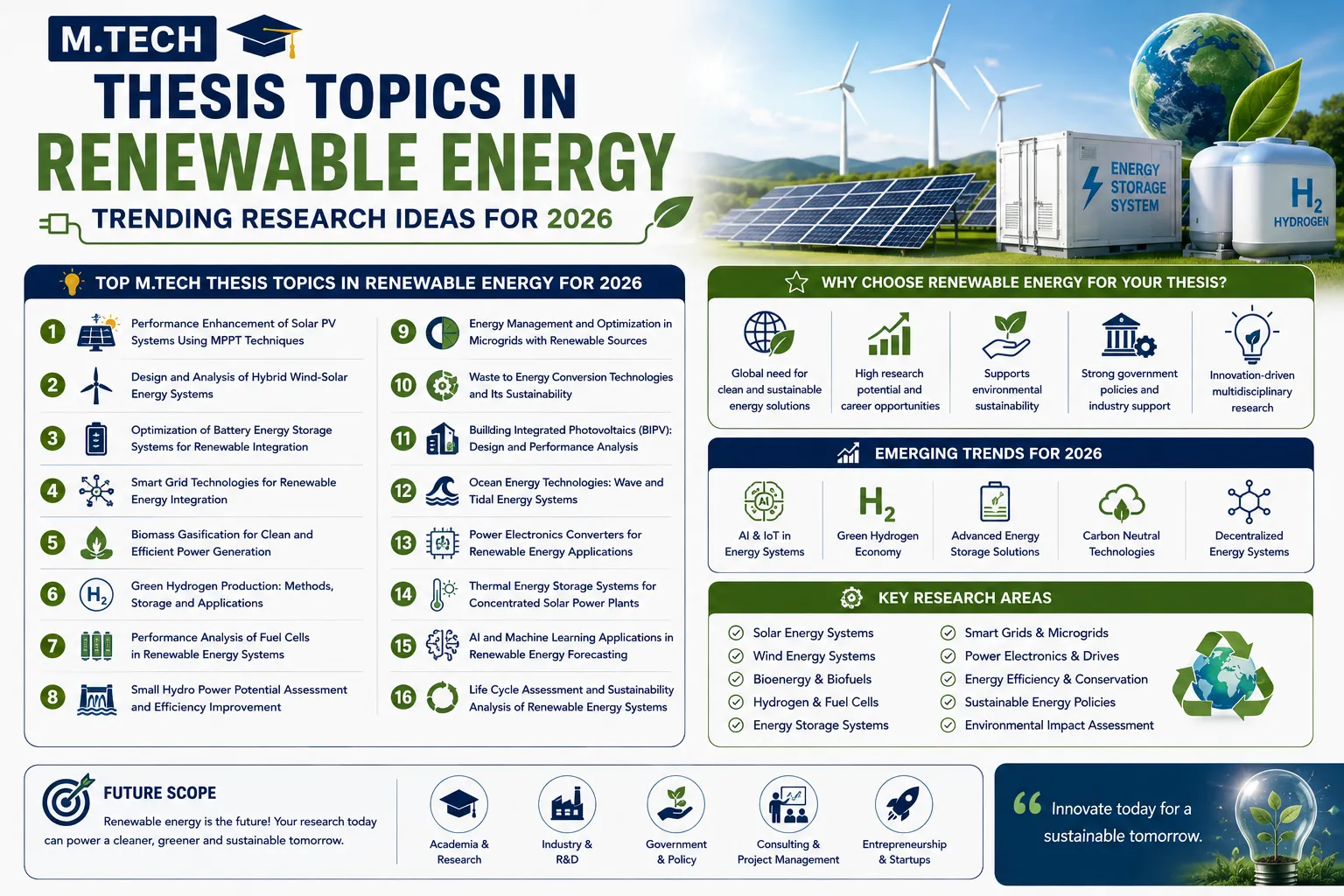
Renewable energy research in 2026 is genuinely moving fast — efficiency records are being broken, hydrogen is shifting from hype to real infrastructure, and AI is becoming core to how energy systems actually run. That pace makes for excellent thesis material, but it also means "renewable energy" itself is far too broad a topic — it spans solar materials science, wind turbine engineering, hydrogen chemistry, storage systems, and grid-level optimization as genuinely distinct research areas. This guide walks through trending, research-ready M.Tech thesis topics in renewable energy for 2026, along with how to narrow a broad theme into something your supervisor will actually approve.
The 2026 Landscape in Brief
Renewable energy in 2026 is shifting from pure capacity growth toward smarter system integration and resilience, driven by falling costs and record installations worldwide. Solar and wind remain the dominant generation sources, but energy storage — especially batteries and long-duration solutions — is now essential for balancing intermittent supply with grid flexibility. AI and automation are increasingly core to system operations, supporting demand forecasting, predictive maintenance, and optimized dispatch across microgrids and distributed energy resources.
Trending M.Tech Thesis Areas in Renewable Energy for 2026
1. Perovskite-Silicon Tandem Solar Cells
Perovskite-silicon tandem solar cells represent a major 2026 efficiency breakthrough: commercial tandem modules now reach 26.9% efficiency versus 21–23% for typical silicon modules alone. This is a genuinely current, well-evidenced research direction with strong quantifiable benchmarks to build a thesis around.
Narrowed thesis example: "Performance and Long-Term Stability Analysis of Perovskite-Silicon Tandem Solar Cells Under Simulated Indian Climatic Conditions"
2. Bifacial and Floating Photovoltaic Systems
Bifacial solar technology captured about 90% of the global cell market in 2024, with bifacial modules delivering 5–25% additional energy compared with monofacial panels. Floating photovoltaic (FPV) systems add a further benefit, reducing reservoir evaporation by up to 60% — combining energy generation with water conservation, a genuinely compelling angle for water-stressed regions.
Narrowed thesis example: "Techno-Economic Feasibility of Floating Photovoltaic Systems for Water Reservoirs in Water-Scarce Regions of India"
3. Green Hydrogen Production via Electrolysis
Global installed electrolyzer capacity for green hydrogen reached 1.4 GW at end-2023, nearly doubling year-on-year — though hydrogen still represents less than 1% of total energy supply, indicating a genuinely early-stage, high-growth research area with substantial room for original contribution. In 2026 specifically, more countries are launching national hydrogen strategies and electrolyzer costs are dropping due to scale and innovation.
Narrowed thesis example: "Efficiency Optimization of PEM Electrolyzers Powered by Variable Solar Input for Decentralized Green Hydrogen Production"
4. Green Hydrogen Integration With Solar Power
Green hydrogen integration with solar power specifically, aimed at making combined systems cost-competitive with fossil fuels, connects two of the field's most active current areas into a single, genuinely rich research direction.
Narrowed thesis example: "Design and Techno-Economic Analysis of a Solar-Powered Green Hydrogen Production System for Small-Scale Industrial Applications"
5. Microgrid Design and Energy Management
In 2024, 59 new microgrids totaling 241 MW were commissioned globally, with builds increasingly tied to resilience after extreme-weather events and mixed solar-storage-fuel-cell asset combinations. Techno-economic assessment and optimal design frameworks for microgrids represent an active, methodologically well-established M.Tech-level research approach.
Narrowed thesis example: "Techno-Economic Optimization of a Hybrid Solar-Battery-Hydrogen Microgrid for Rural Electrification in Off-Grid Indian Villages"
6. AI-Based Predictive Maintenance for Renewable Energy Systems
AI and automation are increasingly core to renewable energy system operations, supporting demand forecasting, predictive maintenance, and optimized dispatch across microgrids and distributed resources — a strong, currently trending intersection between renewable energy and computational methods.
Narrowed thesis example: "Machine Learning-Based Predictive Maintenance Model for Early Fault Detection in Grid-Connected Solar PV Inverters"
7. Lithium-Ion Battery Degradation in Solar Storage
Lithium-ion battery degradation in solar energy storage systems remains a specifically flagged, active research problem — batteries degrade over time, leading to reduced capacity, creating ongoing demand for research into degradation modeling and mitigation strategies.
Narrowed thesis example: "Modeling Capacity Degradation Patterns in Lithium-Ion Battery Storage Systems Under Variable Solar Charging Cycles"
8. Floating Offshore Wind Turbine Design
Floating offshore wind reached about 245 MW operational capacity across 15 projects in 7 countries as of late 2024, with diffuser-augmented ducted turbine designs showing about 7% higher peak power coefficient than earlier ducted units — illustrating specific, quantifiable areas of active wind energy engineering research.
Narrowed thesis example: "Computational Fluid Dynamics Analysis of a Diffuser-Augmented Ducted Wind Turbine Design for Improved Peak Power Coefficient"
9. Quantum Dot Solar Cells
Quantum dot solar cells, using nanocrystal quantum dots to capture more sunlight with optimized bandgap tuning, represent a specifically cited, more experimental advanced materials research direction — well suited to students interested in the materials science end of solar research rather than systems-level engineering.
Narrowed thesis example: "Bandgap Tuning of Quantum Dot Solar Cells for Enhanced Broad-Spectrum Light Absorption Efficiency"
10. Pumped-Storage Hydropower Optimization
Pumped-storage hydropower (PSH) remains the world's largest grid-scale storage technology with 200 GW installed globally — an established but still actively researched technology, particularly around efficiency improvements and hybrid configurations combining PSH with other renewable sources.
Narrowed thesis example: "Optimizing Hybrid Pumped-Storage Hydropower and Solar PV Configurations for Grid-Scale Renewable Energy Balancing"
11. Building-Integrated Photovoltaics (BIPV)
Increased use of Building-Integrated Photovoltaics — solar materials replacing conventional building surfaces — is a specifically flagged 2026 trend, reflecting how solar is integrating more seamlessly into urban infrastructure, offering a strong architecture-engineering crossover thesis direction.
Narrowed thesis example: "Performance Evaluation of Building-Integrated Photovoltaic Facades for Commercial Buildings in Tropical Indian Climates"
12. Smart Grid Integration for Distributed Renewable Resources
Grid integration is evolving with new controls and decentralization approaches specifically designed to manage the growing complexity of distributed renewable resources — a strong systems-level research direction for students interested in power systems engineering applied specifically to renewable integration challenges.
Narrowed thesis example: "A Smart Grid Control Strategy for Managing Voltage Fluctuations From High-Penetration Rooftop Solar in Urban Distribution Networks"
Feasibility vs. Novelty: How to Weigh the Options
Microgrid techno-economic optimization and AI-based predictive maintenance topics tend to be highly feasible for M.Tech timelines, since they're largely simulation-based and rely on established modeling software rather than specialized fabrication equipment. Perovskite solar cell research and quantum dot solar cell work offer higher novelty and stronger current relevance, but typically require specialized materials science lab access and fabrication equipment your department may or may not have. Green hydrogen and floating wind topics sit in between — genuinely current and high-growth, but requiring either specialized electrochemistry equipment or CFD simulation software depending on your specific angle.
Step-by-Step: How to Narrow a Trending Theme Into a Defensible Thesis Topic
- Pick a broad trending area from the list above that matches your genuine interest and department's strengths
- Specify the exact technology or configuration — not "solar cells" but "perovskite-silicon tandem cells"
- Name the specific method — simulation, CFD analysis, experimental fabrication, or techno-economic modeling
- Define your measurable outcome — efficiency percentage, degradation rate, cost per kWh, power coefficient
- State the specific application context — rural electrification, urban rooftop solar, industrial hydrogen production
- Check feasibility against your lab, software, and supervisor expertise before finalizing
- Verify the specific narrow niche isn't already comprehensively covered by very recent (2025–2026) publications
Practical Checklist: Is Your Renewable Energy Thesis Topic Ready?
- Topic specifies an exact technology or system configuration, not a broad category
- A specific method (simulation, CFD, experimental, techno-economic modeling) is named
- A measurable performance metric is defined
- Application context is stated explicitly
- Feasibility matches available lab equipment, software, and time
- Supervisor's expertise aligns with the chosen area
- Recent literature (2025–2026) has been checked to confirm the specific niche isn't already saturated
Two Practical Scenarios
Scenario 1 — Narrowing an Overly Broad Hydrogen Topic
A student initially proposed "Green Hydrogen for Clean Energy" — far too broad to defend as a single M.Tech thesis. After applying the narrowing framework, the topic became "Design and Techno-Economic Analysis of a Solar-Powered Green Hydrogen Production System for Small-Scale Industrial Applications," specifying the exact system configuration, methodology (techno-economic analysis), and application context — resulting in supervisor approval on the first proposal.
Scenario 2 — Choosing Between Two Feasible Directions
A student interested in both perovskite solar cell fabrication and microgrid design used the feasibility comparison to decide: since their department had strong access to simulation software (MATLAB, HOMER) but no specialized thin-film fabrication lab, they chose the microgrid techno-economic optimization direction over the perovskite fabrication direction, recognizing it matched their available resources more closely while still offering a defensible, genuinely current contribution.
Common Mistakes M.Tech Students Make When Choosing a Topic
- Choosing a trending buzzword topic (e.g., "green hydrogen") without narrowing it to a specific system, method, and measurable outcome.
- Ignoring feasibility — selecting a topic that requires fabrication or testing equipment the department doesn't have.
- Not checking recent literature, resulting in a topic already comprehensively addressed in 2025–2026 publications.
- Underestimating simulation software learning curves for tools like HOMER, MATLAB/Simulink, or CFD packages before committing to a heavily simulation-based topic.
- Choosing based on trend popularity alone, rather than genuine interest and department fit, since the topic requires sustained engagement for a year or more.
Frequently Asked Questions
What are trending M.Tech thesis topics in renewable energy for 2026? Leading areas include perovskite-silicon tandem solar cells, bifacial and floating photovoltaics, green hydrogen production and solar integration, microgrid design, AI-based predictive maintenance, lithium-ion battery degradation, floating offshore wind, quantum dot solar cells, pumped-storage hydropower optimization, building-integrated photovoltaics, and smart grid integration.
Why does topic selection matter for an M.Tech thesis in renewable energy?
Renewable energy spans genuinely distinct sub-fields — materials science, power systems, chemical engineering, and computational modeling — and a topic that isn't narrowed to a specific technology, method, and measurable outcome is difficult to complete within a standard M.Tech timeline.
How does trending research area selection affect a thesis's outcomes?
Aligning with an active 2026 research area increases publication potential and industry relevance, but only if the specific niche within that area is narrowed enough to remain original and matches your department's actual lab or simulation capabilities.
How long does it take to complete an M.Tech thesis using this approach?
Simulation-based topics (microgrid optimization, techno-economic modeling) often proceed faster than topics requiring specialized fabrication or extensive experimental testing, so factoring feasibility into topic choice directly affects completion time.
Is professional help available for M.Tech thesis topics in renewable energy?
Yes. ThesisLikho's PhD-qualified experts have guided 10,000+ scholars through topic selection, research methodology, and complete M.Tech thesis writing assistance tailored to renewable energy and other engineering disciplines.
Get Expert Guidance on Your M.Tech Renewable Energy Thesis Topic
Choosing between a trending research area and a feasible, defensible thesis topic takes careful narrowing — matching your interests, your department's resources, and current literature gaps. If you'd like expert input on refining your renewable energy thesis topic or planning your research approach, ThesisLikho's PhD-qualified team offers topic selection support, research methodology guidance, and complete M.Tech thesis writing assistance. If you need expert guidance with your thesis topic, research design, or overall project structure, you can explore our M.Tech Thesis Assistance service.
Get M.Tech Thesis Guidance → https://thesislikho.com/writing-services/thesis-assistance-mtech
Email: support@thesislikho.com
Mobile No.: +91-9289068414 , +91-9643802216