
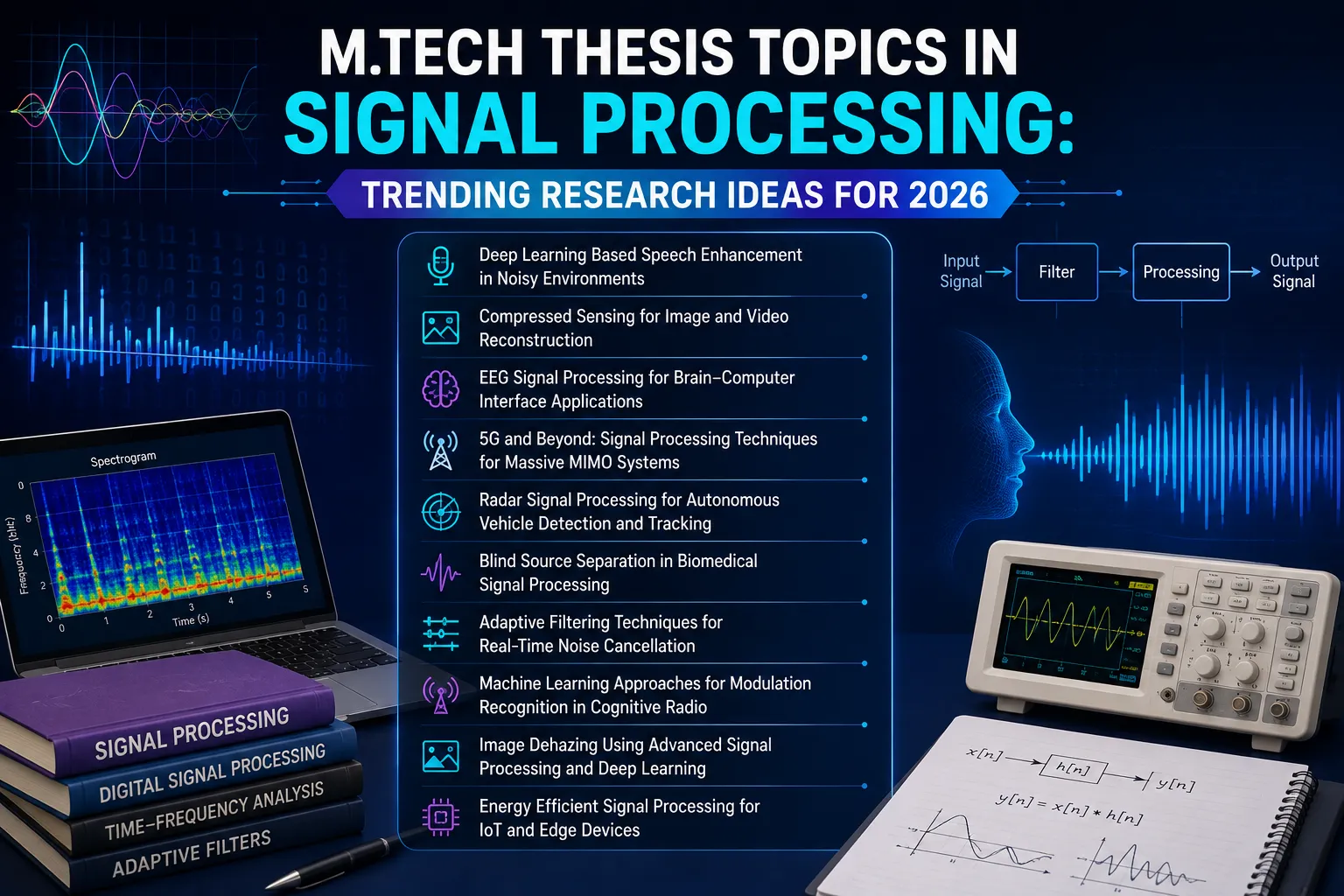
Signal processing might be the single broadest thesis area in electronics engineering — it spans everything from classical filter design to deep learning-based medical image reconstruction, which is exactly why so many scholars searching for M.Tech thesis topics in signal processing trending research ideas for 2026 end up overwhelmed rather than helped. The field is too wide to shortlist by browsing; it needs a filter.
This guide is built the way an experienced signal processing research supervisor would walk you through it — a working framework, not a recycled list. We'll cover categorized topic ideas across the major signal processing subfields, the trends genuinely shaping 2026 research (deep learning-driven biomedical and speech processing chief among them), a feasibility checklist tuned to dataset and tool realities, methodology guidance, and the mistakes that quietly derail a first-time thesis writer.
At ThesisLikho, our PhD-qualified mentors have guided more than 10,000 scholars through topic selection, methodology design, and thesis writing across M.Tech, MBA, and PhD programmes, including signal processing and allied ECE research. What follows draws on that mentoring experience, grounded in current IEEE-indexed research and 2025–2026 developments in deep learning-driven biomedical, speech, and image signal processing.
1. Why Signal Processing Topics Need a Sharper Filter Than Most Fields
Most engineering thesis domains have a natural boundary — wireless communication is about wireless systems, VLSI is about chip design. Signal processing doesn't have that boundary. It touches speech, images, medical signals, radar, audio, sensor networks, and increasingly, nearly every deep learning application built on structured data. That breadth is genuinely exciting, but it also means "I want to do a thesis in signal processing" is roughly as narrow as "I want to do a thesis in engineering."
The second trap specific to this field is data. Unlike topics in RF design or VLSI, where simulation tools largely define feasibility, signal processing theses — especially deep learning-based ones — live or die on dataset access and quality. A fascinating idea involving a specialized medical signal type is only as feasible as your ability to actually get your hands on a usable, appropriately licensed dataset for it. Getting both of these constraints right — subfield focus and data access — before committing to a topic is what separates a thesis that gets built from one that stalls at the literature review stage.
2. What an M.Tech Signal Processing Thesis Actually Requires
M.Tech programmes in India, operating under AICTE's technical education framework, typically require a two-semester (sometimes one-year) dissertation involving a literature survey, a proposed algorithm or system design, implementation and testing (often using MATLAB, Python, or a combination), performance comparison against existing methods using standard evaluation metrics, and a conclusion with future scope. A signal processing thesis specifically is expected to demonstrate a genuine technical contribution — a novel algorithm, an improved architecture, or a rigorous comparative study — validated against a clearly stated benchmark dataset and metric.
Citation discipline in this field typically follows IEEE reference style, since the overwhelming majority of target publication venues — IEEE Transactions on Signal Processing, IEEE Signal Processing Letters, ICASSP proceedings — use IEEE's citation format. Building this consistency in from your first literature review draft saves considerable reformatting time later, and following established academic writing guidance on structuring a methods section (Source: Purdue OWL) helps ensure your methodology chapter reads as rigorous and replicable rather than just a list of steps.
3. M.Tech Thesis Topics in Signal Processing for 2026
Treat the list below as starting directions, not final titles — narrow each to a specific dataset, signal type, or performance metric before taking it to your guide.
A. Biomedical Signal Processing
- Deep learning-based ECG arrhythmia classification using a specific public dataset
- EEG-based seizure detection using convolutional-recurrent hybrid architectures
- Explainable AI (Grad-CAM/SHAP) integration for interpretable ECG classification models
- Multimodal fusion of ECG and PPG signals for continuous cardiac health monitoring
- Deep learning-based sleep stage classification using single-channel EEG
- Denoising autoencoder design for motion-artifact removal in wearable PPG signals
- Transfer learning approaches for EMG-based gesture recognition with limited training data
- Contactless vital sign estimation from radar or camera-based signals
- Deep learning-based fetal ECG extraction from abdominal signal recordings
- Federated learning framework for privacy-preserving biomedical signal classification
- Anomaly detection in continuous glucose monitoring signal streams
- Multimodal biomedical signal-image fusion for automated diagnostic support
B. Medical Image Processing
- Deep learning-based segmentation of tumors in MRI/CT scans using a specific architecture
- Explainable AI framework design for interpretable medical image classification
- Generative adversarial network-based data augmentation for limited medical imaging datasets
- Multimodal fusion of imaging features with genomic or clinical data for diagnostic prediction
- Self-supervised learning approaches for medical image representation with limited labeled data
- Deep learning-based automated lesion detection in a specific imaging modality
- Image super-resolution techniques for low-dose CT scan enhancement
- Vision transformer-based classification for histopathology image analysis
- Federated learning for privacy-preserving multi-institutional medical image analysis
- Deep learning-based image registration for multimodal medical image alignment
- Uncertainty quantification methods for deep learning-based medical image diagnosis
- Domain adaptation techniques for cross-scanner medical image analysis generalization
C. Speech & Audio Signal Processing
- Deep learning-based speech enhancement for noisy real-world environments
- Speaker verification system design using self-supervised speech representations
- Speech emotion recognition using multimodal (audio-text) fusion approaches
- Low-resource Indian language speech recognition using transfer learning
- Voice conversion techniques for assistive communication applications
- Speech-based early detection of neurological disorders (Parkinson's, dementia) using acoustic features
- Acoustic scene classification for smart environment sensing applications
- Deep learning-based audio source separation for multi-speaker environments
- Wake-word detection system design for low-power edge devices
- Speech synthesis quality enhancement using diffusion-based generative models
D. Deep Learning Architectures for Signal Processing
- Comparative performance analysis of CNN versus transformer architectures for time-series signal classification
- Self-supervised pretraining strategies for limited-label signal processing datasets
- Lightweight neural network design for real-time signal processing on edge devices
- Explainable AI technique comparison for signal classification model interpretability
- Few-shot learning approaches for signal classification with scarce labeled data
- Graph neural network applications for structured multichannel signal analysis
- Attention mechanism design for improved feature extraction in time-series signals
- Knowledge distillation techniques for compressing large signal processing models
- Continual learning frameworks for signal classification models under distribution shift
- Foundation model adaptation strategies for domain-specific signal processing tasks
E. Image & Video Processing
- Deep learning-based image denoising for low-light photography applications
- Video super-resolution techniques for surveillance footage enhancement
- Real-time object detection optimization for resource-constrained edge devices
- Image forgery detection using deep learning-based forensic analysis
- Semantic segmentation techniques for autonomous vehicle perception systems
- Deep learning-based image dehazing for outdoor surveillance applications
- Video anomaly detection for smart surveillance system design
- Multi-object tracking algorithm design for crowded scene analysis
- Generative model-based image inpainting for occluded object reconstruction
- Cross-domain image style transfer techniques for data augmentation applications
F. Radar & Sensor Signal Processing
- Deep learning-based target classification for FMCW radar systems
- Human activity recognition using micro-Doppler radar signal analysis
- Radar-based gesture recognition system design for touchless interfaces
- Sensor fusion techniques combining radar and camera data for object detection
- Ground-penetrating radar signal processing for subsurface anomaly detection
- Synthetic aperture radar image classification using deep learning architectures
- Vital sign extraction from radar signals using deep learning-based denoising
- Sonar signal processing for underwater object classification
- Seismic signal processing for automated event detection and classification
G. Wireless & Communication Signal Processing
- Deep learning-based channel estimation for time-varying wireless channels
- Signal modulation classification using deep learning for cognitive radio applications
- Compressed sensing-based sparse signal recovery for wireless sensor networks
- Deep learning-based interference cancellation for multi-user communication systems
- Spectrum sensing algorithm design using deep learning for dynamic spectrum access
- Signal processing techniques for underwater acoustic communication systems
- Deep learning-based beamforming signal processing for smart antenna systems
- Adaptive filtering techniques for echo cancellation in real-time communication systems
- Blind source separation techniques for multi-antenna signal reception
H. Sparse Signal Processing, Compressed Sensing & Signal Reconstruction
- Deep learning-based compressed sensing MRI reconstruction techniques
- Sparse recovery algorithm design for compressive sensing applications
- Generative model-based inverse problem solving for signal reconstruction
- Dictionary learning techniques for sparse representation of biomedical signals
- Phase retrieval algorithm design for coherent imaging applications
- Low-rank matrix completion techniques for missing signal data recovery
- Compressed sensing-based hyperspectral image reconstruction
- Deep unfolding network design for iterative signal reconstruction algorithms
- Sparse signal recovery under non-Gaussian noise conditions
I. Explainability, Robustness & Trustworthy Signal Processing
- Adversarial robustness analysis for deep learning-based signal classification models
- Explainable AI framework design for trustworthy biomedical signal diagnosis
- Uncertainty quantification techniques for safety-critical signal processing applications
- Bias detection and mitigation in deep learning-based medical signal classification
- Robustness evaluation of signal classification models under domain shift
- Interpretable feature extraction techniques for clinical decision support systems
- Privacy-preserving signal processing using differential privacy techniques
- Model calibration techniques for reliable uncertainty estimates in signal classification
- Adversarial attack detection for signal processing-based security applications
J. Emerging & Cross-Disciplinary Signal Processing Applications
- Federated learning framework design for distributed signal processing across edge devices
- Self-supervised and unsupervised learning techniques for label-scarce signal datasets
- Multimodal foundation model adaptation for combined signal-text-image analysis
- Reinforcement learning applications for adaptive signal processing parameter tuning
- Signal processing techniques for structural health monitoring using vibration data
- Deep learning-based fault detection using vibration and acoustic sensor signals
- Environmental sound classification for smart city noise monitoring applications
- EEG-based brain-computer interface signal processing for assistive technology
- Signal processing techniques for driver drowsiness detection using physiological signals
- Quantum-inspired signal processing algorithm design for specific classical applications
- Signal processing for non-invasive blood glucose estimation using optical sensors
- Multimodal signal processing framework for early Parkinson's disease screening
4. Latest Signal Processing Research Trends Shaping 2026
A few cross-cutting shifts are worth understanding before committing to a domain:
- Deep learning has become the default backbone across nearly all applied signal processing subfields, with convolutional, recurrent, generative, reinforcement, autoencoder, and transfer-learning approaches now mapped to specific tasks like segmentation, classification, reconstruction, and anomaly detection across biomedical image and signal processing specifically (Source: Computers, Materials & Continua, "Deep Learning in Biomedical Image and Signal Processing: A Survey," 2025).
- Multimodal fusion is a major, heavily active research direction. Combining imaging features with genomic profiles and clinical records, or audio with text, or radar with camera data, is producing more robust, context-aware predictions than single-modality approaches — and represents a genuinely less-saturated angle relative to single-signal-type studies.
- Explainability and trustworthiness have moved from a nice-to-have to a research requirement, particularly for biomedical and safety-critical applications — post-hoc techniques (Grad-CAM, SHAP, LIME) alongside emerging intrinsically interpretable model designs are actively being developed to support clinical and safety-critical adoption of deep learning-based signal processing.
- 2026 conference programming reflects a clear shift toward foundation models, self-supervised/few-shot learning, and explainable/robust/trustworthy AI as core signal processing research themes, alongside continued classical topics like signal-centric reinforcement learning and next-generation communications signal processing.
- Speech and biomedical signal analysis are converging — acoustic and speech-based screening for neurological conditions (Parkinson's, dementia) is an active, clinically motivated research direction combining classical speech signal processing with modern deep learning, and represents a genuinely emerging, less-saturated niche relative to generic speech recognition topics.
- Federated and privacy-preserving learning is gaining real traction for biomedical signal applications specifically, since biomedical data's sensitivity makes centralized training genuinely problematic — this is both a timely research area and a practically feasible one for M.Tech scholars who can use publicly available datasets to simulate federated settings without needing actual multi-institutional data access.
5. A Topic Selection Framework You Can Actually Use
Step 1 — Interest-to-Dataset Match. List two or three signal processing themes you're genuinely curious about, then immediately check whether a usable, appropriately licensed public dataset exists for that specific signal type and application. Biomedical, speech, and image processing subfields have many well-established public datasets (PhysioNet for biomedical signals, LibriSpeech for speech, various public medical imaging archives) — verify your specific topic maps to one of these before committing.
Step 2 — Gap Verification. Search IEEE Xplore, Google Scholar, and recent conference proceedings for the last 2–3 years in your shortlisted area. Signal processing research moves fast enough that a "gap" from even three years ago has often been closed by newer transformer- or foundation-model-based approaches — narrow by specific dataset, signal type, or performance metric if your search returns dozens of similar studies.
Step 3 — Compute Reality Check. Confirm your available computational resources (GPU access, cloud credits, or department computing clusters) match your intended model complexity — a large transformer-based architecture trained from scratch is rarely feasible on limited university hardware within an M.Tech timeline; transfer learning or fine-tuning pretrained models is usually the more realistic path.
Step 4 — Publication Pathway. Check whether your intended contribution (an architecture modification, a novel fusion approach, a specific performance improvement) is publishable as an IEEE conference paper or in a signal-processing-focused journal — this is a useful sanity check on whether your scope is specific enough to produce a genuine, defensible contribution.
6. How to Identify a Genuine Research Gap
A defensible research gap in signal processing satisfies three conditions:
- It's explicitly flagged in recent literature — a stated limitation, an untested dataset or population, or a performance trade-off (accuracy vs. interpretability, accuracy vs. computational cost) not yet adequately addressed together.
- It has measurable performance relevance — something you can quantify against a standard metric (accuracy, F1-score, SNR improvement, PSNR/SSIM for images) rather than a purely conceptual claim.
- It's answerable with datasets and computational resources available to you within your programme's timeline.
A practical technique: pull 12–15 recent IEEE papers in your shortlisted area, note their stated future work and limitations in a spreadsheet, and look for the two or three that recur — an untested population or dataset, an unaddressed interpretability gap, or a missing comparative baseline against a newer architecture. That recurring gap is usually your strongest, most defensible starting point. For a deeper walkthrough, see [Link: What Is a Research Gap and How to Identify One for Your Thesis].
7. Topic Feasibility Checklist
Before presenting any topic to your guide, verify each of these:
☐ A usable, appropriately licensed public dataset confirmed available for your specific signal type and application
☐ Computational resources (GPU access, cloud credits, or department cluster) confirmed sufficient for your intended model complexity
☐ Topic narrowed to a specific dataset, signal type, and performance metric — not a broad survey
☐ At least 10–15 recent (2023–2026) IEEE-indexed papers identified in the exact area
☐ A clear comparison baseline identified (an existing architecture or method to benchmark against)
☐ Guide has relevant expertise or interest in the chosen signal processing domain
☐ Ethical/data-use considerations checked, particularly for any biomedical or personally identifiable signal data
☐ Topic stated in one sentence with clear performance metrics to be measured
8. Choosing the Right Tools, Datasets, and Methodology
- Python with deep learning frameworks (PyTorch, TensorFlow) — the dominant toolkit for modern signal processing research, particularly for anything involving deep learning architectures, given the extensive library support and pretrained model availability for transfer learning.
- MATLAB with Signal Processing and Deep Learning Toolboxes — still widely used in Indian academic settings for classical signal processing tasks (filtering, spectral analysis, feature extraction) and remains a strong choice for scholars more comfortable with a menu-driven, well-documented environment.
- Public benchmark datasets — PhysioNet for a wide range of biomedical signals (ECG, EEG, PPG); LibriSpeech and Common Voice for speech; various public medical imaging archives for CT/MRI work; established radar and audio datasets for their respective subfields. Anchoring your thesis to a recognized public dataset strengthens both feasibility and your ability to benchmark against prior published results directly.
- Transfer learning and fine-tuning — given realistic M.Tech-level computational constraints, adapting a pretrained model (rather than training a large architecture from scratch) is usually the more feasible and still genuinely novel-enough approach, provided your specific application, fine-tuning strategy, or fusion approach is the actual contribution.
- Explainability toolkits (Grad-CAM, SHAP, LIME implementations, widely available as open-source libraries) — increasingly worth incorporating into any classification-focused thesis, both because it strengthens the work's real-world relevance and because it directly addresses a trend examiners and reviewers are now actively looking for.
Whichever tools and datasets you choose, confirm data licensing and any required ethical clearance early — even publicly available biomedical datasets sometimes carry usage restrictions or require a data use agreement, and this is a step scholars commonly discover too late.
If your topic needs help translating from a research idea into a structured, well-benchmarked thesis document, our M.Tech Thesis Assistance service supports scholars through exactly this stage.
9. Supervisor Approval Tips
- Bring two to three narrowed options, each with a specific dataset, signal type, and metric, rather than a broad theme like "deep learning for signal processing."
- Show your dataset access and computational resources are already confirmed — guides approve topics faster when the "how" is clearly thought through, not just the "what."
- Reference recent (2024–2026) IEEE literature in your pitch — it signals you're working at the current edge of the field, particularly around multimodal fusion and explainability, rather than recycling an older topic list.
- Prepare a one-page concept note: background, gap, proposed architecture/approach, dataset, target performance metrics, and timeline — before your guide meeting.
- Anticipate the "what's novel here" question. Be ready to state, in one sentence, what specifically distinguishes your approach from the closest prior paper you found.
10. Common Mistakes First-Time M.Tech Thesis Writers Make
- Choosing a topic based on trend-chasing ("I want to do something with deep learning and signals") rather than a scoped problem with a specific dataset and metric.
- Underestimating dataset access and licensing — always confirm data availability and any usage restrictions before finalizing scope.
- Copying topic titles verbatim from online lists without checking whether the exact dataset-and-architecture combination has already been extensively studied.
- Skipping the comparison baseline — a thesis proposing a "new" approach without a clear existing method to benchmark accuracy, F1-score, or other relevant metrics against is hard to evaluate and hard to publish from.
- Overestimating available compute — planning a large architecture trained from scratch without confirming GPU access, then discovering months in that training is infeasible within the available hardware.
- Treating the literature review as a summary rather than a synthesis — a strong review surfaces gaps and contradictions, not just a list of paper summaries.
- Ignoring the "why 2026" justification — a strong signal processing thesis explains why the specific gap matters now, tied to real multimodal, explainability, or foundation-model developments, not just that the general topic area exists.
11. Publication Opportunities
M.Tech theses in signal processing are commonly adapted into IEEE conference papers, with student-friendly venues within India — regional IEEE Signal Processing Society events, university-hosted symposiums, and national conferences like NCC — as realistic first targets, with journals like IEEE Signal Processing Letters or specialized biomedical/speech signal processing journals as a stretch goal for particularly strong, novel contributions. Reading widely on Google Scholar for recent survey articles in your specific subfield, and following established academic writing guidance for structuring a clear, replicable methods section (Source: Purdue OWL), meaningfully improves both your thesis quality and its publication readiness. Structuring your results and comparative analysis chapter with publication-ready figures and a clearly stated contribution from the outset makes this conversion considerably easier later.
12. Two Realistic Case Studies
Case Study 1 — From "Deep Learning for Signals" to a Defensible Thesis
An M.Tech scholar at a state technical university began with the idea "deep learning applications in signal processing" — a topic so broad it drew immediate pushback from the department committee. After a structured gap-verification exercise against recent IEEE literature, the scholar narrowed the scope to explainable AI integration for interpretable ECG arrhythmia classification using a specific PhysioNet dataset, combining a CNN-based classifier with Grad-CAM-based interpretability analysis and a clear comparison baseline against existing black-box classification approaches. The narrowed scope — one dataset, one specific improvement (interpretability), one clear baseline — is what got the proposal approved on the second attempt.
Case Study 2 — Building a Thesis Around Realistic Compute Constraints
A first-time M.Tech thesis writer without access to high-end GPU infrastructure initially planned a large transformer architecture trained from scratch for speech emotion recognition. Recognizing that training such a model wasn't realistic on the department's available hardware, the scholar redesigned the project around fine-tuning a pretrained self-supervised speech representation model for emotion recognition on a specific low-resource Indian language dataset, using transfer learning rather than training from scratch. This choice matched the topic directly to available compute while still producing a genuinely novel, publishable contribution — the low-resource language application itself being the distinctive gap — and avoided months of potential delay chasing infeasible training requirements.
If your topic idea resembles either of these scenarios, our M.Tech Thesis Assistance service can help you pressure-test scope, confirm dataset and compute feasibility, and prepare your synopsis presentation.
FAQs
What is "M.Tech thesis topics in signal processing trending research ideas for 2026"?
It refers to identifying current, feasible, and technically defensible research topics within signal processing for the 2026 M.Tech research cycle — spanning biomedical and medical image processing, speech and audio processing, deep learning architectures for signals, radar and sensor processing, and related domains.
Why does M.Tech thesis topics in signal processing trending research ideas for 2026 matter?
Because topic selection determines whether your thesis is genuinely feasible given your dataset access and computational resources, whether your gap is current given how fast deep learning-driven signal processing moves, and how defensible your contribution will be at evaluation and, ideally, publication.
How does this approach affect an M.Tech thesis in practice?
Scholars who confirm dataset and compute feasibility early, and verify their gap against recent (2024–2026) literature, typically experience fewer committee rejections, smoother implementation timelines, and a clearer path to a publishable contribution.
How long does it take to complete an M.Tech thesis using this approach?
Most Indian M.Tech dissertations run one to two semesters depending on the university's structure, following topic approval, literature review, implementation, and thesis writing. A well-scoped, dataset-matched topic meaningfully reduces the time typically lost to data access or compute-related delays.
Is professional help available for M.Tech thesis topics in signal processing trending research ideas for 2026?
Yes — mentorship support covering topic selection, methodology and dataset planning, and thesis structuring is available through services such as M.Tech Thesis Assistance.
What are some examples of strong M.Tech signal processing thesis topics for 2026?
Examples include explainable AI-integrated ECG classification, multimodal biomedical signal-image fusion for diagnostic support, transfer learning-based low-resource speech emotion recognition, and federated learning frameworks for privacy-preserving biomedical signal classification — provided each is scoped to a specific dataset, architecture, and comparison baseline.
Ready to move from a list of ideas to an approved, dataset-ready thesis proposal? Get M.Tech Thesis Guidance from ThesisLikho's PhD-qualified mentors.