
Introduction
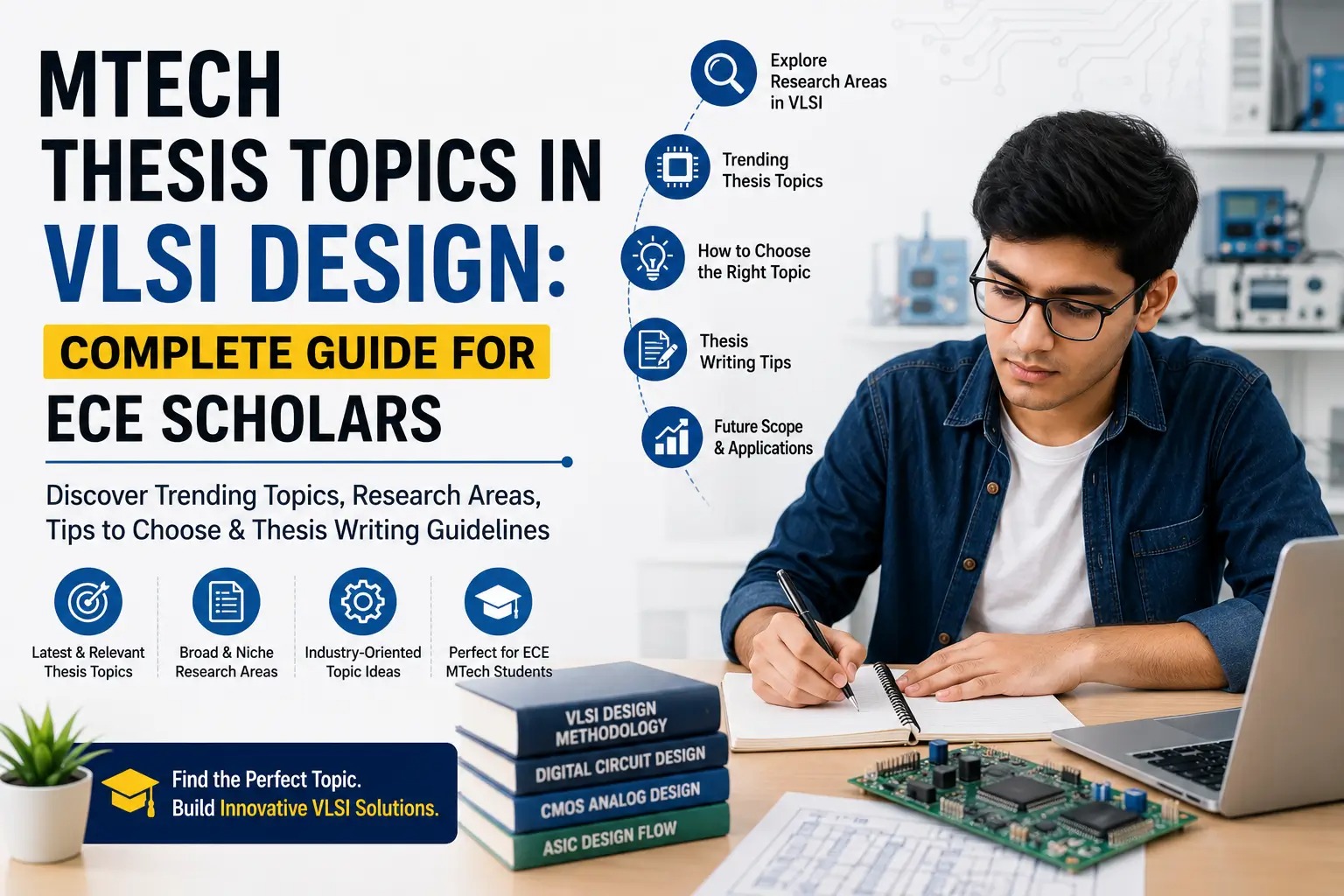
For ECE (Electronics and Communication Engineering) scholars in India, choosing a thesis topic in VLSI (Very Large Scale Integration) Design is one of the most critical decisions during an MTech program. VLSI is at the heart of modern electronics, powering everything from smartphones and IoT devices to AI accelerators and automotive systems. A well‑chosen thesis topic not only strengthens your academic profile but also opens doors to careers in semiconductor industries, research labs, and academia.
1. Why VLSI Design Matters
- Core of Electronics: VLSI integrates millions of transistors into a single chip.
- Industry Demand: Companies like Intel, Qualcomm, Samsung, and Indian firms such as Wipro and Tata Elxsi actively recruit VLSI engineers.
- Research Opportunities: VLSI intersects with AI, IoT, 5G, and automotive electronics.
- National Importance: India’s semiconductor mission emphasizes indigenous chip design and manufacturing.
2. Factors to Consider Before Choosing a Thesis Topic
- Relevance: Align with current industry and academic trends.
- Feasibility: Ensure availability of tools (Cadence, Synopsys, Mentor Graphics).
- Supervisor Expertise: Choose topics where guidance is available.
- Career Goals: Select topics that match your desired career path (industry vs. academia).
- Resources: Check for lab facilities, FPGA kits, or simulation software.
3. Broad Areas in VLSI for Thesis
a) Low Power VLSI Design
Focus on reducing power consumption in chips, crucial for mobile and IoT devices.
b) FPGA and Reconfigurable Architectures
Designing flexible hardware systems using FPGAs for prototyping and real‑time applications.
c) VLSI for AI and Machine Learning
Hardware accelerators for deep learning, neuromorphic computing, and edge AI.
d) Analog and Mixed Signal Design
Design of ADCs, DACs, PLLs, and RF circuits for communication systems.
e) Testing and Verification
Developing efficient algorithms for fault detection, DFT (Design for Testability), and verification.
f) Emerging Technologies
Quantum computing circuits, 3D ICs, and nanotechnology‑based designs.
4. Suggested Thesis Topics in VLSI Design
1. Low Power Techniques in CMOS Circuits
- Clock gating, power gating, and multi‑threshold CMOS.
- Applications in mobile processors and wearable devices.
2. Design of High‑Performance Arithmetic Circuits
- Optimized adders, multipliers, and ALUs.
- Applications in DSP and cryptography.
3. FPGA‑Based System Design for IoT Applications
- Smart home automation systems.
- Real‑time data processing using FPGA boards.
4. Hardware Accelerators for Deep Learning
- CNN and RNN implementations on FPGA/ASIC.
- Edge AI solutions for healthcare and smart cities.
5. Analog VLSI Design for Biomedical Applications
- Low‑noise amplifiers for ECG/EEG monitoring.
- Implantable medical devices.
6. Design and Verification of RISC‑V Processors
- Open‑source processor architecture.
- Applications in embedded systems.
7. 3D IC Design and Thermal Management
- Stacked chip architectures.
- Cooling solutions for high‑density circuits.
8. Fault Tolerant VLSI Systems
- Redundancy techniques for mission‑critical applications.
- Aerospace and defense electronics.
9. VLSI Design for 5G Communication Systems
- RF front‑end circuits.
- Baseband processing hardware.
10. Neuromorphic VLSI Circuits
- Brain‑inspired computing.
- Applications in robotics and AI.
5. Tools and Software for VLSI Thesis
- Cadence Virtuoso: Analog and mixed‑signal design.
- Synopsys Design Compiler: Digital synthesis.
- Mentor Graphics ModelSim: Simulation and verification.
- Xilinx Vivado: FPGA design.
- MATLAB/Simulink: Algorithm prototyping.
- LTSpice: Circuit simulation.
6. Challenges Faced by Indian Scholars
- Access to Licensed Tools: Many universities lack full versions of industry software.
- Funding Limitations: Hardware kits and FPGA boards can be expensive.
- Industry Collaboration: Limited exposure to real‑world projects.
- Time Constraints: Balancing coursework, teaching assistantships, and thesis work.
7. Strategies to Succeed in Your Thesis
- Start Early: Begin literature review in the first semester.
- Set Milestones: Break thesis into chapters and deadlines.
- Collaborate: Work with peers or industry mentors.
- Publish Papers: Aim for IEEE, Springer, or Scopus‑indexed journals.
- Stay Updated: Follow conferences like VLSID (VLSI Design Conference India).
8. Career Opportunities After MTech in VLSI
- Industry Roles: Chip design engineer, verification engineer, FPGA developer.
- Research Labs: DRDO, ISRO, CSIR labs.
- Academia: Lecturer or pursuing PhD in VLSI.
- Startups: Semiconductor design startups in India’s growing ecosystem.
FAQs: MTech Thesis in VLSI Design
1. What is the most trending topic in VLSI for 2026?
Hardware accelerators for AI and RISC‑V processor design are highly trending.
2. Do I need expensive tools for my thesis?
Not always. Many universities provide access, and open‑source tools like RISC‑V simulators are available.
3. Can I publish my thesis work internationally?
Yes. IEEE and Springer conferences welcome quality research from Indian scholars.
4. How important is FPGA knowledge?
Very important. FPGA prototyping is widely used in industry and academia.
5. Is analog VLSI still relevant?
Yes. With IoT and biomedical applications, analog design is crucial.
6. Can I combine AI with VLSI?
Absolutely. AI hardware accelerators are one of the hottest areas in VLSI research.
7. How long should my thesis be?
Typically 80–120 pages, depending on university guidelines.
8. What if my university lacks resources?
Use open‑source tools, collaborate with other institutions, or focus on simulation‑based research.
9. Do companies value MTech thesis work?
Yes. A strong thesis demonstrates problem‑solving and technical skills.
10. Should I aim for patents?
If your work is innovative, filing a patent adds immense value to your profile.
Conclusion
Choosing the right MTech thesis topic in VLSI design is a defining step for ECE scholars in India. Whether you focus on low‑power design, FPGA systems, AI accelerators, or analog circuits, your thesis should reflect both academic rigor and practical relevance. With India’s growing emphasis on semiconductor research and design, VLSI scholars have a unique opportunity to contribute to national and global innovation.
By aligning your thesis with industry trends, using available resources wisely, and staying committed to your research goals, you can build a strong academic profile and open doors to exciting careers.
ThesisLikho supports scholars throughout the dissertation process helping them turn research ideas into quality academic contributions that meet university and publication standards.
Contact ThesisLikho
Website: www.ThesisLikho.com
Call/WhatsApp: +91 96438 02216