
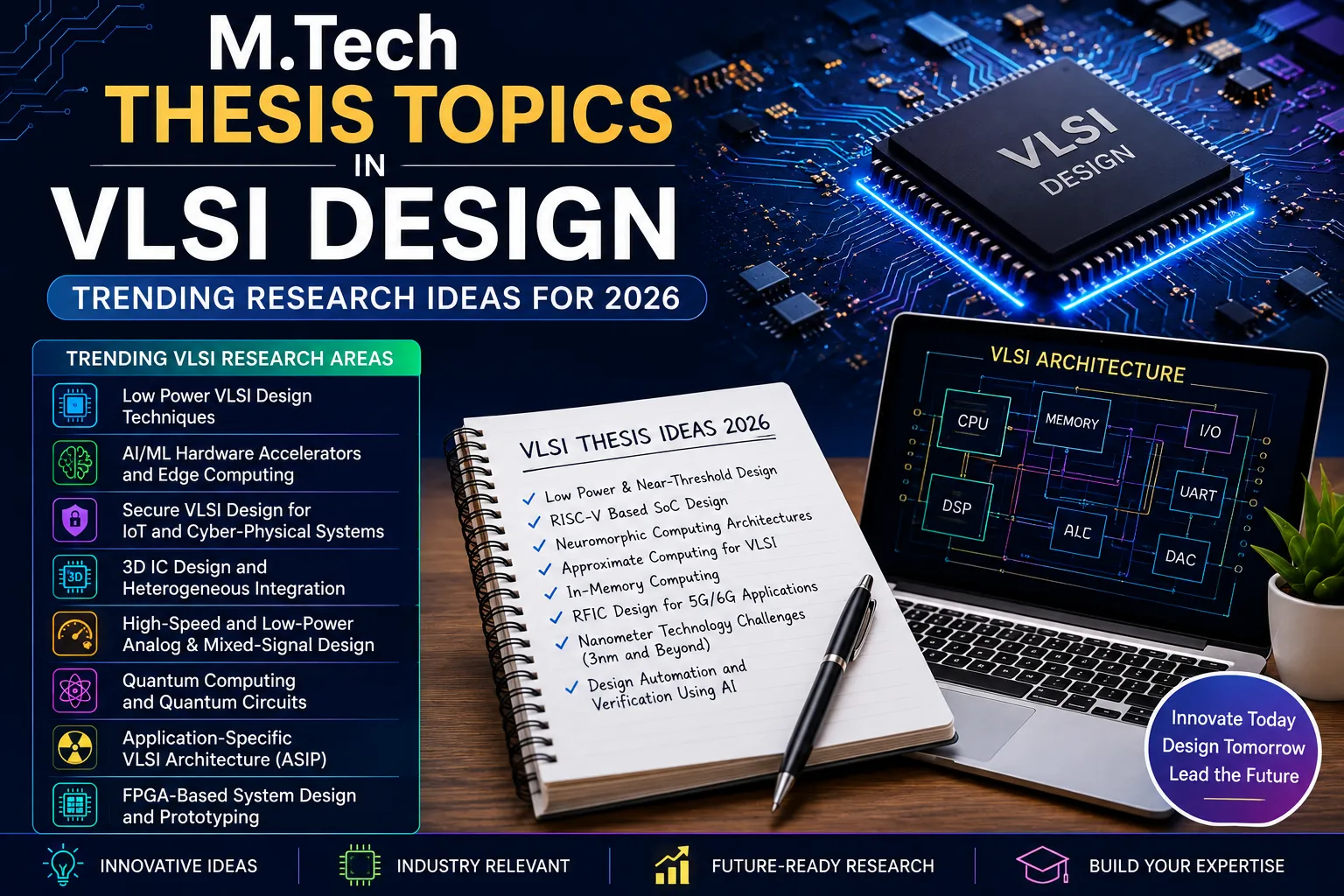
VLSI is one of those M.Tech specializations where the gap between "sounds impressive" and "actually completable in two semesters" is wider than almost any other engineering field. A topic built around cutting-edge 3nm gate-all-around transistor fabrication reads brilliantly on paper, but if your lab only has access to open-source tools and a 130nm process design kit, that gap becomes a real problem partway through your first semester.
This guide covers M.Tech thesis topics in VLSI design trending research ideas for 2026 — organized by domain, matched against realistic tool and simulation access, so you can pick something that's current, genuinely researchable, and finishable within your program's timeline. We've written it the way an experienced VLSI project guide would talk you through the decision, because that's genuinely the kind of mentoring ThesisLikho's technical team provides to the thousands of engineering scholars we've supported through exactly this stage.
Why VLSI Topic Selection Needs Extra Care
VLSI research sits at an unusual intersection: it's simultaneously one of the fastest-moving fields in electrical engineering and one of the most infrastructure-dependent. A brilliant topic idea in AI accelerator design or advanced transistor architecture can be completely unworkable if your department doesn't have the specific EDA tool license, process design kit, or simulation infrastructure the topic assumes.
This makes VLSI topic selection a genuinely different exercise than in software-focused branches — before you fall in love with a specific research direction, you need a clear-eyed picture of what your lab, your university's tool licenses, and your own access to simulation platforms can actually support within your M.Tech timeline. Getting this alignment right early is what separates a thesis that moves smoothly through implementation from one that stalls waiting for infrastructure that was never really available.
Trending VLSI Research Areas for 2026
A few genuine shifts are shaping what counts as current, defensible VLSI thesis material this year.
Gate-all-around (GAA) transistors are actively replacing FinFETs at advanced process nodes, and 2026 industry research presented at the IEEE/JSAP VLSI Symposium has demonstrated that GAA designs with backside power delivery achieve meaningfully higher frequency at low operating voltages compared to FinFET — opening new low-voltage design possibilities relevant to mobile and AI-edge applications. This transition is generating active research interest in comparative device modeling and low-voltage circuit design using GAA architectures.
RISC-V, the open-source instruction set architecture, continues disrupting proprietary processor design, with growing adoption specifically in IoT, automotive, and AI applications. This shift matters for M.Tech research in two ways: it's a genuinely active area for processor microarchitecture research, and its open-source nature has fueled a parallel ecosystem of open-source EDA and verification tools that make hands-on processor design research more accessible to students without commercial tool budgets.
Ultra-low-power, AI-accelerated VLSI architecture for edge computing is a currently active, well-published 2026 research area, particularly work combining FinFET technology with near-threshold voltage computing techniques to meet the strict energy budgets of on-device neural network inference — a genuinely strong fit for a thesis-level contribution given its clear, testable design trade-offs.
Chiplet-based design and UCIe (Universal Chiplet Interconnect Express) integration represent one of the most actively researched shifts in the field, driven by manufacturing yield challenges at advanced process nodes. Recent published research on chiplet-based RISC-V SoC architectures has demonstrated measurable gains in latency, throughput, and power efficiency from modular, AI-optimized chiplet designs compared to monolithic alternatives — a promising area for simulation-based M.Tech research, even without access to actual advanced fabrication.
3D IC integration is being actively explored as a way to reduce memory-logic data movement, described in current conference research as a dominant contributor to energy dissipation in modern AI accelerator systems. This remains a genuinely under-explored area at the thesis level, offering a less saturated research niche for students willing to work with the additional architectural complexity involved.
M.Tech VLSI Thesis Topics by Domain
Below are starting-point topics across the domains most relevant to current VLSI research and realistic for Indian M.Tech program timelines. Treat each as a draft direction — a strong thesis title is usually a narrowed, tool-matched version of one of these, refined with your guide's input and your lab's actual infrastructure.
Low-Power and Ultra-Low-Power Design Topics
Strong candidates include designing and evaluating near-threshold voltage circuits for edge AI inference applications, comparing power-delay trade-offs between FinFET and gate-all-around transistor architectures at the circuit level, developing low-power SRAM cell designs for IoT-class memory applications, exploring dynamic voltage and frequency scaling techniques for battery-powered embedded processors, and designing clock-gating or power-gating architectures for reducing static power in digital ASIC blocks. A related and increasingly relevant direction is investigating compute-in-memory architectures specifically for reducing energy consumption in neural network inference at the edge.
RISC-V and Open-Source Processor Topics
This domain offers particularly strong fit for students working primarily with open-source tools. Promising topics include designing and implementing a low-power RISC-V core variant for a specific embedded application domain (biomedical devices, IoT sensor nodes, or automotive microcontrollers are all active published areas), evaluating custom instruction extensions for RISC-V cores targeting a specific workload like signal processing or lightweight machine learning inference, comparative performance analysis of open-source RISC-V core implementations against commercial embedded processor benchmarks, and exploring RISC-V-based SoC architectures for energy-constrained edge AI applications.
AI Accelerator and Neuromorphic Hardware Topics
Strong directions here include designing energy-efficient hardware accelerators for specific neural network operations (convolution, matrix multiplication) targeting edge deployment, evaluating compute-in-memory approaches for reducing data movement overhead in AI accelerator architectures, comparative analysis of quantization and precision-reduction techniques on hardware accelerator power and area trade-offs, and exploring neuromorphic circuit design approaches for ultra-low-power pattern recognition applications.
Chiplet and 3D Integration Topics
Given how actively this area is being researched, promising simulation-based directions include evaluating UCIe-compliant chiplet interconnect architectures for heterogeneous SoC integration, analyzing power and latency trade-offs in modular chiplet-based processor designs versus monolithic alternatives, exploring thermal and power delivery network challenges specific to 3D-stacked IC architectures, and investigating inter-die communication protocols for reducing energy overhead in multi-chiplet systems.
Memory Design Topics
Strong candidates include designing and evaluating low-power SRAM architectures for cache applications, exploring emerging non-volatile memory technologies (MRAM, ReRAM) for specific embedded use cases, analyzing memory hierarchy trade-offs for AI accelerator workloads, and designing error-correction and fault-tolerance techniques for memory subsystems in safety-critical embedded applications.
RF and Mixed-Signal Design Topics
This domain includes designing low-power analog-to-digital converter architectures for IoT sensor applications, evaluating RF front-end circuit designs for specific wireless communication standards, exploring phase-locked loop design techniques for clock generation in mixed-signal SoCs, and analyzing noise and linearity trade-offs in low-power amplifier circuit designs.
Testing, Verification, and DFT Topics
Strong, often underappreciated thesis directions include developing formal verification methodologies for a specific class of digital circuit designs, exploring machine learning-based approaches to automated test pattern generation, designing built-in self-test (BIST) architectures for embedded memory blocks, and evaluating design-for-testability techniques for reducing test time and cost in ASIC manufacturing flows.
Beginner-Friendly Topics
For students wanting a well-established literature base and a manageable, well-documented scope for a first VLSI thesis: designing and simulating a basic ALU or processor datapath using an open-source RTL-to-GDSII flow, comparative analysis of different adder or multiplier circuit architectures on power-delay-area trade-offs, implementing and evaluating a simple cache controller design, designing a low-power UART or basic communication interface IP block, and analyzing the performance of different flip-flop or latch designs across power and timing metrics.
EDA Tools: Commercial Access vs. Open-Source Alternatives
This is genuinely one of the most practically important sections of this guide, since tool access shapes what's actually achievable within your thesis timeline. Commercial EDA tools — Cadence Virtuoso, Synopsys Design Compiler, and Siemens (formerly Mentor Graphics) tools — remain the industry standard and dominate professional chip design, but come with substantial licensing costs. Many universities gain access through educational programs like the Cadence University Program or equivalent Synopsys and Siemens academic partnerships, which provide free or heavily discounted licenses specifically for student research; some tools also offer short-term trial licenses, typically around 30 days, though this is rarely enough for a full thesis timeline.
Where commercial access isn't available, a genuinely credible open-source ecosystem has matured significantly in recent years. Yosys handles RTL synthesis, Magic and KLayout support circuit layout work, and OpenLane and OpenROAD together provide a full RTL-to-GDSII flow, commonly used with the open SkyWater 130nm process design kit. This open-source pathway has been specifically championed in India by initiatives like VLSI System Design (VSD), which has run open-source RISC-V and chip-design collaborations with several IITs, making a fully open-source thesis workflow a legitimate, well-supported option rather than a compromise.
Before finalizing your topic, confirm exactly which tools your department has genuine, reliable access to — a topic assuming full commercial Cadence access, attempted on a department that only has open-source tooling, is a common and entirely avoidable source of mid-thesis delay.
Understanding Plagiarism Standards for VLSI Theses
VLSI theses involve a mix of narrative chapters and technical implementation, and plagiarism checks apply meaningfully to both. Under UGC's 2018 Academic Integrity Regulations, similarity up to 10 percent is treated as acceptable with no penalty, 10 to 40 percent requires revision and resubmission, and anything above 40 percent carries progressively steeper consequences — these bands apply to M.Tech theses just as they do to other degree levels. Many individual institutes, particularly IIT thesis processing cells, apply stricter internal thresholds in practice, often treating something closer to 10 percent as the practical ceiling for final submission.
This matters specifically for VLSI students in a way it might not for other fields: standard textbook explanations of transistor operation, common circuit topologies, or well-established design equations are exactly the kind of content students are tempted to lightly reword rather than genuinely paraphrase. Explaining a concept like near-threshold voltage operation or GAA transistor structure in your own words, tied specifically to how it applies in your own design, is both more original in a plagiarism-check sense and considerably more useful to a reader than a rephrased textbook definition.
Identifying a Genuine Research Gap in a Fast-Moving Field
VLSI moves fast enough that a research gap can genuinely open and close within a couple of years, which makes gap identification a slightly different exercise here than in more stable fields. Nature's guidance on literature review writing, drawn from editor and researcher interviews, frames a strong review as providing both historical context and a forward-looking perspective on where a field is heading — a framing that matters even more in VLSI, where citing only foundational studies without engaging with the last one to two years of published work signals to a committee that you haven't checked whether your specific angle has already been addressed.
Practical ways to spot a genuine gap in VLSI research include applying an established low-power technique to a newer transistor architecture it hasn't yet been tested on, evaluating a well-studied circuit design under a specific real-world constraint (a particular process node, voltage range, or application domain) that existing published work hasn't covered, or running a comparative study between open-source and commercial tool-flow results for a specific design — a genuinely useful, currently under-published niche given how quickly the open-source EDA ecosystem is evolving.
Tips for Choosing a Feasible Topic
Confirm your department's actual tool access — commercial, open-source, or a specific hybrid — before finalizing your topic, since this single factor determines what's realistically achievable. Match your topic's ambition to your available process design kit; a topic assuming sub-5nm fabrication access when your lab works with a 130nm open-source PDK needs to be reframed as a comparative or simulation-based study rather than an implementation claim. Do a focused literature scan specifically on the last one to two years of published work in your chosen sub-area, since VLSI research dates faster than most other engineering fields. Keep your scope narrow and specific — a well-defined comparative or evaluative study is usually more completable and more defensible than an ambitious, from-scratch novel architecture proposal within a single M.Tech timeline. And align your topic with your career direction, since VLSI specializations (analog design, digital design, verification, physical design) often shape your post-M.Tech job search meaningfully.
Common Mistakes M.Tech VLSI Students Make
A recurring mistake is choosing a topic based on cutting-edge industry news (the newest process node, the latest chiplet announcement) without checking whether the underlying research question is actually testable given available tools and PDKs. Underestimating simulation and verification time is another frequent gap — VLSI design work often takes considerably longer to debug and verify than students initially budget for, leaving thesis writing rushed at the end. Copy-pasting standard circuit theory or transistor-operation explanations from textbooks, rather than paraphrasing in the student's own words tied to their specific design, is a common and avoidable plagiarism-check flag. Skipping a proper baseline comparison — presenting a proposed design's results without benchmarking against an established reference design — significantly weakens a results chapter. And assuming a commercial-tool-based topic will work on open-source infrastructure (or vice versa) without confirming this early is one of the most common, entirely preventable sources of mid-thesis delay in this specific field.
A Realistic Example Scenario
Scenario — Devika, an M.Tech VLSI student in Bengaluru
Devika initially wanted to work on a novel gate-all-around transistor-based accelerator architecture, inspired by recent industry announcements — a topic that sounded exciting but assumed fabrication-level access her department simply didn't have. After a conversation with her guide, she reframed the project as a simulation-based comparative study: evaluating near-threshold voltage operation trade-offs between FinFET and GAA transistor models using available device simulation tools, rather than attempting physical implementation. This version kept her genuine interest in advanced transistor architecture while matching what her lab could actually support — she completed her design and simulation work using her department's existing device modeling software, without ever needing access to fabrication facilities she was never going to have during her M.Tech timeline.
This is a pattern we see constantly in mentoring work: the students who struggle most in VLSI aren't short on exciting ideas — they're short on a version of that idea matched to their actual tool and infrastructure access.
Scenario — Arnav, an M.Tech student pursuing a verification-focused thesis
Arnav's classmates were mostly pursuing design-focused topics, and he initially assumed he needed to follow the same path. But his stronger interest and coursework background was in verification, not physical design. His guide encouraged him to pursue a topic genuinely matched to his strengths instead: developing and evaluating a formal verification methodology for detecting timing violations in a specific class of asynchronous digital circuits. This direction required no fabrication access at all, relied on tools his department already had reliable licenses for, and let him build on his actual coursework strengths rather than starting from scratch in an unfamiliar sub-domain just because it seemed more popular among his peers. His thesis ultimately moved faster than several of his classmates' design-focused projects, precisely because the topic matched both his skills and his available resources from the start.
If you'd like a second opinion on your shortlisted topics before committing, our M.Tech Thesis Assistance service offers exactly this kind of structured topic and feasibility review.
Simulation Resources and Process Design Kits Worth Knowing
Beyond the EDA tool question covered earlier, it's worth knowing specifically which process design kits (PDKs) and simulation platforms are realistically accessible for thesis-level work. The open SkyWater 130nm PDK, paired with the OpenLane flow, has become the de facto standard for open-source, fabrication-realistic thesis work in India and globally, and is well documented with active community support, making it a reasonable default when commercial PDK access isn't available. For students with university-licensed commercial tool access, department-specific PDKs (often tied to whichever foundry the university's Cadence or Synopsys license supports) should be confirmed directly with your lab administrator before finalizing a topic that depends on specific technology node characteristics.
For device-level and circuit-level simulation without needing a full fabrication-realistic PDK, tools like LTSpice (freely available) and NGSpice offer a lower-barrier entry point for topics focused on circuit-level trade-off analysis rather than full physical implementation — a reasonable option for students whose research question is really about comparing circuit behavior or power-performance trade-offs rather than producing a tape-out-ready layout. Confirming which of these resource tiers matches your actual research question, before committing to a topic, is one of the more practical steps you can take early in your thesis planning.
Thesis-Track vs. Project-Track Expectations
As with other M.Tech engineering specializations, not every VLSI program treats "thesis" identically. Some universities run a genuinely research-oriented thesis track, expecting a clearly articulated research gap and a comparative or evaluative contribution beyond a working implementation alone. Others run a more applied, project-based track, where a well-executed, functioning design — a working RTL implementation successfully synthesized and verified — carries more weight than a formal literature-grounded research contribution.
This distinction matters directly for VLSI topic selection specifically, since design and verification work is genuinely time-intensive regardless of format. A thesis-track student should budget meaningfully more time for literature review and comparative analysis framing, while a project-track student can lean more heavily into implementation depth, provided the final working system is technically robust. Confirming which track your specific program follows — and calibrating your topic's ambition accordingly — is worth doing with your guide before finalizing your title.
Frequently Asked Questions
What are M.Tech thesis topics in VLSI design trending research ideas for 2026?
They're a curated, current shortlist of researchable VLSI thesis topics for the 2026 academic cycle — spanning low-power design, RISC-V processor research, AI accelerator hardware, and chiplet-based integration — filtered for realistic tool and simulation access within a typical M.Tech timeline.
How long does it take to complete an M.Tech thesis using this approach? Most M.Tech VLSI theses in India run six to twelve months, often structured as a preliminary design and simulation phase followed by full implementation and verification, depending on program structure and the specific EDA tool access available.
Is professional help available for M.Tech VLSI thesis topic selection?
Yes — structured mentoring on topic selection, tool-flow feasibility, and literature review framing is a standard part of many M.Tech programs. ThesisLikho's technically qualified mentors offer this kind of guided support specifically for VLSI research scholars.
Why does topic selection matter for an M.Tech VLSI thesis?
VLSI topics are unusually infrastructure-dependent — a topic mismatched to your department's actual tool and process design kit access is one of the most common and costly causes of mid-thesis delay, more so than in most other engineering specializations.
How does topic selection affect an M.Tech VLSI thesis overall?
A well-matched, appropriately scoped topic keeps your literature review, simulation work, and results chapter realistic and achievable, while a topic assuming infrastructure you don't actually have access to can stall implementation for weeks or force a late-stage, disruptive topic change.
Get M.Tech Thesis Guidance
If you're weighing a few shortlisted VLSI topics or want a technically qualified mentor to sanity-check your proposal against your department's actual tool access, ThesisLikho's team is here to help.