
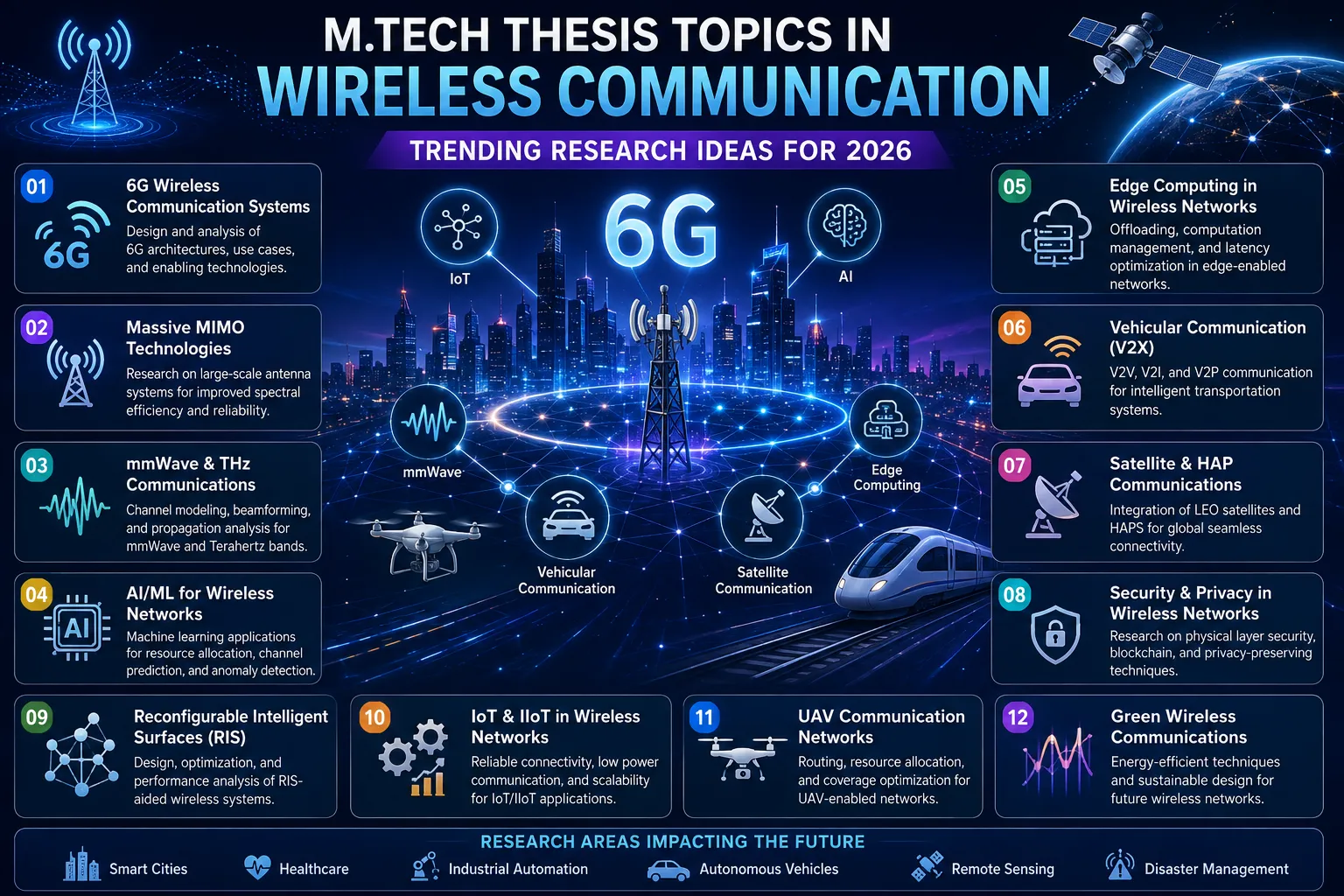
If you're searching for M.Tech thesis topics in wireless communication trending research ideas for 2026, you've probably already discovered the two big traps: picking something so cutting-edge (quantum-everything, 6G-everything) that you can't actually simulate it with the tools your department has, or picking something so generic ("performance analysis of MIMO systems") that it barely clears the plagiarism check against a decade of prior theses on the same title.
This guide is built the way an experienced wireless communication research supervisor would walk you through it — a working framework, not a recycled list. We'll cover categorized topic ideas across major wireless research areas, the trends genuinely shaping 2026 research, a feasibility checklist tuned to simulation-based M.Tech work, methodology and tool guidance, and the mistakes that quietly derail a first-time thesis writer.
At ThesisLikho, our PhD-qualified mentors have guided more than 10,000 scholars through topic selection, simulation planning, and thesis writing across M.Tech, MBA, and PhD programmes, including wireless communication and allied ECE research. What follows draws on that mentoring experience, grounded in current IEEE-indexed research and 2025–2026 developments in 6G, RIS, and AI-driven wireless networks.
1. Why Wireless Communication Topics Need Careful Scoping in 2026
Wireless communication is one of the busiest research areas in Indian M.Tech programmes, which cuts both ways. On one hand, there's an enormous, fast-moving body of literature to draw from — 6G enablers, reconfigurable intelligent surfaces, AI-driven network optimization. On the other, that same popularity means generic titles ("throughput analysis of 5G networks") are heavily saturated, and a supervisor evaluating your synopsis has almost certainly seen a near-identical title before.
The other scoping trap specific to this field is simulation feasibility. A topic built around emerging 6G/THz hardware sounds exciting, but if your actual work will be simulation-based (which most M.Tech theses are), your topic needs to be answerable with tools like MATLAB, NS-3, or OMNeT++ — not dependent on physical hardware your lab doesn't have. Getting this distinction right early is what separates a thesis that gets built versus one that gets stuck at the literature review stage.
2. What an M.Tech Wireless Communication Thesis Actually Requires
M.Tech programmes in India, operating under AICTE's technical education framework, typically require a two-semester (sometimes one-year) dissertation involving a literature survey, a proposed methodology or system model, simulation-based implementation, results and performance comparison against existing approaches, and a conclusion with future scope. Unlike a pure literature-based MBA dissertation, an M.Tech thesis in this domain is expected to demonstrate a genuine technical contribution — a modified algorithm, a novel system model, or a comparative performance study — validated through simulation.
Citation discipline matters here too, typically following IEEE reference style rather than APA, since most target publication venues in this field (IEEE Xplore journals, conferences, Communications Letters) use IEEE's citation format. Consistency in this from your first literature review draft saves considerable reformatting time later.
3. M.Tech Thesis Topics in Wireless Communication for 2026
Treat the list below as starting directions, not final titles — narrow each to a specific system model, parameter set, or comparison baseline before taking it to your guide.
A. 6G Enabling Technologies
- Performance analysis of reconfigurable intelligent surfaces (RIS) for coverage extension in mmWave networks
- RIS-assisted beamforming optimization for indoor 6G scenarios
- Cell-free massive MIMO architecture for uniform user experience in dense deployments
- Terahertz (THz) channel modeling for short-range high-speed 6G links
- Hybrid beamforming design for THz massive MIMO systems
- Energy-efficient RIS placement optimization in urban microcell environments
- AI-assisted channel estimation for RIS-aided wireless systems
- Comparative analysis of RIS versus traditional relay-assisted communication
- Near-field beamforming techniques for extremely large aperture arrays
- Integration of RIS with NOMA for enhanced spectral efficiency
- Cell-free massive MIMO power allocation strategies for 6G networks
- THz communication link budget analysis for indoor short-range applications
B. AI/ML-Driven Wireless Network Optimization
- Deep learning-based channel estimation for massive MIMO systems
- Reinforcement learning for dynamic spectrum allocation in cognitive radio networks
- Machine learning-based handover management in dense heterogeneous networks
- AI-driven resource allocation for network slicing in 5G/6G
- Federated learning for privacy-preserving channel prediction in wireless networks
- Deep learning-based beamforming prediction for mmWave systems
- Neural network-based interference mitigation in multi-cell networks
- AI-based energy-efficient base station sleep scheduling
- Machine learning for adaptive modulation and coding scheme selection
- Deep reinforcement learning for UAV trajectory optimization in wireless relay networks
- AI-driven anomaly detection for wireless network security
- Transfer learning approaches for channel prediction across network deployments
C. Massive MIMO & Beamforming
- Pilot contamination mitigation techniques in massive MIMO systems
- Hybrid analog-digital beamforming design for energy-efficient mmWave systems
- Low-resolution ADC-based massive MIMO receiver design
- Beam management strategies for mobile users in mmWave massive MIMO
- Channel estimation techniques for massive MIMO under high mobility
- Massive MIMO detection algorithm comparison: linear versus non-linear approaches
- Antenna selection algorithms for energy-efficient massive MIMO
- User grouping and scheduling strategies in massive MIMO-NOMA systems
- Massive MIMO performance under imperfect channel state information
- Distributed massive MIMO for cell-free network architectures
D. Non-Orthogonal Multiple Access (NOMA) & Spectrum Efficiency
- Power allocation optimization for downlink NOMA systems
- Comparative performance analysis of NOMA versus OMA under practical channel conditions
- Cooperative NOMA relay design for coverage extension
- NOMA-based resource allocation for IoT device connectivity
- Cognitive radio-inspired dynamic spectrum sharing for 5G/6G coexistence
- Spectrum sensing algorithm design for cognitive radio networks
- NOMA integration with millimeter-wave communication systems
- Interference management in multi-cell NOMA networks
- Energy-efficient NOMA design for massive IoT connectivity
E. UAV and Non-Terrestrial Communication
- UAV-assisted relay network design for disaster communication scenarios
- Trajectory and resource allocation optimization for UAV base stations
- Satellite-terrestrial integrated network architecture for rural connectivity
- UAV swarm communication protocol design for coverage optimization
- Energy-efficient UAV placement for wireless coverage in emergency scenarios
- Non-terrestrial network (NTN) handover management for satellite-terrestrial integration
- UAV-enabled data collection strategy for IoT sensor networks
- Interference analysis in UAV-assisted cellular networks
- Physical layer security for UAV communication links
- Low-earth-orbit (LEO) satellite constellation coverage optimization for 6G
F. Physical Layer Security & Wireless Security
- Physical layer security enhancement using RIS in eavesdropper scenarios
- Secure beamforming design for multi-user MIMO systems
- Artificial noise injection techniques for secure wireless transmission
- Physical layer authentication using channel state information
- Secure NOMA transmission design against internal eavesdropping
- Covert communication techniques in wireless networks
- Jamming detection and mitigation strategies in wireless networks
- Blockchain-integrated security framework for wireless IoT networks
- Quantum key distribution feasibility for secure wireless links
G. IoT, mMTC & Low-Power Wide-Area Networks
- Energy-efficient MAC protocol design for massive IoT connectivity
- LoRaWAN network performance optimization for smart agriculture applications
- NB-IoT resource allocation strategy for dense sensor deployments
- Wireless sensor network routing protocol design for energy efficiency
- Ultra-reliable low-latency communication (URLLC) protocol design for industrial IoT
- Energy harvesting-based wireless sensor network design
- Random access protocol optimization for massive machine-type communication
- Edge computing-integrated IoT architecture for latency reduction
- Wireless body area network (WBAN) protocol design for healthcare monitoring
- Interference mitigation strategies for dense LPWAN deployments
H. Network Architecture: O-RAN, Network Slicing & SDN
- Open RAN (O-RAN) architecture performance evaluation for 5G/6G networks
- Network slicing resource allocation optimization for multi-tenant 5G networks
- Software-defined networking (SDN) integration for dynamic wireless network management
- Network function virtualization (NFV) performance analysis for 5G core networks
- AI-driven network slice orchestration for quality-of-service guarantee
- Edge computing resource allocation for latency-sensitive network slices
- SDN-based load balancing strategy for heterogeneous wireless networks
- O-RAN intelligent controller (RIC) design for network optimization
- Network slicing isolation and security analysis for multi-tenant environments
I. Vehicular & V2X Communication
- Vehicle-to-everything (V2X) communication protocol performance analysis
- Resource allocation strategy for cellular V2X (C-V2X) networks
- Reliability analysis of V2X communication under high mobility scenarios
- Millimeter-wave V2X beam alignment techniques for autonomous vehicles
- Platooning communication protocol design for connected vehicles
- Handover management for vehicular networks in dense urban environments
- Latency optimization for safety-critical V2X applications
- Machine learning-based channel prediction for vehicular networks
- Coexistence analysis between DSRC and C-V2X technologies
J. Energy Efficiency, Green Communication & Emerging Topics
- Energy harvesting-based relay selection for wireless powered communication networks
- Green base station design with renewable energy integration
- Simultaneous wireless information and power transfer (SWIPT) system design
- Energy-efficient resource allocation for heterogeneous cellular networks
- Backscatter communication system design for ultra-low-power IoT
- Free-space optical communication as a complementary link for RF congestion relief
- Visible light communication (VLC) system design for indoor connectivity
- Underwater wireless communication channel modeling and performance analysis
- Molecular communication feasibility study for nano-scale networks
- Full-duplex communication system design for spectral efficiency improvement
- Intelligent omni-surface (IOS) design for simultaneous reflection and transmission
- Semantic communication framework design for bandwidth-efficient 6G transmission
4. Latest Wireless Communication Research Trends Shaping 2026
A few cross-cutting shifts are worth understanding before committing to a domain:
- RIS is moving from theoretical promise to a genuinely active research area. Reconfigurable intelligent surfaces are receiving considerable research attention for their ability to reshape reflected and refracted signal paths, particularly at sub-THz and THz frequencies, addressing blocking and path-loss challenges that pure massive MIMO struggles with alone (Source: peer-reviewed 6G/massive MIMO survey literature, MDPI Sensors).
- 6G is explicitly framed around "connected intelligence", integrating AI, edge computing, and advanced sensing directly into the network rather than treating them as separate layers — with THz communication, NOMA, and RIS positioned as the three core enabling technologies for this shift (Source: recent arXiv survey literature on 6G evolution and research gaps).
- Cell-free massive MIMO and RIS integration with THz systems are among the most actively benchmarked combinations in current research, particularly for addressing THz's severe path-loss and blockage sensitivity (Source: IEEE Xplore literature on RIS-assisted THz MIMO systems).
- Non-terrestrial networks (NTN) are becoming a mainstream 6G research thread, not a niche one, with growing focus on satellite-terrestrial handover, direct-to-cell services, and coverage optimization for underserved regions.
- Simulation-first research remains the practical norm for M.Tech-level work. MATLAB (with its 5G/LTE Toolboxes and Simulink), NS-3, and OMNeT++ remain the dominant tools for wireless systems research, and most currently active topics — RIS beamforming, massive MIMO, NOMA, UAV networks — are entirely tractable through simulation without requiring physical 6G hardware.
5. A Topic Selection Framework You Can Actually Use
Step 1 — Interest-to-Tool Match. List two or three wireless communication themes you're genuinely curious about, then check which ones you can actually simulate with the tools available in your lab (MATLAB/Simulink, NS-3, OMNeT++) or your own laptop. A topic requiring specialized hardware or licensed software you don't have access to isn't feasible, however interesting.
Step 2 — Gap Verification. Search IEEE Xplore, Google Scholar, and arXiv for the last 2–3 years in your shortlisted area — wireless communication research moves fast enough that a "gap" from five years ago has often already been closed. If your shortlisted topic returns dozens of near-identical Indian M.Tech theses, narrow by scenario, parameter set, or comparison baseline.
Step 3 — Scope Reality Check. Confirm your simulation complexity matches your timeline. A full 6G system-level simulation with multiple novel components is rarely feasible within a standard M.Tech timeline; a focused comparative study of one technique against one or two established baselines usually is.
Step 4 — Publication Pathway. Check whether your intended contribution (a modified algorithm, a novel comparison, a specific parameter optimization) is publishable as an IEEE conference paper — this is a useful sanity check on whether your scope is specific enough to produce a genuine, defensible contribution.
6. How to Identify a Genuine Research Gap
A defensible research gap in wireless communication satisfies three conditions:
- It's explicitly flagged in recent literature — a stated limitation, an untested scenario, or a parameter combination not yet studied together (e.g., RIS-assisted NOMA under high-mobility conditions).
- It has measurable performance relevance — something you can quantify through simulation (throughput, BER, latency, energy efficiency, spectral efficiency) rather than a purely conceptual claim.
- It's answerable with tools and computational resources available to you within your programme's timeline.
A practical technique: pull 12–15 recent IEEE papers in your shortlisted area, note their stated future work and limitations in a spreadsheet, and look for the two or three that recur — a specific untested channel condition, an unaddressed trade-off, or a missing comparative baseline. That recurring gap is usually your strongest, most defensible starting point. For a deeper walkthrough, see [Link: What Is a Research Gap and How to Identify One for Your Thesis].
7. Topic Feasibility Checklist
Before presenting any topic to your guide, verify each of these:
☐ Simulation tool (MATLAB/Simulink, NS-3, OMNeT++) confirmed available and suited to the topic
☐ Required toolboxes or libraries (5G Toolbox, LTE Toolbox, INET framework) confirmed accessible
☐ Topic narrowed to a specific system model, scenario, or parameter set — not a broad survey
☐ At least 10–15 recent (2023–2026) IEEE-indexed papers identified in the exact area
☐ A clear comparison baseline identified (an existing algorithm or approach to benchmark against)
☐ Guide has relevant expertise or interest in the chosen wireless domain
☐ Computational resources (processing power, licenses) sufficient for your simulation scale
☐ Topic stated in one sentence with clear performance metrics to be measured
8. Choosing the Right Simulation Tools and Methodology
- MATLAB/Simulink — the most widely used tool for physical-layer and link-level simulation in Indian M.Tech programmes, especially with the 5G Toolbox, LTE Toolbox, and Communications Toolbox for tasks like channel modeling, beamforming, modulation/coding, and MIMO detection algorithm design.
- NS-3 — the standard choice for network-layer and protocol-level simulation, particularly for topics involving routing protocols, network slicing, V2X communication, and large-scale network behavior; widely used for LTE/5G network-level studies.
- OMNeT++ — a strong alternative to NS-3 for wireless and wired network simulation, especially when paired with the INET framework, and commonly used for IoT, sensor network, and protocol-design research.
- Python-based simulation (with libraries for signal processing and machine learning) — increasingly common for AI/ML-driven wireless topics, particularly deep learning-based channel estimation or resource allocation research, since it integrates naturally with TensorFlow/PyTorch.
- Hybrid approaches combining MATLAB for physical-layer modeling with NS-3 for network-layer behavior are used for topics spanning both layers, though this adds integration complexity worth discussing with your guide before committing.
Whichever tool you choose, confirm you (or your department) have working licenses and that your topic doesn't quietly depend on data, hardware, or software you don't actually have access to — this is one of the most common causes of stalled M.Tech theses.
If your topic needs help translating from a research idea into a structured, simulation-backed thesis document, our M.Tech Thesis Assistance service supports scholars through exactly this stage.
9. Supervisor Approval Tips
- Bring two to three narrowed options, each with a specific system model and metric, rather than a broad theme like "6G research."
- Show your simulation tool and baseline are already identified — guides approve topics faster when the "how" is clearly thought through, not just the "what."
- Reference recent (2024–2026) IEEE literature in your pitch — it signals you're working at the current edge of the field, not recycling an older topic list.
- Prepare a one-page concept note: background, gap, proposed system model, simulation tool, expected performance metrics, and timeline — before your guide meeting.
- Anticipate the "what's novel here" question. Be ready to state, in one sentence, what specifically distinguishes your work from the closest prior paper you found.
10. Common Mistakes First-Time M.Tech Thesis Writers Make
- Choosing a topic based on trend-chasing ("I want to do something in 6G") rather than a scoped, simulatable research question.
- Underestimating tool/license access — always confirm simulation software and toolbox availability before finalizing scope.
- Copying topic titles verbatim from online lists without checking whether the exact combination has already been extensively studied.
- Skipping the comparison baseline — a thesis proposing a "new" approach without a clear existing method to benchmark against is hard to evaluate and hard to publish from.
- Neglecting IEEE citation consistency early, leading to reformatting headaches before submission or publication.
- Treating the literature review as a summary rather than a synthesis — a strong review surfaces gaps and contradictions, not just a list of paper summaries.
- Ignoring the "why 2026" justification — a strong wireless communication thesis explains why the specific gap matters now, tied to real 6G/RIS/AI-network developments, not just that the general topic area exists.
11. Publication Opportunities
M.Tech theses in wireless communication are commonly adapted into IEEE conference papers — student-friendly venues within India (regional IEEE conferences, university-hosted symposiums) are realistic first targets, with international IEEE conferences and journals as a stretch goal for particularly strong, novel contributions. Structuring your simulation results and comparative analysis chapter with publication-ready figures and a clearly stated contribution from the outset makes this conversion considerably easier later, and strengthens your thesis defense in the process.
12. Two Realistic Case Studies
Case Study 1 — From "6G Research" to a Defensible Thesis An M.Tech scholar at a state technical university began with the idea "research in 6G wireless communication" — a topic so broad it drew immediate pushback from the department committee. After a structured gap-verification exercise against recent IEEE literature, the scholar narrowed the scope to RIS-assisted beamforming optimization for indoor mmWave coverage extension, matched to MATLAB's 5G Toolbox already available in the department lab and a comparison baseline against conventional relay-assisted beamforming. The narrowed scope — one technology, one scenario, one clear baseline — is what got the proposal approved on the second attempt.
Case Study 2 — Building a Thesis Around Available Simulation Tools A first-time M.Tech thesis writer without strong prior research experience had access only to NS-3 and no MATLAB license. Rather than chasing a physical-layer-heavy topic requiring MATLAB's signal-processing toolboxes, the scholar designed a network-layer study on resource allocation optimization for network slicing in 5G core networks using NS-3, aligning the topic directly with the available tool rather than fighting against a tool gap. This choice avoided months of potential delay chasing software access and produced a complete, simulation-backed thesis within the standard timeline.
If your topic idea resembles either of these scenarios, our M.Tech Thesis Assistance service can help you pressure-test scope, confirm tool feasibility, and prepare your synopsis presentation.
FAQs
What is "M.Tech thesis topics in wireless communication trending research ideas for 2026"?
It refers to identifying current, simulation-feasible, and technically defensible research topics within wireless communication for the 2026 M.Tech research cycle — spanning 6G enablers like RIS and THz, AI-driven network optimization, massive MIMO, NOMA, UAV/non-terrestrial networks, and related domains.
Why does M.Tech thesis topics in wireless communication trending research ideas for 2026 matter?
Because topic selection determines whether your thesis is actually simulatable with the tools you have access to, whether your gap is genuinely current given how fast this field moves, and how defensible your contribution will be at evaluation and, ideally, publication.
How does this approach affect an M.Tech thesis in practice?
Scholars who match their topic to available simulation tools and verify their gap against recent (2024–2026) literature typically experience fewer committee rejections, smoother simulation work, and a clearer path to a publishable contribution.
How long does it take to complete an M.Tech thesis using this approach?
Most Indian M.Tech dissertations run one to two semesters depending on the university's structure, following topic approval, literature review, simulation/implementation, and thesis writing. A well-scoped, tool-matched topic meaningfully reduces the time typically lost to simulation setup delays.
Is professional help available for M.Tech thesis topics in wireless communication trending research ideas for 2026?
Yes — mentorship support covering topic selection, simulation planning, and thesis structuring is available through services such as M.Tech Thesis Assistance.
What are some examples of strong M.Tech wireless communication thesis topics for 2026?
Examples include RIS-assisted beamforming for mmWave coverage extension, deep learning-based channel estimation for massive MIMO, UAV-assisted relay design for disaster communication, and resource allocation optimization for 5G network slicing — provided each is scoped to a specific system model, simulation tool, and comparison baseline.
Ready to move from a list of ideas to an approved, simulation-ready thesis proposal? Get M.Tech Thesis Guidance from ThesisLikho's PhD-qualified mentors.