
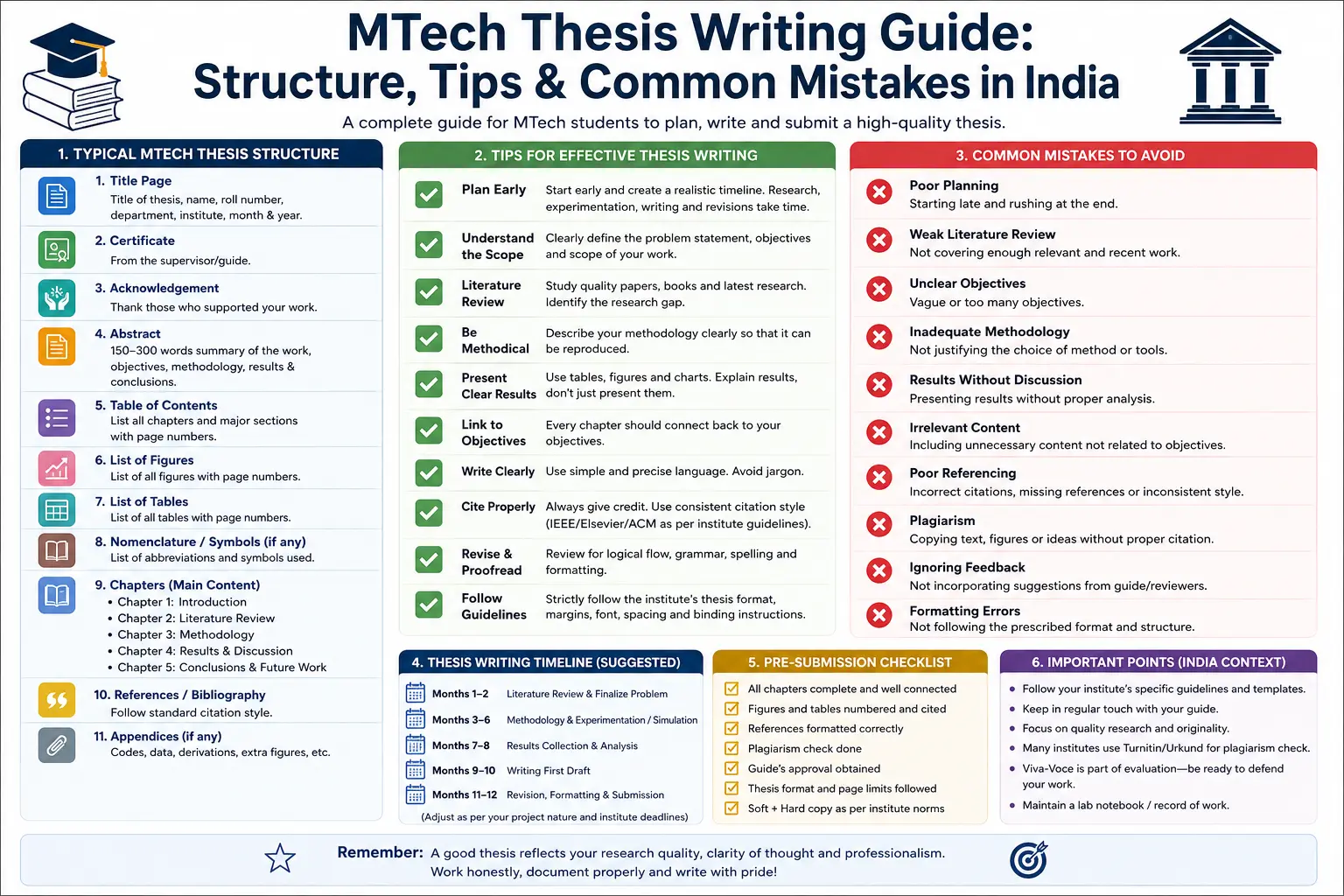
Completing an MTech thesis is one of the most significant milestones in a postgraduate engineering program. Unlike regular coursework or semester projects, an MTech thesis requires students to identify a research problem, conduct an in-depth investigation, analyze data or experimental results, and present original findings in a structured academic document. It is an opportunity to demonstrate technical expertise, analytical thinking, and the ability to contribute to advancements in engineering and technology.
For many students in India, writing an MTech thesis can be challenging. Questions like How do I choose a research topic? What is the correct thesis format? How should I write each chapter? Which research methodology should I use? are common. Without proper planning, students often struggle with literature reviews, experimental design, data analysis, and thesis organization.
This comprehensive guide explains the complete MTech thesis writing process for Indian students. Whether you are pursuing an MTech in Computer Science, Civil Engineering, Mechanical Engineering, Electrical Engineering, Electronics, Information Technology, Artificial Intelligence, or any other engineering discipline, this guide will help you prepare a well-structured, plagiarism-free, and academically strong thesis.
What Is an MTech Thesis?
An MTech thesis is a research-based academic document submitted as part of the Master of Technology degree requirements. It presents original research conducted by the student under the guidance of a faculty supervisor.
Unlike undergraduate projects, an MTech thesis involves:
- Identifying a research problem.
- Reviewing existing literature.
- Designing a research methodology.
- Conducting experiments or simulations.
- Collecting and analyzing data.
- Drawing conclusions based on evidence.
- Suggesting future research directions.
The thesis demonstrates your ability to apply engineering concepts, research methodologies, and technical tools to solve practical problems.
Why Is an MTech Thesis Important?
An MTech thesis plays a crucial role in both academic and professional development.
It helps students:
- Develop advanced research skills.
- Gain expertise in a specialized engineering domain.
- Improve technical writing abilities.
- Learn experimental design and data analysis.
- Publish research papers in journals and conferences.
- Prepare for PhD admissions.
- Strengthen job prospects in R&D organizations and technology companies.
A well-executed thesis also showcases your ability to work independently on complex engineering challenges.
Choosing the Right MTech Thesis Topic
The success of your thesis largely depends on selecting a suitable research topic.
A good topic should:
- Address a real engineering problem.
- Be relevant to current technological developments.
- Have sufficient literature available.
- Be feasible within your available time and resources.
- Offer opportunities for innovation or improvement.
Discuss potential topics with your supervisor before finalizing your research area.
Popular MTech Thesis Topics in India
Computer Science and Artificial Intelligence
- Machine learning for healthcare diagnostics
- Deep learning for image recognition
- AI-based traffic management systems
- Blockchain applications in supply chain management
- Cybersecurity using artificial intelligence
- Cloud computing security models
- Internet of Things (IoT) for smart cities
Mechanical Engineering
- Additive manufacturing and 3D printing
- Optimization of heat exchangers
- Renewable energy systems
- Electric vehicle design improvements
- Finite Element Analysis of mechanical components
- Robotics and automation in manufacturing
Civil Engineering
- Sustainable construction materials
- Smart transportation systems
- Structural health monitoring
- Earthquake-resistant building design
- Wastewater treatment technologies
- Green building practices
Electrical and Electronics Engineering
- Smart grid optimization
- Solar photovoltaic systems
- Power quality improvement
- Electric vehicle charging infrastructure
- Embedded systems design
- Wireless sensor networks
Selecting a contemporary and industry-relevant topic increases the practical value of your research.
Standard Structure of an MTech Thesis
Although formatting requirements vary among IITs, NITs, State Universities, Deemed Universities, and private institutions, most MTech theses follow a similar structure.
Preliminary Pages
Include:
- Title page
- Certificate
- Declaration
- Acknowledgements
- Abstract
- Table of contents
- List of figures
- List of tables
- List of abbreviations
Chapter 1: Introduction
The introduction provides an overview of your research.
It should include:
- Background of the study
- Research problem
- Motivation
- Research objectives
- Scope of the research
- Research questions or hypotheses
- Organization of the thesis
The introduction should clearly explain why your research is important.
Chapter 2: Literature Review
The literature review summarizes previous research related to your topic.
Rather than listing studies individually, organize the review around themes or technological developments.
Include:
- Existing research
- Current technologies
- Research methodologies
- Strengths and limitations of previous studies
- Identification of research gaps
Use recent journal articles from IEEE, Springer, Elsevier, ACM, ASME, ASCE, or other reputable publishers.
Chapter 3: Research Methodology
This chapter explains how your research was conducted.
Include:
Research Design
State whether your work is:
- Experimental
- Simulation-based
- Analytical
- Computational
- Comparative
Tools and Software
Examples include:
- MATLAB
- Python
- ANSYS
- COMSOL
- SolidWorks
- AutoCAD
- LabVIEW
- NS-3
- TensorFlow
- PyTorch
Data Collection
Specify whether data was collected through:
- Laboratory experiments
- Simulations
- Sensors
- Surveys
- Public datasets
- Industrial collaboration
Performance Metrics
Examples include:
- Accuracy
- Precision
- Recall
- Efficiency
- Response time
- Energy consumption
- Load capacity
A clear methodology ensures that your research can be replicated by others.
Chapter 4: Experimental Results and Analysis
Present your research findings using:
- Tables
- Graphs
- Charts
- Images
- Simulation outputs
- Performance comparisons
Interpret your results rather than simply presenting data.
Discuss:
- Trends
- Observations
- Comparisons with previous studies
- Practical significance
Explain why the observed results occurred.
Chapter 5: Discussion
Relate your findings to existing literature.
Discuss:
- Whether objectives were achieved
- Agreement or disagreement with previous studies
- Engineering implications
- Advantages of your proposed approach
- Limitations
This chapter demonstrates your ability to critically evaluate your research.
Chapter 6: Conclusion and Future Scope
Summarize:
- Major findings
- Contributions
- Practical applications
- Limitations
- Recommendations
- Future research opportunities
Avoid introducing new information in the conclusion.
References
Use the citation style prescribed by your university.
Common styles include:
- IEEE
- APA
- Harvard
Ensure every citation appears in the reference list.
Appendices
Include supporting materials such as:
- Source code
- Algorithms
- Experimental setup
- Additional graphs
- Survey questionnaires
- Technical specifications
Step-by-Step Process for Writing an MTech Thesis
Step 1: Understand University Guidelines
Before writing, read your university's thesis manual.
Pay attention to:
- Formatting
- Page limits
- Citation style
- Submission requirements
- Plagiarism policy
Following institutional guidelines from the beginning prevents unnecessary revisions later.
Step 2: Select a Research Problem
Choose a research problem that is:
- Relevant
- Original
- Practical
- Technically feasible
The problem should address a genuine engineering challenge rather than simply repeating existing work.
Step 3: Conduct an Extensive Literature Review
Search high-quality academic databases, including:
- IEEE Xplore
- ScienceDirect
- SpringerLink
- ACM Digital Library
- Scopus
- Google Scholar
Review recent journal articles, conference papers, patents, and technical reports.
Focus on identifying research gaps that your thesis can address.
Step 4: Define Research Objectives
Clearly state what your research intends to achieve.
Example
General Objective:
To develop a deep learning model for detecting pavement cracks using drone imagery.
Specific Objectives:
- To collect and preprocess image datasets.
- To train multiple deep learning models.
- To compare model performance.
- To evaluate accuracy under different environmental conditions.
Objectives should be specific, measurable, and achievable.
Step 5: Design the Research Methodology
Your methodology should explain:
- Research approach
- Experimental setup
- Software tools
- Hardware requirements
- Algorithms
- Performance evaluation methods
Include sufficient detail for reproducibility.
Step 6: Conduct Experiments
Depending on your specialization, experiments may involve:
- Laboratory testing
- Simulations
- Software implementation
- Prototype development
- Machine learning model training
- Performance benchmarking
Maintain accurate records throughout the experimentation process.
Step 7: Analyze Results
Interpret findings using appropriate analytical techniques.
Compare:
- Existing methods
- Proposed solution
- Benchmark datasets
- Performance metrics
Highlight improvements and explain any unexpected observations.
Step 8: Write the Thesis
Write chapters progressively rather than waiting until experiments are complete.
A practical writing sequence is:
- Literature Review
- Methodology
- Results
- Introduction
- Discussion
- Conclusion
- Abstract
This approach often makes the writing process smoother and more efficient.
Formatting Guidelines for an MTech Thesis
Although universities may have different requirements, common formatting standards include:
- Font: Times New Roman
- Font Size: 12 pt
- Line Spacing: 1.5
- Margins: 1 inch (or as specified)
- Chapter titles on separate pages
- Consistent heading styles
- Automatic table of contents
- Numbered tables and figures with captions
Always refer to your department's thesis template before final formatting.
Tools Commonly Used in MTech Research
The tools you use will depend on your discipline. Some of the most widely used include:
Programming and Data Analysis
- Python
- MATLAB
- R
- C++
- Java
Machine Learning and AI
- TensorFlow
- PyTorch
- Scikit-learn
- Keras
Engineering Design and Simulation
- ANSYS
- SolidWorks
- AutoCAD
- CATIA
- COMSOL Multiphysics
Electronics and Embedded Systems
- Proteus
- Keil
- Multisim
- Arduino IDE
- STM32CubeIDE
Documentation and References
- Microsoft Word
- LaTeX
- Zotero
- Mendeley
- EndNote
Choose tools that are widely accepted in your field and suitable for your research objectives.
Common Mistakes to Avoid
Many MTech students lose valuable marks because of avoidable errors.
Some of the most common mistakes include:
Choosing an Overly Broad Topic
A topic that is too broad can become difficult to complete within the available timeframe.
Weak Literature Review
Simply summarizing articles without critical analysis weakens the academic quality of your thesis.
Unclear Research Objectives
Objectives should align with your research problem and methodology.
Inadequate Experimental Validation
Claims should be supported by sufficient experimental evidence or simulation results.
Poor Data Presentation
Avoid cluttered tables or unexplained graphs. Every figure should add value to the discussion.
Ignoring Plagiarism
Copying text, code, or diagrams without proper citation can lead to serious academic consequences.
Weak Discussion
Do not merely present results—interpret them and relate them to previous studies.
Last-Minute Writing
Writing the entire thesis close to the submission deadline often results in poor organization and avoidable errors.
Tips for Indian MTech Students
If you are pursuing an MTech in India, the following strategies can help you produce a high-quality thesis:
- Select a research topic aligned with emerging technologies such as Artificial Intelligence, Machine Learning, Cybersecurity, Electric Vehicles, Industry 4.0, Robotics, Renewable Energy, or Smart Infrastructure.
- Whenever possible, collaborate with industries, research laboratories, or faculty-led funded projects to gain access to real-world datasets and practical applications.
- Use high-quality references from IEEE, Springer, Elsevier, ACM, and Scopus-indexed journals instead of relying solely on websites.
- Maintain version control for your code, simulation files, and datasets to avoid losing important work.
- Document experimental procedures carefully so your research can be reproduced and validated.
- Meet your supervisor regularly to discuss progress and resolve technical challenges early.
- Check your thesis for plagiarism before submission and ensure all borrowed ideas, figures, and algorithms are properly cited.
MTech Thesis Submission Checklist
Before submitting your thesis, confirm that:
- The title accurately reflects your research.
- Research objectives and methodology are aligned.
- The literature review identifies a clear research gap.
- Experimental procedures are explained in sufficient detail.
- Results are supported with tables, graphs, or simulations.
- The discussion critically evaluates the findings.
- The conclusion summarizes contributions without introducing new information.
- References are complete and formatted correctly.
- Grammar, formatting, and technical terminology have been thoroughly reviewed.
- The plagiarism score complies with your university's policy.
Completing this checklist helps ensure that your thesis meets academic standards and minimizes the chances of revisions.
Final Thoughts
An MTech thesis is far more than a graduation requirement—it is an opportunity to demonstrate your ability to solve complex engineering problems through systematic research, innovation, and technical analysis. A strong thesis reflects not only your subject knowledge but also your skills in critical thinking, experimentation, documentation, and professional communication.
Success begins with selecting a focused research problem and continues through careful planning, comprehensive literature review, robust methodology, accurate experimentation, thoughtful analysis, and clear academic writing. By following a structured approach and seeking regular guidance from your supervisor, you can develop a thesis that is technically sound, academically rigorous, and practically relevant.
For Indian MTech students, focusing on emerging technologies and industry-driven research areas can significantly enhance the value of your work. Whether your future plans include research, higher studies, public sector opportunities, or a career in industry, a well-written MTech thesis can serve as a strong foundation for professional growth and lifelong learning.
Website: www.thesislikho.com
Call / WhatsApp: +91-96438 02216