
Introduction
Literature reviews form the foundation of academic research. Before conducting a study, researchers need to understand existing knowledge, identify research gaps, evaluate evidence, and build a strong theoretical framework. However, not all literature reviews follow the same methodology.
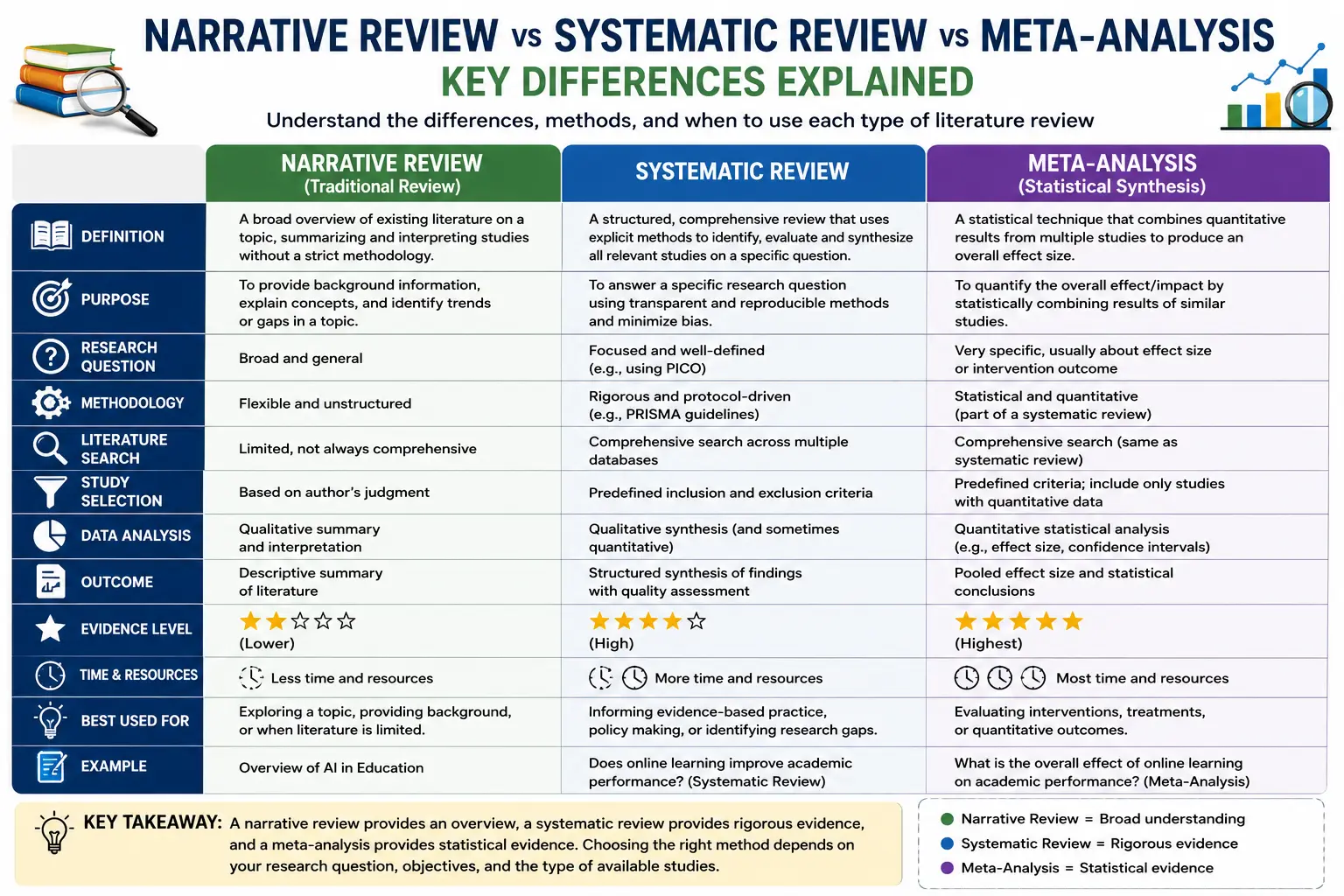
Among the most common approaches used in academic research are the Narrative Review, Systematic Review, and Meta-Analysis. Although these terms are often used interchangeably by beginners, they represent distinct research methods with different objectives, procedures, and outcomes.
Understanding the differences between these review types is particularly important for PhD scholars, postgraduate students, researchers, and faculty members. Choosing the wrong review method can affect the quality, credibility, and publication potential of your research.
In this comprehensive guide, you will learn:
- What a Narrative Review is
- What a Systematic Review is
- What a Meta-Analysis is
- Key differences between them
- Advantages and disadvantages of each approach
- When to use each review type
- Examples from academic research
- Best practices for PhD scholars
What Is a Literature Review?
A literature review is a structured examination of existing research on a specific topic.
The main objectives of a literature review are to:
- Summarize existing knowledge
- Identify research gaps
- Evaluate previous studies
- Develop theoretical foundations
- Support future research
Depending on the research purpose, scholars may choose different review methodologies.
The three most common are:
- Narrative Review
- Systematic Review
- Meta-Analysis
What Is a Narrative Review?
A Narrative Review, also known as a traditional literature review, provides a broad overview and discussion of research on a specific topic.
It focuses on interpreting and summarizing existing studies rather than following a strict methodological process.
Definition
A narrative review synthesizes literature through a descriptive and interpretive approach, allowing researchers to explain concepts, theories, and trends within a field.
Characteristics of a Narrative Review
Broad Scope
Narrative reviews often explore a wide range of studies.
Flexible Methodology
Researchers are not required to follow a standardized protocol.
Qualitative Synthesis
Findings are summarized descriptively.
Theoretical Focus
Emphasis is placed on concepts, frameworks, and interpretations.
Subjective Analysis
Researchers may use professional judgment when selecting and discussing studies.
Example of a Narrative Review
A researcher studying artificial intelligence in education may review:
- AI-based learning tools
- Personalized learning systems
- Educational chatbots
- Student engagement studies
The review discusses themes, trends, and future directions without necessarily documenting every search and selection step.
Advantages of Narrative Reviews
Easy to Conduct
Requires fewer procedural requirements.
Broad Perspective
Provides a comprehensive overview of a field.
Useful for New Topics
Ideal when research areas are still emerging.
Supports Theory Development
Helps build conceptual and theoretical frameworks.
Limitations of Narrative Reviews
Potential Bias
Study selection may be subjective.
Lack of Transparency
Search and inclusion processes are often not fully documented.
Lower Reproducibility
Different researchers may reach different conclusions.
Limited Evidence Strength
Not considered the highest level of scientific evidence.
What Is a Systematic Review?
A Systematic Review is a structured and transparent method of reviewing literature using predefined protocols.
Unlike narrative reviews, systematic reviews aim to minimize bias by following rigorous procedures.
Definition
A systematic review identifies, evaluates, and synthesizes all relevant studies addressing a specific research question using explicit and reproducible methods.
Characteristics of a Systematic Review
Clearly Defined Research Question
Often developed using frameworks such as:
- PICO
- SPIDER
- PICo
Comprehensive Search Strategy
Multiple databases are searched systematically.
Explicit Inclusion Criteria
Researchers establish criteria before screening studies.
Transparent Process
Every step is documented.
Reproducibility
Other researchers should be able to replicate the review.
Example of a Systematic Review
Research question:
"Does online learning improve academic performance among university students?"
Researchers may:
- Search Scopus
- Search Web of Science
- Search PubMed
- Screen thousands of articles
- Apply inclusion criteria
- Assess study quality
- Synthesize findings
The process is usually reported using a PRISMA Flow Diagram.
Advantages of Systematic Reviews
High Scientific Rigor
Follows established protocols.
Reduced Bias
Transparent selection criteria improve objectivity.
Reproducibility
Methods can be replicated.
Strong Evidence Base
Frequently used in healthcare and policy research.
Publication Value
Highly respected by journals.
Limitations of Systematic Reviews
Time-Consuming
May take several months to complete.
Resource Intensive
Requires extensive database searching and screening.
Requires Methodological Expertise
Researchers need training in systematic review methods.
Narrow Focus
Often addresses a highly specific question.
What Is a Meta-Analysis?
A Meta-Analysis is a statistical technique used to combine quantitative findings from multiple studies.
Meta-analysis is often conducted as part of a systematic review.
Definition
Meta-analysis uses statistical methods to calculate an overall effect size from multiple studies investigating the same relationship or intervention.
Characteristics of a Meta-Analysis
Quantitative Approach
Focuses on numerical results.
Statistical Synthesis
Combines data across studies.
Effect Size Calculation
Determines overall impact.
Usually Based on Systematic Reviews
Studies are selected systematically before analysis.
Evidence-Based Conclusions
Provides highly reliable estimates.
Example of a Meta-Analysis
Suppose researchers examine:
"Does mindfulness training reduce stress among university students?"
Twenty studies report stress reduction outcomes.
Meta-analysis combines findings to determine the overall effect.
Advantages of Meta-Analysis
Highest Level of Evidence
Often considered the strongest evidence in research.
Increased Statistical Power
Combines multiple studies.
More Precise Estimates
Produces robust conclusions.
Identifies Patterns
Can reveal trends across different populations and settings.
Limitations of Meta-Analysis
Requires Quantitative Data
Cannot be performed if studies lack statistical results.
Sensitive to Study Quality
Poor-quality studies affect conclusions.
Publication Bias Issues
Unpublished studies may be missing.
Complex Statistical Procedures
Requires advanced analytical skills.
Relationship Between Systematic Reviews and Meta-Analyses
Many researchers assume these are identical, but they are not.
A systematic review can exist without a meta-analysis.
However, a meta-analysis usually requires a systematic review process.
Example
A systematic review identifies 50 studies.
If statistical data are compatible:
- Researchers perform a meta-analysis.
If data are too diverse:
- Researchers provide only qualitative synthesis.
Thus:
Systematic Review ≠ Meta-Analysis
But:
Meta-Analysis + Systematic Review = Common Combination
When Should You Use a Narrative Review?
Narrative reviews are appropriate when:
Exploring Emerging Topics
Example:
Generative AI in higher education.
Building Theoretical Frameworks
Useful for conceptual studies.
Identifying Research Trends
Provides broad understanding.
Writing Traditional Literature Review Chapters
Common in PhD proposals and dissertations.
When Should You Use a Systematic Review?
Systematic reviews are ideal when:
Answering Specific Questions
Example:
"Does remote learning improve academic outcomes?"
Informing Policy Decisions
Provides evidence-based recommendations.
Preparing High-Impact Publications
Many top journals encourage systematic reviews.
Identifying Research Gaps
Supports future studies.
When Should You Use a Meta-Analysis?
Meta-analysis is appropriate when:
Multiple Quantitative Studies Exist
Adequate numerical data are available.
Estimating Overall Effect Size
Researchers want precise conclusions.
Evaluating Interventions
Common in medicine, psychology, and education.
Supporting Evidence-Based Practice
Frequently used in healthcare and policymaking.
Common Mistakes Researchers Make
Calling a Narrative Review a Systematic Review
Many papers claim to be systematic reviews without following systematic procedures.
Ignoring Quality Assessment
Systematic reviews should evaluate study quality.
Conducting Meta-Analysis with Incompatible Data
Studies must be sufficiently similar.
Failing to Document Search Strategies
Transparency is essential.
Confusing Literature Review Chapters with Systematic Reviews
Traditional thesis literature reviews are usually narrative reviews unless systematic methods are used.
Which Review Type Is Best for PhD Scholars?
The answer depends on your research objectives.
Choose a Narrative Review If:
- You are developing theoretical understanding.
- Your topic is broad.
- You are preparing a traditional literature review chapter.
Choose a Systematic Review If:
- You need rigorous evidence synthesis.
- You are publishing a review article.
- You want to identify research gaps objectively.
Choose a Meta-Analysis If:
- Sufficient quantitative studies exist.
- You have statistical expertise.
- Your objective is evidence-based conclusions.
Best Practices for Conducting High-Quality Reviews
Define Clear Objectives
Know exactly what you want to achieve.
Use Multiple Databases
Search broadly.
Document Search Strategies
Maintain transparency.
Assess Study Quality
Evaluate methodological rigor.
Follow Reporting Guidelines
Use PRISMA for systematic reviews.
Avoid Selection Bias
Apply inclusion criteria consistently.
Maintain Detailed Records
Document every decision.
Future Trends in Literature Reviews
The landscape of evidence synthesis continues to evolve.
Emerging approaches include:
- Scoping Reviews
- Rapid Reviews
- Umbrella Reviews
- Integrative Reviews
- Evidence Maps
- AI-Assisted Reviews
These methods complement traditional narrative reviews, systematic reviews, and meta-analyses.
Conclusion
Narrative Reviews, Systematic Reviews, and Meta-Analyses are all valuable research methodologies, but they serve different purposes. Narrative reviews provide broad conceptual understanding and theoretical insights. Systematic reviews offer rigorous, transparent, and reproducible evidence synthesis. Meta-analyses take this a step further by statistically combining results from multiple studies to generate highly reliable conclusions.
For PhD scholars and researchers, understanding these differences is essential for selecting the most appropriate review methodology. The choice should depend on the research question, available evidence, resources, and research objectives. By choosing the right review type and following best practices, scholars can strengthen the quality, credibility, and impact of their academic research.
Website: www.thesislikho.com
Call/WhatsApp: +91 96438 02216