
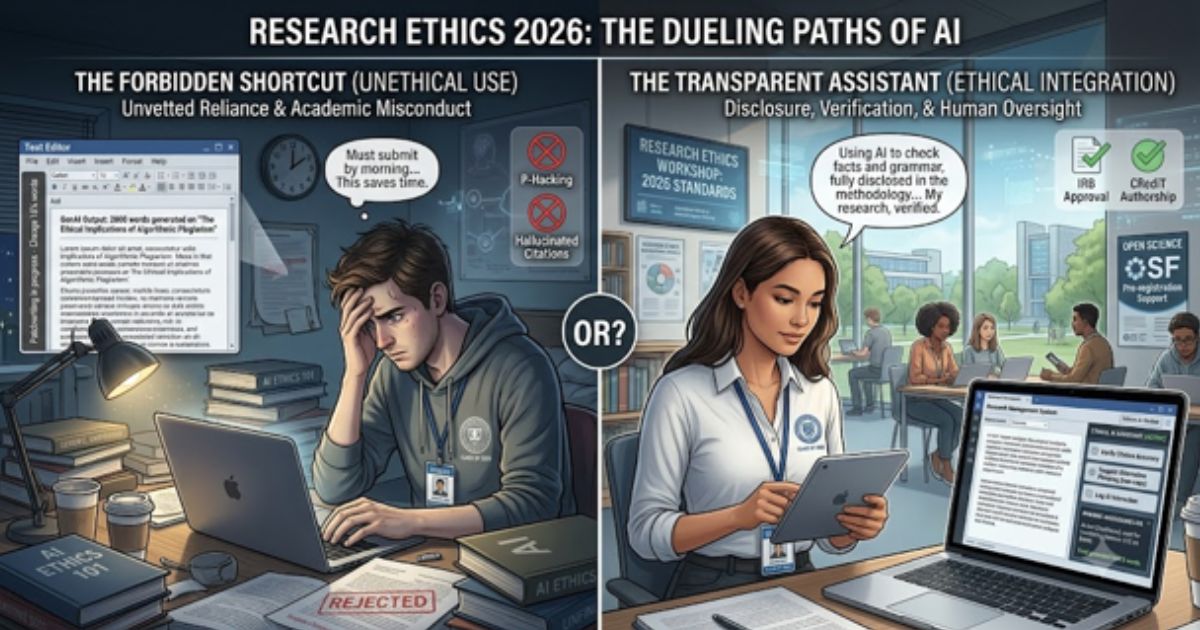
In the highly competitive, hyper-digitized academic landscape of 2026, the phrase "publish or perish" has never carried more weight. Graduate students, doctoral candidates, and early-career researchers face unprecedented pressure to produce high-impact, novel findings at an accelerated pace. However, this pressure, combined with the rapid proliferation of Generative Artificial Intelligence (GenAI), has created a perfect storm for academic misconduct.
Today, research ethics and publication integrity are no longer just about remembering to put quotation marks around a copied sentence. The ethical landscape has evolved into a complex minefield of algorithmic transparency, data privacy, and intellectual property rights. Recent data indicates that while 92% of university students actively use AI tools in their academic workflows, nearly half admit they do not fully understand the ethical boundaries of these technologies. We are witnessing a crisis where students are unintentionally—and sometimes intentionally—lagging behind the ethical standards required by top-tier Scopus and SCI-indexed journals.
This comprehensive, evidence-based guide explores the critical ethical pitfalls where modern students are failing, the severe consequences of publication misconduct, and the exact frameworks students must adopt to ensure their research remains credible, transparent, and ethically sound in 2026 and beyond.
Part 1: The Modern Evolution of Research Ethics
Historically, research ethics primarily concerned the ethical treatment of human subjects (born out of the Nuremberg Code and the Declaration of Helsinki) and the avoidance of blatant plagiarism. While these foundational principles—Autonomy, Beneficence, and Non-maleficence—remain the bedrock of scientific inquiry, the digital age has drastically expanded their definitions.
In 2026, research ethics govern the entire lifecycle of knowledge creation. This includes how a hypothesis is formed, how data is sourced (especially scraped digital data), how algorithms are utilized in data processing, and how authorship is claimed. The traditional "detection-as-deterrent" model—where universities simply run a final paper through Turnitin and punish high similarity scores—is obsolete. Institutions and journals are now shifting toward "Process-Based Integrity." This means evaluators are no longer just looking at the final product; they are scrutinizing the transparency of the process used to arrive at the conclusions.
When technology develops faster than institutional governance, ethical failures occur. For students, ignorance of these new boundaries is no longer an acceptable defense during a peer-review audit or an institutional tribunal.
Part 2: The 7 Critical Pitfalls—Where Students Are Lagging
To fix the crisis of academic integrity, we must first understand exactly where the breakdowns are occurring. Below are the seven major ethical pitfalls where today’s research scholars are falling behind.
1. Algorithmic Plagiarism and the "Invisible Layer" of AI Misuse
The most significant shift in academic dishonesty in the past three years is the rise of Algorithmic Plagiarism. Since GenAI became a mainstream staple, it has evolved into an "invisible layer" in the writing process. Students are using AI not just to proofread, but for initial ideation, literature summarization, and direct composition.
Where Students Lag:
Many students believe that if they prompt an AI to write a paragraph and then manually change a few adjectives (a practice known as "patchwriting"), it constitutes original work. It does not. Furthermore, students are increasingly submitting work heavily reliant on AI-generated content without disclosing the tool's involvement. This violates the core tenet of academic integrity: authentic intellectual effort. As noted in recent academic reviews, relying on AI for core intellectual tasks fundamentally degrades the student’s critical thinking and analytical development.
2. Hallucinated References and Citation Manipulation
One of the most dangerous byproducts of unchecked GenAI use in literature reviews is the phenomenon of "Hallucinated Citations." Language models are designed to predict the next plausible word in a sequence; they are not inherently factual databases.
Where Students Lag:
Students rushing to complete literature surveys often ask AI to generate a list of relevant papers. The AI frequently invents highly plausible-sounding titles, assigns them to real authors, and even generates fake DOIs (Digital Object Identifiers). When students copy and paste these references into their bibliographies without verifying them through databases like Scopus or Web of Science, they commit a severe form of academic dishonesty. Submitting a thesis with fake references destroys the credibility of the entire document and flags the student for immediate disciplinary action.
3. P-Hacking and HARKing (Hypothesizing After Results are Known)
In fields that rely heavily on quantitative data (like psychology, economics, and medical sciences), the pressure to achieve "statistically significant" results (a p-value of less than 0.05) is immense. Journals overwhelmingly favor positive results, creating a bias against publishing null findings.
Where Students Lag:
To force a positive result, students often engage in P-Hacking—running dozens of different statistical tests on a dataset until they accidentally find a correlation that appears significant, and then only reporting that specific test. Closely related is HARKing (Hypothesizing After Results are Known). This occurs when a student explores the data, finds a random pattern, and then writes the introduction of their paper as if they had predicted that pattern all along. Both practices are highly unethical as they inflate false-positive rates and pollute the scientific literature with irreproducible results.
4. Data Fabrication and Falsification
While P-hacking is the manipulation of real data, fabrication and falsification involve outright lying.
- Fabrication: Inventing data sets that were never actually collected.
- Falsification: Manipulating research materials, equipment, or changing/omitting specific data points to make the results align with the desired hypothesis.
Where Students Lag:
In 2026, the rise of "synthetic data" generated by AI has blurred the lines for some students. While synthetic data can be legally used in specific machine-learning training contexts (if explicitly stated), some students are passing off AI-generated datasets as raw, empirical data collected from human participants or field surveys. This is a fatal breach of scientific trust.
5. Authorship Abuse: Ghost, Guest, and AI Authorship
Deciding whose name goes on a research paper—and in what order—is one of the most politically fraught aspects of academia. According to the Committee on Publication Ethics (COPE), authorship must be restricted to individuals who made a substantial intellectual contribution to the conception, design, execution, or interpretation of the study.
Where Students Lag:
Students frequently fall into three traps regarding authorship:
- Ghost Authorship: Paying a third party (a paper mill) to write the manuscript, or failing to credit a junior researcher/statistician who did the heavy lifting.
- Guest/Gift Authorship: Adding the name of a prestigious professor or department head who did no actual work on the paper, solely in the hopes that their reputation will get the paper accepted by a journal.
- AI Authorship: Attempting to list ChatGPT or Claude as a co-author. Standardized journal policies in 2026 explicitly state that AI cannot be an author because it cannot take legal or moral responsibility for the work.
6. Salami Slicing and Self-Plagiarism
Students are often desperate to increase their publication count to improve their CVs for PhD admissions or faculty positions. This desperation leads to unethical publication strategies.
Where Students Lag:
"Salami Slicing" occurs when a student conducts one large, comprehensive study but intentionally slices the data into three or four tiny, separate papers just to get more publications. This skews the scientific literature by making one dataset look like multiple independent studies.
Similarly, Self-Plagiarism (text recycling) occurs when a student copies large sections of their own previously published work into a new paper without citing the original. While it is their own writing, journals require novelty; republishing old work as "new" is a copyright violation and an ethical breach.
7. Bypassing Institutional Review Boards (IRB) and Informed Consent
With the rise of digital sociology and computational research, students often scrape massive amounts of data from social media platforms (like X, Reddit, or TikTok) to analyze human behavior.
Where Students Lag:
Many students mistakenly believe that because data is "publicly available" on the internet, they do not need ethical clearance to use it. This is a severe misconception. Analyzing human data—even digital data—requires approval from an Institutional Review Board (IRB) or Ethics Committee before the research begins. Students are lagging in understanding digital privacy, often publishing recognizable quotes or user data without obtaining informed consent, thereby violating data protection laws like the GDPR and the Digital Personal Data Protection Act.
Part 3: The Devastating Consequences of Publication Misconduct
The academic community polices itself through peer review, and when that trust is broken, the consequences are swift and severe. Students often underestimate the long-term impact of cutting ethical corners.
- Retraction and Public Disgrace: If a journal discovers fabricated data or algorithmic plagiarism post-publication, the paper is formally retracted. The retraction notice, explaining exactly why the paper was pulled, remains permanently attached to the digital record. Platforms like Retraction Watch publicize these failures, creating a permanent, searchable stain on the student's academic record.
- Career Termination: Academic institutions have a zero-tolerance policy for data fabrication. A proven allegation will result in immediate expulsion from a PhD program, the revoking of previously awarded degrees, and termination of academic employment.
- Funding Bans: Government bodies (like the UGC, CSIR, or NSF) will permanently blacklist researchers found guilty of misconduct, barring them from ever receiving research grants in the future.
- Legal and Financial Repercussions: In cases involving medical research, falsified data can lead to dangerous clinical trials, resulting in direct harm to patients and opening the researcher up to criminal liability and massive financial lawsuits.
Part 4: The Blueprint—What Students MUST Do to Ensure Academic Integrity
To survive and thrive in the rigorous academic environment of 2026, students must transition from a mindset of "compliance" to a mindset of "proactive integrity." Here is the exact blueprint students must follow to safeguard their research.
1. Embrace Radical Transparency with AI Usage
You do not have to avoid AI entirely, but you must use it ethically and transparently.
- The Fix: If you use GenAI for any part of your research (e.g., translating text, generating Python code for data analysis, or formatting citations), you must explicitly state this in the Methodology or Acknowledgments section of your paper.
- Rule of Thumb: Use AI as an exoskeleton, not an autopilot. AI can help you structure your thoughts or refine your grammar, but the core hypotheses, critical analysis, and conclusions must originate from your own human intellect.
2. Verify Every Single Citation Manually
Do not trust language models to build your bibliography.
- The Fix: Every time you cite a paper, you must physically access the abstract or full text via a trusted database (Google Scholar, PubMed, IEEE Xplore, Scopus). Verify that the authors, year, and journal match your citation, and ensure that the paper actually supports the claim you are making in your text. Using reference management software like Mendeley or Zotero can help maintain a pristine, verified library of sources.
3. Pre-Register Your Studies to Defeat P-Hacking
The scientific community is moving heavily toward Open Science practices to ensure methodological transparency.
- The Fix: Before you collect a single data point, write down your hypothesis, your exact methodology, and your planned statistical analyses, and upload it to a public registry (such as the Open Science Framework - OSF). Pre-registration proves to journal editors that you did not engage in HARKing or P-hacking, because your analytical plan was time-stamped and locked before you saw the results.
4. Adopt the CRediT (Contributor Roles Taxonomy) System
To avoid authorship disputes and unethical guest authorship, clarity is required from day one.
- The Fix: Use the CRediT system, which is now standard across most major publishers (Elsevier, Springer, Wiley). CRediT defines 14 specific roles (e.g., Conceptualization, Methodology, Software, Formal Analysis, Writing - Original Draft). Before the project begins, the research team should agree on a written document detailing exactly which CRediT roles each person is fulfilling. If someone does not fulfill at least one major role, they belong in the Acknowledgments, not the author list.
5. Prioritize Rigorous Data Management
If a peer reviewer questions your results, you must be able to prove how you arrived at them.
- The Fix: Maintain a meticulous Research Log or Laboratory Notebook. Save every raw dataset, every iteration of your code, and every survey response. When you submit your paper, you should be prepared to upload your raw, anonymized data to a repository (like Figshare or Dryad). "Open Data" is becoming a mandatory requirement for publication in top-tier journals; if you cannot produce your raw data, your paper will be rejected on suspicion of fabrication.
6. Never Bypass the Institutional Review Board (IRB)
No matter how benign your research seems, human subjects require protection.
- The Fix: Whether you are taking physical blood samples or simply sending out an anonymous Google Form survey about workplace stress, you must submit a detailed proposal to your university’s ethics committee. You must generate an Informed Consent Form that clearly explains the purpose of the study, how the data will be stored, and the participant's right to withdraw at any time. Do not collect data until you have the official approval letter in hand.
7. Run Your Own Similarity Checks Before Submission
Do not let the journal be the first entity to check your paper for plagiarism.
- The Fix: Before submitting a manuscript or thesis, run it through institutional-grade software like Turnitin or iThenticate. Review the similarity report critically. A score of 15% might be acceptable if the matches are entirely common methodological phrases and properly formatted quotes. However, if the software highlights entire paragraphs of discussion or analysis, you must rewrite those sections to reflect your original synthesis of the material.
Part 5: The Role of Educational Institutions in 2026
Students cannot bear the burden of academic integrity alone; universities must modernize their approach. In 2026, the literature on educational policy emphasizes a shift from "Detection and Punishment" to "Formative Trust."
Universities are lagging if they only rely on AI-detection software (which has proven to have high false-positive rates, particularly discriminating against non-native English speakers). Instead, institutions must:
- Integrate Ethics into the Curriculum: Research ethics should not be a one-hour seminar during orientation. It must be a core, credit-bearing module integrated into every Master's and PhD program, focusing specifically on data management and ethical AI usage.
- Establish Clear AI Guidelines: Static rules fail as technology evolves. Universities must publish dynamic, campus-wide guidelines defining exactly which AI tools are permissible for which tasks.
- Focus on the Process: Educators should mandate that students submit "version histories" of their documents, early drafts, and annotated bibliographies. Assessing the visible steps of research ensures the student's effort is authentic.
Part 6: How Thesislikho.com Safeguards Your Academic Integrity
Navigating the complex web of modern publication ethics, AI policies, and methodological transparency is overwhelming for early-career researchers. The pressure to publish quickly often tempts students to cut corners, leading to disastrous career consequences.
Thesislikho.com is designed to be your ethical academic partner. We do not write your thesis for you—we provide the expert scaffolding and consultancy required to ensure your original research meets the highest global standards of academic integrity.
How We Elevate Your Research:
- Methodological Auditing and Pre-Registration Support: Our technical consultants help you design robust, reproducible methodologies. We guide you through the process of study pre-registration and power analysis, ensuring your research design is mathematically sound and immune to accusations of P-hacking.
- Ethical Clearance and IRB Preparation: We assist you in drafting flawless Institutional Review Board (IRB) applications. From designing legally compliant Informed Consent forms to outlining secure data anonymization protocols, we ensure your human-subject research is ethically unassailable.
- Advanced Plagiarism and AI-Similarity Analysis: Before you submit your manuscript to a journal, our editorial team runs it through the same university-grade software used by top publishers (like iThenticate). We provide you with a detailed report and guide you on how to ethically paraphrase, synthesize, and properly attribute sources to eliminate accidental plagiarism and reduce your AI-similarity scores legally and transparently.
- Data Management and Open Science Formatting: We help you clean and structure your raw data so it is ready for public repository submission (a requirement for Q1 journals). Our experts ensure your data presentation is transparent, accurate, and free from accidental falsification.
- Targeted Journal Selection (Avoiding Predatory Publishers): One of the biggest ethical pitfalls is accidentally submitting your hard work to a "predatory journal" that publishes fake science for a fee. Thesislikho’s publication experts help you identify legitimate, high-impact, Scopus/SCI-indexed journals that align perfectly with your research, protecting your academic reputation.
In the fast-paced world of 2026, ignorance of publication ethics is a career-ending vulnerability. Do not let a minor formatting error or a misunderstood AI guideline jeopardize years of hard work. Partner with the experts at Thesislikho.com to ensure your research journey is characterized by absolute transparency, rigorous science, and unshakeable ethical integrity.
As AI becomes increasingly integrated into our daily workflows, where do you believe the line should be drawn in academia: Should AI be treated as a forbidden shortcut, or should it be acknowledged as a standard research assistant (like a calculator or spell-check) as long as its use is fully disclosed?
Call / WhatsApp: +91 96438 02216