
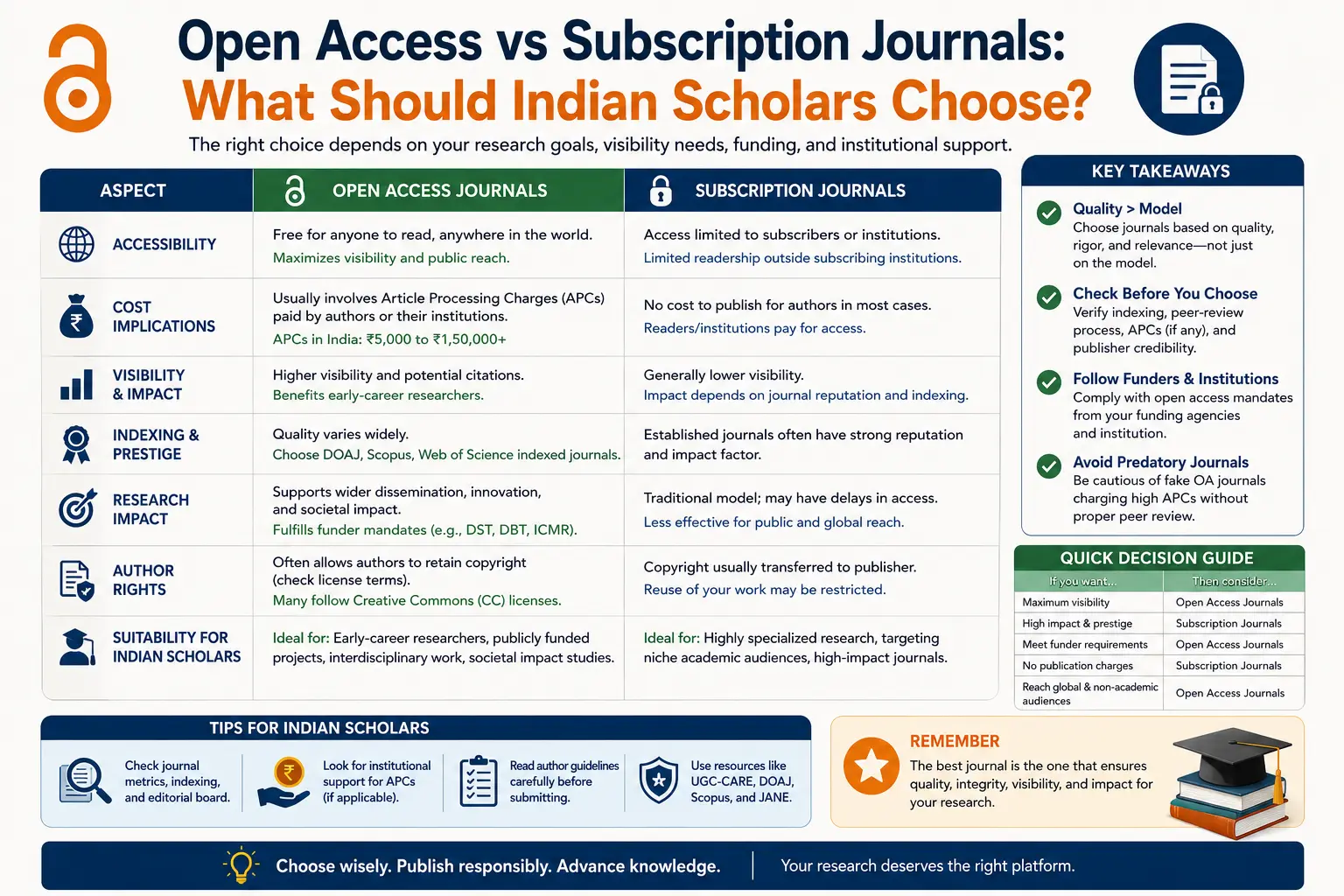
Introduction
Publishing research is one of the most important milestones for PhD scholars, faculty members, research scientists, and postgraduate students. However, after selecting a suitable journal, many researchers face another critical decision:
Should I publish in an Open Access journal or a Subscription-based journal?
This question has become increasingly relevant in India as academic publishing continues to evolve. While Open Access journals promise greater visibility and accessibility, Subscription journals are often associated with established reputations and traditional publishing models.
For Indian scholars, the decision is not always straightforward. Factors such as publication costs, university requirements, funding availability, citation potential, indexing, and career goals all influence the choice.
This comprehensive guide explains the differences between Open Access and Subscription journals, their advantages and disadvantages, and how Indian researchers can choose the right publishing model in 2026.
What Is an Open Access Journal?
An Open Access (OA) journal allows readers to access research articles free of charge.
Anyone with an internet connection can:
- Read articles
- Download papers
- Share research
- Cite publications
without paying subscription fees.
The publication costs are often covered through Article Processing Charges (APCs) paid by authors, institutions, or funding agencies.
Simple Definition
Open Access journals make research freely available to everyone immediately after publication.
What Is a Subscription Journal?
A Subscription Journal restricts access to published articles.
Readers typically gain access through:
- Institutional subscriptions
- University libraries
- Personal subscriptions
- Research databases
The journal earns revenue from subscriptions rather than charging readers directly for individual articles.
Simple Definition
Subscription journals require payment or institutional access to read published research.
How Academic Publishing Has Changed
Traditionally, academic publishing relied almost entirely on subscription models.
Researchers would:
- Submit manuscripts.
- Publish articles.
- Universities would pay subscription fees.
- Readers could access content through libraries.
However, the internet transformed research dissemination.
Researchers began advocating for:
- Free access to knowledge
- Wider dissemination
- Public accessibility
This led to the growth of Open Access publishing.
Today, both publishing models coexist and continue to serve different research communities.
How Open Access Journals Work
The Open Access model shifts costs away from readers.
Instead of readers paying subscription fees:
- Authors
- Universities
- Funding agencies
often pay publication charges.
Once published, articles become freely available worldwide.
Common Open Access Models
Gold Open Access
The entire journal is open access.
Authors often pay APCs.
Green Open Access
Authors publish in traditional journals but deposit copies in institutional repositories.
Hybrid Open Access
Subscription journals allow authors to pay additional fees to make individual articles openly accessible.
How Subscription Journals Work
Subscription journals generate revenue through:
- University subscriptions
- Research libraries
- Professional societies
- Individual memberships
Readers without access often encounter paywalls.
These journals may or may not charge publication fees.
Advantages of Open Access Journals
1. Greater Visibility
One of the biggest advantages of Open Access publishing is visibility.
Anyone can access your research without restrictions.
This includes:
- Researchers
- Students
- Policymakers
- Industry professionals
- General readers
Greater accessibility often leads to wider readership.
2. Higher Citation Potential
Many studies suggest that openly accessible articles receive more downloads and citations.
When more people can read your work, citation opportunities increase.
This can benefit:
- PhD scholars
- Early-career researchers
- Faculty members
who wish to build academic profiles.
3. Faster Knowledge Sharing
Open Access removes barriers to information.
Researchers worldwide can immediately access and build upon published findings.
This is particularly important in rapidly evolving fields such as:
- Artificial Intelligence
- Healthcare
- Biotechnology
- Environmental Science
4. Compliance with Funding Requirements
Many international funding agencies now require:
- Open data
- Open science
- Open Access publication
Publishing in OA journals helps satisfy these requirements.
5. Global Reach
Researchers from developing countries often lack access to expensive subscriptions.
Open Access ensures that scholars worldwide can benefit from your research.
Disadvantages of Open Access Journals
1. Article Processing Charges (APCs)
The most significant drawback is cost.
Many OA journals charge APCs ranging from:
₹30,000 to ₹4,00,000 or more.
For Indian scholars without funding, these costs can be challenging.
2. Predatory Journal Risks
The rapid growth of Open Access publishing has led to an increase in predatory journals.
These journals often:
- Charge fees
- Provide poor peer review
- Lack editorial standards
Researchers must carefully verify journal credibility.
3. Misconceptions About Quality
Some researchers incorrectly assume that all Open Access journals are lower quality.
In reality, many highly respected journals operate under Open Access models.
Advantages of Subscription Journals
1. Strong Historical Reputation
Many of the world's most prestigious journals were traditionally subscription-based.
Researchers often associate these journals with:
- High quality
- Rigorous peer review
- Academic prestige
2. Lower Publication Costs
Many subscription journals publish articles without APCs.
This can be beneficial for:
- PhD students
- Independent researchers
- Scholars with limited funding
3. Established Editorial Standards
Subscription journals often have:
- Experienced editors
- Structured review processes
- Strong publication ethics
4. Institutional Recognition
Many universities continue to highly value publications in established subscription journals.
Disadvantages of Subscription Journals
1. Limited Accessibility
Readers without subscriptions may not access your work.
This reduces potential readership.
2. Reduced Public Impact
Important findings may remain behind paywalls.
As a result, policymakers, practitioners, and independent researchers may not benefit.
3. Lower Discoverability
Restricted access can sometimes limit article downloads and citations.
Open Access vs Subscription Journals: Which Gets More Citations?
A common question among researchers is whether Open Access articles receive more citations.
The answer depends on:
- Discipline
- Research quality
- Journal reputation
- Audience size
However, because Open Access articles are easier to access, they often achieve:
- More downloads
- Greater readership
- Higher visibility
This can contribute to increased citations over time.
Open Access vs Subscription Journals for Indian PhD Scholars
When Open Access May Be Better
Choose Open Access if:
- You have research funding.
- You want maximum visibility.
- Your institution encourages OA publishing.
- Your research has broad public relevance.
- International collaboration is important.
When Subscription Journals May Be Better
Choose Subscription Journals if:
- Funding is limited.
- APCs are unaffordable.
- The journal has a strong reputation.
- Your primary goal is academic recognition.
- Publication costs are a concern.
What Do Indian Universities Prefer in 2026?
Most universities prioritize:
- Journal quality
- Indexing
- Citation impact
rather than the publishing model itself.
Institutions generally value:
High-Quality Journals Indexed In:
- Scopus
- Web of Science
- SCI
- SCIE
Whether the journal is Open Access or Subscription-based is often secondary.
Impact of Open Access on Research Visibility in India
India has witnessed significant growth in Open Access publishing.
Reasons include:
- Increased research output
- Digital transformation
- Government-supported research initiatives
- International collaboration
Open Access helps Indian scholars showcase their work to a global audience without access barriers.
How to Identify a Quality Open Access Journal
Before submitting, verify:
Indexing Status
Check:
- Scopus
- Web of Science
Publisher Reputation
Choose reputable publishers.
Editorial Board
Review editor credentials.
Peer Review Process
Avoid journals promising unrealistically fast acceptance.
APC Transparency
Fees should be clearly displayed.
How to Identify a Quality Subscription Journal
Check:
Scope Alignment
Ensure your research fits the journal.
Impact Metrics
Review:
- Impact Factor
- CiteScore
- Quartile Ranking
Review Quality
Read recent publications.
Publication Ethics
Verify adherence to recognized ethical standards.
Hybrid Journals: The Middle Ground
Many modern journals operate as hybrid journals.
These journals offer:
- Traditional subscription publishing
- Optional Open Access publication
Authors can decide whether to pay APCs.
Hybrid journals provide flexibility for researchers with varying budgets and objectives.
Common Myths About Open Access Publishing
Myth 1: Open Access Journals Are Low Quality
False.
Many highly respected journals operate under Open Access models.
Myth 2: Subscription Journals Always Have Higher Impact
False.
Numerous Open Access journals have excellent citation metrics.
Myth 3: Open Access Guarantees More Citations
Not necessarily.
Research quality remains the most important factor.
Myth 4: All Open Access Journals Charge Fees
False.
Some journals provide Open Access without APCs.
These are often called Diamond Open Access journals.
Future of Academic Publishing in India
Academic publishing continues to evolve rapidly.
Key trends include:
Growth of Open Science
Research transparency is becoming increasingly important.
Expansion of Open Access
Funding agencies increasingly support open dissemination.
AI-Assisted Publishing
Publishers are adopting AI tools for manuscript screening.
Increased Global Collaboration
Researchers seek wider audiences and international visibility.
These trends suggest that Open Access publishing will continue growing in importance.
How Indian Scholars Should Make the Final Decision
Before choosing a journal, ask:
Is the Journal Indexed?
Verify Scopus or Web of Science status.
Can I Afford the APC?
Assess funding availability.
Who Is My Target Audience?
Determine where your readers are most likely to find your work.
What Are My Career Goals?
Publication strategy should align with academic objectives.
Is the Journal Reputable?
Quality should always come first.
Conclusion
The debate between Open Access and Subscription Journals does not have a one-size-fits-all answer. Both models offer valuable opportunities for researchers, and the best choice depends on individual goals, funding, discipline, and publication requirements.
For Indian scholars in 2026:
- Open Access journals offer greater visibility, accessibility, and global reach.
- Subscription journals often provide lower publication costs and long-established reputations.
Rather than focusing solely on the publishing model, researchers should prioritize journal quality, indexing status, peer-review standards, and relevance to their research.
Ultimately, the best journal is the one that ensures your research reaches the right audience while supporting your academic and professional objectives.
Frequently Asked Questions (FAQs)
1. What is the main difference between Open Access and Subscription journals?
Open Access journals provide free access to readers, while Subscription journals require payment or institutional access.
2. Do Open Access journals charge publication fees?
Many Open Access journals charge APCs, although some Diamond Open Access journals publish without fees.
3. Are Open Access journals recognized in India?
Yes. High-quality Open Access journals indexed in Scopus or Web of Science are widely recognized.
4. Which type of journal is better for PhD scholars?
The best choice depends on funding, visibility goals, and journal quality rather than the publishing model itself.
5. Do Open Access articles receive more citations?
They often receive greater visibility and downloads, which may contribute to higher citation rates.
6. Are Subscription journals free for authors?
Many Subscription journals do not charge APCs, but policies vary.
7. How can I avoid predatory Open Access journals?
Verify indexing, publisher reputation, peer-review processes, and editorial standards before submission.
8. Should I choose a journal based only on publication fees?
No. Quality, indexing, reputation, and relevance are far more important than publication costs alone.
Contact ThesisLikho Today
Call / WhatsApp: +91 96438 02216
Visit: ThesisLikho.com