
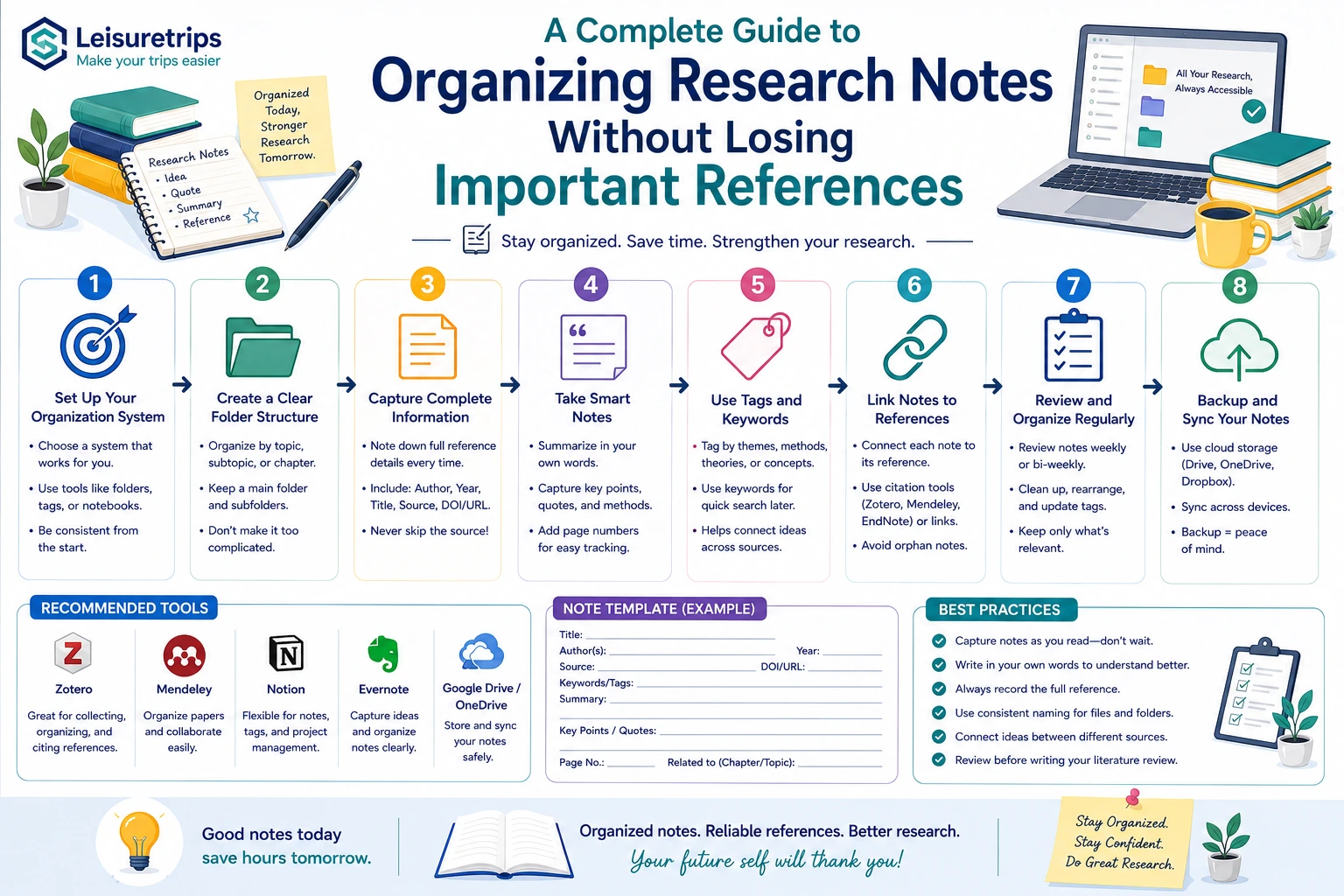
Research is much more than reading journal articles and writing a thesis. Throughout your PhD journey, you'll collect hundreds—sometimes thousands—of research papers, books, reports, datasets, and notes. Without a proper organization system, valuable ideas, important references, and critical insights can quickly become buried under piles of documents or scattered across different folders and devices.
Many PhD scholars in India face the same challenge. They spend hours searching for a journal article they read months ago, struggle to locate the source of a quotation, or accidentally cite the wrong reference. These problems not only waste time but also increase the risk of citation errors, plagiarism, and delays in thesis writing.
The good news is that organizing research notes is a skill you can develop. By following a structured system from the beginning of your research, you can save countless hours, improve your productivity, and make writing your thesis much easier.
This complete guide explains how to organize research notes without losing important references, the best note-taking strategies, useful software tools, and practical tips specifically for PhD scholars and postgraduate researchers.
Why Organizing Research Notes Matters
Research notes are the foundation of your literature review, theoretical framework, methodology, discussion, and conclusion. Every article you read contributes to your understanding of the topic, and every note you take may become an important citation later.
A well-organized note system helps you:
- Find information quickly.
- Avoid duplicate reading.
- Prevent citation mistakes.
- Reduce the risk of plagiarism.
- Save time during thesis writing.
- Keep track of research ideas.
- Improve critical analysis.
- Build stronger arguments.
Instead of wasting hours searching through downloaded PDFs or handwritten notebooks, you'll know exactly where every piece of information is stored.
Common Problems Researchers Face
Many scholars begin their research without a clear organizational strategy. As the number of papers grows, they encounter challenges such as:
- Saving PDFs with random file names.
- Forgetting where a quotation came from.
- Mixing notes from different topics.
- Losing references after changing laptops.
- Creating duplicate notes.
- Forgetting page numbers for direct quotations.
- Using multiple citation styles inconsistently.
- Spending more time searching than writing.
These issues become even more problematic when preparing the literature review or responding to examiner queries.
What Should You Include in Your Research Notes?
Effective research notes should capture more than just summaries. Each note should include enough information to help you understand and cite the source later.
A complete research note should contain:
- Title of the article or book.
- Author(s).
- Year of publication.
- Journal or publisher.
- DOI or URL (if applicable).
- Research objectives.
- Research methodology.
- Sample size.
- Key findings.
- Limitations.
- Important quotations with page numbers.
- Your own observations and critical comments.
- Possible relevance to your research.
Keeping all this information together makes writing citations and literature reviews much easier.
Step 1: Create a Logical Folder Structure
Your digital folders should mirror the structure of your research project.
For example:
PhD Research
iterature Review
Leadership
Innovation
AI
Research Methodology
Data Collection
Data Analysis
Thesis Drafts
References
Conference Papers
Avoid storing everything in a single "Downloads" folder.
Step 2: Use Consistent File Naming
Instead of naming files like:
- paper1.pdf
- article.pdf
- finalversion.pdf
Use a consistent format such as:
Author_Year_ShortTopic.pdf
Examples:
- Sharma_2024_AI_Adoption.pdf
- Kumar_2023_Leadership.pdf
- Gupta_2025_DigitalBanking.pdf
This makes files searchable and easier to identify.
Step 3: Choose a Reliable Note-Taking Method
Different researchers prefer different methods.
Cornell Note System
Divide each page into:
- Main notes
- Keywords
- Summary
This method is excellent for reviewing journal articles.
Outline Method
Organize notes using headings and subheadings.
Example:
Digital Banking
- Adoption
- Security
- Trust
- Customer Satisfaction
This works well for literature reviews.
Mind Mapping
Useful for:
- Brainstorming
- Conceptual frameworks
- Research gap identification
Mind maps help visualize relationships between ideas.
Digital Annotation
Many PDF readers allow highlighting, commenting, and bookmarking.
Benefits include:
- Easy retrieval
- Searchable notes
- Direct connection to source documents
Step 4: Separate Your Notes into Categories
Avoid mixing everything together.
Useful categories include:
Literature Review Notes
Summaries of journal articles.
Methodology Notes
Research methods and sampling strategies.
Theoretical Notes
Important theories and models.
Data Analysis Notes
Statistical methods and interpretations.
Writing Ideas
Potential chapter headings and arguments.
Supervisor Feedback
Comments received during meetings.
Keeping categories separate reduces confusion during thesis writing.
Step 5: Always Record Citation Information Immediately
One of the biggest mistakes researchers make is postponing citation details.
Whenever you read a paper, record:
- Authors
- Publication year
- Journal
- Volume
- Issue
- Pages
- DOI
- Publisher
Never assume you'll remember these details later.
Step 6: Use Citation Management Software
Reference managers are essential for modern researchers.
Zotero
Ideal for beginners.
Features include:
- Free to use
- Browser integration
- Automatic citation generation
- PDF organization
- Note-taking
Mendeley
Popular among PhD scholars.
Features:
- PDF annotation
- Cloud storage
- Collaboration
- Citation generation
EndNote
Preferred by many universities.
Suitable for:
- Large research projects
- Thousands of references
- Advanced citation styles
RefWorks
Often provided through university libraries.
Useful for institutional access.
Step 7: Link Notes to References
Never create notes without linking them to their original source.
Example:
Research Note
Digital banking adoption depends on customer trust.
Source:
Singh (2024), Journal of Banking Research, pp. 45–49.
This simple habit prevents citation errors.
Step 8: Use Color Coding
Visual organization improves productivity.
Example:
- Green – Important theories
- Blue – Research methodology
- Yellow – Research gaps
- Red – Contradictory findings
- Purple – Future research suggestions
Most note-taking applications support color labels.
Step 10: Separate Your Own Ideas from Author Ideas
Always distinguish between:
Original Author's Idea
"This model explains customer adoption."
Your Observation
"This model may also apply to rural banking in India."
Mixing these can unintentionally lead to plagiarism.
Best Digital Tools for Organizing Research Notes
Several applications can simplify research management.
Microsoft OneNote
Ideal for structured notebooks and multimedia notes.
Notion
Excellent for creating databases, research dashboards, and project tracking.
Obsidian
Perfect for linking concepts and building knowledge networks.
Evernote
Suitable for storing web clippings and searchable notes.
Google Keep
Useful for quick reminders and short research ideas.
Google Drive
Provides cloud storage and easy sharing.
Microsoft OneDrive
Good for automatic backup and synchronization.
How to Organize Notes During the Literature Review
As you read each paper, ask yourself:
- What problem is being studied?
- Which theory is used?
- What methodology was applied?
- What are the findings?
- What limitations exist?
- How does this relate to my study?
Recording these answers consistently helps you identify research gaps and organize your review logically.
How to Prevent Losing Important References
Follow these best practices:
- Back up your research regularly.
- Store files in cloud storage.
- Keep copies on an external drive.
- Sync your citation manager across devices.
- Export your reference library periodically.
- Use descriptive file names.
- Record DOIs whenever available.
- Avoid storing files only on one computer.
A small investment in backup practices can save months of work.
Common Mistakes to Avoid
Many researchers unintentionally make organizational mistakes that create problems later.
Avoid:
- Saving files without renaming them.
- Forgetting page numbers for quotations.
- Mixing personal opinions with literature summaries.
- Reading papers without taking notes.
- Using multiple citation styles in one document.
- Ignoring backups.
- Creating duplicate reference libraries.
- Waiting until the writing stage to organize notes.
Tips for Indian PhD Scholars
If you are pursuing a PhD in India, these practices can make your research journey smoother:
- Follow your university's prescribed citation style (APA, MLA, Chicago, IEEE, etc.).
- Organize notes chapter-wise from the beginning.
- Maintain separate folders for UGC guidelines, university regulations, and ethics documents.
- Keep digital copies of supervisor feedback and revisions.
- Use a plagiarism checker before submission to ensure proper citation.
- Schedule weekly sessions to review and organize new notes.
Weekly Research Note Organization Routine
Spending just 30–60 minutes each week can prevent future chaos.
A simple routine:
- Rename newly downloaded papers.
- Add them to the appropriate folder.
- Import them into your reference manager.
- Summarize each paper.
- Highlight key findings.
- Record page numbers for important quotations.
- Update your literature matrix.
- Back up all files.
Consistency is far more effective than trying to organize everything at the end of your PhD.
Frequently Asked Questions (FAQs)
What is the best software for organizing research notes?
For most PhD scholars, a combination of Zotero for reference management and Notion or Microsoft OneNote for note-taking offers an effective and flexible workflow.
Should I take handwritten or digital notes?
Both methods have advantages. Handwritten notes may improve retention, while digital notes are easier to search, organize, and back up. Many researchers use a hybrid approach.
How do I avoid losing references?
Always save complete bibliographic information when reading a source, use citation management software, and maintain regular backups of your files.
Is a literature matrix necessary?
While not mandatory, a literature matrix is highly recommended because it helps compare studies, identify trends, and write a more structured literature review.
How often should I organize my research notes?
Review and organize your notes at least once a week. Regular maintenance prevents clutter and makes thesis writing significantly more efficient.
Conclusion
Organizing research notes is not just about keeping files tidy—it is about creating a reliable system that supports every stage of your thesis. From reading your first journal article to submitting your final dissertation, a well-structured note-taking and reference management process saves time, reduces stress, and improves the overall quality of your research.
Start by creating a logical folder structure, adopting consistent file naming conventions, and recording complete citation details from the very beginning. Use trusted reference management tools, maintain a literature matrix, and back up your work regularly. Most importantly, review and refine your organization system as your research progresses.
For Indian PhD scholars, mastering research organization is one of the smartest investments you can make. A strong note management system not only strengthens your literature review but also ensures that no valuable reference, insight, or idea is lost along the way. By staying organized, you can focus less on searching for information and more on producing original, impactful research that stands up to academic scrutiny.
Call / WhatsApp: +91 96438 02216
Website:www.ThesisLikho.com