
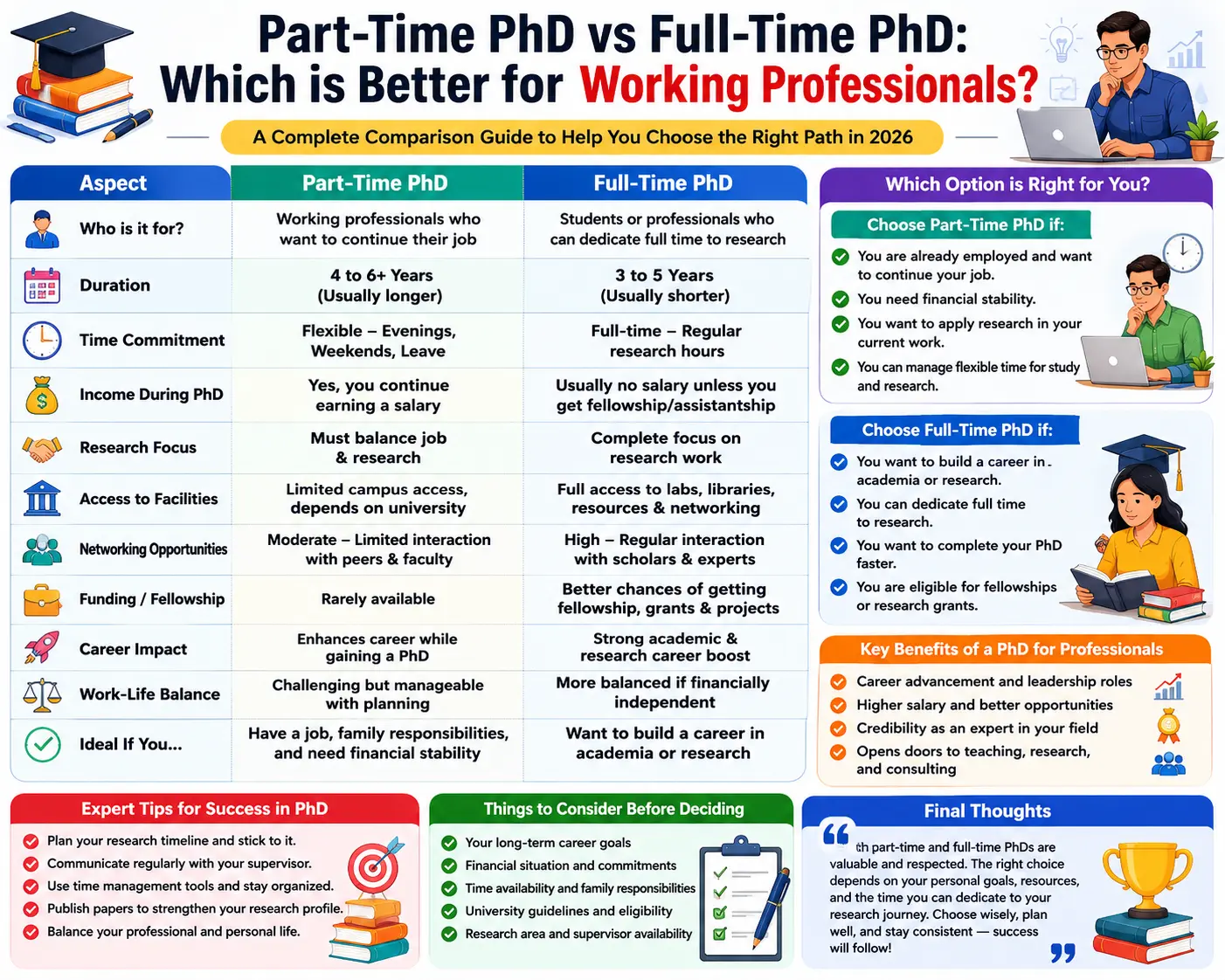
Pursuing a Doctor of Philosophy (PhD) is one of the highest academic achievements and a significant step toward becoming an expert in your field. However, for many working professionals in India, choosing between a part-time PhD and a full-time PhD is a difficult decision. Both options lead to the same doctoral degree, but they differ in terms of time commitment, flexibility, funding, research environment, and career outcomes.
In recent years, the demand for doctoral education has increased due to changing industry requirements, academic opportunities, and the growing emphasis on research and innovation. Professionals working in engineering, management, healthcare, education, information technology, law, and social sciences are increasingly enrolling in PhD programs to enhance their expertise, qualify for teaching positions, or advance into leadership and research roles.
But which option is better for you? Should you leave your job and pursue a full-time PhD, or continue working while completing a part-time doctorate?
This comprehensive guide compares part-time and full-time PhD programs in India, covering eligibility, duration, costs, benefits, challenges, career opportunities, and factors to consider before making your decision.
What Is a Full-Time PhD?
A full-time PhD requires scholars to dedicate themselves entirely to research. Students are expected to attend coursework, meet supervisors regularly, participate in seminars, publish research papers, and spend significant time on campus or in laboratories.
Most full-time scholars receive fellowships, assistantships, or institutional funding, depending on their university and eligibility.
Key Features
- Regular campus attendance
- Full-time research commitment
- Frequent interaction with supervisors
- Access to laboratories and university facilities
- Eligibility for research fellowships
- Faster completion of the degree
What Is a Part-Time PhD?
A part-time PhD is designed for professionals who wish to continue their employment while pursuing doctoral research. Scholars usually conduct research during evenings, weekends, holidays, or flexible working hours.
Many universities require candidates to obtain a No Objection Certificate (NOC) from their employer and ensure that adequate time is available for research.
Key Features
- Continue full-time employment
- Flexible research schedule
- Limited campus visits
- Self-managed research progress
- Suitable for experienced professionals
- Longer duration than full-time programs
Are Part-Time and Full-Time PhD Degrees Equal?
Yes. In India, the degree awarded after successfully completing a PhD is generally the same regardless of whether it was pursued on a part-time or full-time basis, provided the program complies with the regulations of the university and applicable national standards.
The thesis evaluation process, viva voce examination, publication requirements, and academic standards are typically similar for both modes. Employers generally value the quality of the research, publications, skills, and the reputation of the awarding institution more than the mode of study.
Eligibility Criteria
Although eligibility requirements vary among universities, common criteria include:
Full-Time PhD
- Master's degree in a relevant discipline with the required minimum marks.
- Qualification in the university's entrance examination or exemption where applicable.
- Interview or research proposal presentation.
- Availability for full-time research.
Part-Time PhD
In addition to the above, applicants may also need:
- Full-time employment.
- Relevant work experience (where required).
- Employer's No Objection Certificate (NOC).
- Assurance of adequate time and facilities for research.
Always verify the latest admission requirements of your chosen university before applying.
Advantages of a Full-Time PhD
1. Faster Completion
Since research is your primary focus, full-time scholars often complete their degrees more quickly than part-time candidates.
2. Better Research Environment
Daily interaction with faculty members, fellow researchers, laboratories, libraries, and seminars creates a stimulating academic environment.
3. Fellowship Opportunities
Many full-time PhD scholars receive financial support through institutional assistantships or competitive research fellowships, helping them focus on research without relying on external employment.
4. Strong Academic Networking
Regular conferences, workshops, journal clubs, and departmental activities provide opportunities to build professional relationships with researchers and industry experts.
5. Higher Research Productivity
Full-time scholars often have greater opportunities to publish journal articles, present conference papers, and participate in funded research projects.
Challenges of a Full-Time PhD
Despite its benefits, a full-time PhD also has limitations.
Financial Constraints
Leaving a stable job may not be feasible for professionals with family responsibilities or financial commitments.
Limited Industry Experience
Students who remain in academia throughout their doctoral studies may gain less industry exposure compared to working professionals.
Opportunity Cost
Taking several years away from full-time employment can affect immediate earnings and career progression outside academia.
Advantages of a Part-Time PhD
1. Continue Your Career
One of the biggest advantages is that you can retain your job while pursuing higher education.
You continue gaining:
- Professional experience
- Promotions
- Salary increments
- Industry exposure
while simultaneously working toward a doctoral degree.
2. Financial Stability
Since you continue earning a salary, you are less dependent on scholarships or savings.
This makes part-time PhD programs attractive for mid-career professionals.
3. Practical Research Opportunities
Working professionals can often conduct research directly related to workplace challenges.
Examples include:
- AI implementation in manufacturing
- Employee engagement
- Supply chain optimization
- Digital transformation
- Healthcare management
Such industry-focused research can have immediate practical value.
4. Flexibility
Research can often be planned around work schedules, making it easier to balance career and academic goals.
5. Career Advancement
Many professionals pursue a PhD to qualify for senior leadership positions, research roles, consultancy opportunities, or faculty appointments without interrupting their existing careers.
Challenges of a Part-Time PhD
Time Management
Balancing office responsibilities, family commitments, and research requires careful planning and discipline.
Longer Completion Time
Part-time scholars generally take longer to complete coursework, data collection, analysis, and thesis writing.
Limited Campus Interaction
Compared to full-time researchers, opportunities for daily academic discussions and collaborative research may be fewer.
Higher Risk of Delays
Professional responsibilities, transfers, business travel, or personal commitments can slow research progress if not managed effectively.
Which Option Is Better for Working Professionals?
The answer depends on your circumstances and long-term goals.
A part-time PhD may be the better choice if you:
- Have a stable career that you do not want to interrupt.
- Need a regular income.
- Can dedicate consistent time each week to research.
- Wish to solve industry-specific problems through research.
- Are pursuing the PhD primarily for career advancement, professional credibility, or personal growth.
A full-time PhD may be more suitable if you:
- Intend to build a career in academia or full-time research.
- Want to complete the degree as quickly as possible.
- Have access to financial support or fellowships.
- Prefer an immersive research environment with regular supervision and collaboration.
Career Opportunities After a PhD
Both part-time and full-time PhD graduates can pursue rewarding careers, depending on their expertise and interests.
Academic Careers
- Assistant Professor
- Associate Professor
- Research Supervisor
- Academic Administrator
Industry Careers
- Research Scientist
- Data Scientist
- Engineering Consultant
- Product Development Specialist
- Corporate Trainer
- R&D Manager
Government and Public Sector
- Research Organizations
- Public Sector Undertakings (PSUs)
- Policy Think Tanks
- Government Research Institutes
Entrepreneurship and Consulting
A PhD can also strengthen your credibility as a consultant or entrepreneur by demonstrating advanced subject expertise.
How to Choose the Right PhD Mode
Before deciding, ask yourself the following questions:
- What are my long-term career goals?
- Can I afford to leave my job for several years?
- Do I need financial stability during my studies?
- How much time can I realistically dedicate to research each week?
- Does my research require regular laboratory access or specialized equipment?
- Will my employer support my doctoral studies?
- Am I motivated enough to manage independent research over several years?
Your answers will help determine which mode aligns best with your personal and professional circumstances.
Tips for Working Professionals Pursuing a Part-Time PhD
If you decide to pursue a part-time PhD, these strategies can improve your chances of success:
- Create a weekly research schedule and treat it as a fixed commitment.
- Set realistic monthly milestones for literature review, data collection, analysis, and writing.
- Maintain regular communication with your supervisor, even during busy work periods.
- Choose a research topic that aligns with your professional experience whenever possible.
- Use reference management software such as Zotero, Mendeley, or EndNote to organize academic sources.
- Back up your research files regularly using secure cloud storage or version control systems.
- Take advantage of weekends, public holidays, and annual leave for intensive research and writing sessions.
- Prioritize consistency over long but infrequent study sessions.
Common Mistakes to Avoid
Whether you pursue a part-time or full-time PhD, avoid these common pitfalls:
- Choosing a research topic without considering long-term feasibility.
- Underestimating the time required for literature review and thesis writing.
- Delaying communication with your supervisor.
- Ignoring university regulations regarding coursework, publications, or thesis submission.
- Failing to maintain proper research records and documentation.
- Neglecting work-life balance, leading to burnout.
- Copying content without proper citation, resulting in plagiarism.
- Waiting until the final months to begin writing the thesis.
Avoiding these mistakes can save significant time and improve the quality of your doctoral research.
Final Thoughts
Choosing between a part-time PhD and a full-time PhD is a personal decision that should be based on your career aspirations, financial situation, family responsibilities, and research goals. Neither option is universally better—the right choice depends on what best fits your circumstances.
For working professionals who value financial stability and wish to continue advancing in their careers, a part-time PhD offers the flexibility to gain a doctoral qualification without stepping away from employment. On the other hand, individuals aiming for careers in academia, advanced research, or innovation-intensive roles may benefit from the immersive experience and faster progression offered by a full-time PhD.
Whichever path you choose, success depends on careful planning, disciplined time management, consistent communication with your supervisor, and a genuine commitment to high-quality research. A doctoral degree is a long-term investment in your knowledge, expertise, and professional growth. With the right mindset and preparation, both part-time and full-time PhD programs can open doors to meaningful career opportunities and lasting academic achievements.
Website: www.thesislikho.com
Call / WhatsApp: +91-96438 02216