
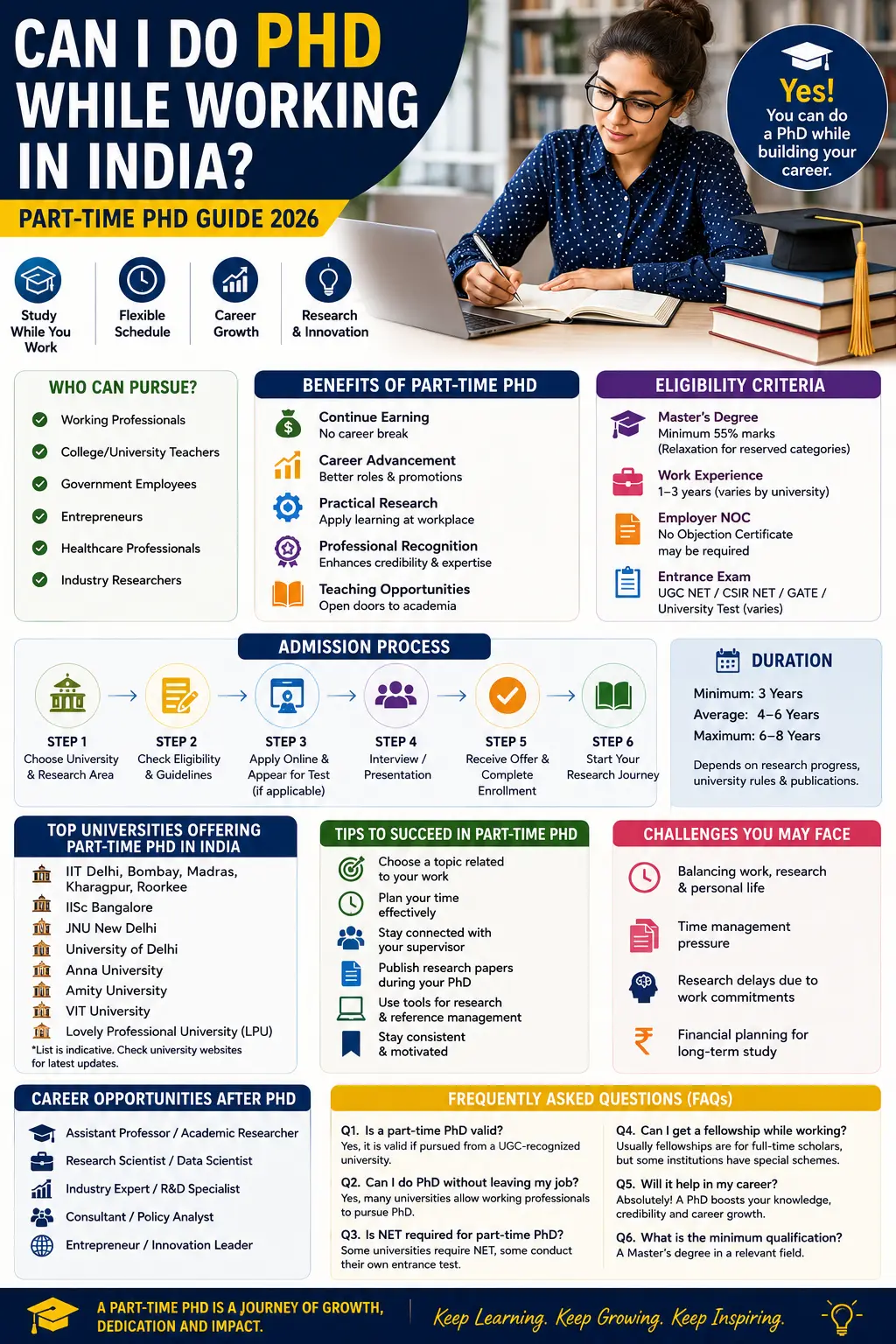
Many professionals in India dream of earning a PhD while continuing their careers. Whether you are a teacher, engineer, researcher, corporate professional, healthcare worker, or government employee, pursuing a doctoral degree can significantly enhance your expertise, career growth, and professional credibility.
A common question among working professionals is: "Can I do a PhD while working in India?" The answer is yes. Many universities in India now offer opportunities for employed candidates to pursue doctoral research through part-time or flexible PhD programs, provided they meet the eligibility requirements.
In this comprehensive guide, we will explain everything you need to know about pursuing a part-time PhD in India in 2026, including eligibility, admission process, benefits, challenges, fees, career prospects, and frequently asked questions.
What Is a Part-Time PhD?
A part-time PhD is a doctoral research program designed for working professionals who cannot devote full-time hours to academic research.
Unlike full-time scholars, part-time PhD candidates continue their employment while conducting research under the supervision of a university-approved guide.
The degree awarded after successful completion is generally the same as a regular PhD. The only difference is the mode of study and research schedule.
Can You Legally Pursue a PhD While Working in India?
Yes. According to current academic regulations in India, many recognized universities allow employed candidates to register for a PhD program.
However, candidates usually need:
- Approval from their employer
- No Objection Certificate (NOC) in many cases
- Proof of work experience
- Availability for research work and university requirements
The exact regulations vary from university to university.
Who Should Consider a Part-Time PhD?
A part-time PhD is ideal for:
College and University Faculty
Teachers often pursue PhDs to meet academic promotion requirements and improve research credentials.
Corporate Professionals
Managers, analysts, IT professionals, and engineers can gain domain expertise through doctoral research.
Government Employees
Government officers and researchers often pursue PhDs related to public policy, administration, economics, or technical fields.
Healthcare Professionals
Doctors, pharmacists, and healthcare administrators can conduct advanced research while continuing practice.
Entrepreneurs
Business owners interested in innovation and research can benefit from doctoral studies.
Eligibility Criteria for Part-Time PhD in India 2026
Although requirements vary, most universities follow similar eligibility standards.
Educational Qualification
Candidates must usually possess:
- Master's degree in a relevant discipline
- Minimum 55% marks or equivalent CGPA
- Relaxation for reserved categories as per government norms
Work Experience
Many institutions prefer candidates with:
- At least 1–3 years of professional experience
- Relevant industry or academic experience
Employer Consent
Some universities require:
- No Objection Certificate (NOC)
- Study leave approval
- Research facility access certificate
Entrance Examination
Candidates may need to qualify:
- University PhD Entrance Test
- UGC NET
- CSIR NET
- GATE
- Other approved examinations
Some institutions exempt NET/JRF-qualified candidates from entrance tests.
Benefits of Doing a PhD While Working
Pursuing a PhD alongside a career offers several advantages.
1. Continue Earning While Studying
One of the biggest advantages is financial stability.
You can:
- Maintain your salary
- Avoid career gaps
- Support your family
- Gain experience while studying
2. Apply Research to Real-World Problems
Working professionals often have access to industry challenges that can become valuable research topics.
This creates opportunities for:
- Industry-driven innovation
- Practical research contributions
- Real-world case studies
3. Career Advancement
A PhD can help professionals qualify for:
- Leadership positions
- Research roles
- Academic careers
- Consulting opportunities
4. Professional Recognition
The doctoral title enhances credibility and demonstrates expertise within a specialized field.
5. Opportunity for Teaching
Many professionals use their PhD qualification to transition into higher education teaching and research.
Challenges of Pursuing a PhD While Working
While rewarding, part-time PhD programs come with challenges.
Time Management
Balancing:
- Work responsibilities
- Research activities
- Family commitments
- University requirements
can become demanding.
Research Pressure
Research requires:
- Literature review
- Data collection
- Data analysis
- Publication writing
These tasks often require consistent effort over several years.
Limited Flexibility
Some universities require:
- Coursework attendance
- Progress presentations
- Research meetings
Working professionals must accommodate these commitments.
Extended Completion Time
Part-time scholars may take longer to complete their research compared to full-time candidates.
Popular Universities Offering Part-Time PhD in India
Several reputed institutions accept working professionals.
Indian Institutes of Technology (IITs)
Many IITs offer external or sponsored PhD options.
Popular choices include:
- IIT Delhi
- IIT Bombay
- IIT Madras
- IIT Kharagpur
- IIT Roorkee
National Institutes of Technology (NITs)
Several NITs provide part-time doctoral opportunities.
Anna University
Well known for engineering and technology research.
Jawaharlal Nehru University (JNU)
Offers research opportunities across multiple disciplines.
University of Delhi
Provides PhD admissions in various departments.
Amity University
Offers flexible doctoral programs for working professionals.
Lovely Professional University (LPU)
Provides research programs with flexible schedules.
VIT University
Popular among engineering and technology researchers.
How Long Does a Part-Time PhD Take?
The duration generally ranges between:
Minimum Duration
3 years
Average Duration
4–6 years
Maximum Duration
6–8 years (depending on university regulations)
Completion time depends on:
- Research complexity
- Publication requirements
- Availability of data
- Candidate commitment
How Much Does a Part-Time PhD Cost in India?
Fees vary significantly.
Government Universities
Approximate annual fees:
₹10,000 – ₹60,000
IITs and NITs
Approximate annual fees:
₹20,000 – ₹1,00,000
Private Universities
Approximate annual fees:
₹50,000 – ₹3,00,000+
Additional costs may include:
- Thesis submission fees
- Examination fees
- Research expenses
- Publication charges
Best Research Areas for Working Professionals
Choosing a topic related to your profession makes research easier and more impactful.
Computer Science
- Artificial Intelligence
- Machine Learning
- Cybersecurity
- Cloud Computing
- Data Science
Management
- Leadership
- HR Analytics
- Marketing Strategy
- Organizational Behavior
- Digital Transformation
Engineering
- Renewable Energy
- Smart Manufacturing
- Robotics
- IoT
- Automation
Education
- Online Learning
- Curriculum Development
- Educational Technology
- Teacher Training
Healthcare
- Public Health
- Hospital Management
- Medical Informatics
- Telemedicine
Tips to Successfully Complete a Part-Time PhD
Choose a Research Topic Related to Your Job
This reduces the burden of collecting data and improves relevance.
Create a Weekly Research Schedule
Dedicate fixed hours every week for:
- Reading
- Writing
- Analysis
Stay Connected With Your Supervisor
Regular communication prevents delays and confusion.
Publish Research Papers Early
Publishing during your PhD improves visibility and strengthens your thesis.
Build a Support Network
Join:
- Academic groups
- Research forums
- Professional associations
Use Research Management Tools
Tools such as:
- Zotero
- Mendeley
- EndNote
- NVivo
- SPSS
can save significant time.
Career Opportunities After a Part-Time PhD
A part-time PhD carries the same academic value as a regular PhD when awarded by a recognized university.
Career opportunities include:
Academia
- Assistant Professor
- Associate Professor
- Research Supervisor
Corporate Sector
- Research Scientist
- Innovation Manager
- Data Scientist
- Strategy Consultant
Government Organizations
- Policy Analyst
- Research Officer
- Technical Expert
Entrepreneurship
Research-driven innovation can lead to startups and consulting opportunities.
Is a Part-Time PhD Worth It in 2026?
For many professionals, the answer is yes.
A part-time PhD allows you to:
- Continue earning
- Gain advanced expertise
- Improve career prospects
- Build research credentials
- Contribute to knowledge creation
However, success requires discipline, planning, and long-term commitment.
If you are passionate about research and willing to invest time consistently, a part-time PhD can be one of the most rewarding educational decisions you make.
Frequently Asked Questions (FAQs)
1. Can I do a PhD while working full-time in India?
Yes. Many universities allow working professionals to pursue part-time or external PhD programs while continuing their employment.
2. Is a part-time PhD valid in India?
Yes. A part-time PhD from a recognized university is valid and generally carries the same academic value as a regular PhD.
3. Do I need my employer's permission for a part-time PhD?
Many universities require a No Objection Certificate (NOC) or employer consent, though requirements vary.
4. How many years does a part-time PhD take?
Most candidates complete their PhD in 4–6 years, depending on research progress and university regulations.
5. Can I become a professor after completing a part-time PhD?
Yes. A recognized PhD degree can qualify you for teaching and academic positions, subject to applicable regulations.
6. Is there an age limit for part-time PhD admission?
Most universities do not have an upper age limit for PhD admission.
7. Can private-sector employees apply for a PhD?
Yes. Employees from IT companies, manufacturing industries, banks, healthcare institutions, and other sectors can apply if they meet eligibility criteria.
8. Which entrance exam is required for a part-time PhD?
Requirements vary. Universities may accept UGC NET, CSIR NET, GATE, or conduct their own entrance examination.
9. Can I receive a fellowship while working?
In most cases, salaried employees are not eligible for regular full-time research fellowships, though some institutions offer special schemes.
10. Is a part-time PhD difficult?
It can be challenging due to work-study balance, but effective time management and consistent effort make it achievable.
Conclusion
Pursuing a PhD while working in India is entirely possible in 2026. With increasing flexibility in doctoral education, professionals now have more opportunities than ever to combine academic research with career growth. By selecting the right university, choosing a relevant research topic, managing time effectively, and maintaining regular communication with supervisors, working professionals can successfully complete a part-time PhD and unlock exciting opportunities in academia, industry, and research.
Contact ThesisLikho Today
Call / WhatsApp: +91 96438 02216
Visit: ThesisLikho.com