
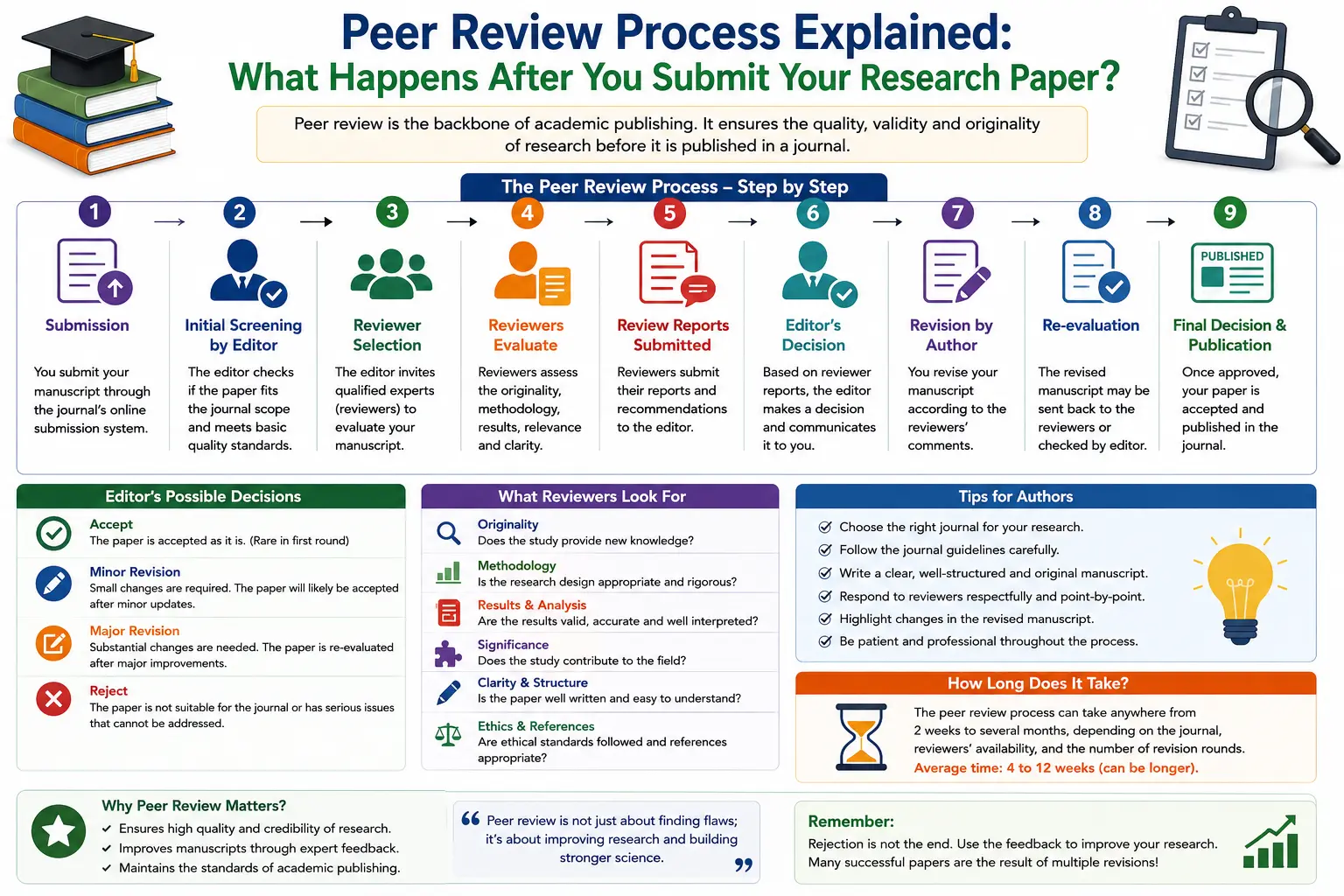
For many researchers, submitting a research paper to a journal is both exciting and nerve-racking. After spending months or even years conducting research, collecting data, analyzing results, and writing the manuscript, the next big question is: What happens after submission?
The answer lies in the peer review process, one of the most important quality-control mechanisms in academic publishing. Peer review helps ensure that published research is accurate, reliable, ethical, and contributes meaningful knowledge to a field of study.
However, many students, early-career researchers, and first-time authors are unfamiliar with the steps that occur after clicking the “Submit” button. Questions such as “Who reads my paper?”, “How long does peer review take?”, and “What are the chances of acceptance?” are common.
In this comprehensive guide, we explain the entire peer review process step by step, helping you understand what happens after you submit your research paper and how to navigate each stage successfully.
What Is Peer Review?
Peer review is the process through which experts in a particular academic field evaluate a submitted manuscript before publication.
The primary objectives of peer review are to:
- Assess research quality
- Verify methodology
- Check originality
- Identify errors
- Improve clarity
- Ensure ethical compliance
- Evaluate significance and contribution
In simple terms, peer review acts as a filter that helps journals publish trustworthy and high-quality research.
Why Is Peer Review Important?
Without peer review, journals could publish inaccurate or misleading findings.
The peer review system helps:
Maintain Academic Standards
Reviewers evaluate whether the study follows accepted scientific and academic practices.
Improve Research Quality
Constructive feedback often strengthens manuscripts before publication.
Detect Errors
Reviewers may identify statistical mistakes, methodological weaknesses, or interpretation issues.
Increase Credibility
Published peer-reviewed research is generally considered more reliable than non-reviewed content.
Protect Scientific Integrity
Peer review helps ensure research findings are accurate and ethical.
Step 1: Submission of the Manuscript
The process begins when authors submit their manuscript through a journal's online submission system.
A typical submission package includes:
- Research manuscript
- Cover letter
- Author information
- Figures and tables
- Supplementary files
- Conflict of interest statements
- Ethical approval documents (if applicable)
After submission, the journal system generates a confirmation email acknowledging receipt.
At this stage, the paper has not yet entered peer review.
Step 2: Initial Editorial Screening
Before reviewers see your manuscript, it undergoes an editorial assessment.
The editor checks whether the manuscript:
- Fits the journal's scope
- Meets formatting guidelines
- Follows ethical standards
- Demonstrates sufficient quality
- Contains plagiarism issues
This stage is sometimes called a desk review.
What Is a Desk Rejection?
A desk rejection occurs when the editor rejects a paper without sending it for peer review.
Common reasons include:
- Poor manuscript quality
- Lack of originality
- Journal scope mismatch
- Weak methodology
- Incomplete submission
- High plagiarism score
Desk rejections are common and should not discourage authors.
Many successful researchers have experienced multiple desk rejections during their careers.
Step 3: Assignment to an Associate Editor
If the manuscript passes the initial screening, it is assigned to:
- Associate Editor
- Handling Editor
- Section Editor
depending on the journal's structure.
The editor becomes responsible for managing the review process.
Their responsibilities include:
- Selecting reviewers
- Monitoring review progress
- Evaluating reviewer recommendations
- Making publication decisions
This stage may take several days to a few weeks.
Step 4: Selecting Peer Reviewers
The editor invites experts who have relevant knowledge in the manuscript's subject area.
Typically:
- 2–4 reviewers are invited
- 2–3 completed reviews are required
Reviewers are selected based on:
- Research expertise
- Publication history
- Academic reputation
- Availability
Finding suitable reviewers is often one of the most time-consuming parts of the process.
Many invited reviewers decline due to workload or scheduling constraints.
Types of Peer Review
Different journals use different review models.
Single-Blind Review
In single-blind review:
- Reviewers know author identities.
- Authors do not know reviewer identities.
This is one of the most common review systems.
Advantages
- Reviewer anonymity encourages honest feedback.
- Easy to implement.
Disadvantages
- Potential reviewer bias.
Double-Blind Review
In double-blind review:
- Authors do not know reviewers.
- Reviewers do not know authors.
Many journals prefer this method to reduce bias.
Advantages
- Greater objectivity.
- Reduced institutional bias.
Disadvantages
- Difficult to completely conceal author identities.
Open Peer Review
In open review:
- Author identities are known.
- Reviewer identities are disclosed.
Some journals even publish reviewer reports.
Advantages
- Increased transparency.
- Greater accountability.
Disadvantages
- Reviewers may hesitate to provide strong criticism.
Step 5: Reviewer Evaluation
Once reviewers accept the invitation, they begin examining the manuscript.
Reviewers evaluate multiple aspects of the research.
Originality
They assess whether the research contributes something new to the field.
Questions include:
- Is the study novel?
- Does it address a research gap?
- Does it provide meaningful insights?
Research Methodology
Reviewers carefully examine:
- Research design
- Sampling methods
- Data collection
- Statistical analysis
- Experimental procedures
Methodological weaknesses are among the most common reasons for revision requests.
Literature Review
Reviewers check whether authors:
- Cite relevant studies
- Discuss recent research
- Position their work appropriately
A weak literature review often triggers revision requests.
Results and Analysis
Reviewers determine whether:
- Results are accurate
- Analyses are appropriate
- Conclusions are supported by evidence
Writing Quality
Reviewers also evaluate:
- Clarity
- Organization
- Grammar
- Readability
Even strong research can face challenges if poorly written.
Step 6: Reviewer Recommendations
After evaluation, reviewers submit their reports and recommendations.
Common recommendations include:
Accept
The paper is ready for publication with minimal or no changes.
This outcome is relatively rare.
Minor Revisions
The paper requires small adjustments such as:
- Clarifications
- Additional references
- Formatting corrections
Acceptance is highly likely after revisions.
Major Revisions
The paper has potential but requires substantial changes.
Examples include:
- Additional analyses
- Expanded discussion
- Methodological clarification
Many papers receive major revision requests.
Reject and Resubmit
The study may be promising but needs extensive restructuring.
Authors may submit a substantially revised version as a new manuscript.
Reject
The manuscript is unsuitable for publication in its current form.
Reasons may include:
- Weak methodology
- Limited contribution
- Significant flaws
Rejection is a normal part of academic publishing.
Step 7: Editorial Decision
The editor reviews:
- Reviewer comments
- Reviewer recommendations
- Personal assessment
The editor then makes a decision.
Importantly, reviewers only make recommendations.
The final decision belongs to the editor.
Sometimes reviewers disagree strongly, requiring the editor to seek additional opinions.
Step 8: Receiving Reviewer Comments
Authors receive:
- Editorial decision letter
- Reviewer reports
- Revision instructions
This is often the most anticipated stage of the process.
Comments may include:
- Questions
- Criticisms
- Suggestions
- Requests for clarification
Constructive feedback is designed to improve the manuscript.
Step 9: Revising the Manuscript
If revisions are requested, authors must carefully address reviewer concerns.
Effective revision involves:
- Updating sections
- Improving explanations
- Adding references
- Revising figures
- Conducting additional analyses
Authors should avoid responding emotionally.
Professionalism is essential.
Step 10: Preparing the Response Letter
Along with the revised manuscript, authors submit a response document.
A strong response letter:
- Addresses every comment
- Explains changes made
- Provides page references
- Respectfully justifies disagreements
Editors appreciate detailed and organized responses.
Step 11: Resubmission
After revisions are completed:
- Manuscript is uploaded again
- Response letter is submitted
- Supporting files are updated
The manuscript returns to the journal for further evaluation.
Step 12: Second Round of Review
Depending on the extent of revisions, the editor may:
Make a Decision Directly
If revisions adequately address concerns.
Send Back to Reviewers
If substantial changes require further assessment.
Multiple review rounds are common.
Some papers undergo:
- Two review rounds
- Three review rounds
- Occasionally more
before final acceptance.
Step 13: Final Acceptance
When the editor is satisfied, the manuscript receives an acceptance letter.
This is a major milestone for researchers.
The acceptance letter confirms that the study will be published.
However, publication itself is not immediate.
Several production steps still remain.
Step 14: Production and Copyediting
After acceptance, the manuscript enters production.
Tasks include:
- Copyediting
- Typesetting
- Formatting
- Quality checks
Editors ensure consistency with journal standards.
Step 15: Proof Review
Authors receive page proofs.
This is the final opportunity to identify:
- Typographical errors
- Formatting issues
- Minor corrections
Major content changes are generally not allowed at this stage.
Step 16: Online Publication
Many journals publish accepted articles online before assigning them to a journal issue.
This stage may be called:
- Early Access
- Online First
- Ahead of Print
The research becomes accessible to readers and researchers worldwide.
Step 17: Issue Publication
Finally, the paper is assigned to a journal volume and issue.
The article receives:
- Final page numbers
- Publication details
- Citation information
The publication process is complete.
How Long Does Peer Review Take?
Peer review timelines vary significantly.
Typical durations include:
Stage Approximate Time
Editorial Screening 1–3 Weeks
Reviewer Selection 1–4 Weeks
Peer Review 4–12 Weeks
Revision Period 2–8 Weeks
Second Review 2–6 Weeks
Production 2–8 Weeks
Overall publication timelines may range from:
- 2 months
- 6 months
- 12 months or more
depending on the discipline and journal.
Common Reasons Papers Get Rejected
Understanding rejection causes helps improve future submissions.
Common reasons include:
Poor Research Design
Weak methodology reduces credibility.
Insufficient Novelty
The study does not contribute new knowledge.
Inadequate Literature Review
Important research is missing.
Weak Data Analysis
Statistical errors undermine findings.
Poor Writing Quality
Unclear presentation limits understanding.
Journal Scope Mismatch
The topic does not align with the journal's focus.
Tips for Navigating Peer Review Successfully
Choose the Right Journal
Ensure alignment between your manuscript and journal scope.
Follow Author Guidelines
Formatting errors create negative first impressions.
Write a Strong Cover Letter
Clearly explain the significance of your research.
Be Patient
Peer review takes time.
Frequent inquiries to editors may not accelerate the process.
Respond Professionally
Treat reviewer comments as opportunities for improvement.
Learn from Rejections
Even rejected papers can become successful publications after revision.
The Future of Peer Review
Academic publishing continues to evolve.
Emerging trends include:
- AI-assisted review tools
- Open peer review
- Transparent review reports
- Post-publication review
- Reviewer recognition systems
These innovations aim to improve efficiency and transparency while maintaining research quality.
Conclusion
The peer review process is the foundation of academic publishing and plays a crucial role in ensuring research quality, credibility, and integrity. While the journey from submission to publication can seem lengthy and complex, understanding each stage helps researchers navigate the process with confidence.
From editorial screening and reviewer evaluation to revisions and final publication, every step contributes to strengthening the scientific value of a manuscript. Receiving revision requests is not a sign of failure but rather an opportunity to improve the quality and impact of your work.
For researchers, especially first-time authors, patience, professionalism, and a willingness to learn are essential. By understanding what happens after submitting a paper and preparing effectively for peer review, authors can significantly increase their chances of successful publication and long-term academic success.
Contact ThesisLikho Today
Call / WhatsApp: +91 96438 02216
Visit: ThesisLikho.com