
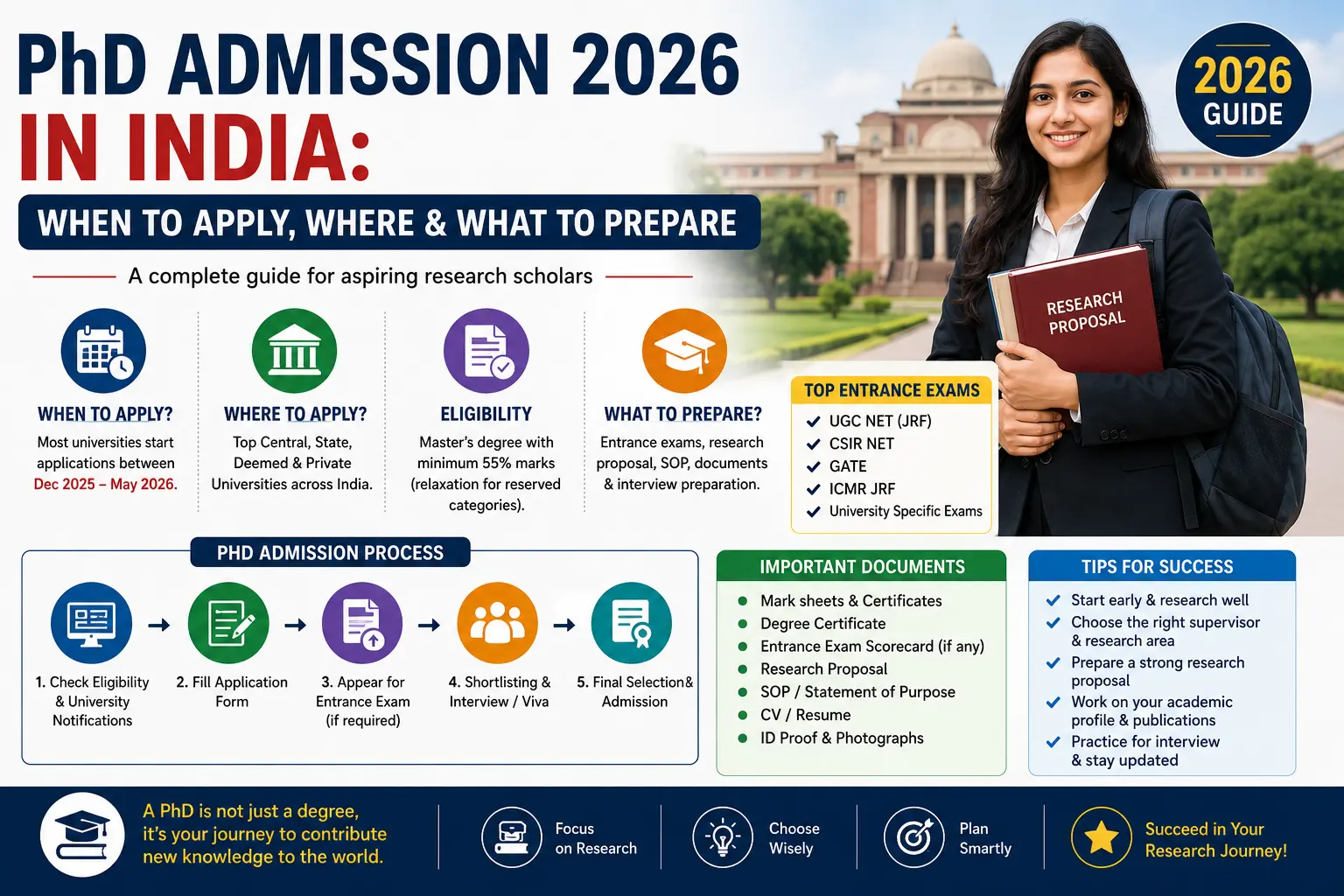
Pursuing a PhD is a significant academic milestone that opens doors to careers in research, teaching, innovation, consulting, and leadership. As India continues to strengthen its higher education and research ecosystem through initiatives like the National Education Policy (NEP), the demand for qualified researchers is growing rapidly. Consequently, thousands of aspirants are expected to apply for PhD Admission 2026 in India across universities, IITs, IIMs, central institutions, and private universities.
However, many students are often confused about when to apply for PhD admission, which universities to target, what entrance exams to prepare for, and how to improve their chances of selection. Since PhD admissions involve multiple stages—including entrance examinations, research proposals, interviews, and document verification—early preparation is essential.
This comprehensive guide covers everything you need to know about PhD Admission 2026 in India, including eligibility, application timelines, top universities, preparation strategies, admission procedures, scholarships, and career prospects.
Why Pursue a PhD in India in 2026?
A PhD (Doctor of Philosophy) is the highest academic qualification awarded by universities. It focuses on original research and contributes new knowledge to a particular field.
The increasing emphasis on research and innovation in India has created new opportunities for PhD scholars in:
- Higher education institutions
- Government research organizations
- Public policy think tanks
- Corporate R&D departments
- Data analytics and AI sectors
- Healthcare and biotechnology industries
Benefits of pursuing a PhD include:
- Advanced subject expertise
- Research and analytical skills
- Academic career opportunities
- Better salary prospects
- Access to fellowships and grants
- International collaboration opportunities
Who Can Apply for PhD Admission 2026?
The basic eligibility criteria for PhD admission in India remain similar across most institutions.
Educational Qualification
Candidates must possess:
- Master's degree in a relevant discipline
- Minimum 55% aggregate marks
For reserved categories:
- 50% marks (as per UGC norms)
Accepted qualifications include:
- MA
- MSc
- MTech
- MBA
- MCom
- MEd
- MCA
- LLM
and equivalent postgraduate degrees.
When to Apply for PhD Admission 2026?
One of the most common questions among aspirants is:
"When should I start preparing for PhD admission?"
The answer is: at least 6–12 months before applications open.
Most universities conduct admissions in two cycles:
January Session
Application Period:
- October–December 2025
Entrance Tests:
- December 2025 to January 2026
Interviews:
- January–February 2026
July Session
Application Period:
- March–June 2026
Entrance Tests:
- June–July 2026
Interviews:
- July–August 2026
Because admission schedules vary by institution, students should regularly monitor university websites.
Top Universities for PhD Admission 2026 in India
Selecting the right university is one of the most important decisions in your doctoral journey.
1. Indian Institutes of Technology (IITs)
Top IITs offering PhD programs include:
- IIT Delhi
- IIT Bombay
- IIT Madras
- IIT Kharagpur
- IIT Kanpur
Popular fields:
- Engineering
- Artificial Intelligence
- Data Science
- Management
- Sciences
2. Indian Institutes of Management (IIMs)
IIMs offer doctoral programs such as:
- PhD in Management
- Fellow Programme in Management (FPM)
Leading options:
- IIM Ahmedabad
- IIM Bangalore
- IIM Calcutta
- IIM Lucknow
3. Central Universities
Some leading choices include:
- University of Delhi
- Jawaharlal Nehru University (JNU)
- Banaras Hindu University (BHU)
- Aligarh Muslim University (AMU)
- Hyderabad Central University
4. National Institutes
Examples:
- TISS
- IISc Bangalore
- NITs
- AIIMS
- NIPER
5. Private Universities
Popular private institutions include:
- Amity University
- Lovely Professional University (LPU)
- Symbiosis International University
- Christ University
- Manipal University
Popular PhD Entrance Exams in India 2026
Many universities require candidates to qualify for entrance examinations.
UGC NET
One of the most widely accepted examinations.
Benefits:
- Eligibility for Assistant Professorship
- PhD admissions
- JRF funding opportunities
UGC NET JRF
Candidates qualifying JRF receive:
- Monthly fellowship
- Better admission opportunities
- Research funding support
GATE
Accepted for:
- Engineering
- Technology
- Science disciplines
Especially useful for IIT admissions.
CAT
Several IIMs consider CAT scores for management doctoral programs.
University Entrance Tests
Many universities conduct their own examinations.
Examples include:
- BHU RET
- JNU PhD Entrance
- DUET (where applicable)
- University-specific tests
What to Prepare for PhD Admission 2026
Preparation should begin well before the application process.
1. Identify Your Research Interest
The first step is selecting a broad research area.
Examples:
Engineering
- Artificial Intelligence
- Machine Learning
- Renewable Energy
Management
- Digital Marketing
- Business Analytics
- Human Resource Management
Education
- Educational Technology
- Inclusive Education
Science
- Biotechnology
- Environmental Science
- Physics
A clearly defined research interest helps during interviews and proposal writing.
2. Prepare for Entrance Examinations
Entrance exams generally cover:
- Research aptitude
- Subject knowledge
- Analytical reasoning
- Quantitative ability
Preparation tips:
- Review previous papers
- Study core concepts
- Practice mock tests
- Improve research methodology knowledge
3. Develop a Research Proposal
Many universities require a preliminary research proposal.
A strong proposal should include:
Research Title
Clear and focused.
Problem Statement
What issue are you addressing?
Objectives
What do you aim to achieve?
Literature Review
What has already been studied?
Methodology
How will the research be conducted?
Expected Outcomes
What contribution will your research make?
4. Improve Academic Writing Skills
Academic writing is crucial for:
- Research proposals
- Statement of Purpose (SOP)
- Publications
- Thesis writing
Practice:
- Research paper reading
- Literature reviews
- Academic referencing styles
5. Build a Research Profile
A strong profile can improve admission chances significantly.
Consider:
- Publishing papers
- Attending conferences
- Presenting research
- Completing online certifications
These activities demonstrate research interest and commitment.
Documents Required for PhD Admission 2026
Most universities ask for:
- Master's degree certificate
- Mark sheets
- Identity proof
- Passport-size photographs
- Category certificate (if applicable)
- NET/JRF/GATE scorecard
- Research proposal
- Statement of Purpose (SOP)
- Updated CV or Resume
Ensure all documents are ready before applications open.
How to Write a Strong Statement of Purpose (SOP)
The SOP often influences shortlisting decisions.
Include:
Academic Background
Highlight relevant education.
Research Interests
Explain what motivates your research.
Career Goals
Describe long-term objectives.
Why This University?
Show alignment between your interests and faculty expertise.
Avoid:
- Generic statements
- Copied content
- Overly broad research goals
How to Prepare for the PhD Interview
The interview is often the deciding stage.
Common questions include:
- Why do you want to pursue a PhD?
- What is your research topic?
- Why did you choose this university?
- What research methods will you use?
- What are your career goals?
Preparation tips:
- Know your proposal thoroughly
- Review subject fundamentals
- Stay updated with recent developments
- Practice explaining your research clearly
Scholarships and Fellowships for PhD Students
Financial support is available through several schemes.
UGC JRF Fellowship
Provides monthly stipend and contingency grants.
CSIR Fellowship
For science-related disciplines.
IIT and IIM Fellowships
Many institutions offer:
- Monthly stipends
- Tuition fee waivers
- Research grants
State Government Scholarships
Various state governments support doctoral research through dedicated fellowship schemes.
Common Reasons for PhD Admission Rejection
Understanding common mistakes can improve your chances.
Weak Research Proposal
Unclear objectives and methodology reduce selection chances.
Poor Interview Performance
Inability to explain research ideas confidently can lead to rejection.
Lack of Subject Knowledge
Insufficient preparation often becomes evident during interviews.
Incomplete Documentation
Missing certificates or application errors may result in disqualification.
Poor Supervisor Match
Research interests must align with faculty expertise.
How to Increase Your Chances of Selection
Start Early
Begin preparation at least six months before applications.
Publish Research
Even one publication strengthens your profile.
Contact Potential Supervisors
Discuss your research interests before applying.
Qualify NET or JRF
These credentials improve credibility and funding prospects.
Attend Academic Conferences
Networking can provide valuable insights and opportunities.
Career Opportunities After a PhD
A PhD opens diverse career paths.
Academic Careers
- Assistant Professor
- Associate Professor
- Professor
- Academic Administrator
Research Careers
- Research Scientist
- Policy Analyst
- Research Consultant
Corporate Careers
- Business Analyst
- Data Scientist
- R&D Specialist
- Innovation Consultant
Government Sector
- Research Officer
- Scientific Officer
- Policy Advisor
Salary After PhD in India
Approximate salary ranges:
Position Salary Range
Assistant Professor ₹8–15 LPA
Associate Professor ₹12–25 LPA
Professor ₹18–40 LPA
Research Scientist ₹10–30 LPA
Corporate Research Professional ₹12–40 LPA
Salaries vary based on specialization, experience, and institution.
Conclusion
PhD Admission 2026 in India presents excellent opportunities for students and professionals interested in research, innovation, and higher education. However, securing admission requires strategic planning, early preparation, and a clear understanding of the admission process.
Start by identifying your research interests, preparing for entrance examinations, building a strong academic profile, and developing a compelling research proposal. Target universities that align with your research goals and connect with potential supervisors whenever possible.
With proper preparation and persistence, you can successfully secure admission to a prestigious doctoral program and begin a rewarding journey toward becoming a researcher, academic, or industry expert. As India's research ecosystem continues to expand, a PhD can provide both intellectual fulfillment and long-term career growth.
Frequently Asked Questions (FAQs)
1. When should I apply for PhD Admission 2026 in India?
Most universities open applications between January and July 2026, while some institutions may begin accepting applications in late 2025.
2. What is the minimum eligibility for PhD admission in India?
Candidates generally need a Master's degree with at least 55% marks (50% for reserved categories as per UGC guidelines).
3. Is UGC NET mandatory for PhD admission?
No. Many universities conduct their own entrance exams, though UGC NET or JRF qualification can provide advantages.
4. Which entrance exams are accepted for PhD admission in 2026?
Popular exams include UGC NET, JRF, GATE, CAT, CSIR NET, and university-specific entrance tests.
5. How long does a PhD take to complete in India?
A PhD generally takes between 3 and 6 years depending on the research area and university regulations.
6. Can working professionals pursue a PhD?
Yes. Many universities offer part-time and executive PhD programs designed for working professionals.
7. Do I need a research proposal before applying?
Many universities require a preliminary research proposal either during the application process or at the interview stage.
8. What is the benefit of qualifying UGC NET JRF?
JRF qualification provides fellowship funding, improves admission prospects, and demonstrates research aptitude.
9. Are scholarships available for PhD students?
Yes. UGC JRF, CSIR Fellowships, institutional assistantships, and government scholarships are available.
10. Is a PhD worth pursuing in India in 2026?
Yes. With increasing research funding, academic opportunities, and industry demand for research professionals, a PhD remains a valuable qualification for long-term career growth.
Contact ThesisLikho Today
Call / WhatsApp: +91 96438 02216
Visit: ThesisLikho.com