
Introduction
PhD students in India frequently comment that undertaking original research at this level is more of a marathon than a sprint. It is a multi-year test of one’s physical and mental endurance. It is not surprising that so many research students describe their experience of doing a PhD in India as exhausting, frustrating, and a hopeless endeavor which is colloquially termed as PhD burnout.
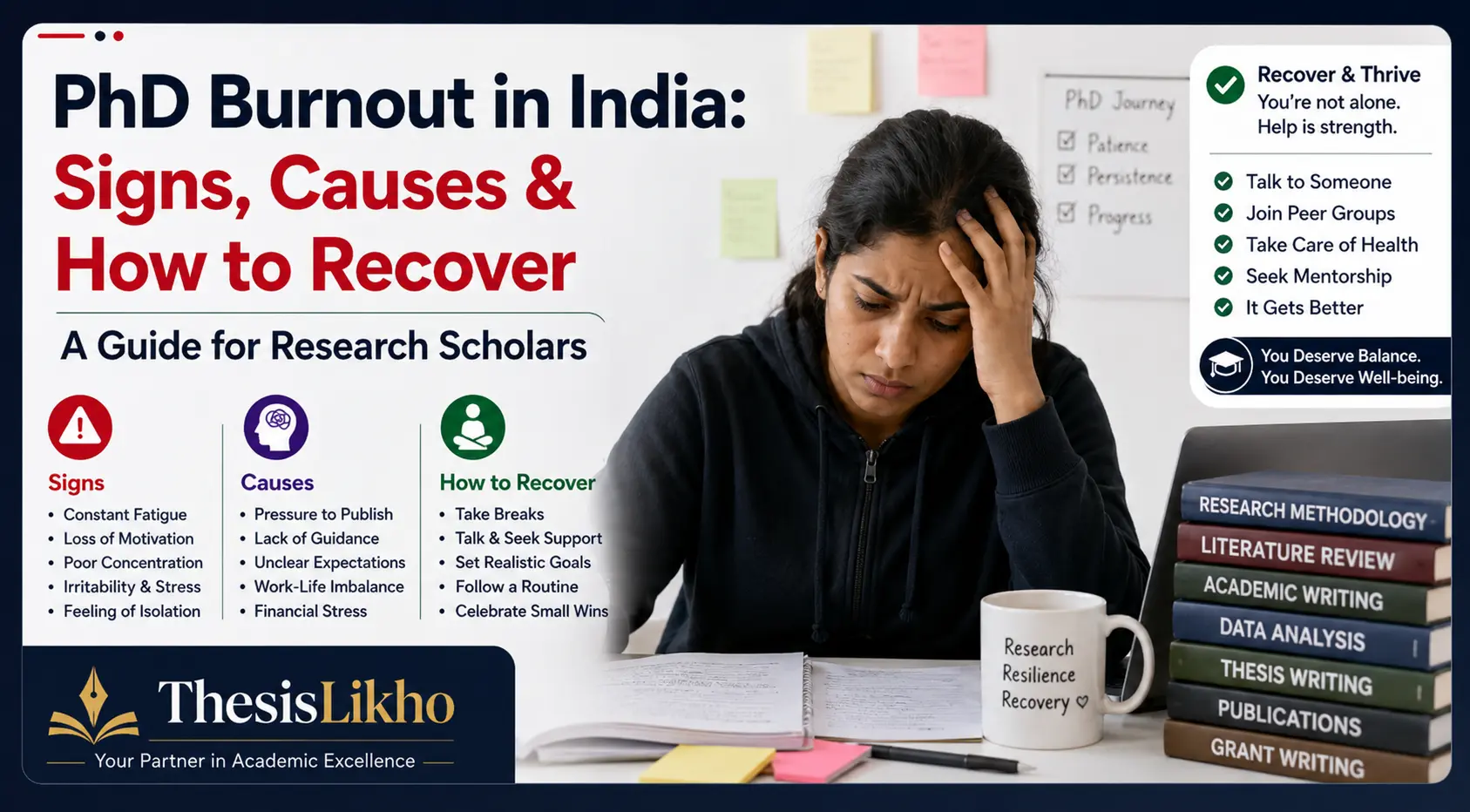
Even though burnout is typically used in a casual context to describe a general sense of tiredness, it is actually defined as a chronic state of physical, mental, and emotional fatigue that is caused by stress which has reached an overwhelming level. PhD student burnout is a serious issue in India. Research PhDs in India face high levels of stress due to the high pressure, expectation, and almost complete lack of support. This blog is a potential resource for PhD students. It discusses the symptoms, causes and the possible ways to recover from a burned out state caused by PhD related stress.
1. PhD Burnout
Burnout is beyond just being stressed out. Stress is often temporary and can serve as a motivator. Burnout is chronic. It is characterized by:
A lack of motivation
Emotional and physical exhaustion
Diminished efficiency and productivity
Emotional and social detachment from research and colleagues
From an analytical perspective, the negative emotional effects and lack of motivation that characterize PhD burnout are likely caused by the pressure and stress of the elongated, and often uncertain and highly scrutinized, doctoral research process.
2. Signs of PhD Burnout
a. Emotional Signs
Anxiety or sadness that becomes chronic
Irritability and mood swings
Disinterest in research or a failure to engage in academic discourse
b. Physical Signs
Chronic fatigue that occurs despite an adequate amount of sleep
Chronic headaches, muscle tension, and digestive disorders
Inconsistent sleep (i.e. insomnia or hypersomnia)
c. Academic Signs
Difficulty concentrating
Procrastination and an overall failure to meet deadlines
Diminished academic performance and an overall decline in the quality of one’s academic work
d. Social Signs
Withdrawal from colleagues and cessation of communication with research mentors
Avoidance of conferences or seminars.
Feeling of isolation or of being misunderstood.
3. Causes of PhD burnout in India
a) Excessive Academic Work
Indian universities create an environment in which students are constantly pressured to assert their importance.
b) Financial Pressure
The majority of PhD students in India have to work on a fellowship, either UGC JRF or CSIR. These fellowships pay poorly, and inconsistent payments are an added pressure, especially on students with families.
c) Lack of Supervisory Support
Some supervisors are simply poor or non-existent. These students have to contend with poor or absent mentorship, and lack of communication seems to frequent these issues as well.
d) Poor Institutional Support
A lack of research infrastructure, coupled with poor administrative facilitation and excessive bureaucracy, makes research in these institutions difficult.
e) Lack of work-life balance
Sociocultural pressures, coupled with poor health, adds to an already stressful life.
f) Lack of Assurance of Income Post PhD
The anxiety of not knowing where to work after a PhD, whether in academia, in industry or in government, adds to the stress.
Impact of burnout
Burnout makes life difficult, and the PhD process strains:
Mental health (anxiety, depression, etc)
Physical health.
Relationships with colleagues, superiors, and family.
Increased rate of abandonment of PhD
How to recover from PhD burnout
a) Acknowledge the problem
Burnout is a common and acceptable reason to stop work. Many doctors feel laziness and blame themselves.
b) Seek Support
Employers: tell them you’re having problems.
Colleagues: tell them about problems, and how to cope.
Counselors: Universities now commonly have mental health services.
c) Work less
Break larger tasks down into smaller tasks and only do those.
d) Make Time for Yourself
Have a good sleep and a good exercise schedule.
Try to do some mindfulness or meditation (maybe try the app Headspace or InnerHour).
Don't feel bad for taking a break.
e) Find Your Motivation Again
Think back to the reason you started your PhD.
Have conversations that are good for your mental state.
Go to seminars outside your research area to inspire you.
f) Make Room for Your Life
Schedule hangouts with family and friends.
Practice your hobbies.
Create a research zone to focus only on research.
g) Look into Many Careers
Not being able to see the future can make people burnout. Look into the many careers - whether you want to go into teaching, the research industry, or even the business field - for some motivation to keep going.
6. What Can Be Done to Prevent Burnout
Filling certain needs like providing counselors and wellness programs, offering punctual stipends (scholarships), teaching supervisors to become good mentors, forming peer groups, and reducing the red tape in research can make an important difference.
7. What Can Be Done to Build Resilience From Burnout
Having some strong coping skills like going to the gym or meditating, strong and useful connections with your colleagues both local and abroad, being prepared to change your plans when some research doesn’t go to plan, and most importantly - learn to celebrate the smaller achievements in your research journey.
Frequently Asked Questions - FAQs
1. Is PhD burnout common in India?
Burnout is perhaps the norm, with the combination of pressure to perform academically, insufficient funding, and concerns about future employment.
2. What is burnout?
Burnout can be described as a combination of fatigue, a lack of motivation, procrastination, and emotional distress.
3. Can burnout cause someone to drop out of a PhD program?
It is certainly possible. Without intervention and the development of healthy coping mechanisms, there is a very real possibility of persistent burnout.
4. Should I tell my supervisor I feel burnt out?
You should. If you are candid, it may lead your supervisor to enact changes to your workload.
5. Can PhD students access professional services?
Most universities have begun to implement counselling services, and there are mental health professionals that can be accessed through external services like Practo.
6. Does the experience of taking a break help?
Yes. Refreshing your focus is possible with the implementation of short breaks but, be warned, long periods of break can be harmful and add to your stress.
7. Does burnout have an impact on your job opportunities?
Yes, if it is not addressed. However, recovering from burnout is a sign of strength and can improve your chances of obtaining a healthy work life.
8. How can institutions help to lessen burnout?
A more flexible system with less bureaucracy, timely financial support, and the provision of more mentors and wellness programs.
9. Is academic stress the only contributor to burnout?
No. There are several factors like financial and personal stress.
10. Is it true that burnout can be aided with the implementation of mindfulness?
Yes. There is evidence to support that mindfulness practices can enhance emotional resilience, lower stress, and improve focus.
Conclusion
There is multi-facetal PhD burnout in India that is affecting thousands of people. It is important to learn the signs of burnout and the implications that it has on both personal life and on research.
Burnout is a signal that the current system is not working. It is possible to recover from burnout with support and the implementation of self-care and self-management. With the introduction of positive change systems that support scholars, instead of exhausting them, a thriving system is possible.
At the end of the day, a thesis is only one portion of the journey that is obtaining a PhD. The PhD journey provides opportunities for developmental growth. This growth is lifelong; it adds ups on a personal level and professional level. Growth is difficult, but stronger support systems tend to provide better endpoints. PhDs demand a lot, and if there is no balance, burnout can happen. Burnout is real, but overcoming it, and being able to look back on this time as a positive, fulfilling part of one’s life is even more real.
ThesisLikho supports scholars throughout the dissertation process helping them turn research ideas into quality academic contributions that meet university and publication standards.
Contact ThesisLikho
Website: www.ThesisLikho.com
Call/WhatsApp: +91 96438 02216