
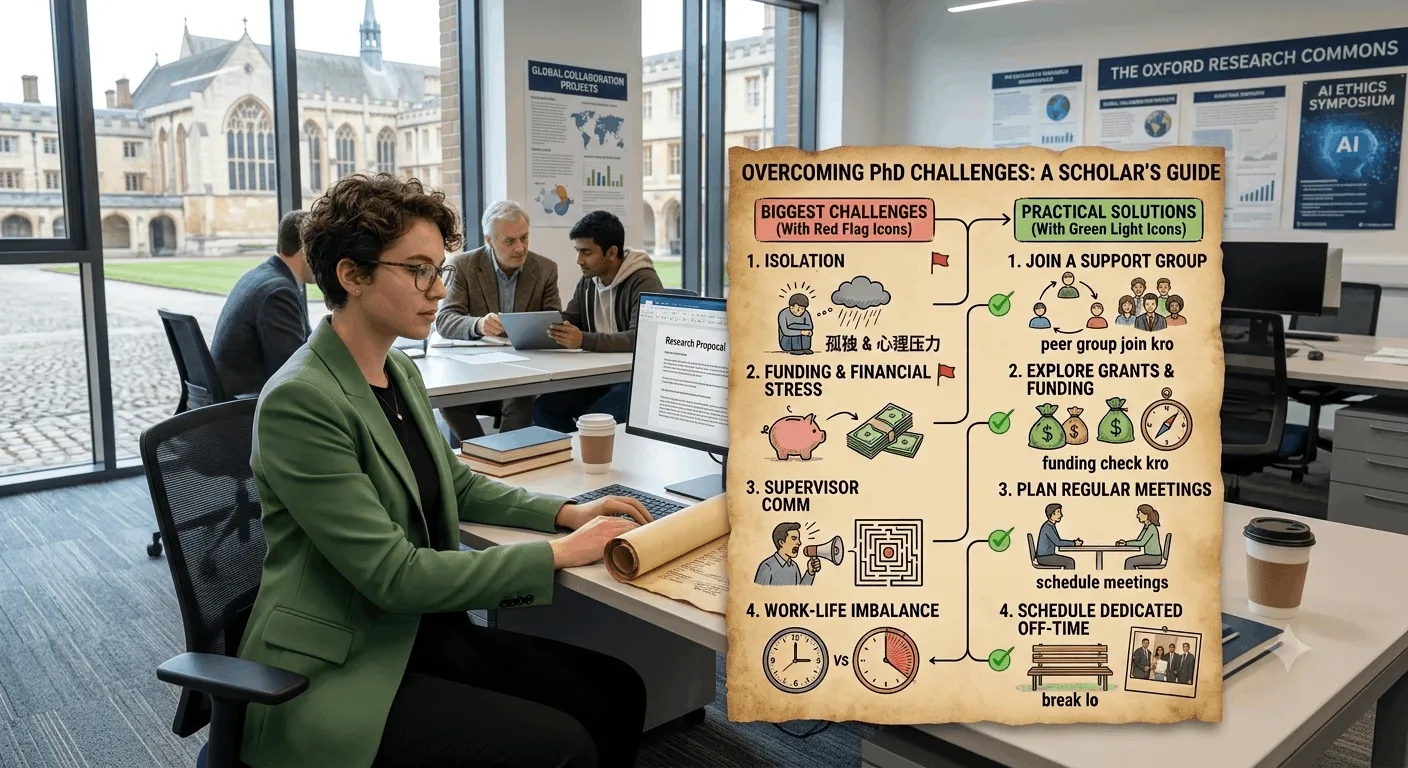
There's a specific kind of loneliness that comes with staring at a half-finished chapter at 11 p.m., wondering if the problem is your research, your ability, or both. If that sounds familiar, you're not experiencing something rare or unusual — you're experiencing one of the most well-documented realities of doctoral study. PhD challenges aren't a sign that something has gone wrong with your particular journey; they're a predictable, recurring part of nearly every doctoral journey, across countries, disciplines, and institutions. This article works through the challenges in doctoral research that come up again and again — isolation, supervisor difficulties, imposter syndrome, funding instability, methodological roadblocks, publication pressure, and the uncertain academic job market — and pairs each one with practical, actionable responses rather than vague reassurance. The goal isn't to convince you the PhD is easy; it's to give you a clear-eyed map of what's normal, what's fixable, and what genuinely deserves outside support, so you can keep moving forward with more confidence and less unnecessary struggle.
What Are the Biggest Challenges Faced by PhD Students? A Quick Overview
The most commonly reported PhD challenges cluster into a handful of categories: academic isolation and loneliness, difficult or mismatched supervisor relationships, imposter syndrome and chronic self-doubt, financial instability, methodological and data-related research problems, mounting pressure to publish, and uncertainty about post-PhD career prospects. These challenges rarely show up one at a time — they tend to compound, since financial stress makes imposter syndrome worse, and imposter syndrome makes it harder to have honest conversations with a struggling supervisor relationship.
Understanding this compounding effect matters because it explains why generic advice like "just manage your time better" so often falls flat. A doctoral student isn't failing at a single skill; they're navigating several interacting pressures simultaneously, often for the first time, without the structured support that undergraduate or even master's study typically provides. The sections below take each major challenge individually, but the practical strategies work best when applied together rather than in isolation.
Academic Isolation: The Challenge Almost Every PhD Scholar Faces
Isolation is consistently named among the most common PhD challenges, and it shows up in more than one form. There's the physical isolation of long, solitary hours with data, literature, or a manuscript that no one else is reading in real time. There's the social isolation of moving to a new city, country, or institution far from existing friends and family. And there's a subtler form — the isolation of being surrounded by people who genuinely don't understand what a PhD actually involves, including well-meaning friends and family members who may not grasp why a research setback feels as significant as it does.
The solution isn't to force yourself into forced positivity or wait for isolation to resolve on its own — it's to deliberately build structure around connection, the same way you'd build structure around a research timeline. Reaching out to current students, labmates, or cohort peers before you even formally start, rather than after isolation has already set in, tends to shorten the adjustment period considerably. Regular participation in departmental seminars, writing groups, or even informal coffee catch-ups with peers outside your immediate research group creates the kind of low-stakes social contact that counteracts isolation without requiring huge time investment.
Practical Ways to Reduce PhD Isolation
Turning connection into a habit rather than a hope is what actually moves the needle here, and a few concrete practices consistently help across disciplines and countries.
- Join or start a regular peer writing group, even a small one meeting weekly for an hour
- Attend departmental seminars and social events consistently, not only when a topic feels directly relevant
- Seek out a peer mentor or "PhD buddy" a year or two ahead of you in the program
- Schedule non-academic social time as deliberately as you schedule research tasks
- Connect with online or cross-institutional communities in your specific research area when local peers are scarce
Supervisor Relationship Difficulties: One of the Most Disruptive Challenges in Doctoral Research
While most supervisor relationships are healthy and genuinely supportive, a mismatched or difficult advisor relationship is one of the most disruptive challenges in doctoral research precisely because it touches every other part of the PhD — funding, direction, feedback quality, and morale all run through this single relationship. Common friction points include a supervisor who is frequently unavailable due to competing commitments, one who gives feedback too rarely or too vaguely to be actionable, or a fundamental mismatch in working style, such as a student who wants close guidance paired with an advisor who expects near-total independence.
The practical fix starts with naming the specific problem precisely rather than describing general dissatisfaction, since "we don't communicate well" is much harder to act on than "I need feedback within two weeks of submitting a draft, and currently I'm waiting six." Sending shorter, more frequent updates rather than large, infrequent chunks of work tends to improve feedback quality and turnaround, since a supervisor can engage more substantively with ten polished pages than with an entire rough chapter. When a second supervisor or committee member is available, increasing their involvement is often a lower-friction fix than confronting a primary supervisor directly. If problems persist despite direct, specific conversation, most programs do have formal escalation paths — a graduate coordinator, ombudsperson, or department chair — and using them is a legitimate step, not an admission of failure.
Imposter Syndrome and Chronic Self-Doubt
Imposter syndrome is remarkably widespread among doctoral students — research estimates place the prevalence of imposter phenomenon symptoms among PhD students somewhere in the 50–75% range, meaning the majority of people around you in any given cohort are quietly managing some version of the same self-doubt you might be feeling. It typically shows up as a persistent sense that your successes are due to luck, timing, or an oversight by others rather than genuine competence, alongside a nagging fear of being "found out" as insufficiently capable for the program.
Knowing the prevalence numbers helps, but it isn't a complete fix on its own — the more durable strategy is building concrete evidence against the distorted belief. Keeping a simple, ongoing record of specific accomplishments, positive feedback, and solved problems gives you something factual to return to when self-doubt spikes, rather than relying on memory alone during a low moment. Talking openly with peers about these feelings, rather than assuming you're uniquely struggling, consistently reduces the isolating power imposter syndrome has, precisely because so many people discover they weren't alone in it. Research has also found a meaningful link between supervisor empathy and lower imposter syndrome severity in doctoral students, which is one more reason a supportive advisor relationship pays dividends well beyond the purely academic.
When Self-Doubt Becomes Something More
It's worth distinguishing ordinary, situational self-doubt from a more persistent pattern. Imposter feelings that come and go around specific milestones — a comprehensive exam, a conference presentation, a hard round of reviewer comments — are extremely common and typically ease with time and evidence-gathering. Persistent, pervasive self-doubt that doesn't respond to any of this, especially alongside symptoms of anxiety or depression, is worth bringing to a university counseling service or mental health professional directly rather than trying to manage entirely on your own; research has found imposter syndrome correlates meaningfully with depression and anxiety symptoms, and campus counseling services exist specifically to support graduate researchers through this.
Financial Instability and Funding Challenges
Money worries are a frequently underdiscussed but highly consequential PhD challenge, and they compound nearly everything else on this list — a student worried about next semester's funding has less capacity to handle a difficult supervisor conversation or a failed experiment with equanimity. Funding structures vary enormously by country, discipline, and institution: some students have guaranteed multi-year funding packages, others rely on a patchwork of teaching assistantships, grants, and part-time work that can shift year to year.
The most protective practical step is treating funding stability as a factor to investigate thoroughly before committing to a program or advisor, not something to sort out reactively once a shortfall appears — a point worth revisiting from the advisor-selection stage of your broader PhD roadmap. For students already navigating uncertain funding, proactively meeting with your graduate school's financial aid or funding office each year, rather than waiting until a gap appears, often surfaces bridge funding, emergency grants, or teaching opportunities that aren't widely advertised. Many students also take on structured part-time work such as teaching or research assistantships, which — when balanced carefully — can provide both income and directly relevant academic experience, though it's worth being honest with your advisor about the time commitment involved so expectations stay realistic on both sides.
Research Problems and Solutions: Methodological and Data-Related Roadblocks
Every doctoral project eventually runs into genuine research problems — data that doesn't behave as expected, a chosen methodology that turns out to be poorly suited to the actual research question, or access to data and equipment that's more limited than initially assumed. These moments can feel like evidence the whole project is failing, when in practice they're an ordinary, expected part of original research, which by definition involves genuine uncertainty rather than a fully known outcome.
A frequent, specific research problem is struggling to define a research gap precisely enough to build a project around, particularly early in candidacy when the existing literature can feel overwhelming and impossible to fully map. The practical fix here isn't to wait for a "perfect," uncontested gap to reveal itself — it's to discuss emerging ideas directly and often with your advisor, lean on recent survey or review papers to see where genuine open questions cluster, and accept that the gap will sharpen and narrow as you progress rather than arriving fully formed at the outset. When data access or quality turns out to be more limited than expected, the fix is rarely to abandon the project outright; it's to revisit the research question's scope with your advisor and consider whether a narrower, well-supported claim is more defensible than an ambitious one built on shaky data.
Common Research Problems and Practical Solutions
Struggling to Define a Clear Research Gap: If you're finding it difficult to identify a meaningful research gap, discuss your ideas with your advisor as early as possible and read recent review papers in your field. These reviews often highlight unresolved questions and emerging research opportunities. Remember that a strong research gap usually becomes clearer over time rather than appearing fully formed from the beginning.
Data Quality or Access Is Weaker Than Expected: When your data is limited or difficult to obtain, reconsider the scope of your research question instead of forcing broad conclusions. A focused study supported by reliable evidence is generally more valuable than an ambitious project built on weak or incomplete data.
Chosen Methodology Doesn't Fit the Research Question: If your research methods no longer seem appropriate, seek guidance from a methodology expert, statistician, or experienced mentor as early as possible. Addressing methodological issues early prevents unnecessary work and improves the overall quality of your research.
Feeling Overwhelmed by the Volume of Existing Literature: Instead of trying to read every available paper before writing, organize your references using citation management software and create a living literature map that evolves as your research progresses. This approach helps you identify key themes without becoming overwhelmed.
Writer's Block During Thesis or Paper Writing: If you're struggling to write complete chapters, start by sharing shorter sections or partial drafts with your advisor. Frequent feedback on smaller pieces of writing is often more productive than waiting until an entire chapter feels perfect before asking for comments.
The Pressure to Publish and the Uncertain Academic Job Market
Many programs now formally expect journal articles or conference papers during candidacy, and even where it isn't formally required, the informal pressure to publish is a widely reported PhD challenge — particularly given how competitive the eventual academic job market tends to be. This pressure can distort decision-making in unhelpful ways, pushing students toward publishing prematurely, over-claiming results to make a paper seem more novel than it is, or spreading effort across too many small papers instead of building toward a stronger, more defensible body of work.
The healthier framing treats publishing as an ongoing part of the research process rather than a final, high-stakes hurdle to clear all at once. Submitting work earlier and treating rejection or requested revisions as expected, useful feedback — rather than a verdict on your competence — tends to produce both better papers and considerably less anxiety over time; persistence through revision, not flawless first drafts, is what actually characterizes most successful academic publishing careers. On the career front, the uncertainty of the academic job market is real and worth acknowledging honestly rather than minimizing — but many doctoral scholars are also increasingly building parallel awareness of research, industry, and policy career paths throughout candidacy, rather than treating an academic faculty position as the only legitimate outcome of years of doctoral work.
Work-Life Balance and Burnout
Long hours, unpredictable deadlines, and the sense that research can always be improved further make work-life balance a persistent PhD challenge rather than a solved problem you eventually master and forget about. Left unaddressed, this imbalance compounds into burnout — a well-documented reality among doctoral students that researchers have linked to workload, funding uncertainty, publication pressure, and supervision quality, not simply poor personal discipline.
Practical boundaries make a measurable difference here, even though they can feel counterintuitive in a culture that sometimes valorizes overwork. Setting and actually protecting specific working hours, taking genuine full days off on a regular basis, and maintaining hobbies or relationships entirely outside academia all show up consistently in guidance from students and researchers who've navigated this successfully. If exhaustion, detachment, or declining motivation persist despite these efforts, that's a signal worth bringing to your university's counseling or wellbeing services directly — these resources exist specifically for graduate researchers, and using them early tends to help considerably more than waiting until symptoms have become severe.
Frequently Asked Questions
What are the biggest challenges faced by PhD students?
The most commonly reported PhD challenges are academic isolation, difficult or mismatched supervisor relationships, imposter syndrome, financial instability, methodological and data-related research problems, pressure to publish, and uncertainty about the academic job market. These challenges frequently compound one another — financial stress worsens self-doubt, for example — which is why addressing them together, rather than treating each as an isolated problem, tends to work better in practice.
How common is imposter syndrome among PhD students?
Very common — research estimates suggest somewhere between 50% and 75% of PhD students experience symptoms of imposter syndrome at some point during their studies. It typically involves persistent self-doubt and a fear of being "found out" as insufficiently capable, despite genuine evidence of competence. Talking openly with peers about it, and keeping a factual record of accomplishments and positive feedback to counter distorted self-perception, are both practical steps that consistently help.
How do I deal with a difficult PhD supervisor?
Start by naming the specific problem precisely — vague dissatisfaction is much harder to act on than a concrete request, such as needing feedback within two weeks of a submission. Sending shorter, more frequent drafts rather than large infrequent chunks of work often improves both feedback quality and turnaround time. If direct, specific conversation doesn't resolve things, most programs have formal escalation paths through a graduate coordinator or department chair, and using them is a legitimate step rather than an admission of failure.
Is it normal to feel isolated during a PhD?
Yes, isolation is one of the most consistently reported PhD challenges, arising from long solitary research hours, geographic relocation away from existing support networks, and simply being surrounded by people who don't fully understand the demands of doctoral study. Deliberately building structured connection — peer writing groups, regular seminar attendance, a peer mentor a year or two ahead of you — tends to counteract isolation far more reliably than waiting for it to resolve on its own.
What should I do if I run into serious problems with my research data or methodology?
Treat this as an expected part of original research rather than evidence the whole project is failing — genuine research, by definition, involves real uncertainty rather than a fully predictable outcome. Revisit the scope of your research question with your advisor if data quality or access is weaker than expected, and consult a methods-focused mentor or statistician early if your chosen approach isn't fitting the question well, rather than persisting with a mismatched method out of momentum.
How can PhD students manage financial stress during their program?
Investigate funding stability thoroughly before committing to a specific program or advisor, since this is far easier to evaluate upfront than to fix reactively once a shortfall appears. For students already facing funding uncertainty, proactively meeting with your graduate school's financial aid office each year, rather than waiting until a gap appears, often surfaces bridge funding or emergency grants that aren't widely advertised. Balanced part-time teaching or research assistantships can also provide both income and directly relevant experience.
How much publishing pressure is normal during a PhD?
Expectations vary significantly by discipline and program, but many now formally expect journal articles or conference submissions during candidacy, and informal pressure exists even where it isn't required. The healthier approach treats publishing as an ongoing part of the research process rather than a single high-stakes hurdle, submitting earlier and treating rejection or revision requests as expected, useful feedback rather than a verdict on your ability.
What can I do about PhD burnout?
Set and actually protect specific working hours, take genuine full days off regularly, and maintain relationships and hobbies entirely outside academia — research has linked burnout to workload, funding uncertainty, and supervision quality rather than simply insufficient personal discipline. If exhaustion, detachment, or declining motivation persist despite these efforts, bringing this to your university's counseling or wellbeing services directly tends to help considerably more than waiting until symptoms worsen.
Should I worry about the uncertain academic job market while still working on my PhD?
It's worth acknowledging the uncertainty honestly rather than minimizing it, since competition for academic faculty positions is genuinely intense in most fields. Many doctoral scholars find it useful to build parallel awareness of research, industry, and policy career paths throughout candidacy rather than treating an academic position as the only legitimate outcome, which also tends to reduce the pressure riding on any single publication or job application.
How can I overcome writer's block during my dissertation?
Sending shorter, more frequent drafts to your advisor — rather than waiting to produce a large, polished chapter before sharing anything — tends to restore momentum more reliably than waiting for perfect conditions to write. Breaking work into small, concrete daily targets and treating early drafts as deliberately rough working documents, rather than final prose, also reduces the pressure that often causes writer's block in the first place.
Do all PhD students experience these challenges, or is it just a matter of poor planning?
Nearly every PhD student encounters at least some of these challenges, and research consistently frames them as structural features of doctoral study — arising from funding models, supervision quality, and the inherently uncertain nature of original research — rather than individual planning failures. Recognizing that these problems are common and expected, not a personal shortcoming, is itself part of what makes them easier to address directly rather than hide.
Where can PhD students get additional support beyond peer advice?
Most universities offer graduate-specific counseling and wellbeing services, financial aid or funding offices, graduate coordinators or ombudspersons for supervisor conflicts, and writing centers for drafting support. These resources exist specifically because these challenges in doctoral research are common and expected, so using them early — rather than waiting until a problem becomes severe — tends to produce much better outcomes than trying to manage everything alone.
Conclusion
The challenges covered here — isolation, supervisor difficulties, imposter syndrome, funding instability, research problems, publication pressure, and burnout — aren't signs that your particular PhD journey is going unusually badly. They're the well-documented, shared terrain of doctoral study across disciplines and countries, and recognizing them as common rather than personal failures is often the first real step toward addressing them effectively. Practical, specific action beats vague reassurance every time: name the actual problem, build deliberate structure around connection and boundaries, treat setbacks in research and publishing as expected parts of the process rather than verdicts on your ability, and use the institutional support around you — advisors, peers, counseling services, funding offices — rather than trying to carry every challenge alone. A PhD is genuinely demanding, but it's also navigable, and scholars who address these challenges directly and early tend to move through the program with considerably more resilience and far less unnecessary struggle than those who try to power through in isolation.