
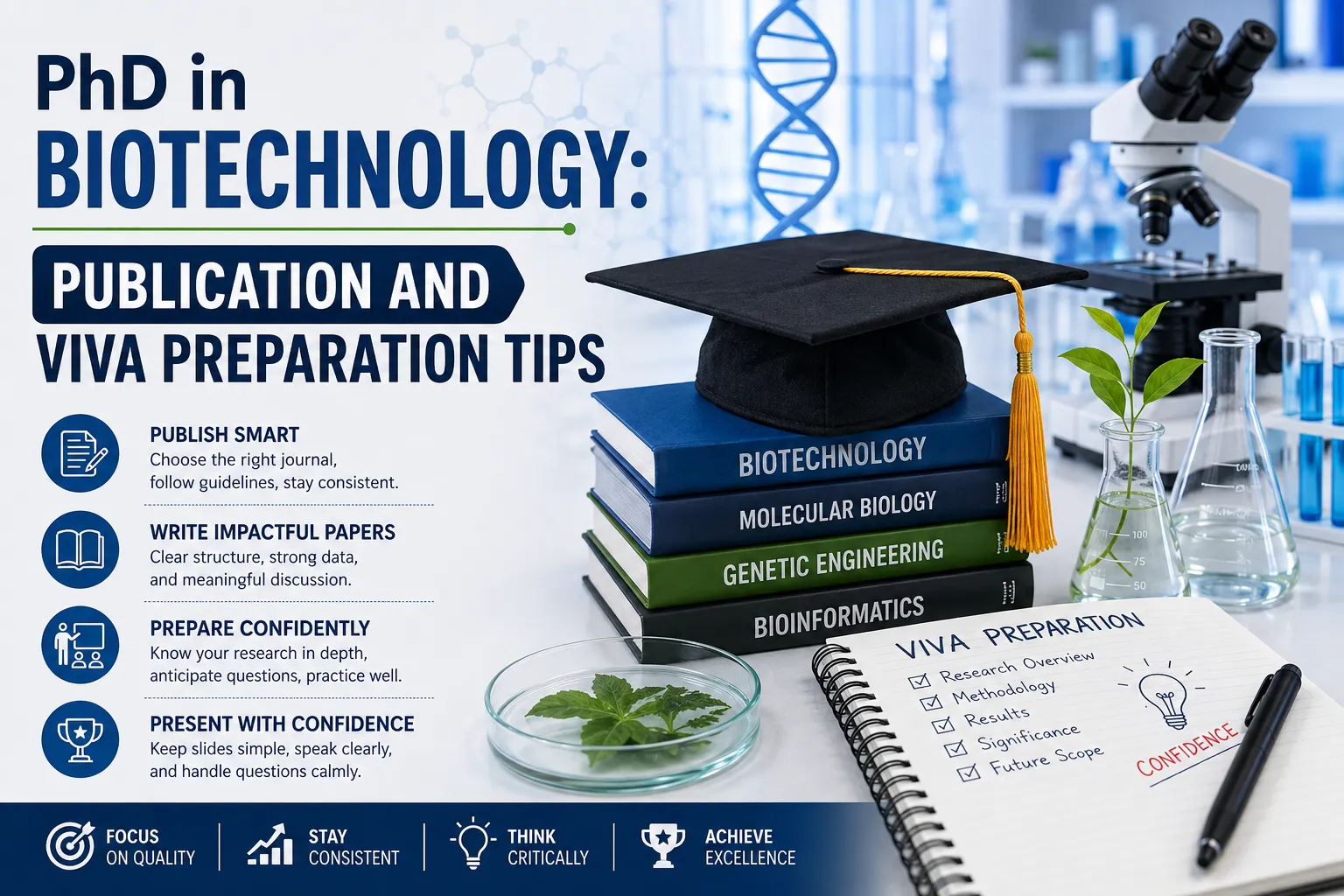
If you're a PhD Biotechnology scholar facing both a publication milestone and your upcoming viva, you're working in a field with a genuinely unusual publication landscape — biotechnology journals span an enormous prestige range, from top-tier venues with single-digit acceptance rates down to journals with barely-there impact factors, and unlike most PhD disciplines, biotechnology scholars often have to think carefully about patent timing before they publish anything at all. This guide on PhD in biotechnology publication and viva preparation tips walks through both processes step by step, tailored specifically to how biotechnology research actually gets published, protected, and defended.
This is written for first-time PhD thesis writers in India who want a practical, biotechnology-specific roadmap rather than generic academic advice.
Why Biotechnology's Publication Landscape Is Unusually Wide
Biotechnology has a genuinely wider spread of journal prestige and rigor than many other PhD disciplines. Top-tier venues like Nature Biotechnology carry impact factors above 40 with acceptance rates around 8 percent — the large majority of submissions are desk-rejected before even reaching peer review — while other legitimate, properly indexed biotechnology journals carry impact factors under 1. This spread means journal-tier strategy is a genuinely consequential decision for biotechnology scholars, not a formality, and understanding roughly where your specific findings realistically fit on this spectrum before you submit anywhere saves significant wasted time on mismatched submissions.
ThesisLikho's PhD-qualified experts, who've guided over 10,000 scholars through publication and defense preparation, see biotechnology scholars run into two recurring issues: submitting genuinely strong applied research to venues expecting a different kind of contribution (basic biological mechanism versus a broadly applicable technology or tool), and publishing a finding publicly before checking whether it might have been patentable — a mistake that can't be undone once the disclosure has happened.
The Patent-Before-Publication Question
This deserves dedicated attention, since it's genuinely distinctive to biotechnology and closely related applied fields in a way most other PhD disciplines' scholars never need to think about. Public disclosure of a finding — including publishing a paper, presenting at a conference, or in some cases even certain forms of thesis submission — can create prior art that precludes or limits future patent filing in many countries, since patent law generally requires an invention to be genuinely novel and undisclosed at the time of filing.
If your research has produced something with genuine commercial or applied potential — a novel construct, a method, an engineered organism, a formulation — it's worth pausing before submitting anything for publication to ask whether this specific finding might be patentable, and if so, coordinating with your institution's Technology Transfer Office before any public disclosure happens. A nondisclosure agreement is typically the very first formal step in any technology transfer or commercialization conversation, specifically because of this disclosure risk. This isn't a step to improvise late — building a brief conversation with your supervisor and, where relevant, your institution's technology transfer office into your publication planning from the start avoids the genuinely irreversible mistake of accidentally disclosing away your own patent rights.
Step-by-Step Publication Roadmap
Identify which specific findings from your thesis have genuine standalone publication value — a novel method, a significant experimental result, or a substantial literature synthesis can each be a paper candidate before your full thesis is complete. Before drafting anything, check whether any of these findings might be patentable, and coordinate with your technology transfer office if so, before any public disclosure. Shortlist three to five target journals across a realistic prestige range, from an ambitious top-tier reach to a solid, appropriately-scoped fallback, rather than only targeting the highest-impact-factor option. Format your manuscript according to your target journal's specific conventions, verify the journal's legitimacy against Scopus, Web of Science, or PubMed indexing before submitting, and track your manuscript through the editorial process, responding methodically to any reviewer comments you receive.
Most Indian universities recommend or require at least one publication in a peer-reviewed venue before biotechnology PhD thesis submission, though the specific requirement varies by institution and has shifted somewhat since India's 2025 update to peer-reviewed journal quality standards — always confirm your specific university's current requirement with your research cell.
Understanding What a Top-Tier Journal Actually Wants
This is worth understanding clearly before you target an ambitious venue, since it's a common, avoidable source of desk rejection. Top-tier biotechnology journals specifically look for papers where the technology, method, or platform itself is the central contribution — not simply an enabling tool used along the way to reach an interesting biological finding. A useful question to ask honestly about your own manuscript: is your paper really about a biological finding (which likely belongs in a more biology-focused venue), or is it about a tool, method, or platform that will change how other researchers in your field do their work (which is what top-tier technology-focused biotechnology journals are actually looking for)? Editors at these venues also expect systematic comparison against existing approaches, testing across multiple biological systems rather than a single narrow context, and honest, explicit assessment of limitations — not just a demonstration that a method works once.
Getting this fit assessment right before submitting saves real time, since a genuine mismatch between what your paper actually offers and what a specific journal is looking for is one of the most common reasons for fast desk rejection, regardless of how solid the underlying research is.
Journal Selection Checklist for Biotechnology Scholars
- The journal's scope and editorial bar (technology-focused versus biology-focused, applied versus basic science) genuinely matches what your specific manuscript offers
- The journal is verifiably indexed in Scopus, Web of Science, or PubMed, checked against the official database rather than the journal's own claim
- Editorial board members are named with verifiable academic or industry affiliations
- Peer-review process, typical timeline, and reviewer composition (academic, industrial, regulatory expertise, where relevant) are clearly published
- The journal meets your university's current publication requirement, confirmed directly with your research cell
- Article processing charges, if any, are transparent and disclosed before submission, not after acceptance
An important update for Indian scholars: the UGC-CARE list, long treated as the default checklist for "acceptable" journals, was formally discontinued as a mandatory list in February 2025, replaced by a broader "Suggestive Parameters for Peer-Reviewed Journals" framework approved in June 2025. Many universities haven't yet updated their internal regulations to reflect this — verify your specific institution's current requirement rather than assuming the old CARE list is still operative.
Avoiding Predatory Journals
Predatory journals are a genuine risk in biotechnology given how many open-access venues exist across such a wide prestige spectrum, some genuinely rigorous and some not. Warning signs include guaranteed or unusually fast acceptance, vague or unverifiable editorial board members, aggressive unsolicited email invitations to submit, undisclosed article processing charges, and a journal scope so broad it spans unrelated fields alongside biotechnology. COPE's guidance on predatory publishing specifically recommends independently verifying a journal's editorial board, peer-review transparency, and indexing claims rather than relying solely on the journal's own self-description. A quick, reliable check: ask your supervisor or a senior researcher in your specific biotechnology sub-field whether they recognize the journal — personal, field-specific knowledge often catches red flags a database search alone might miss.
What a Realistic Peer-Review Timeline Actually Looks Like
Understanding a realistic timeline helps you plan your publication strategy against your actual thesis deadline. A representative applied-biotechnology journal's process typically runs: roughly three weeks for editorial desk screening, checking fit, clarity, and technical readiness — a manuscript that reads as basic science without a clear applied contribution commonly gets filtered out at this stage before ever reaching reviewers. Peer review itself commonly takes six to twelve weeks, often involving two to four reviewers spanning academic, industrial bioprocess, and, where relevant, regulatory expertise. A first editorial decision typically follows, with major revision being the most common outcome for manuscripts that pass initial screening. Revision rounds and final publication then add further weeks to months, depending on how substantial the requested revisions are.
Given this realistic multi-month timeline, beginning your publication process well before your planned thesis submission deadline — rather than treating it as a late-stage task — is essential for having a genuine publication in hand, or at least well into the review process, by the time your thesis is finalized.
Responding to Reviewer Comments
For each reviewer comment, restate it clearly, numbered to match the reviewer's original numbering, then state your specific response — what you changed and why, with supporting data or reasoning where relevant, or the evidence-based justification for a respectful disagreement — and point to the exact section, figure, or table in your revised manuscript where the change appears. Biotechnology reviewers, particularly at applied and technology-focused journals, often specifically probe whether your method or finding has been tested across multiple relevant contexts rather than just one — be ready to either provide this additional validation or explain clearly why your specific scope is appropriate and sufficient for your paper's claims.
Viva Preparation Timeline
Eight to ten weeks before your viva, re-read your full thesis and note weak spots, particularly around methodological choices and regulatory or biosafety decisions you'll need to justify. Six to eight weeks before, prepare your presentation slides, typically expected to run fifteen to twenty minutes. Four to six weeks before, draft anticipated questions, especially on why you chose your specific experimental approach over alternatives, and how you navigated any regulatory or ethics requirements your research involved. Three to four weeks before, run a mock viva with your supervisor or lab peers. One to two weeks before, refine your presentation based on mock-viva feedback and revisit your published papers, if any. Two to three days before, do only light review — re-read your abstract, key findings, and contribution statement. On the day itself, arrive early with a printed, annotated copy of your thesis.
Defending Regulatory and Biosafety Choices at Your Viva
This deserves specific attention for biotechnology scholars, since it's an area of questioning most other PhD disciplines don't face in the same way. If your research involved genetically engineered organisms, animal studies, or human-derived material, examiners commonly probe your regulatory and ethics decisions directly — which specific clearances your work required (IBSC, RCGM, GEAC, CPCSEA, or ICMR-aligned ethics review, depending on your research type), how long securing them took, and how you designed your methodology around any constraints they imposed. Being able to discuss these decisions concretely and confidently, rather than treating them as a bureaucratic afterthought mentioned briefly in your methodology chapter, is exactly what distinguishes a strong defense from a shaky one in this specific area.
Thesis Defense Checklist
- Your thesis contribution and technical novelty can be stated clearly in two to three sentences
- Every methodology and experimental design choice has a clear, defensible rationale ready
- You can discuss your specific regulatory or biosafety pathway (IBSC, RCGM, GEAC, CPCSEA, or ICMR-aligned) concretely, not just in general terms
- You can explain why you didn't use alternative approaches or techniques an examiner might raise
- Presentation is rehearsed within the expected time limit
- Published or in-press papers, and any patent filings, are ready to reference as supporting evidence
- A printed, annotated copy of the full thesis is ready for the viva itself
- Mock viva completed with supervisor or peer feedback incorporated
Two Realistic Scenarios
Scenario 1 — Coordinating a Patent Filing Before Publication
Priya, a biotechnology PhD scholar, developed a novel enzyme engineering approach with clear industrial application potential. Before drafting a manuscript, she raised this specifically with her supervisor, who connected her with the university's technology transfer office. They confirmed the finding was genuinely patentable and initiated a provisional patent filing before Priya submitted her manuscript for publication — meaning her public disclosure came after her filing date rather than before it, preserving her patent rights. This coordination added roughly six weeks to her publication timeline but protected value that a rushed, unplanned publication would have permanently forfeited.
Scenario 2 — Matching a Manuscript to the Right Journal Tier
Rohit initially targeted a top-tier, technology-focused journal for his work on an engineered microbial strain, but after reading the journal's specific editorial guidance closely, recognized his paper's core contribution was really a biological finding about the strain's metabolic behavior, with the engineering method serving mainly as an enabling tool rather than the paper's actual protagonist. Rather than risking a fast desk rejection at a mismatched venue, he redirected his submission to a strong applied biotechnology journal with a more appropriate scope, where his manuscript was sent out for full review and eventually accepted after one revision round — a considerably better outcome than the likely desk rejection his original target would have produced.
Both scenarios point to the same underlying lesson: strategic, well-planned publication decisions — checking patentability before disclosure, and matching manuscripts to genuinely appropriate venues — protect both your intellectual property and your publication record more effectively than moving quickly without this planning.
Publication Ethics and Plagiarism
UGC's anti-plagiarism policy sets the acceptable similarity limit at or below 10 percent, excluding references, bibliography, and properly cited quotes, checked using approved software like Turnitin or iThenticate. A high raw similarity score isn't automatically plagiarism — properly cited quotes, standard technical terminology, and a substantial reference list can all inflate the raw percentage, so always check the filtered or excluded version of your report rather than reacting to the raw number alone. Research and Publication Ethics coursework is now mandatory during pre-PhD coursework at most Indian universities, covering plagiarism, authorship, and predatory-journal awareness.
If you need expert guidance with your research methodology, publication strategy, thesis writing, or viva preparation, you can explore our PhD Thesis Assistance service, where our PhD-qualified experts help biotechnology scholars navigate journal selection, patent timing coordination, and defense preparation with confidence.
How Long Does This Whole Process Take?
Given biotechnology's multi-stage peer-review process — desk screening, review, revision, and publication — most scholars are advised to begin their publication process at least twelve to eighteen months before their planned thesis submission deadline, longer than in some other disciplines, given how many weeks each individual review stage can take and how common a major-revision outcome is even at appropriately-targeted journals. If patent coordination is relevant to your work, factor in additional time before any public disclosure, since this step genuinely cannot be rushed without risking your patent rights.
For viva preparation specifically, an eight-to-ten-week runway from first re-read to actual defense day is a realistic, well-tested timeline. Overall PhD completion in India for biotechnology commonly runs four to six years, factoring in coursework, experimental work with its associated regulatory clearances, publication, and final defense stages.
FAQs
What is included in PhD in biotechnology publication and viva preparation tips?
It covers understanding biotechnology's unusually wide journal prestige spectrum, checking whether findings are patentable before public disclosure, matching manuscripts to the right journal tier and editorial focus, avoiding predatory venues, and preparing for viva questions specifically around regulatory and biosafety decisions.
Why does PhD in biotechnology publication and viva preparation matter?
Biotechnology has genuinely distinctive publication considerations — particularly the risk of accidentally forfeiting patent rights through premature public disclosure — that most other PhD disciplines don't face. Understanding these specifics protects both your intellectual property and your publication record.
How does PhD in biotechnology publication and viva preparation affect a PhD thesis?
Coordinating patent timing correctly protects commercial value your research might have; matching manuscripts to appropriately-scoped journals avoids wasted submission cycles; and preparing specifically for regulatory-decision questioning strengthens your viva defense in an area examiners in this field commonly probe.
How long does it take to complete a PhD thesis using this approach?
Most biotechnology PhD scholars should begin their publication process twelve to eighteen months before their planned thesis submission deadline, given multi-stage review timelines. Overall biotechnology PhD completion in India commonly runs four to six years.
Is professional help available for PhD in biotechnology publication and viva preparation tips?
Yes. Many biotechnology PhD scholars work with experienced research mentors to navigate journal selection, coordinate patent timing with their institution, and prepare systematically for their viva — this is exactly the kind of support ThesisLikho's PhD-qualified experts provide.
Book a PhD Research Consultation: If you're navigating journal selection, patent timing, or viva preparation and want expert input before your next milestone, ThesisLikho's PhD-qualified experts can help you move forward with confidence. Book Your Consultation →