
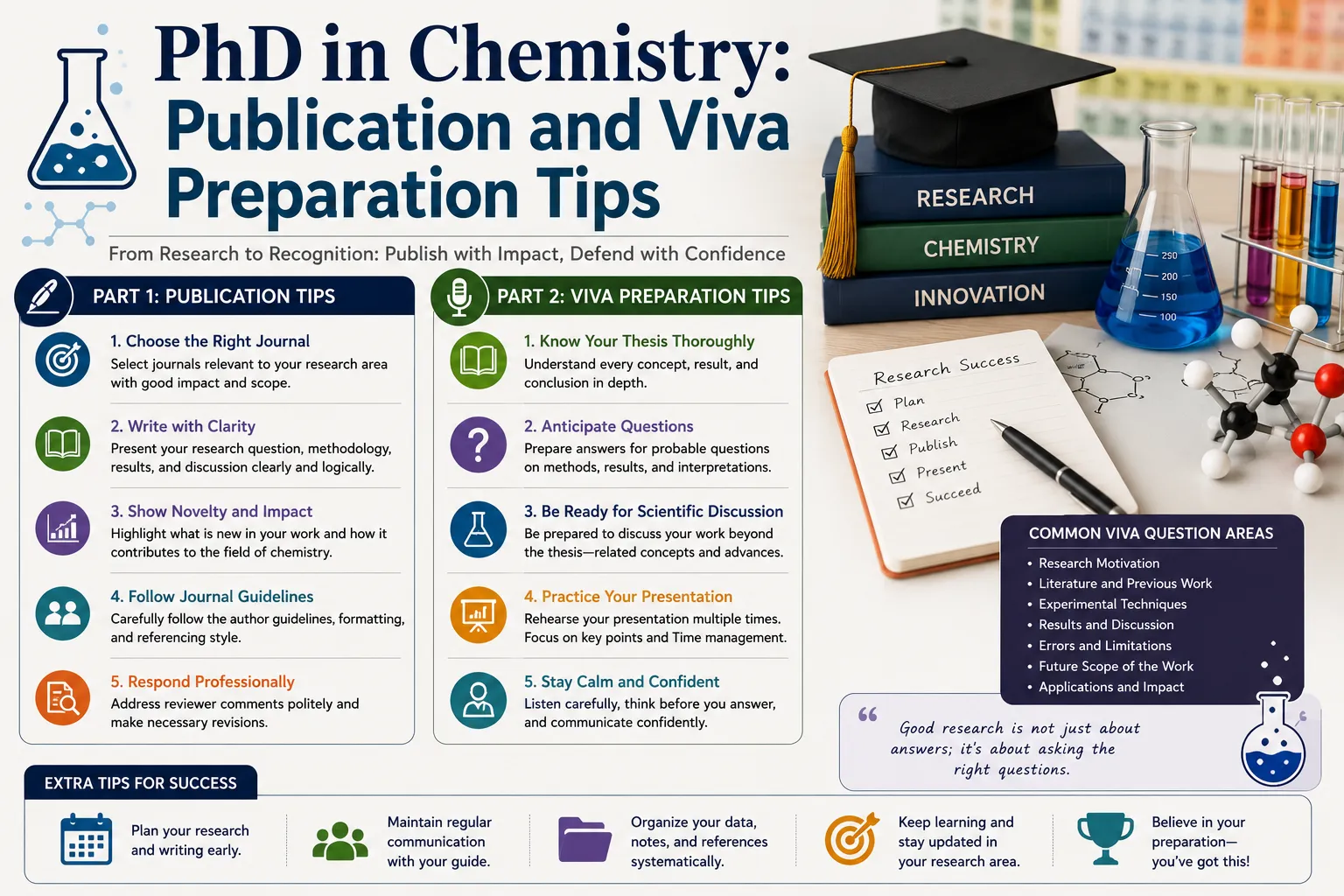
Chemistry PhD candidates face a viva unlike most other disciplines — you might genuinely be asked to explain a reaction mechanism at the whiteboard, or interpret a spectrum you haven't looked at in months, on the spot. Getting your publications right beforehand and preparing specifically for this kind of technical, hands-on defense are both essential. This guide breaks down PhD in chemistry publication and viva preparation tips, covering journal selection, characterization data requirements, and exactly what a chemistry defense tends to probe.
Publication: Choosing the Right Journal for Your Work
Match Journal Scope to the Nature of Your Contribution
Journal choice should match the specific nature of your contribution. Sub-field-deep papers often fit specialty journals — Organic Letters, JACS Au, ACS Catalysis, or sub-field RSC journals like Soft Matter or Polymer Chemistry — better than broad-scope flagship journals. A genuinely broad, cross-disciplinary result, by contrast, is better suited to a wider-audience journal like Chemical Science, where editors specifically expect the paper to make clear why the result matters beyond just one specialty. Before submitting, honestly assess which category your work falls into — a technically excellent but narrowly specialized result submitted to an overly broad flagship journal is likely to be seen as a poor fit, not a strong contribution.
Understand the Desk Rejection Filter
Flagship, high-impact chemistry journals apply an active editorial filter, with desk rejection rates of roughly 60–70%. Editors are specifically looking for genuinely novel contributions, not competent extensions of established work. The fastest way to get desk-rejected is submitting work editors recognize as part of an active research line where similar contributions have appeared recently — which means checking the very latest literature immediately before submission, not just at the start of your project, is a genuinely important step. A result that was novel when you started your project two years ago may no longer be, and confirming this before submission can save a wasted review cycle.
Prepare Complete Characterization Data From the Start
Full characterization data — not just synthesis yields — is required for reported synthesis experiments across chemistry journals. For known compounds, you need to provide the source of the material or a reference to the published literature preparation method and its characterization data; procedures already reported elsewhere should be cited rather than re-detailed, unless you've modified them.
For all new compounds appearing as title compounds in your work, adequate evidence establishing both identity and degree of purity must be provided — typically as a combination of data and explanation. ¹³C-NMR and ¹H-NMR data should typically be included, and spectral data for known compounds should be presented only if it augments or updates previously published data. Build this characterization discipline into your lab practice from the start of your PhD, not just at the writing stage — retroactively generating complete characterization data for a compound synthesized years earlier is far harder than doing it properly the first time.
Don't Overlook Supporting Information Logistics
Supporting Information must be submitted at the same time as your main manuscript, and you should confirm it's viewable using accepted software and file formats before submission. This is an easy-to-overlook logistical requirement that can genuinely delay your submission if missed — check your target journal's specific Supporting Information format requirements well before your intended submission date, not the night before.
Anticipate Reviewer Expectations on Characterization Rigor
RSC journal reviewers specifically check whether adequate characterisation data has been provided for materials or compounds, including copies of relevant spectra in the supporting information. If your work is purely computational, studying properties of materials not yet experimentally characterized, include explicit discussion of why the material is potentially interesting to the chemistry community, and, where possible, calculations demonstrating synthetic feasibility — reviewers will look for this framing even in the absence of experimental data.
Viva: What Makes a Chemistry Defense Distinctive
Expect On-the-Spot Technical Demonstration
Chemistry thesis defenses are heavily focused on experimental technique, characterisation methods, and mechanistic understanding. Committee members will expect you to explain not just what you did, but why you chose specific reagents, conditions, or analytical techniques — demonstrating genuine understanding rather than simply having followed a procedure correctly.
This often takes a genuinely hands-on form: committee members may ask you to interpret spectra on the spot, explain a reaction mechanism at the whiteboard, or justify why you chose one synthetic route over another. The underlying expectation is that you could adapt, troubleshoot, and explain your chemistry to someone outside your immediate specialism — not just recite the procedure you followed in the lab.
Prepare for Applied Problem-Solving Questions
A specifically flagged, commonly asked defense question illustrates this well: "A reviewer says your characterisation data is insufficient — what additional experiments would you run?" This kind of question tests applied, on-the-spot problem-solving, going beyond simply defending what you already did to demonstrating you understand what a stronger version of your evidence would look like.
Know Your Mechanisms Cold
If your thesis includes chemical mechanisms or catalytic cycles, you need a detailed understanding of how those mechanisms were defined, and you must be able to recreate the derivations if asked by examiners. For catalytic cycle work specifically, be ready to explain the various steps around the cycle and how your particular research fits into it. This isn't something you can convincingly improvise under pressure — revisit your mechanisms deliberately as part of your preparation, not just your results.
Refresh Your Foundational Chemistry Knowledge
Refreshing foundational undergraduate-level chemistry knowledge — including complex named reactions and mechanisms outside your immediate thesis topic — is specifically recommended before a chemistry viva. Examiners may probe foundational understanding beyond just your thesis's specific subject matter, and being caught off guard by something like the Wittig reaction or the pKa of acetone is a genuinely avoidable stumble. Examiners typically begin by asking candidates to give an overview of their thesis before moving into more detailed and mechanistic questioning, so your preparation should cover both layers — the big-picture narrative and the granular chemical detail underneath it.
Practical Checklist: Chemistry Publication and Viva Readiness
- Target journal scope matches whether your contribution is sub-field-deep or broadly significant
- Latest literature checked immediately before submission, not just at project start
- Complete characterization data (NMR, purity evidence) prepared for all new compounds
- Known compound procedures properly cited to prior literature, not unnecessarily re-detailed
- Supporting Information format confirmed against the target journal's specific requirements
- Computational-only work includes explicit discussion of chemistry-community relevance and synthetic feasibility, where applicable
- Able to explain reagent, condition, and technique choices, not just describe procedures followed
- Mechanisms and catalytic cycles rehearsed well enough to recreate derivations under questioning
- Prepared for applied problem-solving questions ("what would you do if...")
- Foundational undergraduate-level chemistry refreshed, beyond just the thesis's specific topic
Two Practical Scenarios
Scenario 1 — Choosing the Right Journal Tier
A scholar developed a novel catalyst with strong performance specifically within a niche subfield of asymmetric catalysis. Initially targeting a broad flagship journal, the scholar recognized after reviewing recent editorial guidance that the result's significance was genuinely strongest within the specialty catalysis community rather than broadly across chemistry. Redirecting the submission to ACS Catalysis instead of a broader flagship journal resulted in a faster, more favorable review process, since the paper was evaluated by reviewers already primed for its specific conventions and significance.
Scenario 2 — Preparing for a Mechanism Question Under Pressure
While preparing for their viva, a scholar reviewed their thesis and realized they could describe their catalytic cycle's overall outcome clearly but struggled to recreate the full mechanistic derivation step-by-step without referring back to their notes. Recognizing this gap during preparation rather than during the actual viva, the scholar spent dedicated time redrawing the mechanism from memory repeatedly until it could be reproduced confidently at the whiteboard — turning a potential weak point into a well-rehearsed strength before the real examination.
Common Mistakes PhD Chemistry Scholars Make
- Submitting a sub-field-specific result to an overly broad flagship journal, mismatching scope and significance.
- Assuming characterization data prepared early in the PhD is still complete without checking it against current journal requirements before submission.
- Treating Supporting Information format as an afterthought, risking submission delays from format issues.
- Memorizing what happened in the lab without understanding why, leaving the viva's "why did you choose this" questions difficult to answer convincingly.
- Preparing only the thesis's specific content, neglecting foundational chemistry knowledge examiners may still probe.
Frequently Asked Questions
What is PhD in chemistry publication and viva preparation about?
It covers two related final-stage requirements: selecting the right journal and preparing complete characterization data for publication, and preparing for a chemistry viva that heavily emphasizes hands-on technical demonstration — interpreting spectra, explaining mechanisms, and justifying synthetic route choices.
Why does publication and viva preparation matter for a PhD in chemistry?
Chemistry journals apply strict characterization and novelty standards that differ meaningfully by journal tier, while chemistry vivas specifically test applied, on-the-spot technical understanding rather than just memorized procedure — both require deliberate, discipline-specific preparation beyond general academic writing advice.
How does publication and viva preparation affect a PhD thesis in chemistry specifically?
Since chemistry examiners commonly ask candidates to reproduce mechanisms or interpret data live during the defense, preparation that focuses only on the written thesis without rehearsing this hands-on demonstration leaves a genuine gap in viva readiness.
How long does it take to complete a PhD thesis using this approach?
Building proper characterization documentation habits from early in the PhD, rather than retroactively compiling it before submission, typically saves significant time and reduces the risk of publication delays later.
Is professional help available for PhD in chemistry publication and viva preparation?
Yes. ThesisLikho's PhD-qualified experts have guided 10,000+ scholars through journal selection, characterization documentation support, and viva preparation tailored to chemistry and other research disciplines.
Get Expert Guidance on Your Publication and Viva Preparation
Navigating journal selection, characterization requirements, and mechanism-focused viva preparation takes structured planning specific to chemistry's technical demands. If you'd like expert support identifying the right journals for your chemistry research or preparing confidently for hands-on viva questioning, ThesisLikho's PhD-qualified team offers publication support, viva preparation guidance, and complete PhD thesis writing assistance. If you need expert guidance with your publication strategy, viva preparation, or overall thesis timeline, you can explore our PhD Thesis Assistance service.
Book a PhD Research Consultation → https://thesislikho.com/writing-services/thesis-assistance-phd