
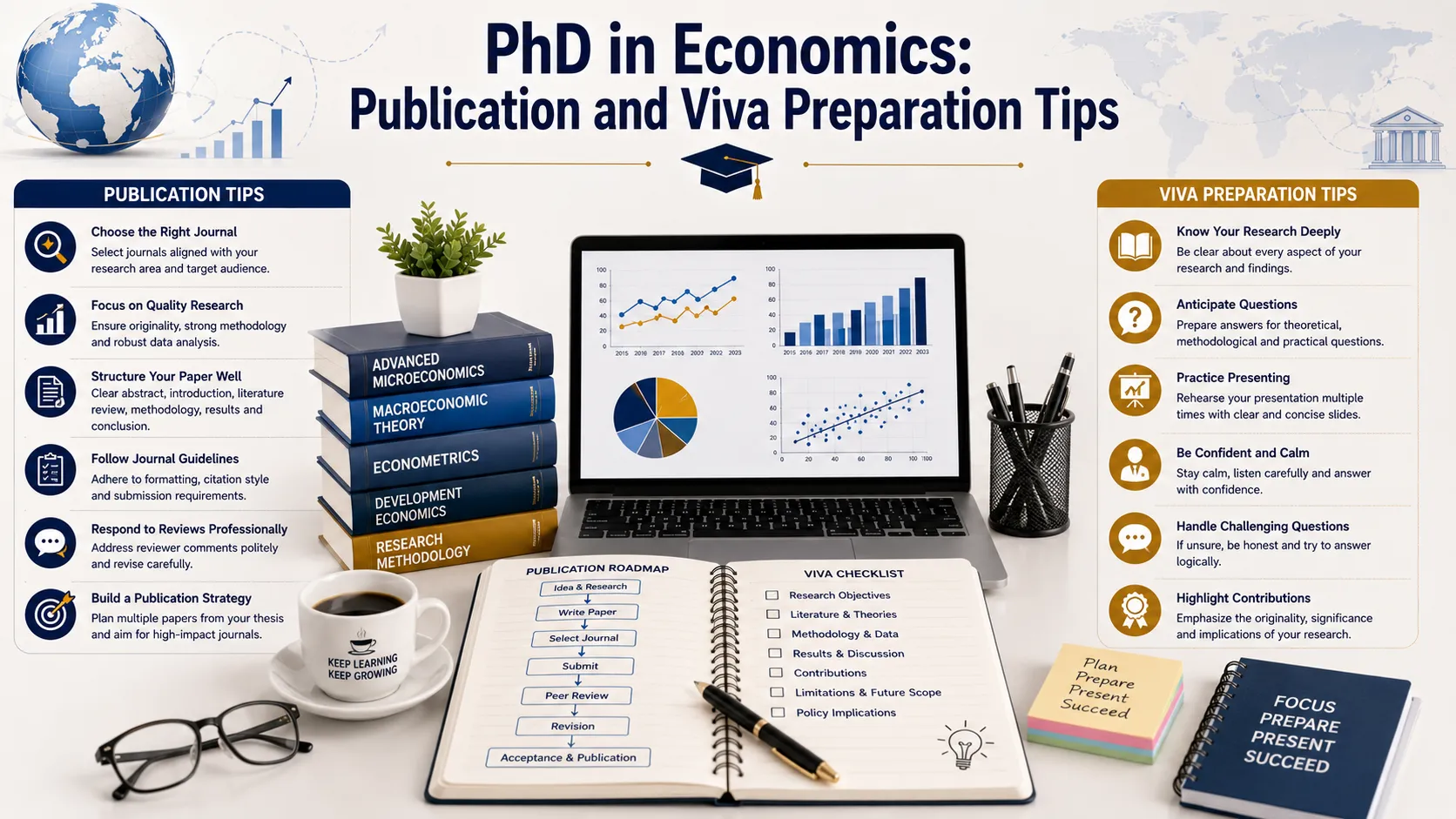
Economics PhD scholars face a publication culture that looks noticeably different from most other disciplines — and understanding that difference early can save you significant stress later. This guide breaks down PhD in economics publication and viva preparation tips, covering the essay-based thesis structure, the job market paper, realistic publication expectations, and how to walk into your defense genuinely prepared.
Publication: Understanding the Economics-Specific Culture
The Three-Essay Thesis Structure
A widely recommended strategy for economics PhD scholars is to write the doctoral thesis as a collection of several essays, each corresponding to a paper that is already published or publishable in an academic journal by the time of the defense. This essay-based structure — commonly three chapters, each functioning as a standalone paper — is now the dominant format in economics, distinct from the single continuous monograph structure common in many other disciplines. If you're coming from a field where the thesis is one long, unified argument, this structural difference is worth internalizing early, since it shapes how you should be planning and drafting from the start of your PhD, not just at the writing stage.
The Job Market Paper Is Your Centerpiece
Central to this structure is the "job market paper" — the piece of work, usually sole-authored, that proves you can conduct independent research and forms the centerpiece of your academic job search. This paper carries disproportionate weight: it's what departments read first, what you'll present in job talks, and often what defines how your early research identity gets established. Extra care with the abstract, introduction, and conclusion of this paper is worth the investment, since these are the sections most readers and examiners engage with closely and where they form their overall impression.
Plan Your Timeline Backward From the Job Market Cycle
A widely cited practical guideline from experienced placement advisors: by the time job market interviews approach, a typical three-chapter dissertation needs one chapter fully finished and polished (your job market paper), a second chapter well advanced with results and a draft, and a third chapter at least a well-matured idea with some early results. Working backward from this expectation — rather than treating all three chapters as equally paced — helps you allocate your limited time where it matters most as your program progresses.
Present Early and Often
Presenting your job market paper in a seminar or brownbag before wider or higher-stakes presentations is considered essential, not optional. Take in as much criticism as possible at this stage, and consider rehearsing with a smaller, friendlier audience — your advisor, close peers — before presenting to external or more high-stakes audiences. This staged approach lets you catch weaknesses while the cost of doing so is still low.
Set Realistic Publication Target Expectations
It doesn't have to be a "top 5" journal — American Economic Review, Econometrica, Journal of Political Economy, Quarterly Journal of Economics, or Review of Economic Studies — for a publication to meaningfully help your academic career. Publishing in a solid field journal, even one that isn't the top journal in that specific field, demonstrates that you can complete rigorous work, pass peer review, and contribute genuinely to the literature. Empirical data on the field bears this out directly: in one large sample of economics publications, only around 12% appeared in a top-5 journal — meaning the substantial majority of solid, career-relevant economics publications appear in strong field journals rather than the very top tier. Setting your publication expectations around this reality, rather than the top-5 benchmark alone, keeps your publication strategy both ambitious and realistic.
Use Seminars and Conferences as a Deliberate Strategy
Presenting research at seminars and conferences is considered one of the easiest and most valuable ways to build both a publication track record and a professional network while still in graduate school — for direct, substantive feedback and for getting your name and work known in your field. Data from published economics papers shows the median paper received 9 individual comments and was presented at only 1 seminar on average, though top papers were presented at up to 23 — a useful reminder that iterative feedback through seminar presentation is a completely normal part of the process, not a sign your paper isn't ready yet.
Plan Around Long Review Timelines
The economics publication process typically takes more than a year from first submission to final editorial decision. Given typical PhD program durations of three to four years post-master's, this timeline needs to be built into your planning from early in the program — submitting your first paper only in your final year leaves very little room for the revision cycles that are a normal part of the process.
Viva/Defense: Preparing With Economics-Specific Considerations
Develop and Demonstrate Economic Intuition
Interviewers and examiners consistently look for a candidate's ability to reason intuitively about economic mechanisms, not just execute technical methods correctly. Being able to run a regression or specify a structural model correctly is necessary, but committees are equally interested in whether you can explain, in plain terms, why the mechanism you're studying works the way it does — and defend that intuition when pushed. This is best developed through practice: presenting often, watching others present, and specifically working on explaining your economic reasoning without hiding behind technical jargon.
Learn From Watching Others Defend
Attending recruiting seminars and watching other candidates present and get questioned is genuinely useful preparation. Defending your own work in a formal setting is a different skill from teaching or informal presenting — observing how experienced examiners probe methodology, challenge assumptions, and press on interpretation gives you a realistic sense of what to expect and prepare for.
Prepare Your Identification Strategy Defense Specifically
Given how central identification strategy is to modern economics research, expect sustained questioning on exactly why your chosen identifying assumption is credible in your specific context — not just what method you used, but why that method's core assumption plausibly holds for your data and setting. This is very likely to be the most heavily probed area of your defense, so rehearsing a clear, confident explanation of your identification strategy specifically is time well spent.
Rehearse Your Introduction and Conclusion Until They're Airtight
Since these sections are what examiners and readers engage with most directly in forming their impression, make sure you can walk through your research question, contribution, and main findings clearly and concisely without notes — this is often where the viva effectively begins, even if the harder technical questions come later.
Redo Your Presentation With a Smaller Audience First
Just as with your job market paper, rehearsing your defense presentation with your advisor or close peers before the formal viva lets you catch weak points and awkward framing while the stakes are still low.
Practical Checklist: Publication and Viva Readiness for Economics PhD Scholars
- Thesis structured as an essay-based collection, with each chapter aiming toward independent publishability
- Job market paper identified clearly and prioritized for polish (abstract, introduction, conclusion especially)
- Publication timeline planned backward from the job market cycle, accounting for 1+ year review timelines
- Job market paper presented at a seminar/brownbag before wider presentation
- Publication target set realistically — a strong field journal, not exclusively top-5
- Multiple seminar/conference presentations planned as a deliberate feedback and visibility strategy
- Identification strategy defense rehearsed specifically and thoroughly
- Economic intuition behind key mechanisms can be explained clearly, without relying purely on technical language
- Introduction and conclusion can be presented confidently without notes
- A smaller, informal mock defense has been completed before the formal viva
Two Practical Scenarios
Scenario 1 — Structuring the Thesis Around the Job Market Timeline A scholar in their third year realized their three planned dissertation chapters were all at roughly the same early stage, with the job market approaching in under a year. Recognizing the mismatch with the recommended staggered timeline, the scholar prioritized bringing one chapter — a labor economics paper with a clean regression discontinuity design — to full polish as the job market paper, while deliberately keeping the other two chapters at "well advanced" and "well-matured idea" stages respectively. This matched the realistic expectations of the job market cycle rather than trying to finish all three chapters simultaneously and diluting focus across all of them.
Scenario 2 — Defending an Identification Strategy Under Pressure During a mock viva with peers, a scholar studying the labor market effects of a minimum wage policy was pressed repeatedly on why their difference-in-differences design's parallel trends assumption was plausible given uneven treatment timing across states. Rather than treating this as a weakness to avoid discussing, the scholar used the mock session to develop a clearer, more confident explanation citing pre-trend robustness checks already included in the paper — turning what had been a vague answer into a well-rehearsed, specific defense that held up well when the same question came up in the actual viva.
Common Mistakes Economics PhD Scholars Make
- Treating the thesis as a single unified monograph rather than an essay-based collection aimed at independent publishability.
- Underestimating publication review timelines, leaving too little time for revision cycles before the job market or thesis submission.
- Fixating on top-5 journals exclusively, when strong field journal publications realistically make up the large majority of career-relevant output at this stage.
- Skipping early seminar presentation of the job market paper, missing low-stakes opportunities to catch weaknesses before higher-stakes presentations.
- Preparing only the technical defense of a method, without equally rehearsing the underlying economic intuition examiners will probe.
Frequently Asked Questions
What is PhD in economics publication and viva preparation about?
It covers two related final-stage requirements specific to economics: building a publication record — typically structured around an essay-based thesis and a central job market paper — and preparing to defend that work in a viva or job market context where identification strategy and economic intuition are heavily scrutinized.
Why does publication and viva preparation matter for a PhD in economics?
Economics has a distinct essay-based thesis culture and a demanding, timeline-sensitive job market process; understanding both early allows scholars to structure their research and publication strategy realistically, rather than discovering these expectations too late in the program.
How does publication and viva preparation affect a PhD thesis in economics specifically?
Since the job market paper often defines a scholar's early research identity and career trajectory, how well it's developed, presented, and defended has outsized influence compared to the other thesis chapters.
How long does it take to complete a PhD thesis using this approach?
The economics publication process alone typically takes over a year per paper from submission to decision, meaning realistic planning requires submitting early — often starting seriously by the second or third year of the program — to have publishable or under-review work by the job market stage.
Is professional help available for PhD in economics publication and viva preparation?
Yes. ThesisLikho's PhD-qualified experts have guided 10,000+ scholars through publication strategy, journal targeting, and viva preparation support tailored to economics and other research disciplines.
Get Expert Guidance on Your Publication and Viva Preparation
Navigating the economics-specific publication culture — essay-based thesis structuring, job market paper development, and realistic journal targeting — takes planning well ahead of your defense and job market timeline. If you'd like expert support building your publication strategy or preparing confidently for your viva, ThesisLikho's PhD-qualified team offers publication support, viva preparation guidance, and complete PhD thesis writing assistance. If you need expert guidance with your publication strategy, viva preparation, or overall thesis timeline, you can explore our PhD Thesis Assistance service.
Book a PhD Research Consultation → https://thesislikho.com/writing-services/thesis-assistance-phd