
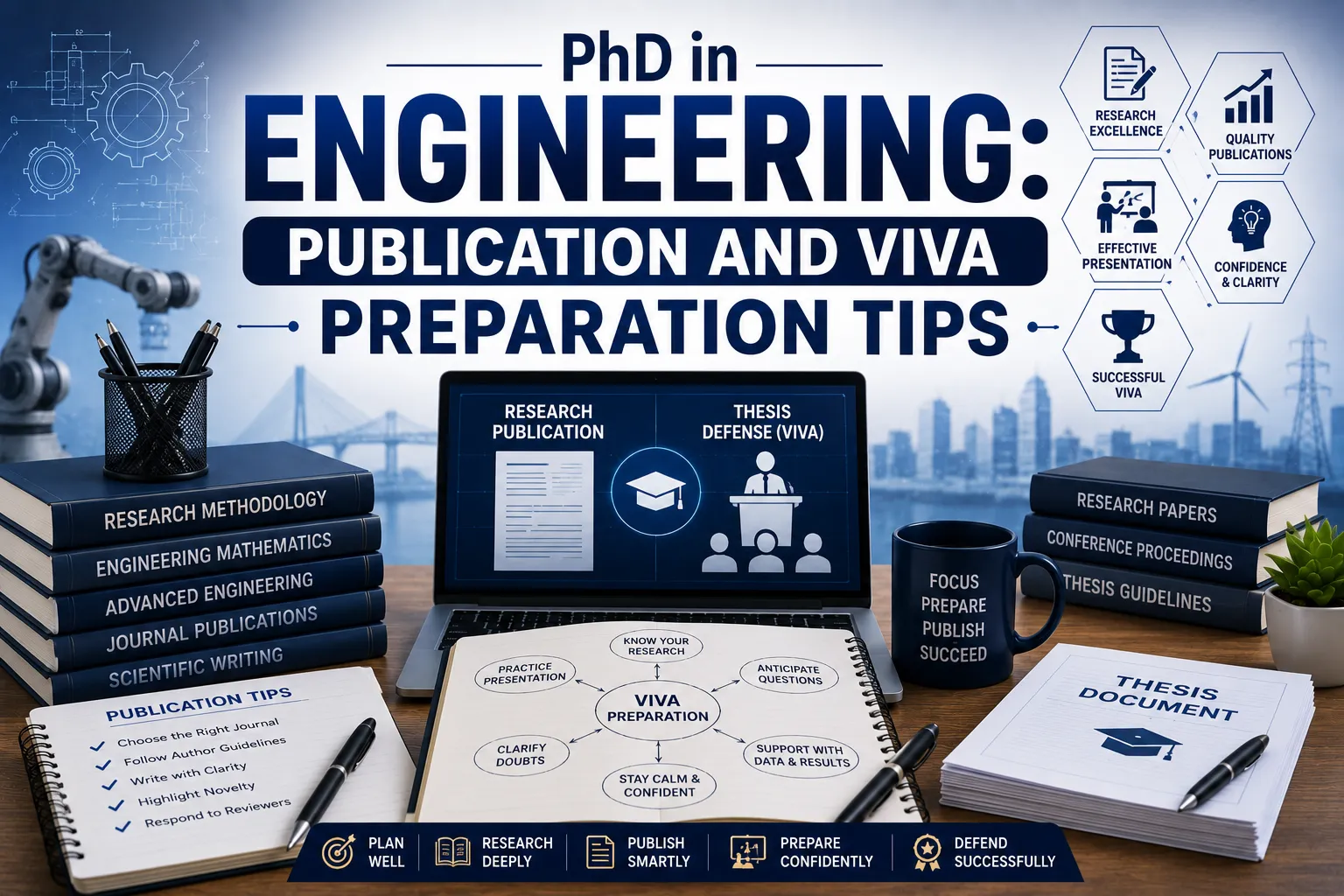
If you're a PhD Engineering scholar facing the twin milestones of getting published and defending your thesis, you're dealing with a discipline that has its own distinct publication culture — conference papers that carry real academic weight, IEEE's specific formatting conventions, and a genuine risk of predatory conferences that other fields don't face nearly as often. This guide on PhD in engineering publication and viva preparation tips walks through both processes step by step, tailored specifically to how engineering research actually gets published and defended.
This is written for first-time PhD thesis writers in India who want a practical, engineering-specific roadmap rather than generic academic advice.
Why Engineering Publication Culture Is Different
Engineering and computer science have a publication culture that differs meaningfully from most other PhD disciplines, and understanding this early changes how you should plan both your publication strategy and your viva preparation. Unlike fields where only journal articles carry real weight, peer-reviewed conference papers at IEEE, ACM, and Springer LNCS venues are treated as broadly equivalent to journal publications in engineering and computer science — Scopus-indexed conference papers count toward your h-index, and Web of Science maintains a dedicated index specifically for conference proceedings. This gives engineering PhD scholars a genuine strategic choice most other disciplines don't have.
ThesisLikho's PhD-qualified experts, who've guided over 10,000 scholars through publication and defense preparation, see engineering scholars run into two recurring issues: not strategically choosing between conference and journal routes based on their actual timeline, and falling for predatory conference invitations — a risk that's measurably higher in engineering than in most other academic fields.
Step-by-Step Publication Roadmap for Engineering Scholars
- Identify publishable results early. A novel algorithm, an experimental validation, or a design methodology chapter are typically your strongest candidates — not every result needs to wait until your full thesis is complete.
- Decide your conference-vs-journal strategy (covered in detail below) based on your PhD timeline and the maturity of your results.
- Format according to your target venue's conventions from the start — IEEE's two-column format, in particular, is distinct enough that retrofitting a paper written for a journal into conference format (or vice versa) wastes real time.
- Verify your target venue's legitimacy using EI Compendex, Scopus Source List, or the Web of Science Master Journal List before submitting.
- Submit and track your manuscript through the venue's submission system.
- Respond to reviewer comments methodically if you receive a revision request.
- Consider a patent filing alongside or instead of a publication if your research has direct applied or industrial value.
- Use your accepted or published work as supporting evidence in your thesis and viva preparation.
Most Indian universities recommend or require at least one publication in a peer-reviewed venue before thesis submission, though the specific requirement (journal vs. conference, quantity) varies by institution and has shifted somewhat since India's 2025 update to peer-reviewed journal quality standards — always confirm your specific university's current requirement with your research cell.
Conference Paper or Journal Paper: Which Comes First?
This is a genuinely strategic decision in engineering research, not a formality. Conference papers are typically shorter (4–8 pages), undergo a lighter, faster review process (roughly 2–6 months from submission to decision), and let you present and get feedback on preliminary results quickly. Journal papers are longer (8–20 pages), undergo more rigorous single- or double-blind peer review, and generally carry somewhat higher academic weight for mature, comprehensive results.
Practical decision guide:
If you have preliminary or partial results and need early feedback, go with a conference paper first. If you have mature, comprehensive results with full experimental validation, a journal paper is the better fit. If your PhD timeline is tight and you need a publication milestone soon, a conference paper's faster review cycle works in your favor. And if you're building toward a stronger, more citable long-term publication record, a journal paper — potentially after a related conference paper — is the way to go.
A common, legitimate strategy — sometimes called "evolutionary publishing" — is to present preliminary results at a conference, then substantially extend the work (with genuinely new material, properly citing the earlier version) into a full journal paper later. IEEE's own policy on this requires that each new version contain sufficient original material beyond the previous one, and that the prior version be clearly cited — self-plagiarism rules apply even when you're extending your own earlier work.
IEEE Formatting and Submission Conventions
Most Indian engineering PhD programs expect IEEE-style formatting, which has specific conventions worth getting right from your first draft:
- Two-column layout, Times New Roman, typically 10pt body text, with specific section headings in all capital letters (INTRODUCTION, METHODOLOGY, RESULTS, CONCLUSION).
- In-text citations are numbered in square brackets — [1], [2] — in the order they first appear, not alphabetically by author name.
- Reference list entries follow IEEE's specific format: author initials and surname, title in quotation marks, journal or publisher name, volume, page range, month and year, and DOI where available.
- Official templates in both Microsoft Word and LaTeX format are available directly from IEEE's author resources — using these from the start avoids formatting rework later.
Getting this format right early matters more in engineering than scholars sometimes realize, since reviewers and examiners in this discipline are accustomed to a specific visual and citation convention, and formatting inconsistencies can read as a lack of attention to disciplinary norms.
Journal Selection Checklist for Engineering Scholars
- The journal's scope clearly matches your specific sub-field (not just "engineering" broadly)
- The journal is verifiably indexed in Scopus, Web of Science, or (for engineering specifically) EI Compendex — checked against the official database, not just the journal's own claim
- Editorial board members are named with verifiable academic affiliations
- Peer-review process and typical review timeline are clearly published
- The journal meets your university's current publication requirement (confirm directly with your research cell)
- Article processing charges, if any, are transparent and disclosed before submission, not after acceptance
Important update for Indian scholars: The UGC-CARE list, long treated as the default checklist for "acceptable" journals, was formally discontinued as a mandatory list in February 2025, replaced by a broader "Suggestive Parameters for Peer-Reviewed Journals" framework approved in June 2025. Many universities haven't yet updated their internal regulations to reflect this — verify your specific institution's current requirement rather than assuming the old CARE list is still the operative standard.
Avoiding Predatory Conferences and Journals
This risk is measurably higher in engineering than in most academic fields, given how heavily conference publishing features in the discipline. A few practical, engineering-specific verification steps:
- Check EI Compendex — widely used specifically to verify legitimate engineering conference proceedings, in addition to the Scopus Source List or Web of Science's Conference Proceedings Citation Index.
- Be suspicious of unusually broad conference scopes — a legitimate engineering conference is typically narrowly focused; a conference title spanning "Science, Engineering, Medicine, and Humanities" in one event is a strong red flag.
- Watch for guaranteed or extremely fast acceptance — genuine peer review takes real time; acceptance promised within days is not a good sign.
- Scrutinize unsolicited invitation emails carefully — a 2025 editorial analysis found only around 7% of such solicitation emails were actually relevant to the recipient's own research area, meaning skepticism toward unsolicited invitations is a reasonable default, not paranoia.
- Verify unclear or unusually high registration fees against what similar legitimate conferences in your sub-field typically charge.
If you're ever uncertain, the simplest and most reliable check is often the least technical one: ask your supervisor or a senior researcher in your specific sub-field whether they recognize the conference or journal — personal, field-specific knowledge frequently catches red flags that a database search alone might miss.
Patents as a Publication-Equivalent Output
This is a genuinely underused option for engineering PhD scholars with applied, industry-relevant innovations. Many Indian institutions accept a filed patent application (not necessarily a granted one) as satisfying part of a scholar's publication requirement — though this varies significantly by university and department, so confirm directly with your research cell before relying on this route.
A patent filing can be a particularly strong option when your research produces a genuinely novel device, process, or system with commercial or applied relevance, since it demonstrates a different but equally valid form of research contribution than a journal or conference paper — and it can meaningfully strengthen your viva defense by giving you a concrete, tangible outcome to discuss alongside your academic publications.
The Peer-Review Process for Engineering Papers
- Editorial/program committee screening — checks whether your paper fits the venue's scope before assigning reviewers.
- Reviewer assignment — typically 2–3 reviewers for conferences, sometimes more for journals, assessing technical soundness, novelty, and clarity.
- Review reports — reviewers evaluate your methodology, experimental validation, and contribution against the venue's specific criteria.
- Decision — accept, minor/major revision, or reject, based on aggregated reviewer input.
If your research involves synthesizing existing literature systematically — common for scholars working in fast-moving areas like AI/ML applications or advanced materials — the PRISMA Statement's structured, 27-item checklist for transparently reporting how sources were identified and screened remains a widely recognized framework for demonstrating a systematic, non-arbitrary review process (Source: PRISMA Statement).
Responding to Reviewer Comments
Engineering reviewers typically focus heavily on technical soundness and experimental rigor, so your response should be equally precise:
- Restate each comment, numbered to match the reviewer's original numbering.
- State your specific response — what you changed (with technical justification) or why you respectfully disagree, backed by evidence or additional data where possible.
- Point to the exact section, equation, or figure in your revised manuscript where the change appears.
A well-structured, technically specific response makes it far easier for an editor or program committee to verify your changes quickly, rather than searching the manuscript to confirm your claims — vague or non-specific responses are a common reason engineering paper revisions stall in another review round.
Viva Preparation Timeline
- 8–10 weeks before: Re-read your full thesis; note weak spots, especially in experimental design and results interpretation.
- 6–8 weeks before: Prepare your presentation slides (typically 15–20 minutes).
- 4–6 weeks before: Draft anticipated questions, especially on methodology choices and alternative approaches you didn't take.
- 3–4 weeks before: Run a mock viva with your supervisor or lab peers.
- 1–2 weeks before: Refine your presentation based on mock-viva feedback; revisit your published papers, if any.
- 2–3 days before: Light review only — re-read your abstract, key results, and contribution statement.
- Day of viva: Arrive early with a printed, annotated thesis copy; stay calm and let your preparation carry you.
Thesis Defense Checklist
- Your thesis contribution and technical novelty can be stated clearly in 2–3 sentences
- Every methodology and experimental design choice has a clear, defensible rationale ready
- You can explain why you didn't use alternative approaches or techniques an examiner might ask about
- Presentation is rehearsed within the expected time limit
- Published or in-press papers, and any filed patents, are ready to reference as supporting evidence
- A printed, annotated copy of the full thesis is ready for the viva itself
- Mock viva completed with supervisor or peer feedback incorporated
Common Viva Mistakes to Avoid
- Over-preparing the slides, under-preparing for technical questioning — the presentation is a small part of the viva; defending your technical choices under questioning is where most scholars are actually tested.
- Not being able to justify why you chose one algorithm, material, or experimental setup over an obvious alternative.
- Memorizing answers rather than understanding the underlying reasoning, which falls apart under a follow-up question.
- Being defensive about experimental limitations rather than acknowledging them confidently as a sign of rigor.
- Skipping the mock viva, leaving you unprepared for the specific questioning style your actual examiners use.
Two Realistic Scenarios
Scenario 1 — Choosing Between a Conference and a Journal
Vikram, a PhD scholar working on a novel optimization algorithm for wireless sensor networks, had preliminary results with about 18 months left before his planned submission. Rather than waiting to accumulate a "complete" study for a journal, he targeted an IEEE conference first — securing a publication milestone within roughly four months of submission, well within his timeline pressure. He then extended the work with additional experimental validation and new material, properly citing his earlier conference version, and submitted the expanded study to an IEEE Transactions journal. This staged approach gave him two publications instead of one, an early confidence boost from conference feedback, and stronger material for his eventual viva defense.
Scenario 2 — Catching a Predatory Conference Invitation
Sneha received an email inviting her to present as a "distinguished young researcher" at an "International Conference on Engineering, Science, and Emerging Technologies" — flattering language for a second-year PhD student with no publications yet. Before submitting her abstract, she checked the conference against EI Compendex and the Scopus Source List and found no record of it. The conference's broad, unfocused topical scope and guaranteed-acceptance language were both red flags she recognized from her department's predatory-publishing awareness session. She declined, saving both a registration fee and the risk of a worthless line on her CV — and mentioned the invitation to her supervisor, who confirmed it matched a known predatory pattern.
Both scenarios point to the same underlying lesson: strategic, verified publication choices — not just publishing quickly — are what actually strengthen an engineering PhD's record and viva defense.
Publication Ethics and Plagiarism
- Plagiarism threshold: UGC's anti-plagiarism policy sets the acceptable similarity limit at ≤10% (excluding references, bibliography, and properly cited quotes), checked using approved software like Turnitin or iThenticate. A high raw similarity score isn't automatically plagiarism — properly cited quotes, standard equations, and technical notation common across engineering papers can inflate the raw percentage, so always check the filtered/excluded version of your report (Source: Turnitin Educator Resources).
- Self-plagiarism in evolutionary publishing: If you extend a conference paper into a journal submission, ensure the journal version contains genuinely new material beyond the conference version, and cite your earlier work clearly — most venues, including IEEE, have explicit policies requiring this.
- Research and Publication Ethics (RPE) coursework is now mandatory during pre-PhD coursework at most Indian universities, covering plagiarism, authorship, and predatory-venue awareness.
If you need expert guidance with your research methodology, publication strategy, thesis writing, or viva preparation, you can explore our PhD Thesis Assistance service, where our PhD-qualified experts help engineering scholars navigate conference-vs-journal strategy, predatory-venue verification, and defense preparation with confidence.
How Long Does This Whole Process Take?
Conference paper timelines from submission to decision typically run 2–6 months, while journal papers commonly take 3–6 months or longer, given more rigorous review. Given rejection and revision cycles are common, most engineering PhD scholars are advised to begin their publication process at least 12–18 months before their planned thesis submission — earlier than in some other disciplines, given how useful an early conference publication can be for building momentum and feedback into later journal submissions or patent applications.
For viva preparation specifically, an 8–10 week runway from first re-read to actual defense day gives enough room for a genuine mock viva and follow-up refinement. Across the full PhD journey, engineering PhD completion in India commonly runs 3–5 years, factoring in coursework, experimental work, publication, and final defense stages.
FAQs
What is included in PhD in engineering publication and viva preparation tips?
It covers choosing between conference and journal publication routes, following IEEE formatting conventions, verifying venue legitimacy to avoid predatory conferences, considering patent filing as a publication-equivalent output, and preparing systematically for your thesis defense.
Why does phd in engineering publication and viva preparation tips matter?
Engineering has a distinct publication culture — conference papers carry real academic weight, and predatory conferences pose a measurably higher risk than in most other fields. Understanding these specifics, rather than applying generic academic advice, directly affects both your publication record and your viva defense strength.
How does phd in engineering publication and viva preparation tips affect a PhD thesis?
A well-chosen conference-then-journal publication strategy gives you evidence of independent peer review to draw on during your viva, while verified, legitimate publications (versus predatory ones) protect your academic credibility going into your defense.
How long does it take to complete a PhD thesis using this approach?
Most engineering PhD scholars begin their publication process 12–18 months before their planned thesis submission, with conference papers taking 2–6 months and journal papers 3–6 months or longer from submission to decision. Overall PhD completion in India commonly runs 3–5 years.
Is professional help available for phd in engineering publication and viva preparation tips?
Yes. Many engineering PhD scholars work with experienced research mentors to navigate conference-versus-journal strategy, verify venue legitimacy, structure reviewer responses, and prepare systematically for their viva — this is exactly the kind of support ThesisLikho's PhD-qualified experts provide.
Book a PhD Research Consultation: If you're deciding between a conference and journal submission, verifying a venue's legitimacy, or preparing for your viva,
ThesisLikho's PhD-qualified experts can help you move forward with confidence. Book Your Consultation →