
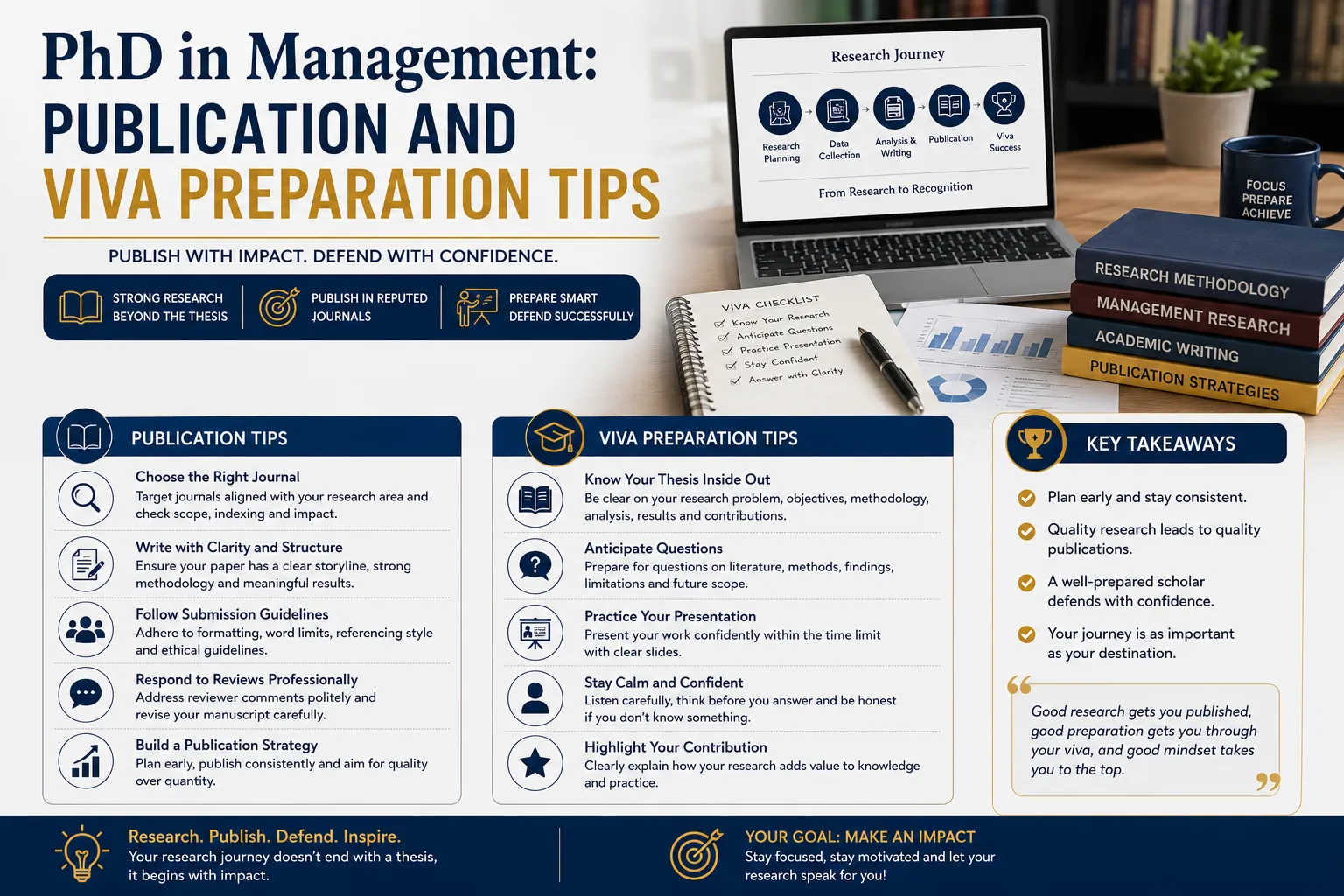
If you're a PhD Management scholar staring down two of the most stressful milestones in your entire doctoral journey — getting a paper published and defending your thesis at the viva — you're not alone in finding this stage overwhelming. This guide on PhD in management publication and viva preparation tips walks you through both processes step by step, from selecting the right journal to handling tough examiner questions with confidence.
This is written specifically for first-time PhD thesis writers in India who want a clear, practical roadmap rather than vague encouragement.
Why Publication and Viva Preparation Go Together
Most PhD Management scholars treat publication and viva preparation as two separate hurdles, tackled one after the other under deadline pressure. In practice, they're deeply connected: a well-published paper strengthens your viva defense, because it gives you evidence that independent reviewers have already scrutinized and validated part of your contribution. Understanding PhD in management publication and viva preparation tips together — rather than in isolation — gives you a real strategic advantage going into your final defense.
ThesisLikho's PhD-qualified experts, who've guided over 10,000 scholars through thesis writing and defense preparation, consistently see the same pattern: scholars who start publication planning early, rather than treating it as an afterthought before submission, walk into their viva noticeably more confident and better prepared to defend their methodology and contribution.
Step-by-Step Publication Roadmap
- Identify publishable chapters early. Not every thesis chapter needs to become a paper — your literature review synthesis, a novel methodology, or a key empirical finding are usually your strongest candidates.
- Draft with a journal audience in mind. Write your manuscript for a specific journal's scope and readership from the start, rather than writing generically and trying to fit it in later.
- Shortlist 3–5 target journals using the journal selection checklist below, ranked from most to least ambitious.
- Prepare your submission package — manuscript, cover letter, author declarations, and any required ethics statements.
- Submit and track your manuscript through the journal's editorial system.
- Respond to reviewer comments methodically (covered in detail below) if you receive a revise-and-resubmit decision.
- Finalize acceptance and proofs, then use the published (or in-press) paper as supporting evidence in your thesis and viva preparation.
Most Indian universities recommend or require at least one publication in a peer-reviewed journal before thesis submission, with some departments requiring two depending on discipline and internal rules . It's worth confirming your specific university's current requirement directly with your research cell, since publication norms have shifted meaningfully in the past year.
Journal Selection Checklist
Before submitting anywhere, run your shortlist through this checklist:
- The journal's scope clearly matches your research topic and methodology
- The journal has a transparent, named editorial board with verifiable academic affiliations
- Peer-review process, timelines, and criteria are clearly published on the journal's website
- The journal meets your university's current publication requirement (verify this directly — see note below)
- Average time-to-decision and time-to-publication are reasonable and clearly stated
- Article processing charges (if any) are transparent, reasonable, and not tied to guaranteed acceptance
- The journal has an ISSN, DOI assignment, and permanent archiving arrangement
Important update for Indian scholars: The UGC-CARE list, long treated as the default checklist for "acceptable" Indian journals, was formally discontinued as a mandatory approved-journal list as of February 2025. It has been replaced by a broader "Suggestive Parameters for Peer-Reviewed Journals" framework, approved in June 2025, which evaluates journals across eight quality categories — including editorial board strength, content quality, research ethics, and visibility — rather than relying on a single fixed list. Many universities have not yet updated their internal PhD regulations to reflect this change, so always verify your specific institution's current publication requirement with your research cell rather than assuming the old CARE list is still the operative standard.
Avoiding Predatory Journals
Predatory journals prioritize profit over genuine peer review, and publishing in one can seriously damage your academic credibility — sometimes permanently, since predatory publishers frequently refuse or heavily charge for article withdrawal requests . Warning signs to watch for:
- Guaranteed acceptance or unusually fast publication timelines (days rather than weeks)
- Vague or unverifiable editorial board members
- Aggressive, unsolicited email invitations to submit
- Article processing charges that aren't disclosed until after acceptance
- Poor website quality, inconsistent formatting, or copied-looking author instructions
- No clearly stated peer-review or ethics policy
COPE's guidance on predatory publishing specifically recommends that authors perform due diligence on a journal's editorial board, review process, and indexing claims before submitting, rather than relying solely on a journal's own self-description (Source: COPE). A quick practical check: search the journal name alongside terms like "predatory" or "Beall's list" (the concept, if not the exact list, is still widely referenced), and verify the editorial board members' affiliations independently rather than taking the journal's website at face value.
Manuscript Submission Workflow
Pre-submission
Prepare the manuscript, formatting, cover letter, and ethics declarations. Typical duration: 1–2 weeks.
Submission
Upload the manuscript through the journal's online editorial system. Typical duration: Same day.
Editorial Screening
The editor checks the manuscript for journal scope, quality, and compliance before peer review. Typical duration: 1–3 weeks.
Peer Review
Experts evaluate the study's methodology, originality, and overall quality. Typical duration: 4–12 weeks.
Decision
The journal issues a decision such as acceptance, minor revision, major revision, or rejection.
Revision
Address reviewer comments, revise the manuscript, and resubmit. Typical duration: 2–6 weeks.
Final Acceptance
The accepted manuscript undergoes proof review and final checks. Typical duration: 2–4 weeks.
Publication
The article is published online or in print, depending on the journal's publication schedule.
The Peer-Review Process, Explained
Peer review exists to catch errors, weaknesses, and gaps in a manuscript's contribution before it becomes part of the permanent scholarly record. For most management journals, this means:
- Editorial screening — the editor checks whether your manuscript fits the journal's scope before sending it further.
- Reviewer assignment — typically 2–3 subject-matter experts are assigned to independently assess your manuscript.
- Review reports — reviewers evaluate your methodology, contribution, clarity, and literature grounding, usually against a structured set of criteria.
- Editorial decision — based on reviewer input, the editor decides to accept, request revisions (minor or major), or reject.
If your topic involves synthesizing existing literature systematically as part of a review-style paper, the PRISMA Statement's structured checklist for reporting how sources were identified, screened, and included offers a transferable framework for demonstrating a systematic (not arbitrary) selection process to reviewers (Source: PRISMA Statement).
How to Respond to Reviewer Comments
This is one of the most anxiety-inducing steps in the entire publication process — and also one of the most learnable. Elsevier Researcher Academy's guidance on this exact challenge recommends taking a short pause after receiving reviewer feedback before drafting a response, giving yourself time to absorb the comments and, ideally, get a second opinion from a co-author or supervisor before reacting .
Reviewer Response Template
For each reviewer comment, structure your response as:
- Restate the comment (numbered, matching the reviewer's original numbering)
- State your response — what you changed, or why you respectfully disagree, with evidence
- Point to the exact location of the change in your revised manuscript (e.g., "Page 14, paragraph 2")
A well-structured response makes it easy for the editor to verify exactly what changed, rather than making them search the manuscript to confirm your claims — vague responses are one of the most common reasons revisions stall in another review round .
If you disagree with a comment: Respond with evidence and professional tone, not defensiveness. Frame disagreement around scientific or methodological reasoning ("our approach is more appropriate for this specific research question because...") rather than dismissing the reviewer's concern outright.
Viva Preparation Timeline
8–10 Weeks Before
Read your thesis thoroughly and identify weak areas, gaps, or sections that may need clarification.
6–8 Weeks Before
Prepare a clear 15–20 minute presentation highlighting your research objectives, methodology, findings, and contributions.
4–6 Weeks Before
List likely viva questions and practice answering them, especially those related to your research methodology and key decisions.
3–4 Weeks Before
Conduct a mock viva with your supervisor or colleagues to build confidence and improve your responses.
1–2 Weeks Before
Refine your presentation based on feedback and review any published papers related to your research.
2–3 Days Before
Do a light revision by reviewing your abstract, research contribution, and major findings. Avoid learning new material.
Viva Day
Arrive early, carry an annotated copy of your thesis, stay confident, and answer questions clearly and calmly.
Tip: Many Indian universities conduct a pre-submission seminar before the final thesis submission. Treat it as a practice viva, as it provides valuable experience in answering research-related questions before your actual defense.
Thesis Defense Checklist
- Thesis contribution and research gap can be stated clearly in 2–3 sentences
- Every methodology choice has a clear, defensible rationale ready
- Presentation is rehearsed within the expected time limit (commonly 15–20 minutes)
- Anticipated questions list covers methodology, limitations, and contribution to knowledge
- Published or in-press papers (if any) are ready to reference as supporting evidence
- A printed, annotated copy of the full thesis is ready for the viva itself
- Mock viva completed with supervisor or peer feedback incorporated
- You know your examiners' research background and likely areas of interest
Common Viva Mistakes to Avoid
- Over-preparing the presentation, under-preparing for questions. The presentation is a small part of the viva; question handling is where most scholars are actually tested.
- Memorizing answers word-for-word rather than understanding the underlying reasoning — memorized answers fall apart under a follow-up question.
- Being defensive about limitations. Acknowledging your study's limitations confidently is a sign of rigor, not weakness.
- Not knowing your own methodology's alternatives. Examiners often ask why you didn't use a different approach — be ready to explain the trade-off, not just defend your choice blindly.
- Skipping the mock viva. Scholars who skip this step are far more likely to be thrown off by an unexpected question style on the actual day.
- Arriving without a physical copy of the thesis or without having reread it recently enough to locate specific sections quickly.
Two Realistic Scenarios
Scenario 1 — Selecting a Journal and Responding to Major Revisions
Anjali, a PhD Management scholar studying organizational change readiness, shortlisted five journals using the checklist above and confirmed her university's current publication requirement with her research cell — discovering that her institution had updated its policy following the UGC-CARE list's 2025 discontinuation and now used the newer Suggestive Parameters framework instead. After submitting to her top choice, she received a major-revision decision with 14 reviewer comments. Rather than responding immediately, she took Elsevier's recommended pause, discussed the comments with her supervisor, and built a numbered response document pointing to exact page changes in her revised manuscript. Her revision was accepted in the next round — she credits the structured response format, not just the content of her changes, for a smoother second review.
Scenario 2 — Preparing a 20-Minute Viva Presentation
Rohit, defending a thesis on supply chain risk resilience, built his viva timeline eight weeks out. He spent the first few weeks re-reading his full thesis and listing every methodology decision he'd need to defend, then built his 20-minute presentation only after that groundwork was done — rather than starting with slides first. His mock viva, run by his supervisor and two senior peers, revealed that he struggled to justify why he hadn't used an alternative quantitative model. He spent his final two weeks specifically shoring up that one answer rather than re-polishing his slides. On the actual viva day, an examiner asked almost exactly that question — and he answered it confidently because he'd already worked through it.
Both scenarios point to the same underlying lesson: structured, methodical preparation — for publication and for the viva — consistently outperforms last-minute intensity.
If you'd like a deeper walkthrough of designing your methodology chapter before you even get to the publication or viva stage, our guide on How to Design a Research Methodology for a PhD in Management covers that groundwork in detail. And if your defense is still weeks away, our guides on How to Prepare for a Thesis Viva Voce Examination and Common Thesis Viva Questions and How to Answer Them go deeper into the defense itself.
Publication Ethics and Plagiarism: What You Must Get Right
Academic integrity issues are one of the fastest ways to derail both your publication and your thesis submission, so it's worth being precise about the actual numbers:
- Plagiarism threshold: UGC's anti-plagiarism policy sets the acceptable similarity limit at ≤10% (excluding references, bibliography, and properly cited quotes) for thesis acceptance without penalty, using UGC-approved software such as Turnitin or iThenticate. A high raw similarity score isn't automatically plagiarism — properly cited quotes, common phrases, and a large reference list can all inflate the raw percentage, so always check the filtered/excluded version of your report before panicking .
- Authorship clarity: COPE's authorship guidance stresses resolving contribution and authorship-order questions with co-authors and supervisors early in the writing process, since ambiguity here is a common source of disputes after submission — clarify this before, not after, you submit (Source: COPE).
- Research and Publication Ethics (RPE) coursework: Most Indian universities now require scholars to complete a mandatory Research and Publication Ethics module during pre-PhD coursework, covering plagiarism, authorship, and predatory-journal awareness.
If you need expert guidance with your research methodology, publication strategy, thesis writing, or viva preparation, you can explore our PhD Thesis Assistance service, where our PhD-qualified experts help scholars navigate publication ethics, journal selection, and defense preparation with confidence.
How Long Does This Whole Process Take?
Publication timelines vary considerably by journal type: fast-track journals can publish within 4–8 weeks, while standard peer-reviewed journals typically take 3–6 months from submission to final publication. Given rejection and revision cycles are common, most PhD scholars are advised to begin their publication process at least 6–12 months before their planned thesis submission deadline, rather than treating it as a last-minute step.
For viva preparation specifically, an 8–10 week runway from first re-read to actual defense day is a realistic, well-tested timeline — giving enough room for a genuine mock viva and follow-up refinement without letting preparation drag into diminishing returns. Across the full PhD journey, from thesis submission to final viva completion, the assessment process is typically expected to conclude within about three months, though actual timelines vary by university and examiner availability.
FAQs
What is included in PhD in management publication and viva preparation tips?
It covers selecting the right journal, avoiding predatory publishers, understanding the peer-review process, responding to reviewer comments professionally, and preparing systematically for your thesis defense — including a realistic timeline and common mistakes to avoid.
Why does PhD in management publication and viva preparation matter?
A strong publication record demonstrates that your research has already withstood independent scrutiny, which strengthens your position at the viva. Preparing for both together — rather than treating them as separate, sequential hurdles — gives scholars a real strategic advantage.
How does publication and viva preparation affect a PhD thesis?
Published or in-press papers can serve as supporting evidence during your viva defense, and the discipline of responding to reviewer comments builds exactly the kind of structured, evidence-based reasoning examiners expect to see during questioning.
How long does it take to complete a PhD thesis using this approach?
Most scholars should begin their publication process 6–12 months before their planned submission deadline, and allow 8–10 weeks for structured viva preparation once your thesis is finalized. Overall PhD completion timelines in India commonly range from 3–5 years, factoring in coursework, research, publication, and final defense stages.
Is professional help available for PhD in management publication and viva preparation tips?
Yes. Many PhD scholars work with experienced research mentors to navigate journal selection, avoid predatory publishers, structure reviewer responses, and prepare systematically for their viva — this is exactly the kind of support ThesisLikho's PhD-qualified experts provide.
What is the current plagiarism/similarity limit for a PhD thesis in India?
Most Indian universities require similarity to stay at or below 10% (excluding references, bibliography, and properly cited quotes), following UGC's anti-plagiarism policy, checked using approved software like Turnitin or iThenticate.
Book a PhD Research Consultation: If you're navigating journal selection, reviewer feedback, or viva preparation and want expert input before your next milestone, ThesisLikho's PhD-qualified experts can help you move forward with confidence. Book Your Consultation →