
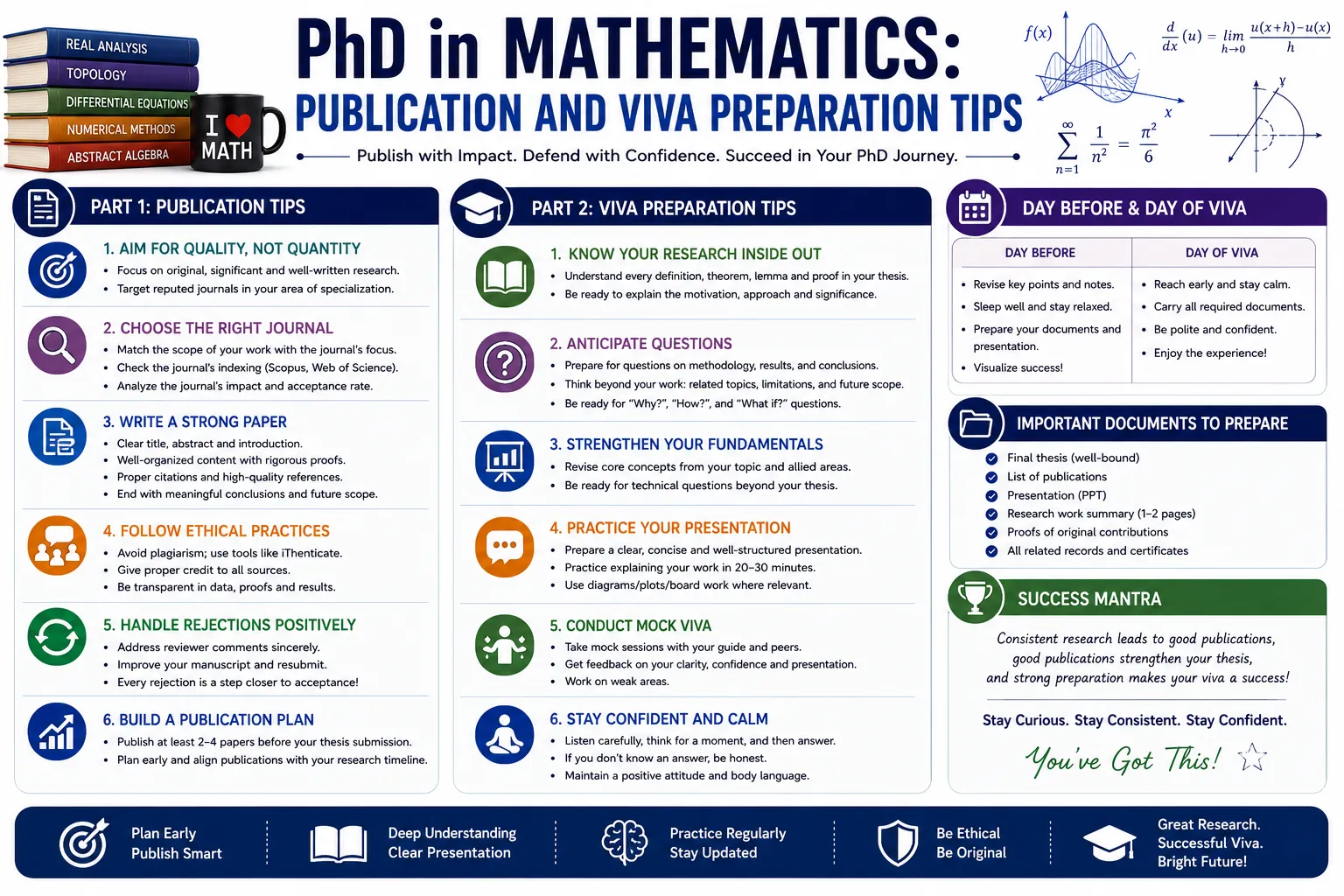
Mathematics PhD scholars face a strange kind of patience test that scholars in faster-moving fields don't: you can prove a genuinely solid result, submit it to a good journal, and then wait. Not weeks — often a year or more — before you hear back with a verdict. If you're searching for PhD in mathematics publication and viva preparation tips, you've probably already run into this timeline reality, and you're wondering how to plan a thesis submission and a viva defense around a publishing process that moves this slowly.
This tutorial walks through both challenges the way a mathematics research supervisor would — candidly, with real numbers on what to expect from journal review, and a concrete plan for defending years of proof-based work in a room full of examiners trained to find the weak link in your argument.
At ThesisLikho, our PhD-qualified mentors have guided more than 10,000 scholars through thesis writing, publication strategy, and viva preparation across disciplines, including mathematics. What follows draws on that mentoring experience, checked against current UGC regulations, bibliometric research on mathematics publication timelines, and Mendeley's guidance on reference management for academic writing.
1. What UGC Actually Requires for Publication in 2026
Publication is not a mandatory UGC requirement for PhD thesis submission. The University Grants Commission's 2022 regulations withdrew the earlier mandatory publication clause after a review of scholars across central universities and IITs found the old rule was pushing many papers into low-quality, non-Scopus-indexed journals rather than improving genuine research quality.
What UGC's regulations do require is that a scholar present at least two research papers at conferences or seminars before submitting the dissertation; formal publication itself is described as encouraged, not mandatory. That said, individual universities frequently layer their own, stricter requirement on top of this national baseline — so check your specific institution's PhD ordinance directly rather than assuming the UGC minimum applies unchanged.
This distinction matters more in mathematics than in almost any other discipline, precisely because of how slowly mathematics journals move — a point covered in depth in the next section. If your university's own ordinance still requires formal publication before submission, understanding the realistic mathematics publishing timeline early is essential for planning your PhD schedule sensibly, rather than discovering the mismatch in your final year.
2. Why Mathematics Publishing Moves So Slowly — And Why That's Less of a Problem Than It Seems
Here's a number worth knowing early: bibliometric research shows mathematics journals have publication delays that can range from one to three years between submission and final publication — and unlike most scientific fields, this delay hasn't meaningfully decreased over time (Source: bibliometric analysis of preprint-to-publication timelines in mathematics journals, arXiv). Elapsed time from preprint posting to formal journal publication in mathematics runs over a year on average — notably longer than physics, where the comparable delay is typically under six months.
Why does mathematics move this slowly? The mathematics community maintains its own particularly rigorous standard of peer review — commonly called "refereeing" — and it has to be genuinely detailed, because a proven mathematical result can be cited and relied upon indefinitely; unlike an empirical finding that might be superseded by newer data, a correct proof doesn't go stale. This is part of why mathematics journals behave, in citation terms, more like humanities journals than typical science journals — citation half-lives in mathematics often exceed ten years, meaning a paper's relevance is measured in decades, not months.
The practical implication for your PhD planning: a long publication delay in mathematics is a normal feature of the field, not a signal that something has gone wrong with your specific paper. Build this into your thesis timeline from the outset — if your university expects publication before submission, start the submission process considerably earlier than you would in a faster-moving field, and don't panic if you're still waiting on a first decision a year after submitting.
3. arXiv and Refereeing: How Mathematics Publishing Actually Works
Mathematics has one publishing habit almost every scholar in the field adopts: near-universal use of arXiv, the preprint server, alongside or ahead of formal journal submission. Mathematicians rely heavily on arXiv specifically to share and track new research findings quickly, since the formal peer-review and publication process is comparatively slow.
In practice, this means your actual research visibility timeline often runs on two tracks: your arXiv preprint, which the community can read, cite, and respond to almost immediately after you post it, and your formal journal publication, which may not appear for a year or more afterward. Most authors submit their arXiv preprint at roughly the same time they submit to a journal, and a majority of published mathematics papers on arXiv were posted there before the journal's formal "received" date.
A practical, less commonly discussed benefit: articles deposited on arXiv tend to receive measurably more citations than equivalent non-deposited articles — a real, documented citation advantage across multiple mathematics journals studied. For a PhD scholar, this is a strong practical argument for posting your results to arXiv promptly, even while a formal journal decision is still pending — your work becomes visible and citable to the community well before the traditional publication process concludes.
One caution specific to arXiv's general/unmoderated categories: because arXiv itself doesn't peer-review submissions before posting, categories like "General Mathematics" occasionally attract a disproportionate number of amateur or unverified claims — this doesn't affect properly categorized, legitimate research submissions, but it's worth knowing when navigating the platform, and it's exactly why formal refereed publication still matters even in a field that relies heavily on preprints.
4. Choosing the Right Journal for Your Mathematical Result
Given the long review timelines discussed above, journal selection deserves even more careful thought in mathematics than in faster-moving fields — a rejection after a year-long review is a genuinely costly setback. A few practical steps:
- Match your result's significance to the journal's tier realistically. Top-tier venues (Annals of Mathematics, Inventiones Mathematicae, Journal of the AMS) are appropriate for genuinely field-advancing results; most PhD-stage first publications are better matched to respected specialist or regional journals in your specific subfield.
- Check recent issues for comparable results. If your target journal hasn't published anything closely related to your specific subfield or technique in the last two to three years, it may not be the right fit even if the stated scope technically matches.
- Weigh the review timeline against your thesis submission deadline honestly. If your university requires publication before submission and your timeline is tight, a journal known for faster turnaround in your subfield may be the more strategic choice over a longer shot at a top-tier venue.
- Consider your supervisor's publication history and network — journals where your supervisor or their close collaborators have published previously often provide a useful, realistic benchmark for both fit and expected review timeline.
- Confirm indexing status (Scopus, Web of Science, MathSciNet, zbMATH) against your specific university's requirement before committing — this avoids an eligibility mismatch discovered only after a long review process concludes.
5. Structuring a Mathematics Paper for Submission
Mathematics papers follow a somewhat different structure from empirical science papers, and getting this right makes your paper considerably easier for a referee to evaluate:
- Abstract — a precise, self-contained statement of your main result and its significance, written last even though it appears first.
- Introduction — states the problem, situates it within existing literature, and clearly states your main theorem or result, typically in the final paragraph rather than buried mid-section.
- Preliminaries/Notation — establishes definitions, notation, and any background results your proof depends on, written so a competent reader in your subfield doesn't need to chase down every prerequisite separately.
- Main results and proofs — the core of the paper; proofs should be complete and rigorous, with lengthy technical lemmas often placed in a dedicated section or appendix to keep the main argument's logical flow readable.
- Discussion/Further directions — connects your result to the broader field and, briefly, states what remains open — genuinely useful material to have ready for your eventual viva as well.
Apply your target journal's citation style consistently from your first draft — reformatting an entire reference list after a rejection-and-resubmit cycle, especially given mathematics' long review timelines, is a costly, avoidable time sink.
If you'd like structured support turning thesis chapters into submission-ready manuscripts, our PhD Thesis Assistance service works through exactly this stage with scholars.
6. Managing References and Citations With Mendeley
Given how long a mathematics literature review can run — and how often you'll be citing decades-old foundational results alongside very recent preprints — a reference management tool is worth setting up early rather than assembling citations manually at the end. Mendeley, Elsevier's free reference manager, is widely used across academic disciplines for exactly this purpose: it lets you store, organize, and tag references as you read, and generates properly formatted citation lists automatically in your target journal's required style (Source: Mendeley guidance on academic reference management).
A few practical habits worth building in from the start: tag references by subfield or by which section of your thesis or paper they'll support, since mathematics literature reviews often span both classical foundational results and very recent arXiv preprints that need to be tracked separately; note the arXiv version alongside the formally published version for any preprint you cite, since papers frequently update between the two, and citing the wrong version can misattribute a result; and keep your citation style consistent across your thesis and every paper draft you're preparing in parallel, since manually reconciling different formats later is exactly the kind of low-value work a reference manager exists to eliminate.
7. Navigating the (Long) Review and Revision Process
A few things worth knowing given mathematics' distinctive review timelines:
- A year (or more) of silence is often genuinely normal, not a sign your paper has been forgotten or rejected outright — mathematics editors frequently struggle to secure referees willing to commit to the detailed, time-consuming review a rigorous proof requires.
- "Major revisions" is a positive signal, not a rejection — it means a referee engaged seriously enough with your proof to identify specific gaps or unclear steps, which is considerably better than a fast, superficial rejection.
- Respond to every referee comment explicitly, including technical objections you believe are mistaken — a careful, point-by-point response addressing each comment, even respectfully disagreeing where warranted, is standard practice and helps move a second review round along faster.
- Keep your arXiv preprint updated as you revise in response to referee feedback, so the version the community is actively reading and citing stays aligned with your most current, most correct argument.
- If genuinely concerned about an unreasonable delay, most mathematics journals have a formal channel — typically a polite status inquiry to the editor — though given the field's well-documented slow review norms, patience is usually the more realistic first response than escalation.
8. Common Publication Mistakes to Avoid
- Submitting to multiple journals simultaneously — a violation of standard academic publishing ethics across virtually all mathematics venues, and a serious problem if discovered.
- Underestimating the review timeline when planning your thesis submission — given mathematics' one-to-three-year publication delays, assuming a fast turnaround is one of the most common and costly planning errors PhD scholars make in this field.
- Skipping arXiv posting out of an assumption that it might undermine formal publication chances — in mathematics, this is essentially the opposite of the actual norm, where preprint posting alongside submission is standard and even correlates with a measurable citation advantage.
- Treating a proof gap flagged by a referee defensively rather than as a genuine opportunity to strengthen (or, occasionally, correct) the result before it's permanently in the published record.
- Neglecting to reconcile arXiv and journal versions after revisions, leaving inconsistent versions in circulation that can confuse later citations of your own work.
9. What the Viva Voce Actually Tests in Mathematics
A useful mental reframe before viva preparation: your Doctoral Committee has already judged your thesis worth defending — that's why you've reached this stage. The viva isn't testing whether your proofs are correct in some abstract sense; it's testing whether you genuinely understand every step of your own argument deeply enough to have produced it yourself, and whether you can respond, in real time, to probing about its logical structure, its assumptions, and its place in the broader field.
In mathematics specifically, examiners typically probe: your command of the precise logical structure of your key proofs (not just the final result, but why each step is valid), your ability to explain why you chose your specific proof technique or approach over plausible alternatives, your honest awareness of where your result's assumptions or scope are limited, and your sense of what the natural next open question is, given what you've established.
10. How to Prepare for Your Mathematics PhD Viva
- Re-derive your key proofs from memory, without your written thesis in front of you. This is the single most diagnostic preparation exercise for a mathematics viva — if you can walk through your main argument's logical steps unaided, you're genuinely ready for that line of questioning; if you find yourself needing to check your written proof, that's exactly where to focus more preparation time.
- Prepare a concise verbal summary of your main result and why it matters, pitched at a level a competent mathematician outside your specific subfield could follow.
- Revisit very recent literature (papers published after your own core work was completed) — examiners often ask how your result relates to work that's appeared even in the last few months.
- Practice explaining your proof technique choices out loud. Articulating "why this approach and not an alternative" is noticeably harder in real-time speech than it feels when reasoning silently, and rehearsal genuinely closes that gap.
- Prepare direct, specific answers about your result's limitations and assumptions — examiners notice when a candidate is reflective rather than defensive about the boundaries of what they've actually proven.
- Run a mock viva with your supervisor or lab-mates, ideally including someone outside your immediate subfield whose questions are more likely to mirror an external examiner's than a close collaborator's would.
- Don't underestimate logistics and rest — arrive well-rested; a rushed, anxious start to a proof-heavy defense affects your ability to recall and reconstruct detailed logical arguments far more than most candidates expect.
For a broader walkthrough of the whole viva process, see How to Prepare for a Thesis Viva Voce Examination.
11. Common Viva Questions and How to Approach Them
- "Walk me through the proof of your main theorem." Be ready to do this at the board or on paper, not just verbally — mathematics vivas frequently expect live derivation, not just description.
- "Why did you choose this proof technique rather than [an alternative approach]?" Answer with the specific trade-off you weighed — computational tractability, generality, elegance — rather than simply "it worked."
- "Where exactly does your argument break down if [a stated assumption] doesn't hold?" This tests genuine understanding of your proof's boundaries — have this mapped out clearly rather than guessing under pressure.
- "How does your result relate to [a specific recent paper]?" Expect at least one question referencing very current literature — a brief, honest "I'm aware of that result; here's how I see it connecting to mine" is stronger than an uncertain guess.
- "What's the most natural open question that follows from your work?" Have a genuine, specific answer ready — this is a common closing-style question, and a vague "more research is needed" answer reads noticeably weaker than a concrete proposed direction.
12. Two Realistic Scenarios
Scenario 1 — Planning a Thesis Timeline Around Mathematics' Slow Publication Cycle
A mathematics scholar in the final year of their PhD assumed a six-month journal review process, similar to what colleagues in engineering departments experienced, and planned their thesis submission accordingly. After learning that mathematics journals typically take one to three years between submission and publication, the scholar checked their university's specific ordinance and confirmed it only required two conference presentations, not formal publication, before thesis submission — allowing the scholar to submit their thesis on schedule while their journal submission continued its slower, separate timeline in parallel, with the arXiv preprint already providing visible, citable research output in the meantime.
Scenario 2 — Preparing for a Proof-Heavy Viva Under Time Pressure
A mathematics scholar with a viva scheduled only a month after final thesis approval worried that passive re-reading wouldn't be sufficient preparation. Rather than simply reviewing the written thesis, the scholar spent the first two weeks re-deriving each major proof from scratch without reference to the written version, identifying two specific steps that required extra rehearsal to explain clearly. The final two weeks combined a mock viva at the board with a lab-mate outside the scholar's specific subfield and a review of papers published in the area over the preceding six months. The scholar reported that the actual viva's technical questions closely matched the proof steps flagged as needing extra rehearsal during preparation.
If you're navigating either of these situations, our PhD Thesis Assistance service can help you build a realistic publication timeline and structured viva preparation plan specific to mathematics research.
FAQs
What is "PhD in mathematics publication and viva preparation tips"?
It refers to the practical steps mathematics PhD scholars take to publish their research — including journal selection, arXiv preprint norms, and navigating a notably slow peer review process — alongside structured preparation for defending proof-based research in the final viva voce examination.
Why does PhD in mathematics publication and viva preparation tips matter?
Because mathematics publication timelines (commonly one to three years) are considerably longer than in most other disciplines, directly affecting how you plan your thesis submission timeline, and viva preparation for proof-heavy work requires a distinct kind of readiness — the ability to re-derive, not just describe, your own arguments under questioning.
How does this approach affect a PhD thesis in practice?
Scholars who understand mathematics' realistic publication timeline early can plan their thesis submission sensibly around it rather than assuming a fast turnaround, and those who prepare for their viva by actively re-deriving their proofs — rather than passively re-reading their thesis — typically perform more confidently under detailed technical questioning.
How long does it take to complete a PhD thesis using this approach?
Most Indian PhD programmes run three to six years. Since UGC's 2022 regulations no longer mandate formal publication nationally before submission, and given mathematics' notably long journal review timelines, scholars can often align thesis submission with research completion — using arXiv preprints to establish visible research output — rather than waiting on an unpredictable, often multi-year formal publication decision.
Is professional help available for PhD in mathematics publication and viva preparation tips?
Yes — mentorship support covering manuscript preparation, journal selection, and structured viva preparation is available through services such as PhD Thesis Assistance.
Ready to build a realistic publication and viva timeline for your mathematics PhD?Book a PhD Research Consultation with ThesisLikho's PhD-qualified mentors.