
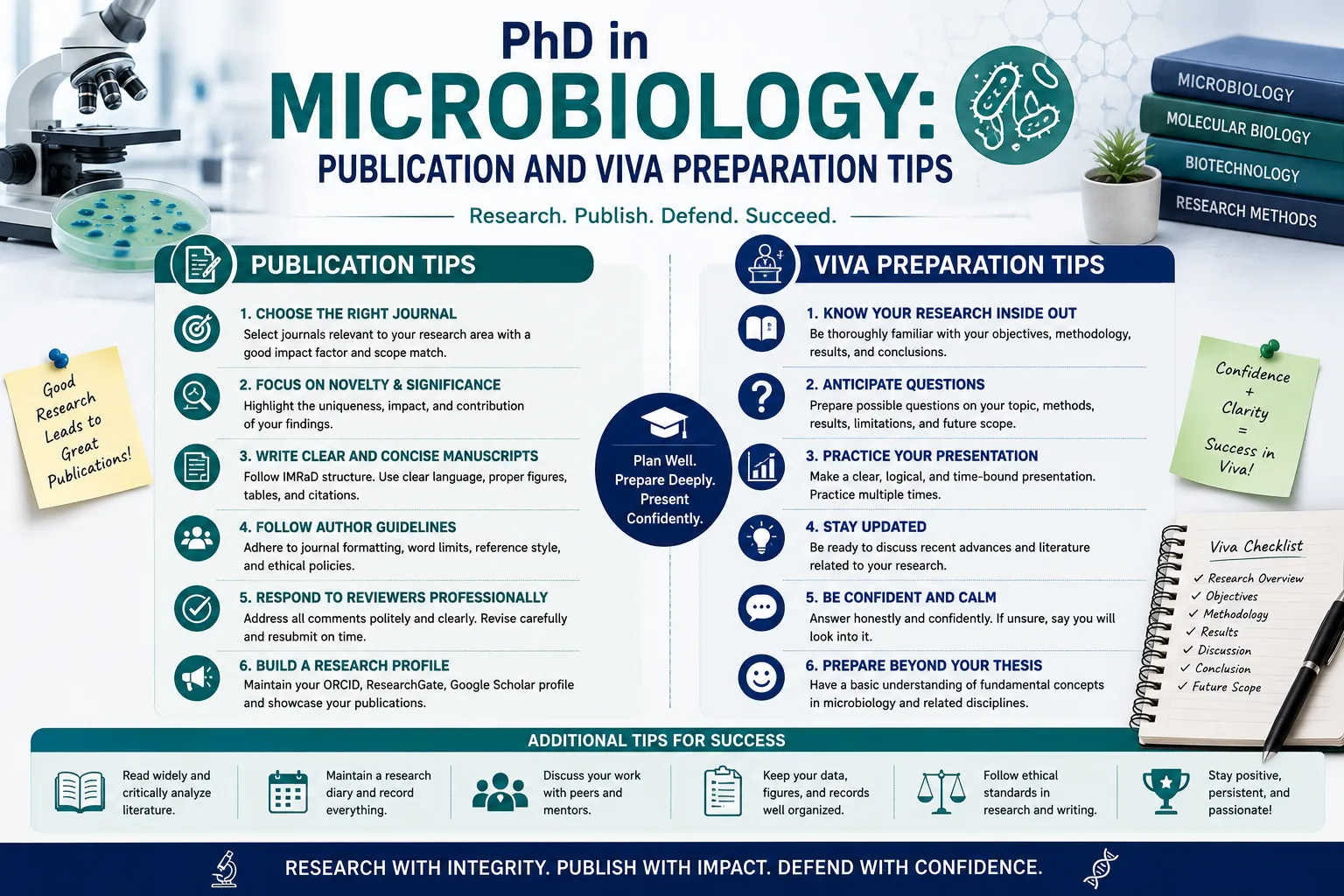
You've generated the data, run the assays, sequenced the genomes or characterized the isolates — and now two very different challenges sit ahead: getting your findings published in a journal that will actually be read by the microbiology community, and defending years of lab work in front of a panel that will ask you to justify every methodological choice you made. PhD in microbiology publication and viva preparation tips come down to understanding what each of these processes specifically rewards — precision and reproducibility for publication, deep command of your own data and its limitations for the viva — and preparing deliberately for both rather than treating them as afterthoughts once the lab work is technically finished.
This guide walks through how to choose the right microbiology journal for your findings, what reviewers and editors in this field specifically look for, and how to prepare for a microbiology-specific viva where examiners will probe your experimental design, controls, and data interpretation in detail. We've grounded this in current 2026 microbiology publishing norms and the patterns we see across scholars ThesisLikho supports through the publication and viva stage.
Why Publication and Viva Preparation Deserve Dedicated Planning
Publication and viva preparation are often treated as things that happen naturally once the "real" research is done, but both actually require distinct, deliberate skill sets that many scholars only develop under time pressure near the end of their PhD. Publishing well means learning to write for reviewers who evaluate methodology rigor and reproducibility with genuine scrutiny — microbiology reviewers in particular tend to focus heavily on experimental controls, statistical validity, and whether claims are proportionate to the evidence presented. Defending well at a viva means being able to explain not just what you did, but why every alternative approach was set aside, and being ready to discuss the limitations of your own data as comfortably as its strengths.
Treating these as two separate preparation tracks, each deserving weeks of dedicated attention before your final submission and defence, consistently produces stronger outcomes than assuming either will simply fall into place once the lab work concludes.
Is Publication Still Mandatory Before Submission?
Under the UGC (Minimum Standards and Procedure for Award of PhD Degree) Regulations 2022, mandatory pre-submission publication was formally withdrawn — publication is now strongly recommended rather than a compulsory requirement for thesis submission. In practice, however, most microbiology departments and supervisors still expect at least one publication or a manuscript well into the review process before a scholar is permitted to submit, both because it demonstrates the work has survived external peer scrutiny and because publication record matters considerably for post-PhD academic and research positions.
Whatever your specific university's current policy, treating publication as a genuine goal — not a regulatory checkbox — tends to produce a stronger, more carefully reasoned thesis overall, since preparing a manuscript for peer review forces a level of precision and defensibility that benefits your full dissertation as well.
Choosing the Right Microbiology Journal
Microbiology as a field spans an unusually wide range of specialized and general venues, and matching your specific findings to the right journal matters considerably for both acceptance likelihood and appropriate audience reach. High-impact, broad-scope venues like Trends in Microbiology carry significant prestige and a correspondingly competitive acceptance bar, generally suited to findings with wide field-level significance rather than a single, narrowly scoped result. Field-specific flagship venues like the ISME Journal, published by the International Society for Microbial Ecology, are the natural target if your work centers on microbial community analysis, metagenomics, or environmental and ecological microbiology at a systems level. Dedicated venues like Microbiome suit work with a strong metagenomics, gut flora, or host-microbiome interaction focus. Mid-tier, broader-scope journals such as Current Microbiology or Microbiological Research remain solid, realistic targets for well-executed but more narrowly scoped PhD findings, offering a faster review process and a less competitive acceptance bar than flagship venues.
Before submitting anywhere, check a target journal's current scope description carefully against your specific findings, review its recent published issues to confirm your work genuinely fits its typical content, and discuss journal choice explicitly with your supervisor, who likely has direct experience with how competitive and appropriate specific venues are for work at your career stage.
What Microbiology Reviewers Actually Look For
Microbiology peer review carries some field-specific scrutiny worth anticipating directly. Reviewers consistently check for appropriate and clearly described experimental controls — positive and negative controls, appropriate replicates, and confirmation that contamination or cross-contamination has been genuinely ruled out, since these are foundational credibility markers in a field where subtle procedural errors can produce misleading results. They check whether statistical methods match your actual experimental design, particularly for studies involving multiple comparisons or complex datasets like sequencing data, where inappropriate statistical treatment is a common and easily flagged weakness. They check whether strain, isolate, or sample identification methods are described with enough precision that another lab could genuinely reproduce your work — vague species or strain identification is a frequent, avoidable source of reviewer pushback. And they check whether your conclusions are proportionate to your actual evidence, since overstating the generalizability or significance of findings from a limited sample or single-site study is one of the most common critiques microbiology reviewers raise.
Current Microbiology Research Areas Shaping Publication Decisions
Several research areas are particularly active in current microbiology publishing, and understanding where your work sits relative to these trends can meaningfully inform both journal choice and how you frame your contribution. Antimicrobial resistance remains one of the most heavily published and closely watched areas across the field, spanning mechanism studies, surveillance research, and novel intervention strategies. Microbiome and metagenomics research, examining microbial communities and host-microbe interactions, continues to expand rapidly and has driven significant growth in dedicated venues built specifically around this focus. Host-microbe interaction studies, bridging microbiology with immunology and cell biology, remain a consistently active publication area. And computational and genomic approaches — including CRISPR-based techniques and large-scale sequencing analysis — increasingly intersect with traditional wet-lab microbiology research, creating publication opportunities at that specific methodological intersection.
Positioning your specific findings clearly within or adjacent to these active areas, where genuinely applicable, can strengthen your manuscript's framing and help editors and reviewers immediately understand its relevance to current field priorities.
Structuring a Microbiology Manuscript for Acceptance
A strong microbiology manuscript follows field conventions closely: a methods section detailed enough for genuine reproducibility, including exact strain sources, growth conditions, and any deviations from standard published protocols; results presented with appropriate statistical treatment and, where relevant, effect sizes rather than significance testing alone; figures that are self-explanatory with complete, precise legends, since reviewers and readers frequently evaluate figures before reading full methods in detail; and a discussion that explicitly addresses limitations rather than only emphasizing strengths, since acknowledged limitations read as scientific maturity rather than weakness.
Following your target journal's specific author guidelines exactly — reference formatting, figure resolution requirements, word limits — matters more in microbiology submission than scholars sometimes assume, since formatting non-compliance is a common and entirely avoidable reason for desk rejection before a manuscript even reaches peer review.
Common Reasons Microbiology Papers Get Rejected
- Insufficient or unclear experimental controls, leaving reviewers unable to confirm findings aren't explained by contamination, batch effects, or other confounds.
- Inappropriate statistical analysis for the specific experimental design, particularly common in studies with complex or high-dimensional data like sequencing results.
- Overstated conclusions relative to sample size or study scope, claiming broader significance than a limited dataset can actually support.
- Insufficient methodological detail for reproducibility, especially around strain identification, culture conditions, or reagent sourcing.
- Poor fit with the target journal's scope, submitting genuinely strong work to a venue where it simply doesn't match the journal's stated focus and readership.
- Weak positioning within current literature, failing to clearly establish what specific gap or contribution the study addresses relative to recent, closely related published work.
Understanding Your Viva Panel's Focus Areas
A microbiology PhD viva typically probes several specific areas beyond just your headline findings. Examiners consistently focus on experimental design justification — why you chose specific strains, media, incubation conditions, or assay methods, and what alternatives you considered and set aside. They probe controls and validation in detail, since a scholar who can't clearly explain why a specific control was included (or wasn't) raises immediate concerns about experimental rigor. They test your understanding of your statistical approach, not just your ability to report a p-value, and they frequently ask about the biological significance of a finding as distinct from its statistical significance — two things that are related but genuinely different, and conflating them is a common vulnerability under viva questioning.
Examiners also consistently probe your work's limitations and what you'd do differently with more time or resources — a question that rewards honest, specific reflection rather than either defensive dismissal or excessive self-criticism.
Preparing to Defend Your Methodology and Controls
The strongest preparation for methodology-focused viva questions is working through, in writing, exactly why each major experimental decision was made and what the genuine alternatives were — not vaguely, but specifically enough that you could explain it to someone unfamiliar with your project in under a minute. For each major experiment or assay in your thesis, be ready to explain: why this specific method was chosen over alternative available techniques, what controls were included and exactly what each one rules out, and what the known limitations of the method are, even when it's the field-standard approach.
This preparation should happen well before your viva date, ideally worked through as you write each results chapter rather than reconstructed under pressure in the final weeks before your defence — scholars who've genuinely internalized this reasoning throughout their PhD tend to answer confidently and specifically, while those attempting to reconstruct it only just before the viva often struggle with exactly the kind of "why not X instead" questions examiners reliably ask.
Presenting Data Clearly During Your Viva
Most microbiology vivas open with a presentation of your key findings, and how clearly you present data at this stage sets the tone for the entire session. Lead each major finding with the specific biological question it addresses, not just the raw result, so examiners immediately understand why the finding matters before evaluating whether it's convincingly supported. Use clean, uncluttered figures during your presentation — the same figures from your thesis are usually appropriate, but simplify further where a slide needs to communicate quickly during live discussion rather than being pored over on the page. And be ready to move fluidly between your summary slides and your full thesis data, since examiners frequently ask to see a specific figure, table, or raw dataset in more detail than your presentation slides show.
Anticipating Microbiology-Specific Viva Questions
Beyond general thesis defence questions, microbiology vivas commonly include field-specific lines of questioning worth preparing for directly: questions about how you ruled out contamination or confounding variables in specific experiments; questions about why you chose a particular strain, cell line, or model organism over alternatives, and what limitations that choice introduces for generalizing your findings; questions probing your understanding of the biological mechanism behind a statistically significant result, not just the statistical result itself; and questions about reproducibility — whether your specific findings have been replicated, and if not, what would be needed to establish that they hold beyond your own lab's specific conditions.
Preparing specific, confident answers to these predictable question types, rather than hoping they won't come up, is one of the most effective uses of your final pre-viva preparation time.
Real Scholar Preparation Examples
Example 1 — Publication strategy. A scholar studying antibiotic resistance mechanisms in a specific bacterial species initially targeted a high-impact, broad-scope journal for her primary findings paper, but after reviewing the journal's recent issues closely with her supervisor, recognized her single-mechanism, single-species study was better matched to a more specialized microbiology journal with a faster review timeline and a readership genuinely focused on resistance mechanism research. The manuscript was accepted after one round of revisions, considerably faster than the broader venue's typical review timeline would have allowed, and gave her a genuine publication well before her thesis submission deadline.
Example 2 — Viva preparation. A scholar defending research on host-microbiome interactions built a structured preparation document working through each of his six major experiments, writing out for each one why the specific method was chosen, what controls were included and what they ruled out, and what the honest limitations were. During his viva, when an examiner asked why he hadn't used an alternative, newer sequencing approach for one key experiment, he was able to explain specifically why the method he'd chosen was more appropriate given his sample type and available resources at the time the experiment was designed — a confident, specific answer that closed the question in a single exchange rather than escalating into extended scrutiny.
Common Mistakes in Publication and Viva Preparation
- Choosing a journal based on prestige alone, without checking whether the specific scope genuinely matches your findings.
- Underestimating how much detail reviewers expect around experimental controls and strain or sample identification.
- Overstating conclusions in a manuscript relative to what a limited sample or single-site study can actually support.
- Treating viva preparation as review rather than active reconstruction of the reasoning behind every major methodological decision.
- Only preparing to explain what you did, without preparing to explain why alternatives were set aside or what the limitations of your chosen approach are.
- Neglecting to prepare for biological-versus-statistical-significance questions, a common and predictable source of confusion under viva pressure.
- Waiting until the final weeks before submission or viva to begin dedicated preparation, rather than building publication and defence readiness throughout the PhD.
- Not reviewing recent papers in your target journal closely enough before submission, missing signals about current scope, style, and reviewer expectations.
Publication and Viva Preparation Checklist
Before submitting a manuscript or entering your viva, confirm you have:
- Identified a target journal whose scope genuinely matches your specific findings, not just its overall prestige
- Reviewed recent issues of your target journal to confirm current scope and style expectations
- Described experimental controls, strain identification, and methodology with full reproducibility-level detail
- Matched statistical methods appropriately to your specific experimental design
- Written conclusions proportionate to your actual sample size and study scope
- Worked through, in writing, the specific justification and alternatives considered for each major methodological choice
- Prepared clear, self-explanatory figures for both your manuscript and your viva presentation
- Practiced explaining biological significance distinctly from statistical significance for your key findings
- Prepared honest, specific answers about your study's limitations and what you'd do differently
How Long Does It Take to Complete a PhD Thesis Using This Approach?
Preparing a strong manuscript for submission, from first draft to acceptance, typically takes three to eight months including peer review and revision cycles, and is best started well before your final thesis submission deadline rather than treated as a parallel final-year task. Dedicated viva preparation — building out methodology justifications and rehearsing presentation of key findings — typically takes four to six weeks of focused work in the final stretch before your defence date.
Is Professional Help Available for PhD in Microbiology: Publication and Viva Preparation Tips?
Yes — many scholars work with academic mentors or research consultancies to identify the right target journal for their specific findings, strengthen manuscript methodology sections before submission, and build structured viva preparation around their own experimental decisions. ThesisLikho's PhD-qualified research experts have supported microbiology and life sciences scholars through exactly this stage, helping ensure manuscripts are appropriately targeted and vivas are approached with genuine, well-rehearsed command of the underlying research — all while keeping the work and findings entirely your own. Explore ThesisLikho's PhD thesis assistance services for one-on-one guidance.
FAQs
What is PhD in microbiology publication and viva preparation tips?
It refers to the specific practices that help microbiology PhD scholars publish their findings successfully in appropriately matched journals and defend their thesis confidently at the viva — covering journal selection, manuscript structuring, and preparation for the methodology-focused questioning typical of microbiology defences.
How long does it take to complete a PhD thesis using this approach?
Manuscript preparation and peer review typically take three to eight months, best started well before thesis submission, while dedicated viva preparation typically takes four to six weeks of focused work before the defence date.
Is professional help available for PhD in microbiology publication and viva preparation tips?
Yes. Research consultancies and academic mentors, including ThesisLikho's PhD-qualified experts, help scholars target the right journals and prepare structured, confident viva defences while preserving full research originality.
Why does PhD in microbiology publication and viva preparation tips matter?
Because publication strengthens both your thesis's credibility and your post-PhD career prospects, and strong viva preparation is what allows years of careful lab work to be defended confidently rather than undermined by unprepared answers to predictable methodology questions.
How does PhD in microbiology publication and viva preparation tips affect a PhD thesis?
Together, they determine whether your findings reach the wider scientific community through peer-reviewed publication and whether your final defence reflects the true strength of your research — both outcomes depend heavily on deliberate, field-specific preparation rather than assuming either will naturally follow from good lab work alone.
Ready to prepare a publication-ready manuscript and a confident viva defence?
Book a PhD Research Consultation → https://thesislikho.com/writing-services/thesis-assistance-phd