
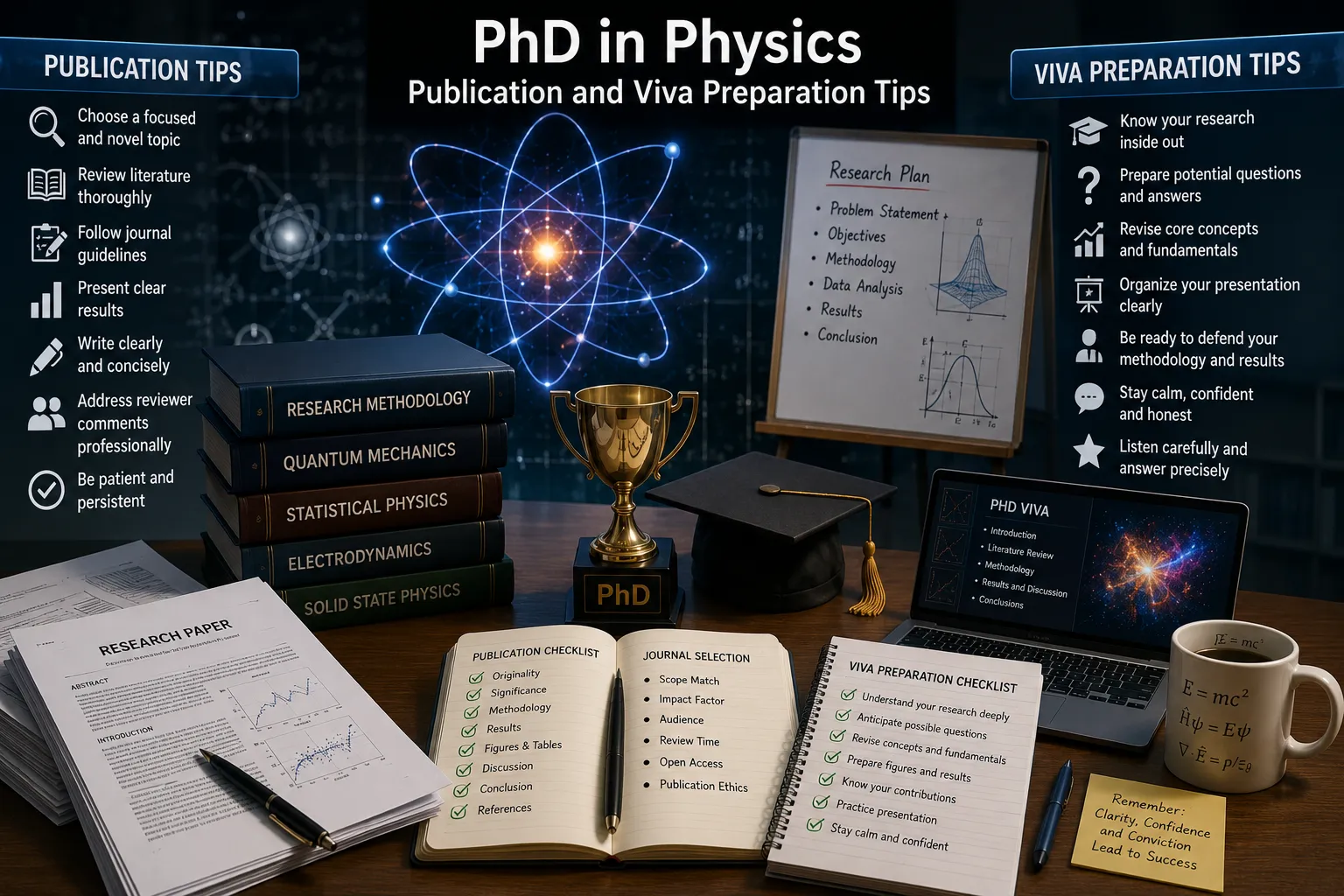
Somewhere around the third year of a physics PhD, two questions start crowding out everything else: "should I be publishing by now?" and "what on earth will they ask me in the viva?" If you're searching for phd in physics publication and viva preparation tips, you're likely at exactly that stage — data in hand, a thesis taking shape, and a growing sense that the finish line involves two very different challenges: getting your work into a journal, and then defending it in a room full of people whose job is to find its weak points.
This tutorial walks through both, the way a research supervisor would across a few candid conversations — what's actually required under current UGC rules, how physics publishing norms differ from other disciplines (hello, arXiv), and how to walk into a viva voce prepared rather than just hopeful.
At ThesisLikho, our PhD-qualified mentors have guided more than 10,000 scholars through thesis writing, publication strategy, and viva preparation across disciplines, including physics. What follows draws on that mentoring experience, checked against current UGC regulations and publisher guidance from IEEE and established research-methods literature.
1. What UGC Actually Requires for Publication in 2026
Here's the part that surprises a lot of scholars: publication is not a mandatory UGC requirement for PhD thesis submission. The University Grants Commission's 2022 regulations withdrew the earlier mandatory publication clause, after a review of over 2,500 research scholars across central universities and IITs found that mandatory publication hadn't improved research quality — a large share of papers under the old rule were landing in low-quality, non-Scopus-indexed journals rather than genuinely useful venues (Source: UGC, Minimum Standards and Procedure for Award of Ph.D. Degree Regulations, 2022).
What UGC's regulations do require is that a scholar present at least two research papers at conferences or seminars before submitting the dissertation; publication itself is described as encouraged, not mandatory (Source: UGC Regulations, 2022, Clause 10.6).
That said — and this is the part scholars often miss — your specific university almost certainly has its own additional requirement layered on top of the UGC baseline. Most Indian universities still expect at least one paper in a UGC-CARE listed or Scopus-indexed journal before final submission, even though UGC itself no longer mandates it nationally. So the honest answer to "do I need to publish?" is: check your own university's PhD ordinance, not just the UGC regulation, because the two frequently diverge.
Practically, this means your first concrete step shouldn't be picking a journal — it should be pulling your university's current PhD ordinance and reading the exact clause on publication and conference presentation, since departments within the same university sometimes interpret UGC's "encouraged, not mandatory" language differently. Physics departments, given the field's strong publish-and-preprint culture, often lean toward informally expecting publication even where it isn't a formal submission requirement — worth clarifying directly with your supervisor rather than assuming either way.
2. Why Physics Publishing Works Differently
Physics has one publishing habit that scholars coming from other disciplines often don't expect: near-universal use of preprint servers, especially arXiv, before or alongside formal peer-reviewed submission. In most physics subfields, posting a preprint isn't seen as undermining the eventual journal publication — it's the norm, and it establishes priority on results while the slower peer-review process runs in parallel.
This matters practically for two reasons. First, it means your "publication timeline" as a physics scholar often has two milestones, not one: preprint posting and formal journal acceptance — and your supervisor and Doctoral Committee may treat both as meaningful markers of progress. Second, it means your literature review needs to account for both preprint and peer-reviewed versions of related work, since in fast-moving subfields (condensed matter, high-energy physics, astrophysics) the preprint is often the version that's actually being cited and built upon at the time you're working.
3. Choosing the Right Journal for Your Physics Research
Journal selection mistakes cost scholars months, so this deserves real thought rather than a rushed decision at submission time. A few practical steps:
- Match scope, not prestige, first. Read the "Aims & Scope" section of your shortlisted journals carefully — an article can be rejected before peer review simply because it falls outside a journal's declared scope, regardless of quality (Source: IEEE Author Center guidance, a principle that holds across physics-adjacent publishers as well).
- Check your reference list for natural fits. The journals your most-cited sources were published in are usually a strong shortlist starting point.
- Search the target journal's recent issues for papers similar to yours in method or subfield — if nothing comparable has appeared there in the last two to three years, it may not be the right fit even if the scope technically matches.
- Weigh journal tier against realistic timeline. A high-impact-factor journal with a six-to-nine-month review cycle may not suit a scholar close to submission deadlines; a respected but faster mid-tier journal sometimes serves the thesis timeline better.
- Confirm indexing status (Scopus, Web of Science, UGC-CARE) against your university's specific requirement before committing — this single check avoids a rejected-for-eligibility problem after months of review.
4. Preprints and arXiv: What Physics Scholars Need to Know
If your subfield uses arXiv (most of physics does), a few practical norms are worth knowing:
- Posting to arXiv before formal peer-reviewed submission is standard practice in most physics subfields and generally does not count as "prior publication" that would block journal submission — but always check your target journal's specific preprint policy, since this varies by publisher and occasionally by field.
- Keep your arXiv version and your submitted manuscript version clearly tracked — reviewers and committee members may reference either, and inconsistencies between versions can create confusion during evaluation.
- Citing arXiv preprints in your own thesis is generally acceptable in physics, but note in your reference list whether a cited preprint has since been formally published, and cite the peer-reviewed version where one exists — this is a small detail examiners do notice.
5. Structuring a Physics Paper for Submission
Most physics papers follow a fairly standard structure, and sticking close to it makes reviewers' jobs easier (which, not coincidentally, makes your paper easier to accept):
- Abstract — a tight, self-contained summary of the problem, method, and key result, written last even though it appears first.
- Introduction — establishes the research gap and states your contribution clearly in the final paragraph, not buried mid-section.
- Theory/Methods — enough detail for a competent researcher in your subfield to follow your approach, with derivations placed in appendices where they'd otherwise interrupt the flow.
- Results — presented with clear, well-labeled figures; avoid duplicating the same data in both a figure and a table.
- Discussion — connects your results back to the stated gap and to relevant prior work, including any conflicting findings.
- Conclusion — states what you found and, briefly, what remains open — this "future work" framing is also useful material for defending your contribution later in your viva.
Whatever citation style your target journal uses, apply it consistently from the first draft — reformatting an entire reference list after a rejection-and-resubmit cycle is a common, avoidable time sink.
If you'd like structured support turning thesis chapters into submission-ready manuscripts, our PhD Thesis Assistance service works through exactly this stage with scholars.
6. Navigating Peer Review and Revisions
A few things worth knowing before your first submission:
- Reviews take longer than you'll expect. Review timelines vary considerably by journal and depend on how quickly an editor can locate qualified, available reviewers — build buffer time into your thesis submission timeline rather than assuming a fast turnaround (Source: IEEE Author Center, on publisher-side review-timeline variability, a pattern that generalizes across most peer-reviewed venues).
- "Major revisions" is not a rejection. It's the most common outcome for a solid paper and should be treated as an invitation to strengthen the work, not a signal to abandon the submission.
- Respond to every reviewer comment explicitly, even ones you disagree with — a point-by-point response letter that addresses each comment (agreeing and revising, or explaining respectfully why you haven't) is standard practice and speeds up the second review round.
- If you believe a review was unfair or technically inaccurate, most publishers have a formal escalation path — typically writing to the editor-in-chief with your specific concerns rather than resubmitting elsewhere out of frustration (Source: IEEE Author Center guidance on challenging editorial decisions, a process broadly mirrored across major physics publishers).
7. Common Publication Mistakes to Avoid
- Submitting to multiple journals simultaneously — nearly all reputable publishers explicitly prohibit this, and it can result in serious ethical consequences if discovered (Source: IEEE Author Center submission policies, reflecting a norm standard across peer-reviewed physics publishing).
- Under-citing your own preprint or thesis chapters — if material overlaps between your arXiv preprint, your thesis, and your journal submission, disclose this rather than letting an editor discover it independently.
- Skipping the "Aims & Scope" check and submitting to a journal purely for its impact factor.
- Treating co-authorship informally — agree on author order and contribution statements with your supervisor and collaborators before submission, not after a dispute arises.
- Ignoring predatory journal warning signs — unusually fast acceptance, vague peer-review descriptions, and aggressive solicitation emails are the classic signals; UGC's own review found predatory-journal publication was a widespread problem under the old mandatory-publication rule, which is part of why that rule was withdrawn.
8. What the Viva Voce Actually Tests
It helps to reframe the viva mentally before you start preparing for it: the committee already believes your thesis is defensible — that's why you've reached this stage. The viva isn't testing whether your work is good; it's testing whether you understand it deeply enough to have produced it yourself, and whether you can think on your feet about its implications and limitations.
In practice, examiners are typically probing four things: your command of the theoretical foundations underlying your work, your ability to justify specific methodological choices, your honest awareness of your study's limitations, and your sense of where the work sits in the broader field — including what a logical next study would look like.
It's also worth remembering that a viva is a conversation, not an interrogation. Examiners generally want your thesis to succeed — a poor viva outcome reflects badly on the examination process too. That doesn't mean the questioning will be soft, but it does mean an examiner pressing hard on a particular point is usually testing depth of understanding, not looking for a reason to fail you.
9. How to Prepare for Your Physics PhD Viva
- Re-read your own thesis as if you're an examiner, annotating anything you'd challenge if it weren't your own work — this single exercise surfaces most of the questions you'll actually be asked.
- Prepare a two-minute and a ten-minute summary of your thesis — you'll likely need both, depending on how the viva opens.
- Revisit your literature review with fresh eyes, especially papers published after you finished your own data collection — examiners often ask how your findings relate to very recent work.
- Rehearse defending your methodology choices out loud, not just in your head — articulating "why this approach and not an alternative" is noticeably harder in speech than it feels in your mind.
- Prepare for the limitations question directly — have two or three genuine limitations ready to discuss with the same confidence as your strengths; examiners notice when a candidate is defensive rather than reflective about weaknesses.
- Do a mock viva with your supervisor, lab-mates, or a mentor unfamiliar with the finer details of your work — an outsider's questions often mirror an examiner's more closely than a labmate's would.
- Sleep and logistics matter more than scholars expect — arrive rested and early; a rushed, anxious start affects recall far more than most candidates anticipate.
For a broader walkthrough of the whole viva process, see How to Prepare for a Thesis Viva Voce Examination.
10. Common Viva Questions and How to Approach Them
While no two vivas are identical, a few question categories come up consistently for physics theses:
- "Summarize your thesis in a few sentences." Have this ready verbatim — it's the most common opener, and stumbling here sets an unnecessarily anxious tone for the rest of the session.
- "Why did you choose this method over [alternative]?" Answer with the specific trade-off you weighed, not just "it's standard in the field" — examiners want to see you made an informed choice, not a default one.
- "What would you do differently if you started this project again?" This is a limitations question in disguise — answer honestly rather than claiming you'd change nothing.
- "How does your finding relate to [a specific paper]?" Expect at least one question referencing recent literature you may not have deeply engaged with in your written thesis — a brief, honest "I'm aware of that work; here's how I see it relating to mine" is a stronger answer than guessing confidently.
- "What's the broader significance of this work?" Practice a concise answer that connects your specific result to the wider question your subfield cares about — this is where a well-rehearsed answer distinguishes a strong candidate.
- "Where would this research go next?" Have a genuine, specific answer, not a vague "more studies are needed" — examiners respond far better to a concrete proposed next step.
For a fuller question bank and answering strategies, see [Link: Common Thesis Viva Questions and How to Answer Them].
11. Two Realistic Scenarios
Scenario 1 — Publication Timeline Pressure A physics scholar in the final year of their PhD assumed publication was mandatory under UGC rules and delayed their thesis submission by nearly a year waiting for a journal decision. After checking both UGC's 2022 regulations and their own university's specific ordinance, the scholar discovered their university only required conference presentation of two papers, not formal publication, before submission — allowing them to submit the thesis while the journal review continued in parallel, rather than treating publication as a submission blocker.
Scenario 2 — Viva Preparation Under Time Pressure A physics scholar scheduled their viva only three weeks after final thesis approval and felt underprepared. Rather than re-reading the entire thesis passively, the scholar built a structured plan: re-reading with an examiner's mindset over the first week, drafting written answers to the ten most likely questions (informed by their supervisor's experience with the specific examiner panel), and running two mock vivas with lab-mates in the final week. The structured approach, rather than raw hours spent, is what made the difference — the scholar reported the actual viva questions closely matched several of their prepared answers.
If you're navigating either of these situations, our PhD Thesis Assistance service can help you build a realistic publication and viva-preparation timeline aligned to your specific university's requirements.
FAQs
What is "phd in physics publication and viva preparation tips"?
It refers to the practical steps physics PhD scholars take to publish their research — including journal selection, preprint norms, and peer review navigation — alongside structured preparation for the final viva voce examination.
Why does phd in physics publication and viva preparation tips matter?
Because publication strategy affects your thesis timeline directly, especially given UGC's 2022 rule change, and viva preparation directly affects your performance in the final, high-stakes evaluation of years of research work.
How does this approach affect a PhD thesis in practice?
Scholars who check both UGC regulations and their specific university's requirements early avoid unnecessary submission delays, and those who prepare systematically for the viva — rather than relying on general familiarity with their own thesis — typically perform more confidently under examiner questioning.
How long does it take to complete a PhD thesis using this approach?
Timelines vary by university, but most Indian PhD programmes run three to six years including coursework, research, and viva preparation. Since UGC no longer mandates formal publication before submission, scholars can often align their thesis submission with their research completion rather than an unpredictable journal review timeline
Is professional help available for phd in physics publication and viva preparation tips?
Yes — mentorship support covering manuscript preparation, journal selection, and structured viva preparation is available through services such as PhD Thesis Assistance.
Ready to build a realistic publication and viva timeline for your physics PhD? Book a PhD Research Consultation with ThesisLikho's PhD-qualified mentors.