
Introduction
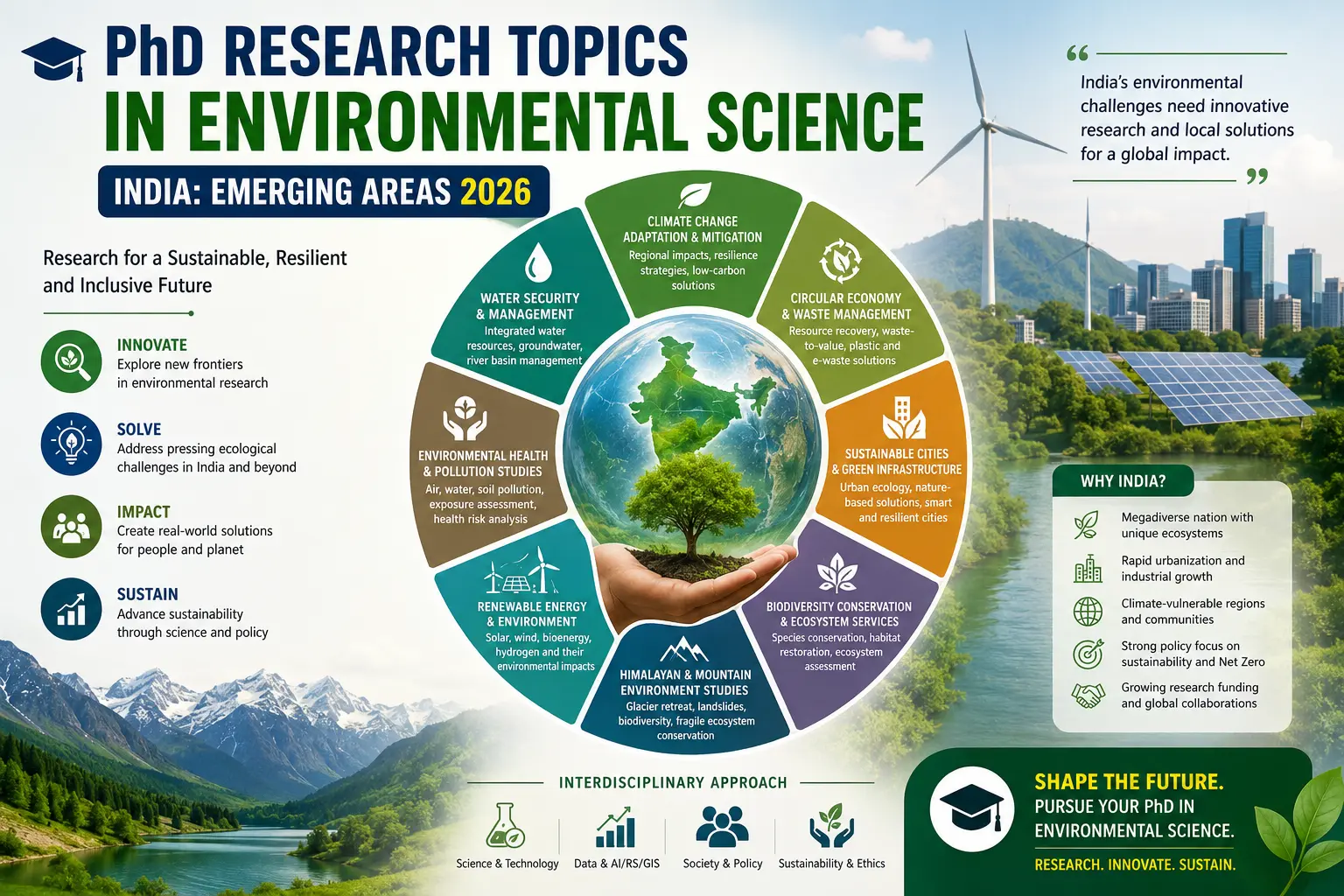
Environmental Science has become one of the most important academic and research disciplines in India. Rapid urbanization, industrial growth, climate change, biodiversity loss, pollution, and increasing pressure on natural resources have created new environmental challenges that require innovative solutions. As India moves towards sustainable development and climate resilience, the demand for high-quality environmental research is growing significantly.
For PhD scholars, Environmental Science offers a wide range of interdisciplinary research opportunities. Government agencies, universities, research institutes, and industries are investing heavily in environmental research to address emerging ecological concerns. In 2026, several new research areas are gaining attention due to policy changes, technological advancements, and global sustainability goals.
If you are planning to pursue a PhD in Environmental Science in India, selecting a relevant and future-oriented research topic is crucial. This article explores the most promising and emerging PhD research topics in Environmental Science for 2026.
Why Choose Environmental Science for a PhD?
Environmental Science is an interdisciplinary field that combines biology, chemistry, geology, geography, engineering, public policy, and data science. The field offers opportunities to work on real-world problems while contributing to sustainable development.
Benefits of pursuing a PhD in Environmental Science include:
- Growing demand for environmental experts
- Opportunities in academia and research institutions
- Employment in government agencies
- International collaboration opportunities
- Industry demand for sustainability professionals
- Contribution to environmental conservation and climate action
With increasing environmental awareness and stronger regulations, environmental research is expected to expand significantly in the coming years.
Emerging Environmental Research Trends in India
Before selecting a PhD topic, it is important to understand current environmental priorities in India.
Major research drivers in 2026 include:
- Climate change adaptation
- Net-zero emissions goals
- Renewable energy transition
- Sustainable agriculture
- Air quality management
- Water security
- Biodiversity conservation
- Circular economy practices
- Environmental monitoring through Artificial Intelligence
- Urban sustainability
These areas provide excellent opportunities for impactful doctoral research.
1. Climate Change Adaptation and Resilience
Climate change remains one of the most significant environmental challenges facing India.
Potential PhD Topics:
- Climate vulnerability assessment of Indian cities
- Impact of climate change on Himalayan ecosystems
- Community-based climate adaptation strategies
- Climate-resilient agricultural systems
- Heatwave management in urban regions
- Climate risk assessment for coastal communities
- Climate-induced migration in India
- Carbon sequestration potential of Indian forests
Research in this field supports national and global climate policies while helping vulnerable populations adapt to changing environmental conditions.
2. Air Pollution Monitoring and Control
India continues to face severe air pollution challenges in many urban and industrial regions. Improving air quality has become a national priority.
Research Areas:
- Source apportionment of urban air pollution
- Indoor air pollution assessment
- Impact of vehicular emissions on public health
- Low-cost air quality monitoring technologies
- Artificial Intelligence-based air quality prediction
- Agricultural stubble burning and pollution mitigation
- Air pollution trends in smart cities
- Green infrastructure for air quality improvement
These topics have direct relevance to public health and environmental policy.
3. Water Resource Management and Water Security
Water scarcity is emerging as a critical issue in many parts of India. Sustainable water management is therefore a major research focus.
Potential Research Topics:
- Groundwater depletion assessment using GIS
- Rainwater harvesting effectiveness in urban areas
- River ecosystem restoration strategies
- Water quality monitoring using remote sensing
- Sustainable watershed management
- Climate change impacts on water availability
- Industrial wastewater treatment innovations
- Water governance and policy evaluation
Researchers working in water security contribute directly to sustainable development goals.
4. Renewable Energy and Environmental Sustainability
India is rapidly expanding its renewable energy sector to reduce carbon emissions and achieve energy security.
Emerging Topics:
- Environmental impacts of large-scale solar farms
- Sustainable biofuel production
- Life-cycle assessment of renewable energy systems
- Wind energy and biodiversity interactions
- Green hydrogen production and sustainability
- Renewable energy adoption in rural India
- Carbon footprint analysis of energy technologies
- Energy transition and environmental policy
This field combines environmental science with engineering and sustainability studies.
5. Biodiversity Conservation and Ecosystem Restoration
India is one of the world's biodiversity hotspots. However, habitat loss, pollution, and climate change threaten many species and ecosystems.
Research Opportunities:
- Conservation genetics of endangered species
- Restoration ecology of degraded landscapes
- Human-wildlife conflict management
- Pollinator diversity and ecosystem services
- Biodiversity assessment using environmental DNA
- Forest ecosystem resilience under climate change
- Wetland conservation strategies
- Community-based conservation models
These studies support biodiversity protection and ecological sustainability.
6. Sustainable Agriculture and Agroecology
Agriculture remains the backbone of India's economy, but environmental sustainability in farming is becoming increasingly important.
Potential PhD Topics:
- Organic farming and soil health improvement
- Sustainable irrigation practices
- Agroecological approaches to climate resilience
- Soil carbon sequestration in agricultural lands
- Precision agriculture using AI and remote sensing
- Sustainable fertilizer management
- Agricultural biodiversity conservation
- Climate-smart agriculture models
Research in this area benefits both farmers and environmental conservation efforts.
7. Waste Management and Circular Economy
India generates enormous quantities of municipal, industrial, electronic, and plastic waste.
Emerging Research Topics:
- Plastic waste recycling technologies
- Circular economy implementation in Indian industries
- E-waste management challenges
- Biomedical waste treatment innovations
- Waste-to-energy technologies
- Municipal solid waste management systems
- Industrial waste valorization
- Behavioral aspects of waste segregation
Circular economy research is receiving substantial attention from policymakers and industries.
8. Urban Environmental Sustainability
Urbanization is creating environmental pressures related to pollution, transportation, energy consumption, and waste generation.
Research Areas:
- Sustainable urban planning
- Green building assessment
- Urban heat island mitigation strategies
- Smart city environmental performance evaluation
- Urban ecosystem services
- Sustainable transportation systems
- Green infrastructure planning
- Environmental justice in urban areas
These topics align with India's Smart Cities Mission and urban sustainability goals.
9. Environmental Biotechnology
Biotechnology is increasingly being used to address environmental problems through innovative biological solutions.
Potential Topics:
- Bioremediation of contaminated sites
- Microbial treatment of industrial wastewater
- Algae-based carbon capture technologies
- Biofertilizers and sustainable agriculture
- Environmental genomics applications
- Biosensors for pollution monitoring
- Microplastic degradation using microorganisms
- Phytoremediation of polluted soils
Environmental biotechnology offers excellent opportunities for interdisciplinary research.
10. GIS, Remote Sensing, and Environmental Modeling
Advanced technologies are transforming environmental monitoring and management.
Emerging Research Topics:
- Satellite-based land use change analysis
- Climate change modeling using GIS
- Forest cover monitoring through remote sensing
- Environmental disaster prediction systems
- AI-powered environmental monitoring
- Urban expansion and ecological impacts
- Drought prediction models
- Flood risk assessment and mapping
These technologies provide valuable tools for evidence-based environmental management.
11. Environmental Health and Public Health Linkages
The connection between environmental quality and human health is becoming increasingly important.
Research Opportunities:
- Health impacts of air pollution
- Waterborne disease risk assessment
- Climate change and disease transmission
- Environmental toxicology studies
- Heavy metal exposure assessment
- Occupational environmental health risks
- Urban environmental stress and mental health
- Public health adaptation to climate change
This field offers opportunities for collaboration between environmental scientists and medical researchers.
12. Microplastics and Emerging Pollutants
Microplastics and emerging contaminants represent a growing environmental challenge.
Potential Topics:
- Microplastic pollution in Indian rivers
- Microplastics in agricultural soils
- Pharmaceutical contaminants in water bodies
- Emerging pollutants in urban ecosystems
- Human exposure pathways to microplastics
- Ecotoxicological impacts of microplastics
- Removal technologies for emerging contaminants
- Monitoring frameworks for new pollutants
Research in this area is expected to grow rapidly in the coming decade.
13. Coastal and Marine Environmental Research
India's extensive coastline supports diverse ecosystems and millions of livelihoods.
Research Areas:
- Coastal ecosystem resilience
- Mangrove restoration and carbon sequestration
- Marine pollution assessment
- Sea-level rise impacts on coastal communities
- Sustainable fisheries management
- Coral reef conservation
- Blue economy and sustainability
- Coastal vulnerability mapping
These topics are highly relevant for climate adaptation and marine conservation.
14. Environmental Policy and Governance
Scientific research plays a critical role in shaping environmental policies and regulations.
Potential PhD Topics:
- Evaluation of environmental regulations in India
- Climate governance frameworks
- Environmental impact assessment effectiveness
- Sustainable development policy analysis
- Environmental justice and equity
- Community participation in environmental management
- Green finance and sustainability
- Policy mechanisms for achieving net-zero targets
Policy-oriented research helps bridge the gap between science and decision-making.
15. Artificial Intelligence in Environmental Science
Artificial Intelligence is revolutionizing environmental research through predictive analytics and automated monitoring.
Emerging Topics:
- AI-based climate forecasting
- Machine learning for biodiversity monitoring
- Smart pollution detection systems
- Environmental risk prediction models
- AI-driven waste management systems
- Remote sensing image analysis using deep learning
- Predictive modeling of environmental disasters
- Intelligent resource management systems
AI-enabled environmental research is likely to dominate future scientific advancements.
How to Choose the Best PhD Research Topic
Selecting the right topic is one of the most important decisions in a PhD journey.
Consider the following factors:
Research Relevance
Choose a topic that addresses current environmental challenges and future priorities.
Availability of Data
Ensure sufficient data and resources are available for conducting meaningful research.
Supervisor Expertise
Align your research interests with faculty expertise and institutional strengths.
Funding Opportunities
Research topics aligned with national priorities often attract funding from government agencies.
Career Prospects
Select a topic that offers strong employment opportunities in academia, industry, and government sectors.
Interdisciplinary Potential
Interdisciplinary research often leads to broader impact and greater innovation.
Future Scope of Environmental Science Research in India
India's commitment to sustainability, renewable energy, biodiversity conservation, and climate action is creating unprecedented opportunities for environmental researchers. Funding agencies such as government ministries, scientific research councils, and environmental organizations are increasingly supporting innovative environmental projects.
Future growth areas include:
- Climate resilience research
- Artificial Intelligence applications
- Green technologies
- Circular economy systems
- Sustainable urban development
- Environmental health studies
- Renewable energy sustainability
- Ecosystem restoration science
Researchers with expertise in these areas are likely to remain in high demand over the next decade.
Conclusion
Environmental Science is one of the most dynamic and impactful research fields in India today. As environmental challenges become more complex, the need for innovative research solutions continues to grow. PhD scholars have the opportunity to contribute directly to sustainability, climate action, biodiversity conservation, pollution control, and resource management.
The emerging research areas of 2026—including climate change adaptation, renewable energy, artificial intelligence, circular economy, water security, environmental biotechnology, and ecosystem restoration—offer excellent opportunities for meaningful and high-impact doctoral research.
By selecting a relevant, future-focused, and interdisciplinary topic, PhD candidates can not only advance scientific knowledge but also build rewarding careers while contributing to a more sustainable and resilient India.
ThesisLikho supports scholars throughout the dissertation process helping them turn research ideas into quality academic contributions that meet university and publication standards.
Contact ThesisLikho
Website: www.ThesisLikho.com
Call/WhatsApp: +91 96438 02216