
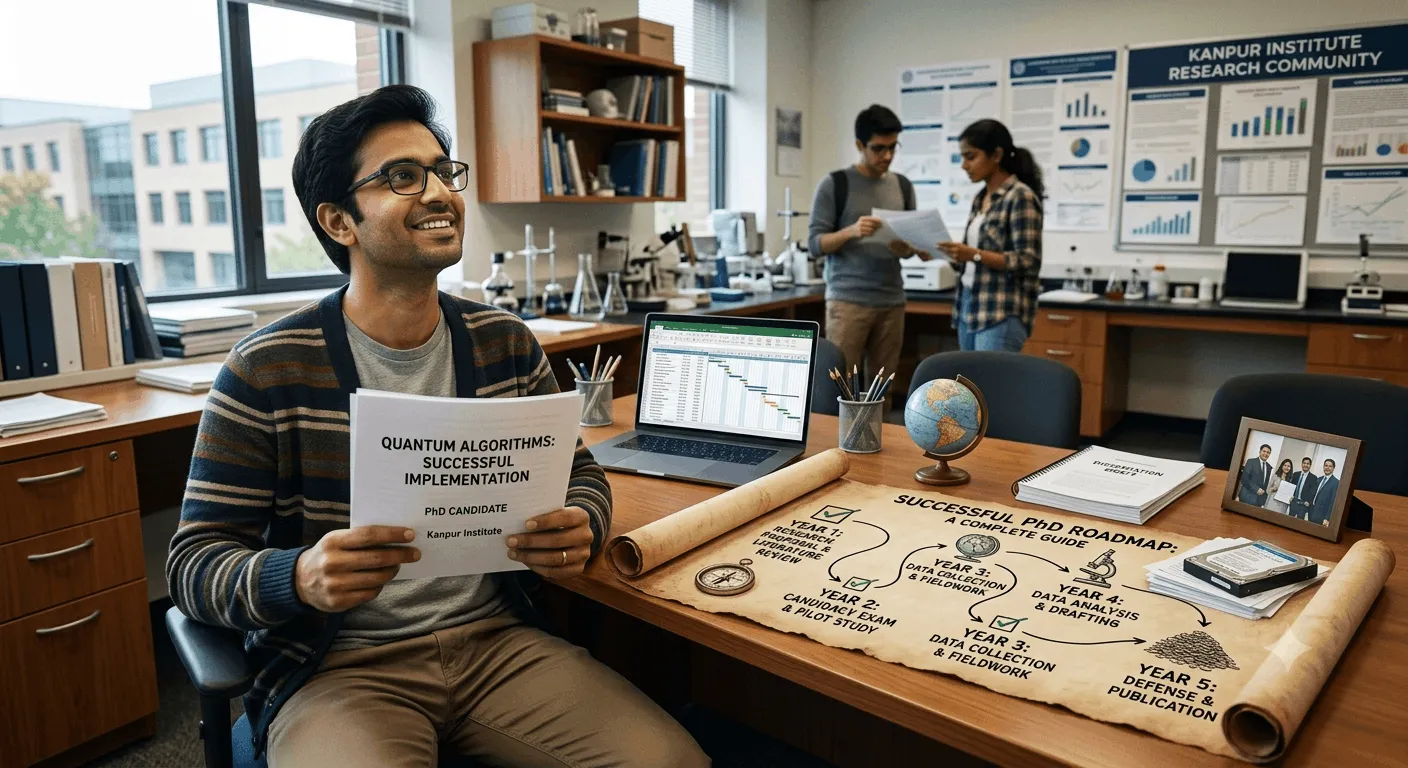
Somewhere between accepting your PhD offer and the moment you finally submit your dissertation, a genuinely difficult truth becomes obvious: nobody actually hands you a map. You're expected to know when to take your qualifying exam, when to start publishing, when to propose your dissertation topic, and when to schedule your defense — largely by absorbing scattered advice from your advisor, your department handbook, and whichever senior student happens to answer your questions honestly. That gap matters more than it should, because doctoral attrition is a real and well-documented problem, not a rare misfortune. This guide lays out a complete PhD roadmap from admission through graduation, with realistic timelines, the doctoral research milestones every program shares in some form, and the specific decision points — advisor selection, comprehensive exams, the dissertation proposal, publishing, and the final defense — where students most often lose time they didn't need to lose. Whether you're preparing to apply, just starting your first year, or trying to figure out why year three feels harder than year one was supposed to be, this roadmap will help you see the whole journey clearly enough to plan around it.
What Are the Stages of a PhD? A Bird's-Eye View First
A PhD moves through five broad stages regardless of country or discipline: pre-admission preparation, coursework and foundational training, the qualifying or comprehensive examination, the dissertation research and writing phase, and the final defense followed by graduation formalities. Terminology and exact sequencing shift between countries and universities — some systems bundle coursework and candidacy into a single early phase, others separate them sharply — but the underlying logic holds everywhere: progress needs to be visible, documented, and defensible to an advisor, committee, or panel at each checkpoint, rather than something you simply assert has happened.
Understanding this five-stage shape early is what lets you plan proactively instead of reacting to deadlines as they arrive. Doctoral programs are long enough — typically four to seven years depending on field and country — that treating each stage as a separate, disconnected task is exactly how students end up behind. A PhD roadmap works best as a single continuous plan, where your coursework choices are already shaped by the dissertation topic you're circling, and your comprehensive exam reading list overlaps deliberately with your eventual literature review.
Stage 1 — Pre-Admission: Building the Foundation Before You Even Start
Most competitive PhD programs expect serious preparation to begin well before the application portal even opens, and treating admission as the actual starting line is one of the earliest planning mistakes prospective doctoral students make. This preparatory stage involves identifying a genuine research interest (not just a broad field, but a specific gap or question), researching potential supervisors whose work aligns with that interest, and, in many systems, making informal contact with those supervisors before formally applying.
Application materials for doctoral programs are evaluated differently than undergraduate or master's applications — admissions committees are specifically looking for clarity of research purpose and evidence that you understand what original contribution to knowledge actually means, not simply strong grades. A generic statement of purpose that could apply to any program in the field is one of the fastest ways to signal you haven't done this preparatory thinking, and faculty reviewers notice this pattern quickly. Realistically, this means starting research on programs, faculty, and funding roughly a full year before your intended start date, since recommendation letters, standardized tests where required, and a tailored proposal all take longer to do well than most applicants expect.
Stage 2 — Coursework and Foundational Training
The first one to two years of most PhD programs are spent completing required coursework, methodology training, and any prerequisite background your specific research area demands. This period looks deceptively similar to a master's degree, which is part of why it can lull students into underestimating how much groundwork they should be laying for later stages during this time.
The strategic move during coursework is to treat every seminar paper, methods course, and elective as a small rehearsal for your dissertation rather than an isolated requirement to clear. Choosing course topics and paper assignments that circle your eventual research area — even loosely — means you arrive at your qualifying exam and dissertation proposal with usable material already drafted, rather than starting that writing from a blank page after coursework ends. This is also the window in which the advisor relationship gets established and tested in real working conditions, which matters far more than it might seem at the time.
Choosing and Working With Your Advisor: The Relationship That Shapes Everything Else
An advisor relationship is one of the very few genuinely irreversible decisions in a PhD roadmap, and it deserves more deliberate evaluation than most students give it. Unlike almost every other choice in the program, switching advisors mid-program is a significant setback for both parties, and faculty have little practical ability to simply release an underperforming advisee either — which means both sides are, in effect, making a multi-year commitment after a comparatively short courtship.
The most reliable source of information isn't the advisor's publication record or reputation, but direct conversations with their current and former students — including those who struggled, not just their most visible successes. Ask specifically about communication style and frequency, how feedback is given, whether funding has historically been stable, how long students typically take to graduate under that supervision, and what happens when a student and advisor disagree on direction. A pattern worth taking seriously: research has found doctoral candidates working under negative or unstable supervisory relationships face a meaningfully elevated risk of dropping out entirely, which makes this evaluation stage far more consequential than it initially feels.
Advisor Fit: What to Look For and What Should Give You Pause
Clearly Communicates Expectations: A strong advisor explains how often you'll meet, how quickly they typically provide feedback, and what they expect from students. Be cautious if they are vague or avoid discussing how the advising relationship works on a day-to-day basis.
Reliable Funding: Current students should be able to confirm that funding is stable and consistently available throughout the program. Treat funding promises with caution if they depend on future grants or are described as uncertain from semester to semester.
Supports Student Independence: A good advisor encourages students to publish their own research, present at conferences, and develop independent academic profiles. A potential warning sign is an advisor who discourages independent publishing or insists on being the senior author on every paper regardless of contribution.
Strong Student Outcomes: Look at how long previous students took to graduate and where they are now. Advisors whose students regularly finish within the program's average timeframe generally provide effective mentorship. Be cautious if many students take significantly longer than expected or leave the program without completing their degrees.
Research Interests Truly Align: The best advisor-student relationships are built on genuine research overlap rather than loosely related topics. If an advisor seems interested only in having additional help for their own projects with little flexibility for your research interests, the fit may not be ideal.
Welcomes Questions and Discussion: A supportive advisor creates an environment where students feel comfortable asking basic questions, seeking clarification, and respectfully disagreeing. If an advisor reacts to questions with irritation, impatience, or dismissiveness, it may indicate communication challenges that could affect your research experience.
None of these signals is individually disqualifying — an overcommitted senior advisor with prestige can still be an excellent mentor, and a brand-new junior faculty member can be deeply invested in your success. The point is to gather enough information from multiple sources, especially current students, that you're making an informed choice rather than a hopeful one.
Stage 3 — The Qualifying Exam or Comprehensive Exam: Your Gateway to Candidacy
A qualifying or comprehensive examination exists to formally validate that you're ready to move from being a student absorbing knowledge to a researcher capable of designing and executing an original study. Passing it typically confers "advancement to candidacy," a formal status change that most programs treat as the real midpoint of the PhD roadmap, even though it usually happens well before the halfway mark chronologically.
Programs vary considerably in format — some use written exams on broad reading lists, others require an oral defense of a proposed research direction, and many combine both. What's consistent across formats is the underlying expectation: you need to demonstrate command of your field's core literature and methodology, and increasingly, you need to show that your proposed dissertation direction is both original and feasible within a realistic timeframe. Many programs set a hard institutional deadline for this exam — often by a specific year or term after admission — precisely because delaying it tends to cascade into delaying everything downstream.
The most effective preparation treats the exam reading list as material you're building toward your literature review anyway, rather than a separate hurdle to clear and then set aside. Students who compartmentalize exam prep from dissertation work often find themselves re-reading and re-synthesizing the same literature twice; students who prepare with the dissertation already in mind carry that synthesis forward directly into their proposal.
Stage 4 — The Dissertation Proposal and Research Phase
Once you've advanced to candidacy, the dissertation proposal formalizes exactly what you intend to research, how, and why it matters — and getting committee approval on this document is typically the second major gate in the doctoral research milestones sequence. A strong proposal does more than describe a plan; it anticipates the questions a committee will ask and addresses feasibility concerns before they're raised as objections.
The research phase that follows is, for most students, the longest and least externally structured stage of the entire program. Unlike coursework or exam preparation, there's no syllabus telling you what to do this week, which is precisely why it's the stage where drift and delay accumulate most easily. Building your own milestone structure here — quarterly check-ins with your advisor, self-imposed drafting deadlines, or a shared project timeline — replaces the external structure that disappeared once coursework ended.
Many programs and disciplines also expect students to submit journal articles or conference papers during this phase, tying your internal doctoral research milestones to external peer review as an additional form of validation. This serves two purposes worth taking seriously: it builds your publication record before the job market, and it forces earlier, smaller-scale feedback on your methodology and framing than waiting for a full dissertation committee review would provide.
A Realistic PhD Timeline: Year by Year
Actual PhD timelines vary widely depending on the country, university, research field, and funding structure. The outline below represents a common progression, but you should always confirm the official milestones and deadlines for your specific doctoral program.
Year 1 – Coursework and Foundation Building: The first year is usually dedicated to completing coursework, developing research skills, learning research methodologies, and building a productive relationship with your advisor. By the end of the year, your coursework plan is typically approved, and your research interests become more focused.
Year 2 – Coursework Completion and Qualifying Exams: During the second year, students generally finish any remaining coursework, prepare for qualifying or comprehensive examinations, and begin a more detailed literature review. Successfully passing the qualifying or comprehensive exam is the major milestone of this stage.
Year 3 – Dissertation Proposal and Candidacy: The third year focuses on developing a detailed dissertation proposal, refining the research methodology, and obtaining approval from the dissertation committee. Once the proposal is approved, students usually advance to official PhD candidacy.
Year 4 – Research and Data Collection: Most students spend the fourth year conducting the primary research, collecting data, performing experiments, or carrying out fieldwork, depending on their discipline. Many also submit their first research paper to a journal or present their findings at an academic conference.
Year 5 – Data Analysis and Dissertation Writing: During the fifth year, the emphasis shifts to analyzing research findings, writing dissertation chapters, and preparing additional publications based on the completed work. By the end of this stage, the dissertation committee often reviews the first complete draft of several chapters.
Year 6 and Beyond – Final Revisions and Graduation: Some doctoral programs require additional time to complete revisions, respond to committee feedback, finalize the dissertation, and prepare for the oral defense. The final milestone is successfully defending the dissertation and completing all graduation requirements to earn the PhD degree.
Common Mistakes That Quietly Delay Graduation
Recognizing these patterns early is far easier than correcting them after they've already cost you a year or more. A few show up across nearly every discipline and program type.
- Treating the research phase as unstructured "free time" instead of building self-imposed milestones and deadlines
- Waiting too long to start writing, on the assumption that data collection must be fully finished first
- Avoiding difficult conversations with an advisor about direction, funding, or pace until frustration has already built up
- Chasing an ever-expanding scope instead of defining a defensible, finishable project early in candidacy
- Isolating from peer networks and support systems, which research consistently links to higher attrition risk
- Neglecting to publish or present until very late in the program, losing the earlier feedback and job-market benefits publishing provides
The Reality of PhD Attrition — And Why It Changes How You Should Plan
It's worth being direct about a statistic most prospective and current PhD students don't hear clearly enough: doctoral attrition is genuinely common, not a marginal or unusual outcome. Widely cited research on doctoral completion places overall attrition somewhere in the 40–50% range across disciplines, with completion rates roughly a decade after starting landing around 57% in some of the largest tracked cohorts, and attrition running notably higher in humanities and social science fields than in STEM disciplines.
This isn't included here to alarm you — it's included because it reframes how you should approach the entire roadmap. If close to half of students who start a PhD program don't finish it, the specific, structural factors that predict completion (funding stability, advisor fit, realistic milestone pacing, and social support) deserve at least as much of your planning attention as the intellectual content of your research itself. Research tracking the timing of doctoral dropout has found attrition risk is highest in the earlier years of a program and is closely tied to funding instability — which is exactly why the advisor and funding evaluation covered earlier in this roadmap isn't a minor administrative detail, but one of the highest-leverage decisions in the entire process.
Burnout and mental health strain are well-documented realities of doctoral study rather than signs of individual failure — surveys of doctoral candidates have found large majorities reporting moderate to severe stress, with a substantial share meeting criteria consistent with burnout, and research has linked pressure to publish, workload, funding uncertainty, and poor supervision quality to these outcomes. Programs and institutions increasingly recognize this and are expanding counseling, mentorship training, and wellbeing resources in response, though access and stigma remain real barriers for many students. Building deliberate rest, peer community, and realistic pacing into your PhD timeline isn't a departure from serious academic planning — it's a documented part of what separates students who finish from those who don't.
Stage 5 — The Dissertation Defense and Graduation
The final defense, sometimes called a viva voce depending on the country and system, compresses years of research into a single evaluative session where you explain, justify, and sometimes actively defend your own work in front of an examining committee. The emphasis examiners place isn't flawless perfection — it's intellectual ownership: demonstrating that you understand your work's genuine contributions, its limitations, and its place in the broader field, including the questions you'd want to pursue next if you continued the line of research.
Effective defense preparation starts well before the scheduled date. Rereading your own dissertation as if you were a skeptical outside reader, anticipating the two or three hardest questions a committee member in your field would likely ask, and rehearsing a concise explanation of your core contribution in plain language are all far more valuable in the final weeks than last-minute content revisions. After the defense, most programs still require a round of final revisions, formatting checks against university-wide dissertation standards, and administrative clearance before the degree is formally conferred — a stage students sometimes underestimate in how much lead time it requires before an actual graduation date.
Final-Stage Checklist Before Your Defense
A structured pass through this list in the weeks before your defense catches the kind of avoidable administrative and preparation gaps that add unnecessary stress to an already demanding milestone.
- Dissertation formatting matches your university's specific style and submission guidelines exactly
- All committee members have received the final draft within the required notice period
- You've rehearsed a clear, concise verbal summary of your core contribution and its significance
- You've anticipated likely questions from each committee member based on their own research background
- Required administrative forms, ethics clearances, and library submission steps are identified and scheduled
- You have a realistic post-defense revision plan in case moderate changes are requested
Frequently Asked Questions
What are the stages of a PhD?
Most doctoral programs move through five broad stages: pre-admission preparation and advisor research, coursework and foundational training, a qualifying or comprehensive examination leading to candidacy, the dissertation proposal and independent research phase, and finally the dissertation defense followed by administrative graduation formalities. Exact terminology and sequencing vary by country and discipline, but every system requires visible, documented progress checkpoints rather than simply asserting that work has happened.
How long does a PhD typically take to complete?
Most PhD programs take between four and seven years, though this varies significantly by country, discipline, and funding structure. Some institutional policies set hard outer limits — commonly around seven to nine years from admission — after which continued enrollment requires special exception. Fields with heavy laboratory or clinical components sometimes run shorter than humanities programs, where extensive independent archival or theoretical work can extend the research phase considerably.
What is the qualifying exam and why does it matter so much?
A qualifying or comprehensive exam formally validates that you're ready to move from coursework into independent dissertation research, and passing it typically confers "advancement to candidacy" status. Many programs set a firm institutional deadline for this exam, since delays here tend to cascade into delays at every later doctoral research milestone. Preparing for it using material that overlaps with your eventual dissertation literature review, rather than treating it as an isolated hurdle, saves significant duplicated effort later.
How common is it to not finish a PhD program?
More common than most prospective students realize. Widely cited research places overall doctoral attrition somewhere around 40–50% across disciplines, with completion rates about a decade after starting landing near 57% in large tracked cohorts, and attrition running higher in humanities and social science fields than in STEM. This reflects structural factors — funding instability, advisor fit, and program pacing — at least as much as it reflects any individual student's ability or effort.
How do I choose the right PhD advisor?
Talk directly to an advisor's current and former students, including those who struggled as well as those who thrived, and ask specifically about communication style, feedback turnaround, funding stability, and typical time to graduation. Research interests should genuinely overlap with yours rather than merely sit in the same broad field, and you should feel comfortable asking basic questions without facing dismissiveness. Because switching advisors mid-program is a significant setback for both parties, this evaluation deserves more deliberate research than almost any other early decision in your PhD roadmap.
Should I publish papers during my PhD, or wait until it's finished?
Publishing during the program, rather than waiting until the dissertation is complete, is increasingly expected and genuinely advantageous. It ties your internal progress to external peer review, provides earlier feedback on your methodology and framing than a full committee review would, and builds a publication record that matters considerably on the academic job market. Many programs formally expect journal articles or conference papers as part of the dissertation research phase rather than treating them as optional extras.
What should I do if my relationship with my advisor isn't working?
Address concerns directly and early rather than letting frustration accumulate silently, since unresolved advisor conflict is a well-documented contributor to attrition. Seek advice from a trusted senior student or program coordinator who doesn't have a stake in the relationship, and be specific about what isn't working — communication frequency, feedback quality, or direction disagreements each call for different conversations. If the relationship is genuinely unworkable, most programs do have processes for changing advisors, though it's a significant transition that's far better avoided through careful selection upfront.
How should I prepare for my dissertation defense?
Start well before the scheduled date by rereading your own dissertation as a skeptical outside reader would, anticipating the hardest likely questions from each committee member based on their research background, and rehearsing a concise, plain-language explanation of your core contribution. Examiners are assessing intellectual ownership of your work — your ability to explain its contributions and limitations — rather than flawless perfection, so overpreparing narrow factual details tends to matter less than being able to discuss your work's broader significance confidently.
Is it normal to feel burned out during a PhD?
Yes — burnout is a well-documented and common experience in doctoral study rather than a sign of individual failure, with surveys of PhD candidates finding large majorities reporting moderate to severe stress and a substantial share meeting criteria consistent with burnout. Contributing factors researchers have identified include workload, funding uncertainty, pressure to publish, and supervision quality, all of which are structural rather than purely personal. If you're experiencing this, most institutions now offer counseling and wellbeing resources specifically for graduate researchers, and reaching out to your program's support services or a mental health professional early tends to help more than waiting until symptoms worsen.
What's the difference between advancing to candidacy and finishing coursework?
Finishing coursework simply means you've completed the required classes and training; advancing to candidacy is a formal status change that follows passing your qualifying or comprehensive exam and often approval of your dissertation proposal. Candidacy signals that your committee has formally validated both your readiness to conduct independent research and the feasibility of your specific proposed project — it's a substantive gate, not just an administrative one.
How far in advance should I start preparing a PhD application?
Serious preparation typically needs to start about a full year before your intended start date, since identifying a genuine research interest, researching potential supervisors, securing strong recommendation letters, and drafting a tailored (not generic) research proposal all take longer to do well than most applicants expect. Waiting until application portals open to begin this groundwork is one of the most common reasons otherwise-qualified applicants submit weaker materials than their actual potential would suggest.
What happens between the defense and actual graduation?
Most programs require a round of final revisions based on committee feedback, formatting checks against university-wide dissertation submission standards, and administrative clearance steps before the degree is formally conferred. This stage is frequently underestimated in how much lead time it requires — students sometimes assume graduation follows immediately after a successful defense, when in practice formatting and administrative processing can add real weeks to the final timeline.
Conclusion
A PhD is genuinely one of the longest, least externally structured academic journeys most people will ever undertake, which is exactly why having a clear PhD roadmap matters as much as the quality of the research itself. Understanding the five broad stages — pre-admission preparation, coursework, candidacy exams, the dissertation research phase, and the final defense — along with the specific doctoral research milestones and decision points within each one, turns a process that can feel formless and overwhelming into something genuinely plannable. Choose your advisor with real diligence, treat coursework and exam preparation as building blocks toward your dissertation rather than separate hurdles, publish along the way rather than waiting until the end, and take the documented realities of attrition and burnout seriously enough to build support and realistic pacing into your plan from the start. None of this replaces the intellectual work of doing original research — but it removes the avoidable delays and isolation that derail so many otherwise capable doctoral students, and gives you the clearest possible path from admission to graduation.