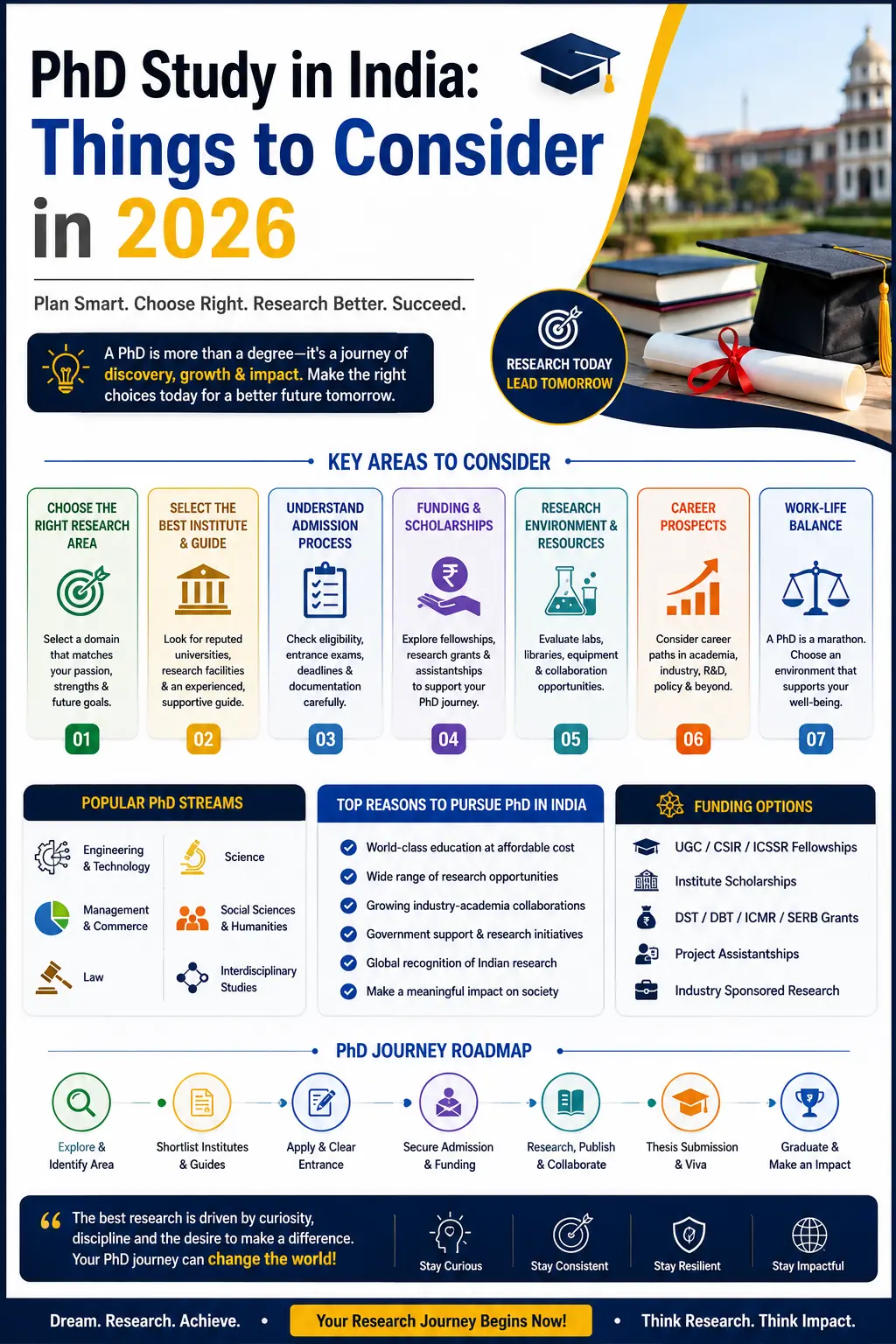
PhD studies in India are both exciting and challenging. India’s rapidly shifting academic environment means that the digital age, coupled with the global AI and research inclusion, have changed the ways researchers conduct studies, write theses, and publish research. In the current age, there are many factors that lead to the successful completion of a PhD. Some of these factors include mastering the art of academic research, coupled with the use of various digital and academic tools to increase speed and efficiency, and maintain a competitive edge against other researchers in the academic field.
In this detailed blog, with a word count of close to 3,000, we will look at the tools that every PhD student in India will have to use in 2026, based in the areas of research, writing, collaboration, data science, and productivity, as well as tools that will help ensure mental well-being.
1. Research Tools
PhD Students’ Research Tools
Most AI-assisted tools help researchers a lot with writing.
Research Search Engines
Google Scholar: Scholars who would like to read articles and/or do research usually check Google Scholar first.
Microsoft Academic: Part of Copilot, AI-assisted academic search engine that gives suggestions and helps citing.
Semantic Scholar: Academic search engine that uses AI to show main findings of research and filter out noise.
Dimensions.ai: Shows academic research funding and citations.
Books
Shodhganga: Electronic database of Indian theses and dissertations.
National Digital Library of India (NDLI): Digital database and a collection of academic research.
CFP: Call for Papers or requests for researchers to write articles.
AI-Assisted Literature Review Tools
Elicit: Literature review tool that writes literature reviews.
2. Writing Tools
Grammarly Premium: Proofreads and checks for writing ease and plagiarism.
Academic Writing Tools
Grammarly Premium: Proofreads and checks for writing ease and plagiarism.
QuillBot: Paraphrasing and summarization tool for writing drafts.
Copilot for Word: AI features of Word for writing.
Citation Management
Zotero: Free, open-source citation management with cloud support.
Mendeley: Popular reference management with collaboration, especially in India.
EndNote: Advanced citation management for complex bibliographies.
Plagiarism Checkers
Turnitin: Widely used for checking plagiarism for thesis in Indian universities.
Urkund: Plagiarism checking software used by many Indian institutions.
PlagScan: Cheap solution for independent researchers.
3. Data Analysis Tools
Statistical Analysis
R & RStudio: Spanish for statistical computing.
Python (with NumPy, Pandas, and SciPy): A must for research with heavy data.
SPSS: Still in use in social sciences.
Stata: Software of choice in policy and econometric research.
Specialized Tools
MATLAB: Sciences and engineering.
NVivo: Analyzing qualitative data of interviews and case studies.
ATLAS.ti: Another qualitative research software.
Visualization Tools
Tableau: Powerful software to create interactive dashboards with data.
Microsoft Power BI: Software for data visualization from Microsoft.
OriginLab: Scientific data analysis and graphing.
4. Collaboration & Networking Tools
Academic Networking
ResearchGate: Share your papers, ask and answer questions, and collaborate.
Academia.edu: Networking site for researchers.
ORCID: Researcher ID for a lifetime.
Project Management
Trello: Visual task management.
Notion: Notes, tasks, and collaboration in one place.
Slack: Research group communication.
Virtual Collaboration
Zoom & Microsoft Teams: Virtual meeting and conferencing software.
Overleaf: LaTeX editing software for collaboration.
GitHub: Collaboration software for research involving code.
5. Productivity & Time Management Tools
Task Management
Todoist: Great task management software.
Microsoft To Do: Task management software that integrates with Outlook and Teams.
Notion Calendar: Merges scheduling with research notes.
Note-Taking
Obsidian: Knowledge management platform with Markdown-based notes.
Evernote: First popular research note organizing platform.
OneNote: Free and part of Microsoft ecosystem.
Focus & Well-Being
Forest App: Focus and productivity app with game mechanics.
Headspace: Stress management app through meditation.
RescueTime: App that tracks productivity and time and task management.
Tools for Publishing & Visibility
Journal Selection
Elsevier Journal Finder: Pairs manuscripts with appropriate journals.
Springer Journal Suggester: Tool for locating a journal outlet for publication.
Think. Check. Submit.: Confirms that a journal is not a predatory journal and is legitimate.
Research Impact
Altmetric: Measures research impact and tracks online engagement.
Scopus: Citation database popular in India.
Web of Science: Global citation database.
Open Access Platforms
arXiv: Preprint repository for physics, mathematics, and computer science.
bioRxiv & medRxiv: Preprint repositories for biology and the medical sciences.
OSF (Open Science Framework): Preprints and research support with data repositories.
India-Specific Tools & Initiatives
Government Platforms
UGC CARE List: Endorsed publication lists for Indian scholars.
e-ShodhSindhu: A higher education e-resource consortia.
SWAYAM: Online skill development courses.
Funding & Grants
DST (Department of Science & Technology) grants.
CSIR Fellowship Management System.
ICSSR for grants for social science research.
Emerging Tools in 2026
AI-Powered Assistants
Copilot for Research: tailored AI assistant for the literature review, research writing, and data analysis.
ChatGPT-6 Academic Mode: AI with a specialization in academic writing.
SciSpace: AI-based paper reading and summarizing.
Blockchain in Academia
Proof of Authorship Tools: Original research is confirmed and stamped with a time.
Decentralized Publishing Platforms: Transparent peer review systems.
🧪 Lab & Experiment Tools
Digital Lab Notebooks
LabArchives: Digital Lab Notebook
Benchling: Life Sciences Research
ELNs (Electronic Lab Notebooks), Integrated with Indian Institutions
9. Well-being & Work-Life Balance Tools
PhD life is understandably stressful.
InnerHour: Indian Mental Health App
Practo: Online Doc
Health Metrics: Fitbit & Oura Ring
Conclusions
By 2026, a PhD scholar in India will not have the luxury to rely solely on traditional techniques. The right combination of tools from AI-based research, citation, analytics, collaborative tools, data tools, and tools for maintaining wellness will transform the process from a stressful journey to a successful and fulfilling experience of doing a doctorate.
Using these tools will enable scholars to
Save time from doing things that are redundant and repetitive.
Ensure that innovative and original outputs are made.
Collaboration on a global scale becomes possible.
Publishing is made possible in authentic journals.
Physical and mental wellness is maintained.
Research will be digital, collaborative, and based on AI in India. All PhD scholars who adapt to this system will not just survive, but will thrive.
Frequently Asked Questions - FAQs
1. Why should PhD scholars in India use digital tools in 2026?
Digital tools save time, improve accuracy, and make research more efficient. They help with literature reviews, citation management, plagiarism checks, data analysis, and even stress management. Using them ensures your thesis meets international standards.
2. Can Thesis Likho help me choose the right tools for my research?
Yes. We guide scholars on selecting tools based on their discipline—whether it’s SPSS for social sciences, MATLAB for engineering, or NVivo for qualitative research. Our experts also train students to use these tools effectively.
3. Are these tools expensive?
Not always. Many essential tools like Zotero, Shodhganga, NDLI, and ResearchGate are free. Paid tools such as Grammarly Premium, EndNote, and SPSS may require subscriptions, but Thesis Likho can suggest affordable alternatives or institutional access options.
7. Can AI tools like Copilot or ChatGPT-6 write my thesis for me?
No. AI tools are assistants, not replacements. They can help with summarizing papers, refining language, and generating ideas, but the intellectual contribution must come from you. Thesis Likho ensures ethical use of AI in academic writing.
8. What India-specific platforms should I use during my PhD?
- UGC CARE List: To avoid predatory journals.
- Shodhganga: Repository of Indian theses.
- SWAYAM: Free online courses for skill enhancement.
- DST/CSIR/ICSSR portals: For funding opportunities.
9. How does Thesis Likho support data analysis?
We provide training and assistance in tools like R, Python, SPSS, NVivo, and Tableau. Our experts can help scholars clean datasets, run statistical tests, and visualize results for thesis chapters.
ThesisLikho supports scholars throughout the dissertation process helping them turn research ideas into quality academic contributions that meet university and publication standards.
Contact ThesisLikho
Website: www.ThesisLikho.com
Call/WhatsApp: +91 96438 02216