
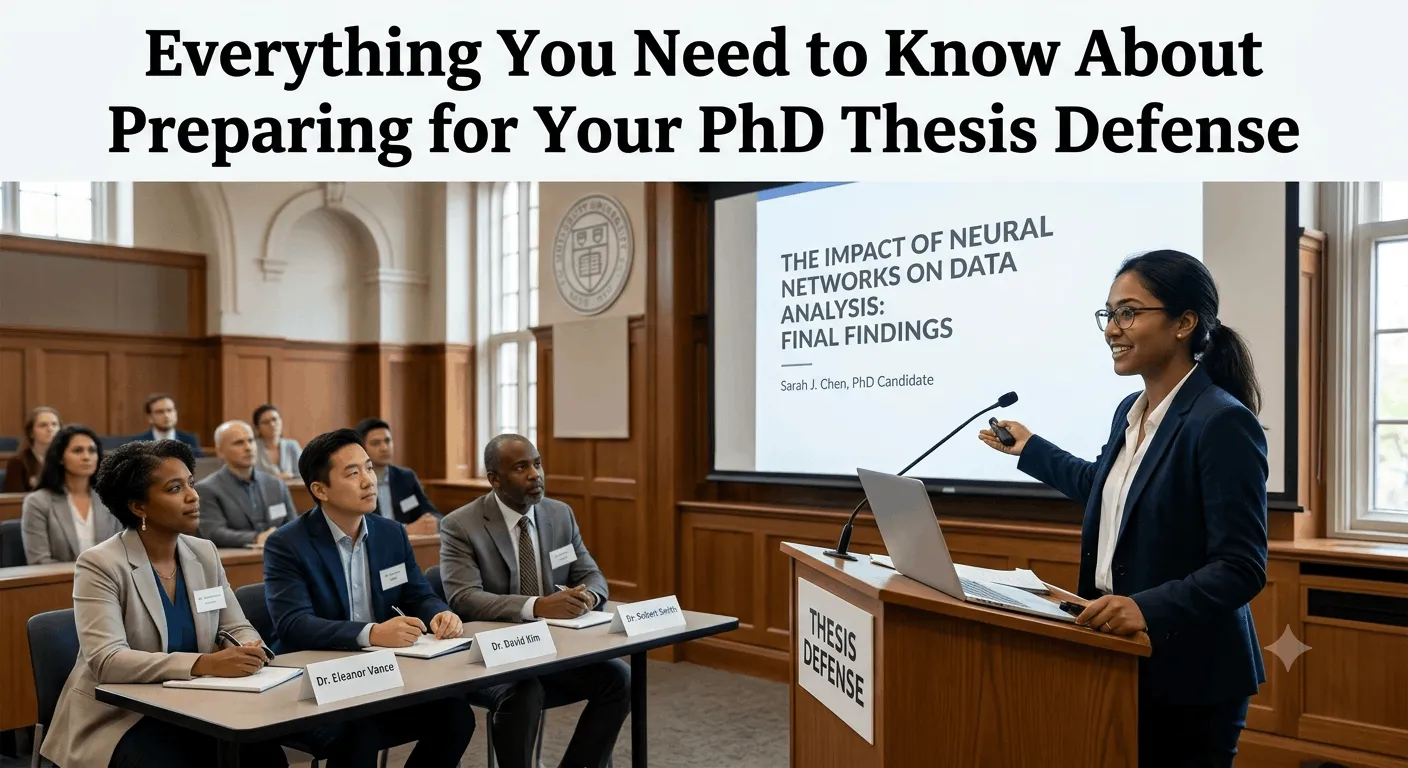
Introduction
There's a particular kind of nervousness that sets in once a thesis defense date actually appears on the calendar. Years of research, writing, and revision suddenly compress into a single room, a panel of examiners, and a conversation that will determine whether all of it holds together. That nervousness is completely normal, and it's worth saying clearly upfront: the PhD viva is not designed to be an ambush. Examiners have already read your thesis, they generally want you to succeed, and the entire exercise exists to confirm something you already know deep down — that this is genuinely your work, and that you understand it more thoroughly than anyone else in the room. This guide is a complete, practical walk-through of thesis defense preparation: what the viva actually tests, the specific categories of questions examiners reliably ask, how to structure your preparation in the weeks before the date, what a mock defense should look like, and what the range of realistic outcomes actually means so you're not blindsided by anything on the day. If you're staring down a defense date and wondering exactly where to start, this is the structured plan.
How Do I Prepare for My PhD Thesis Defense?
You prepare for a PhD thesis defense by re-reading your own thesis critically as if you were an examiner, preparing a concise five-minute overview of your research that you can deliver without notes, anticipating and rehearsing answers to the standard categories of viva questions (overview, methodology, findings, limitations, and contribution), running at least one full mock defense with colleagues or your supervisor acting as examiners, and managing the practical logistics of the day so your energy and focus are available for the conversation itself. Most vivas last between one and three hours and are built around a genuine academic conversation rather than a hostile interrogation, so preparation is less about memorizing a script and more about being able to explain and defend every meaningful decision you made.
The sections below break that process into a realistic sequence, starting weeks before the defense date and working through to the day itself, along with a clear picture of what the different possible outcomes actually mean so you can walk in with accurate expectations rather than worst-case assumptions.
What the Viva Is Actually Testing
Before diving into preparation tactics, it helps to understand what examiners are genuinely assessing, because that understanding shapes how you should spend your preparation time. The viva's core purpose is to confirm that the work is authentically yours, that you have a deep and current understanding of your project, and that you can be recognized as a competent, independent researcher in your field. Examiners will have read your thesis in advance and will probe its aims, methodology, findings, limitations, and original contribution, expecting you to explain, justify, and defend the choices you made and to correct any errors they identify along the way.
It's worth internalizing a specific reassurance that shows up consistently across guidance on this topic: a supervisor who has judged a thesis ready for submission is effectively signaling real confidence that the candidate will pass. Outright failure is extremely rare — typically affecting well under 1% of viva outcomes — and the most common results by a wide margin are a pass with either no corrections or minor corrections. None of this means the viva is easy or that you can walk in unprepared, but it does mean the baseline expectation, walking in, should be reasonable confidence rather than dread.
Complete Guide to PhD Thesis Defense Preparation: Step by Step
Step 1: Re-Read Your Thesis as a Critical Outsider, Not the Author
The first and most foundational preparation step is rereading your entire thesis, but with a deliberate shift in perspective — not as the person who wrote it, but as someone encountering it fresh and looking for weak points, unclear arguments, or unjustified leaps. This is more valuable than endless re-reading in the ordinary sense, since simply rereading familiar material tends to reinforce what you already believe rather than surfacing genuine vulnerabilities. A more efficient version of this step involves building a thesis map and chapter-by-chapter summaries rather than rereading cover to cover repeatedly, so you can quickly locate any specific argument, figure, or citation an examiner might ask about without flipping through the entire document under pressure.
As you go through each chapter, explicitly note the significant decisions you made — why you chose a particular methodology over an alternative, why you framed your research question the way you did, why you selected a specific sample or dataset — since these decision points are precisely what examiners are trained to probe. If you can't currently articulate a clear, honest reason for a choice you made months or years ago, that's exactly the gap to close before the defense, not to discover during it.
Step 2: Prepare a Concise, Confident Overview of Your Whole Thesis
Nearly every viva opens with some version of the same request: give a brief overview of your research. This is consistently the most common opening question across disciplines and institutions, and it sets the tone for everything that follows, so it deserves focused, deliberate preparation rather than improvisation. The strongest answers follow a clear, repeatable structure: your research question, what gap or problem it addressed, what you did methodologically, what you found, and why it matters — typically delivered in three to five minutes, structured clearly enough that even a non-specialist in the room could follow the arc of the project.
Practice this overview out loud repeatedly, ideally in front of another person, until it flows naturally rather than sounding memorized or read from notes. Examiners are specifically listening for clarity, confidence, and whether you can articulate your core contribution in your own words, and a summary that sounds rehearsed word-for-word often comes across as less convincing than one that's clearly internalized and delivered with natural variation each time you say it.
Step 3: Prepare for the Standard Categories of Viva Questions
While no two vivas are identical, the range of likely questions clusters into a fairly predictable set of categories across institutions and disciplines. These generally include overview and framing questions about your thesis as a whole, questions about your research problem and its rationale, questions probing your engagement with the existing literature, methodology questions (consistently the most heavily probed area of any viva), questions about your findings and how you interpreted them, and questions about your thesis's limitations and directions for future research.
Methodology deserves particular focus in your preparation, since it's consistently identified as the area examiners scrutinize most heavily. Be ready to explain not just what method you used, but why you chose it over plausible alternatives, what its limitations are, and how those limitations shape how confidently your findings can be interpreted. A related and frequently asked question worth preparing deliberately is some version of "what would you do differently if you were starting again" — this isn't a trick question designed to expose weakness, but a genuine test of intellectual maturity, and a thoughtful answer that identifies one honest methodological improvement generally reads far better than a defensive claim that nothing would change.
Similarly, be ready to speak honestly about both the strongest and weakest aspects of your own thesis. Examiners are explicitly testing self-awareness here, and a candidate who can clearly articulate genuine limitations of their own work, while still standing firmly behind its core contribution, generally comes across as more credible and more doctoral-level than one who either can't identify any weaknesses or who undersells their contribution out of excessive caution.
When answering any specific question, a simple and effective structural pattern to practice is: give a direct answer first, follow with a brief explanation, then link the answer explicitly back to your own study and its specific context. This structure keeps answers focused and prevents the common trap of rambling toward an answer rather than starting with one.
Step 4: State Your Original Contribution With Precision
One of the most consistently asked and consequential questions in any viva is some version of "what is the main original contribution of your thesis." Vague or overly broad answers here — describing simply what topic you studied rather than what you specifically discovered, built, or demonstrated — noticeably weaken a candidate's overall performance, even when the underlying research is strong. A well-prepared answer names two or three specific, original contributions with precision: not "I studied X," but something closer to "I identified a specific relationship that had not previously been examined in this particular context," stated concretely enough that an examiner immediately understands exactly what's new.
Preparing this answer explicitly, in advance, rather than trusting that it will come together naturally in the moment, is one of the highest-value uses of your preparation time, precisely because this question appears in nearly every viva and because vague answers to it are disproportionately damaging to how the whole defense is perceived.
Step 5: Run at Least One Full Mock Defense
Practicing your answers alone, even out loud, is valuable, but it's not a substitute for a genuine mock defense with real follow-up questioning under some simulated pressure. Arrange for your supervisor, colleagues, or fellow doctoral candidates to act as examiners in a full run-through, asking questions and pushing back on your answers the way real examiners would, rather than simply nodding along. This kind of realistic practice, run under conditions that simulate actual pressure and genuine follow-up probing, is one of the most effective things you can do to reduce the number and severity of corrections you're likely to receive, since it surfaces gaps in your reasoning while there's still time to address them.
If a full mock panel isn't feasible, even a single knowledgeable colleague asking hard questions and pressing on your answers is considerably better than solo rehearsal alone. The specific value of mock practice isn't memorizing better answers — it's experiencing, in a lower-stakes setting, what it feels like to be pushed on a weak point, so the real viva doesn't deliver that experience for the first time on the day that matters most.
Step 6: Understand the Realistic Outcomes Before You Walk In
Knowing the actual range of possible viva outcomes in advance helps enormously with managing anxiety, since it replaces vague, catastrophic worst-case thinking with an accurate picture of what's actually likely. Broadly, viva outcomes fall into a small number of categories: a pass with no corrections (relatively rare, since some level of feedback is genuinely common even for excellent theses), a pass with minor corrections (by far the most common positive outcome, typically involving small clarifications, typographical fixes, or tightened citations completed within one to three months without requiring re-examination), a pass with major corrections (more substantial revisions to structure, methodology, or argumentation, typically completed within three to twelve months, sometimes with a follow-up review), and, in rare cases, a requirement to resubmit with a full re-examination.
It's worth being aware that the boundary between what counts as "minor" versus "major" corrections is genuinely subjective and varies by examiner — some examiners classify a long list of clarification requests as minor, while others might classify a shorter but more structurally significant list as major. This variability isn't a flaw to be anxious about; it simply means the specific label matters less than working through whatever list you receive systematically and communicating regularly with your supervisor throughout the correction period.
Viva Preparation Tips for Managing the Day Itself
Beyond content preparation, the practical logistics of the defense day deserve real attention, since even excellent preparation can be undermined by poor sleep, rushed travel, or unfamiliar surroundings. Confirm the format in advance — whether your viva is closed (examiners only) or open to a wider audience — since knowing exactly who will be in the room removes one avoidable source of uncertainty. Plan your journey and arrival with real buffer time, eat something substantial beforehand even if you're not hungry, and avoid last-minute cramming on the morning of the defense, since at that point additional reading is far less valuable than arriving calm, rested, and clear-headed.
During the defense itself, it's entirely acceptable — and generally read positively by examiners — to pause and think before answering a difficult question, rather than rushing to fill silence with an underdeveloped response. It's also completely reasonable to ask an examiner to clarify or rephrase a question you don't immediately understand. Neither of these habits signals weakness; both signal the kind of careful, deliberate thinking examiners are specifically trying to assess.
PhD Thesis Defense: How to Prepare Effectively
Re-read Your Thesis Thoroughly: Before your defense, read your entire thesis again with a critical perspective. Create a chapter-by-chapter summary and a clear thesis map so you can quickly locate important details, arguments, or references without searching through the document during the viva.
Prepare a Strong Overview Statement: Practice delivering a concise 3–5 minute summary of your research aloud. This is one of the most common opening questions in a thesis defense, and a confident overview creates a positive first impression for the examination.
Be Ready to Defend Your Methodology: Understand exactly why you selected your research methodology instead of alternative approaches. Be prepared to discuss its strengths, limitations, assumptions, and how it best addresses your research question, as methodology is often the most thoroughly examined part of the viva.
Clearly Explain Your Original Contributions: Identify two or three specific and original contributions your research makes to the field. Avoid vague statements and be ready to explain precisely how your work advances existing knowledge or solves a research problem.
Conduct a Mock Thesis Defense: Arrange at least one full practice session with your advisor, colleagues, or fellow researchers who can ask realistic follow-up questions. A mock defense helps identify weak areas while you still have time to strengthen your answers.
Understand Possible Outcomes: Familiarize yourself with the different defense outcomes, which may range from no corrections, minor revisions, major revisions, or, in rare cases, resubmission. Understanding these possibilities helps reduce unnecessary anxiety and sets realistic expectations.
Plan the Day of Your Defense Carefully: Get adequate sleep the night before, allow extra travel time if attending in person, eat a proper meal, and avoid last-minute cramming. Good preparation and a calm mindset help you stay focused and think clearly throughout the defense discussion.
Common Mistakes Candidates Make When Preparing for a Viva
A recurring mistake is treating thesis defense preparation as an exercise in rereading the document over and over, rather than actively rehearsing spoken answers to likely questions. Passive familiarity with your own writing is not the same skill as being able to explain and defend a decision clearly, out loud, under real-time questioning, and the two need to be practiced separately.
A second common mistake is preparing a memorized, word-for-word script for the opening overview and reciting it rigidly, which can come across as rehearsed rather than genuinely understood. Internalizing the structure of the answer — research question, method, findings, contribution — while allowing the specific phrasing to vary naturally each time you practice it, generally reads as more confident and authentic to examiners than a fixed script.
A third mistake, particularly common among otherwise well-prepared candidates, is skipping a genuine mock defense in favor of solo review, on the assumption that reading through likely questions alone is sufficient preparation. Solo review can't replicate the specific experience of being pushed on a weak point in real time, which is precisely the experience that a mock defense is designed to simulate safely, before the actual viva.
Do's and Don'ts for Thesis Defense Preparation
Do prepare and rehearse a concise, structured overview of your entire thesis that you can deliver confidently without reading from notes.
Do run at least one full mock defense with real follow-up questioning, not just solo review of likely questions.
Do prepare an honest, specific answer about your thesis's genuine limitations alongside its strongest contributions.
Do build in real buffer time and rest before the defense day rather than cramming until the last possible moment.
Don't treat rereading your thesis passively as a substitute for actively rehearsing spoken answers out loud.
Don't memorize a rigid, word-for-word script for your opening overview; internalize the structure instead and let the phrasing vary naturally.
Don't assume a request for major corrections is a failure — it's a common, well-documented outcome that still results in the degree being awarded once the revisions are completed.
Don't rush to fill silence with an underdeveloped answer; pausing to think before responding to a hard question is normal and generally viewed positively.
Frequently Asked Questions
How do I prepare for my PhD thesis defense?
Re-read your thesis critically as if you were an examiner, prepare and rehearse a concise three-to-five-minute overview of your entire research, anticipate and practice answers to standard question categories (overview, methodology, findings, limitations, contribution), run at least one full mock defense with real follow-up questioning, and manage the practical logistics of the day so you arrive rested and clear-headed.
What questions are most commonly asked in a PhD viva?
The most common questions cluster around six categories: an opening overview of your thesis as a whole, your research problem and its rationale, your engagement with the existing literature, your methodology (the most heavily probed area), your findings and their interpretation, and your thesis's limitations and directions for future research. A near-universal opening question asks for a brief summary of your research, typically in three to five minutes.
How long does a PhD viva usually last?
Most vivas last between one and three hours, with the majority lasting approximately two hours. There's no fixed standard duration across institutions, so it's worth confirming the expected format and length with your department in advance.
What are the possible outcomes of a PhD viva?
Outcomes generally range across a small set of categories: pass with no corrections (relatively rare), pass with minor corrections (the most common positive outcome, typically completed within one to three months), pass with major corrections (more substantial revisions, typically within three to twelve months, sometimes requiring a follow-up review), and, in rare cases, resubmission with full re-examination. Outright failure is extremely rare.
What is the most important question to prepare for in a thesis defense?
Two questions deserve especially deliberate preparation: the opening request for a brief overview of your entire thesis, and the question asking you to state your original contribution precisely. Vague answers to either — particularly the contribution question — noticeably weaken overall performance even when the underlying research is strong, so both deserve rehearsed, specific answers.
Should I do a mock defense before my actual viva?
Yes. Running at least one full mock defense, with a supervisor or colleagues asking real follow-up questions and pushing back on your answers, is one of the most effective ways to surface weak points in your reasoning while there's still time to address them, and it meaningfully reduces the likelihood of significant corrections.
Is it normal to receive corrections after a PhD viva?
Yes, and it's the norm rather than the exception. The large majority of candidates receive some level of corrections, most commonly minor ones, and this is generally treated as a standard and expected part of the process rather than a sign that the defense went poorly.
What should I do if I don't know the answer to a viva question?
It's acceptable to pause and think before answering, and to ask an examiner to rephrase or clarify a question you don't immediately understand. If you genuinely don't know something, it's better to say so honestly and reason through what you do know that's relevant, rather than guessing or bluffing, since examiners are generally more interested in how you think through a problem than in whether you have an instantly perfect answer.
How should I answer a question about my thesis's limitations?
Prepare this answer in advance rather than improvising it. Identify genuine, specific limitations honestly, while also being ready to explain how those limitations affect the interpretation of your findings and what, if anything, you'd do differently with hindsight. A candidate who can articulate real limitations with self-awareness generally comes across as more credible, not less.
How far in advance of my viva should I start preparing seriously?
Most guidance suggests beginning focused preparation — building a thesis map, rehearsing your overview, running mock defenses — several weeks to a month before the scheduled date, rather than relying on last-minute cramming. Preparation that's spread out with real practice sessions consistently produces stronger, calmer performance than compressed, rushed preparation in the final days.
Conclusion
Preparing for a PhD thesis defense isn't about memorizing a perfect script or anticipating every possible question with certainty — it's about knowing your own research thoroughly enough, and having practiced explaining it enough times out loud, that you can respond to genuine follow-up questioning with clarity and composure rather than panic. Re-read your thesis critically, prepare and rehearse a confident overview, know exactly how to state your original contribution with precision, run a real mock defense that pushes back on your answers, and understand the realistic range of outcomes so you walk in with accurate expectations rather than worst-case fears. The viva is, at its core, a conversation about work you already know better than anyone else in the room. If you've made it to the point of scheduling your defense, your supervisor and your committee already believe you're ready for this conversation — the preparation described here is simply what turns that belief into the calm, clear performance that lets you demonstrate it yourself.