
PhD Thesis Format in India (2026): Complete Structure & Writing Guidelines
Table of Contents
- Introduction
- What Is a PhD Thesis Format?
- PhD Thesis Structure in India (Chapter-Wise)
- PhD Thesis Writing Guidelines 2026
- Formatting Rules: Font, Margin, Spacing, Citation
- University-Wise Formatting Comparison
- Common Mistakes Students Make
- Step-by-Step Solution to Avoid Mistakes
- PhD Submission Process & Requirements
- Career Scope After PhD in India
- Expert Tips for a Strong Thesis
- FAQs
- Conclusion
Introduction
Confused about the correct PhD thesis format in India? You're not alone — thousands of research scholars struggle every year to match university and UGC expectations while structuring their thesis correctly. This guide gives you an updated, 2026-ready breakdown of the PhD thesis structure, formatting rules, and writing guidelines followed across Indian universities, so you can submit your thesis with confidence and avoid last-minute rejection from your Research Advisory Committee.
Whether you're just starting your synopsis or finalizing your final draft, this article covers everything — chapter order, referencing style, common formatting mistakes, and what examiners actually look for.
What Is a PhD Thesis Format?
A PhD thesis format is the standardized structure and presentation style — covering chapter order, page layout, referencing, and submission requirements — that a doctoral candidate must follow when writing their dissertation. In India, this format is broadly guided by UGC (University Grants Commission) regulations, but each university, IIT, or Deemed-to-be-University may add its own specific formatting rules on top of the base structure.
Because requirements can vary, always cross-check the latest format circular issued by your own university's Research/PhD cell before final submission — this guide gives you the general structure most institutions follow.
PhD Thesis Structure in India (Chapter-Wise)
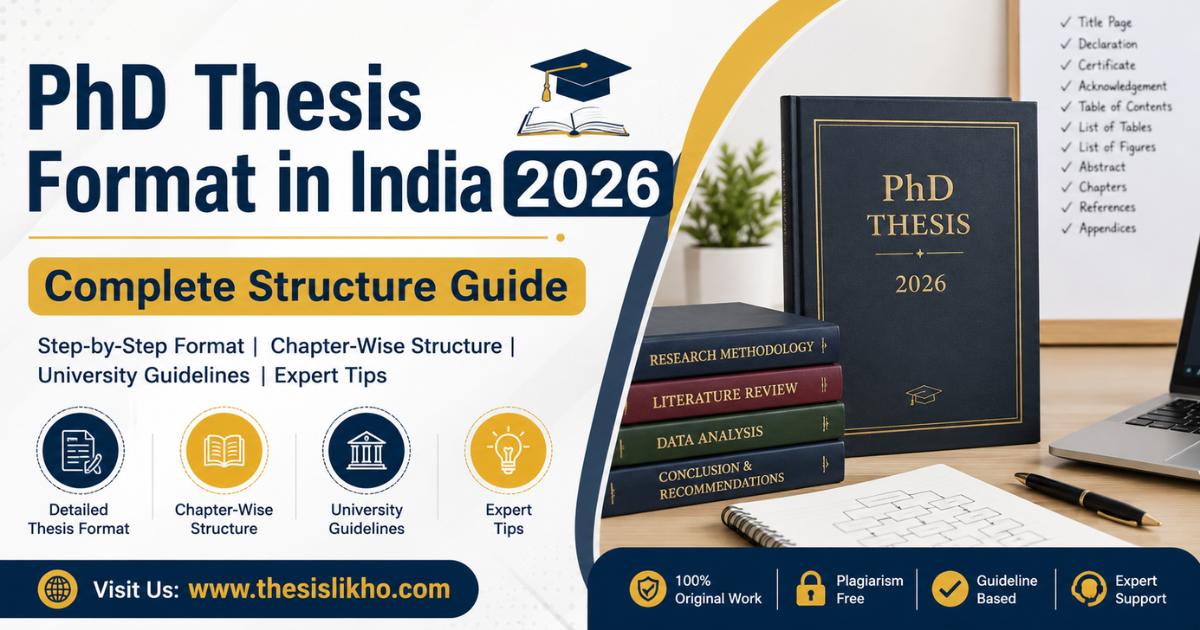
1. Preliminary Pages
- Title page
- Certificate from the supervisor/guide
- Declaration by the candidate
- Acknowledgement
- Table of Contents
- List of Tables/Figures
- List of Abbreviations
- Abstract/Synopsis
2. Chapter 1 – Introduction
Introduces the research problem, background, objectives, scope, and significance of the study.
3. Chapter 2 – Review of Literature
A critical survey of existing research, identifying gaps that justify your study.
4. Chapter 3 – Research Methodology
Explains research design, data collection methods, sample size, tools, and analysis techniques used.
5. Chapters 4–6 – Data Analysis & Results
Presents findings, analysis, interpretation, tables, and graphs relevant to the objectives.
6. Final Chapter – Conclusion & Recommendations
Summarizes key findings, contribution to the field, limitations, and scope for future research.
7. End Matter
- Bibliography/References
- Appendices
- List of Publications (if any)
PhD Thesis Writing Guidelines 2026
H3: Search Intent — What Examiners Expect in 2026
Universities are increasingly checking for plagiarism compliance (UGC mandates a similarity index, typically below 10%), proper citation software use (Mendeley, Zotero, EndNote), and digital repository submission via Shodhganga.
H3: Keyword-Relevant Formatting Basics
- Font: Times New Roman, 12pt (body text)
- Line spacing: 1.5
- Margins: 1.5 inch (left), 1 inch (right, top, bottom)
- Page numbering: bottom-center or bottom-right
- Referencing style: APA, MLA, or Chicago (as prescribed by department)
University-Wise Formatting Comparison
Referencing StyleAPA/UGC styleIEEE (for engineering)Varies — often APASimilarity Index LimitUsually ≤10%Usually ≤10%Usually ≤10–15%Submission ModeShodhganga + hard copyInstitute repository + hard copyVaries by universityBinding RequirementHardbound, black/maroonHardbound (institute-specific color)Hardbound
Note: Exact requirements differ — always confirm with your university's PhD cell or ordinance document.
Common Mistakes Students Make
- Inconsistent heading styles across chapters
- Referencing not matching the required citation style
- Ignoring the university-prescribed margin/font rules
- Weak or vague research objectives in Chapter 1
- Literature review written as a summary instead of a critical analysis
- Submitting without a similarity/plagiarism check
Step-by-Step Solution to Avoid Mistakes
- Get the latest format circular from your university's PhD/Research cell — don't rely on old templates from seniors.
- Create a formatting template first (headings, fonts, spacing) before writing content.
- Use reference management software from day one to avoid last-minute citation cleanup.
- Run a plagiarism check well before your pre-submission seminar, not just before final submission.
- Get chapter-wise feedback from your supervisor rather than sharing the full draft only at the end.
- Cross-check the final draft against your university's thesis format checklist before binding.
PhD Submission Process & Requirements
- Eligibility: Completion of required coursework, minimum residency period, and RAC (Research Advisory Committee) approval.
- Required Documents: No-objection certificate, plagiarism report, list of publications, synopsis approval letter.
- Important Stages: Pre-submission seminar → Synopsis submission → Thesis submission → Viva-voce.
- Fee Structure: Thesis submission and evaluation fees vary by university — check your institute's fee notification.
- Extension/Scholarship Matters: JRF/SRF fellowship continuation rules differ by funding body (UGC, CSIR, ICMR, etc.) — verify with your fellowship cell.
Career Scope After PhD in India
Career Opportunities
- Assistant Professor / Academic roles (NET/SET or PhD-based eligibility)
- Research Scientist positions in government labs (CSIR, DRDO, ICAR)
- Postdoctoral research (India or abroad)
- R&D roles in private industry
- Policy research and think tanks
Skills in Demand
- Data analysis and statistical tools
- Academic writing and publication record
- Grant writing and project management
- Subject-specific technical expertise
Expert Tips for a Strong Thesis
- Start formatting correctly from Chapter 1 itself — retrofitting formatting later wastes significant time.
- Keep a running bibliography instead of adding references at the end.
- Get your abstract reviewed separately — it's often the first (and sometimes only) part examiners read closely.
- Maintain version control of your drafts to avoid submitting outdated chapters.
FAQs
1. What is the standard PhD thesis format followed in India? Most Indian universities follow a UGC-aligned structure: preliminary pages, introduction, literature review, methodology, results/analysis, conclusion, and references — though exact formatting rules vary by institution.
2. Is Shodhganga submission mandatory for PhD thesis? Yes, UGC regulations require universities to upload PhD theses to the Shodhganga repository, typically after successful viva-voce.
3. What referencing style should I use for my PhD thesis? It depends on your department — APA is common for social sciences and humanities, while IEEE is common for engineering and technical fields. Check your department's prescribed style.
4. What is the maximum allowed similarity/plagiarism percentage? Most universities cap it around 10%, per UGC's plagiarism policy regulations, though some allow slightly higher limits — confirm with your institute.
5. How many chapters should a PhD thesis have? There's no fixed number, but most theses have 5–7 chapters: introduction, literature review, methodology, one or more results/analysis chapters, and a conclusion.
6. What font and spacing should I use for my thesis? Times New Roman 12pt with 1.5 line spacing is the most common requirement, but always verify against your university's specific format guide.
7. Do all universities require hardbound thesis copies? Most do, often with a university-specified cover color, but binding requirements can differ — check your PhD cell's submission guidelines.
Conclusion
Getting your PhD thesis format in India right isn't just about following a checklist — it's about presenting years of research work in a way examiners can evaluate fairly and efficiently. Use this guide as a starting framework, but always validate the final structure, referencing style, and submission requirements against your own university's latest thesis ordinance before you print and bind your final copy.
Need help structuring or formatting your thesis? Reach out for guidance on WhatsApp: +91 96438 02216