Introduction
Choosing PhD Thesis Help in India becomes difficult when a scholar cannot tell the difference between genuine research guidance and a service that simply promises a completed document. The real problem may be an unclear research gap, misaligned objectives, weak methodology, unstructured data, disconnected chapters or unresolved supervisor comments. Selecting the wrong support can introduce fabricated references, confidentiality risks, incorrect analysis or writing the scholar cannot defend. This 2026 guide provides a practical nine-point evaluation process for choosing ethical assistance at the right research stage. It explains what responsible support should include, which documents are needed for an assessment, how each thesis section should be reviewed, what warning signs to avoid and when expert input may be useful. University rules, supervisor directions and ethics approvals must remain the primary requirements.
Quick Answer
Choose PhD Thesis Assistance that first diagnoses your research stage, defines written deliverables, uses verifiable sources, works only with authentic data, protects confidentiality and keeps you involved in every decision. Avoid fabricated findings, copied chapters, fake citations and guaranteed approval, publication or similarity claims. Verify all support against university and supervisor requirements.
Table of Contents
- What is PhD thesis help in India?
- Why do scholars need thesis assistance?
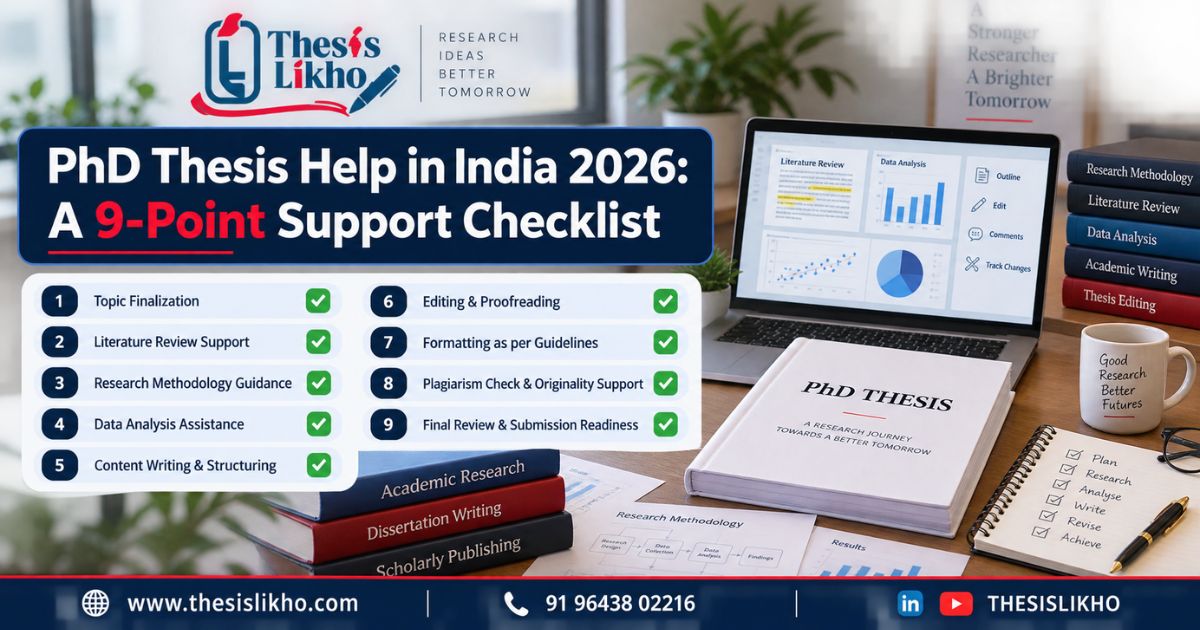
- Nine-point selection process
- Stage-wise guidance
- Required documents and information
- Common mistakes and academic risks
- Final support checklist
- When expert review is useful
- Frequently asked questions
Quick Highlights
Review area: What the scholar should check
Main problem The topic, literature, methodology, data and chapters do not form one coherent study
Recommended approach Diagnose the exact stage and purchase only clearly defined support.
Required information Proposal, objectives, guidelines, completed work, anonymised data and supervisor comments
Major risks Fabricated sources, invented data, copied writing, confidentiality breaches and unrealistic guarantees.
Final action Approve a milestone-based scope and verify every deliverable before using it.
What Is PhD Thesis Help in India?
PhD Thesis Help in India refers to ethical academic guidance and technical support that helps a doctoral scholar improve genuine research work. Depending on the scholar’s stage, it may include topic refinement, literature-search planning, methodology review, authentic data analysis, chapter editing, citation correction, formatting and submission-readiness checks.
It should not mean purchasing authorship or asking another person to conduct undisclosed research. The scholar must retain intellectual ownership, understand the study and remain capable of explaining the research problem, method, evidence, analysis and contribution during reviews or the viva.
Three related terms need clarification:
- PhD Thesis Assistance: Focused help with one or more academic or technical stages.
- PhD Thesis Support Services: A defined collection of services delivered through milestones.
- Thesis writing help: Guidance, developmental editing and academic communication support—not permission to misrepresent someone else’s work as the scholar’s own.
Why Do PhD Scholars Need Thesis Assistance?
The research problem is still broad.
A subject area may be interesting without being researchable. Scholars often need help converting an area into a specific problem, gap, question and achievable set of objectives.
Literature has been collected but not synthesised.
Hundreds of saved papers do not automatically produce a defensible review. The scholar must compare evidence, theories, methods, findings and unresolved limitations.
Objectives and methodology do not align
An objective requiring comparison, prediction or exploration needs an appropriate design, data source and analytical method. Misalignment can affect the entire thesis.
Data exists, but the analysis plan is unclear.
Software cannot decide the research logic. Statistical or qualitative techniques must follow the objectives, data type, assumptions and approved methodology.
Chapters were written separately.
The introduction may promise one study while the results and conclusion report something different. A cross-chapter review is needed to restore a consistent argument.
University and supervisor requirements are unresolved.
Formatting, declarations, similarity procedures, repository requirements and submission workflows can vary by university, department and registration year. Generic templates may not apply.
How to Choose PhD Thesis Help in India: Nine-Point Process
1. Diagnose the exact research stage
Identify whether you are at topic selection, proposal, literature review, methodology, data collection, analysis, chapter writing, revision or final submission. Write the present problem in one sentence.
Verify: The provider assesses existing work before offering a package.
Risk: Buying complete support when only a focused methodological or editorial review is required.
2. Check subject and methodology capability
Subject knowledge alone is not sufficient. The reviewer should understand the research design, evidence type and analysis relevant to the project.
Verify: Ask who will review the subject content and who will review the method or statistics.
Risk: Technically polished writing based on an unsuitable research design.
3. Demand a written scope
The scope should list inputs, deliverables, exclusions, milestones, revision conditions, communication process and a realistic timeline.
Verify: Each output is specific—for example, “objective-method alignment review” rather than “complete research solution.”
Risk: Disputes caused by vague promises and undefined revisions.
4. Test source-verification standards
Every important reference should be traceable. Ask whether DOI, journal, author, year and relevance are checked against the source.
Verify: Sample references can be located in legitimate databases or publisher pages.
Risk: Invented, irrelevant or incorrectly attributed citations.
5. Confirm the authentic-data policy
Support may include anonymised data cleaning, coding, statistical testing, qualitative analysis and interpretation. It must never include invented participants, responses, interviews or experimental findings.
Verify: The analysis plan maps each objective to variables, data and an appropriate method.
Risk: Results the scholar cannot verify or defend.
6. Review confidentiality safeguards
Remove unnecessary personal identifiers before sharing files. Agree on authorised access, storage, communication and deletion practices, particularly for patient, participant or organisational data.
Verify: The provider explains who can access the files and how sensitive information is handled.
Risk: Privacy breaches or unauthorised disclosure of unpublished research.
7. Check scholar involvement
Ethical support should involve questions, explanations, draft reviews and decisions by the scholar. The final work should remain understandable and defensible.
Verify: Milestones include scholar approval rather than silent end-to-end production.
Risk: Receiving a document that does not reflect the approved study or the scholar’s knowledge.
8. Examine revision and quality-control procedures
Ask how supervisor comments, cross-chapter inconsistencies, data changes, citations and final formatting are tracked.
Verify: There is one controlled master file and a written response-to-comments record.
Risk: Corrections are lost across multiple uncontrolled drafts.
9. Reject unrealistic guarantees
No external service controls university approval, viva outcome, publication acceptance or the final interpretation of a similarity report.
Verify: Claims are realistic, and limitations are disclosed.
Risk: Academic, financial and reputational harm from misleading promises.
Stage-Wise PhD Thesis Assistance
Research stageTypical difficultySuitable ethical support Expected output
Topic and proposal Broad topic or unclear contribution Feasibility, gap and objective review Focused research direction
Literature review Descriptive summaries Search planning and thematic synthesis Evidence-based gap argument
Methodology Design does not answer objectives Design, sampling, tool and analysis review Aligned methodology framework
Data analysis Output without research meaning Transparent analysis and interpretation guidance Objective-wise verified findings
Results and discussion Repetition or unsupported claims Results audit and critical discussion review Evidence-based interpretation
Citations and references Missing or unverifiable sources Source and reference matching Traceable reference set
Editing and formatting Disconnected chapters and inconsistent style Developmental editing and compliance review Coherent master document
Final submission Unresolved comments or document errors Checklist-based readiness audit Verified submission package
Topic and proposal
The title, problem statement, gap, questions, objectives, methodology and expected contribution must describe one feasible study. Novel terminology does not create novelty without evidence.
Literature review
Organise studies by theme, theory, method or disagreement. Use foundational and current sources where relevant. A literature matrix can reveal gaps without relying on unsupported statements such as “no study exists.”
Research methodology
Define the design, setting, population, sample, tools, variables or themes, data-collection process, ethical safeguards and analysis. The method must reflect what the scholar can genuinely conduct.
Data analysis
Preserve the anonymised dataset, codebook and output. Select analyses according to objectives and assumptions, not according to whichever result appears significant. Report contradictory and non-significant findings honestly.
Results and discussion
Results should present authentic findings; the discussion should compare them with relevant scholarship, explain possible reasons, consider limitations and clarify the contribution without overstating causation.
Citations and references
Match every in-text citation with the reference list. Check important bibliographic information against the source. Reference-management software helps, but imported metadata still requires verification.
Formatting and submission
Follow the university and departmental requirements applicable to the scholar. Freeze one approved master document before final formatting and inspect the final PDF after conversion.
Required Documents, Tools and Information
For an initial assessment, prepare only the materials relevant to your stage:
- Working or approved thesis title
- Proposal, synopsis or approved research plan
- Research problem, questions and objectives
- University, department and formatting guidelines
- Ethics approval and authorised amendments, where applicable
- Completed chapters and literature matrix
- Data-collection instrument and permission records
- Anonymised dataset, codebook and analysis output
- Supervisor or research-committee comments
- Current citation style and reference library
- Submission checklist and next verified deadline
Useful tools may include legitimate literature databases, Zotero or another reference manager, suitable statistical or qualitative software, a document-comparison tool and the institution’s authorised similarity system. Tools assist research; they do not replace scholarly judgment.
Common Mistakes and Academic Risks
Mistake Consequence Better correction
Choosing solely by the lowest price Important review stages may be excluded Compare itemised deliverables.
Requesting a complete thesis without participation The scholar may not understand or defend the work Use milestone-based guidance.
Sharing identifiable data Confidentiality or ethics risk Anonymise and limit access.
Accepting unverified references Fabricated or irrelevant evidence Check every important source.
Analysing data before confirming objectives Results may not answer the study Build an objective-analysis matrix.
Using automatic paraphrasing to lower similarity Meaning and citations may be damaged Rewrite from understanding and verify sources.
Ignoring university instructions Format or compliance corrections Audit against current official requirements
Trusting approval or publication guarantees Misleading expectations and financial risk Choose transparent, limited claims.
Final PhD Thesis Support Checklist
- The exact research stage and problem are documented.
- Scope, deliverables, exclusions, milestones and revisions are written.
- Subject and methodology reviewers are identified.
- Sources are genuine, relevant and traceable.
- Only authentic scholar-authorised data will be analysed.
- Confidential information is removed or securely controlled.
- Objectives, methods, results and conclusions are aligned.
- Every chapter remains understandable to the scholar.
- Citations and reference entries match.
- University and supervisor requirements are verified.
- No approval, publication or similarity guarantee is offered.
- The final editable file, change record and supporting output will be provided.
When Is Expert Review Useful?
Expert review may help when a topic remains broad, the research gap is difficult to defend, objectives conflict with the method, the dataset requires a transparent analysis plan, results are hard to interpret, chapters contradict one another, references are unreliable or supervisor comments affect several sections.
It can also be useful before a research-committee presentation, pre-submission review or final formatting stage. The purpose should be to identify weaknesses, explain corrections and strengthen the scholar’s own research—not to replace authorship.
Need clarity about your thesis stage? Share your discipline, working title, completed work and present difficulty for a confidential assessment through ThesisLikho or WhatsApp.
Frequently Asked Questions
1. What is included in PhD Thesis Help in India?
Depending on the research stage, support may cover topic refinement, proposal review, literature synthesis, methodology alignment, authentic data analysis, results interpretation, chapter editing, citation verification, formatting and submission-readiness checks. A responsible provider should define the exact inclusions and exclusions after assessing the existing work.
2. Is PhD Thesis Assistance ethical?
It is ethical when it provides consultation, feedback, analysis guidance, language editing and formatting while the scholar retains authorship and responsibility. It becomes problematic when another person fabricates data, writes undisclosed research, supplies false approvals or creates work the scholar presents without understanding.
3. How do I choose reliable PhD Thesis Support Services?
Choose support that assesses your present stage, provides a written scope, identifies suitable expertise, verifies references, uses authentic data, protects confidentiality and delivers work through reviewable milestones. Avoid providers offering guaranteed approval, guaranteed publication, invented results or an assured similarity score.
4. What documents are needed for an initial thesis assessment?
Usually, the working title, proposal or synopsis, objectives, applicable university guidelines, completed chapters, anonymised data or output and supervisor comments are enough to begin. Share only relevant files and remove personal, patient or confidential organisational identifiers unless secure authorised handling is established.
5. How much does PhD thesis assistance cost?
Cost depends on the stage, subject, methodology, amount and quality of completed work, data complexity, number of chapters, required reviews and timeline. A credible estimate should follow a document assessment and written scope rather than a generic quotation based only on page count.
6. How long does PhD thesis support take?
A focused chapter review may require less time than correcting methodology, analysing data and aligning an entire thesis. The timeline also depends on source access, scholar feedback and supervisor revisions. Milestone-based scheduling is more realistic than a universal delivery promise.
7. Can PhD thesis support guarantee university approval?
No. University evaluators, research committees, supervisors and examiners determine academic outcomes. Ethical support can improve clarity, alignment, evidence presentation and compliance, but it cannot guarantee acceptance, marks, viva performance, publication or any specific similarity result.
Conclusion
Choosing PhD Thesis Help in India should begin with a precise diagnosis of the research problem—not a generic package. The right support connects the topic, literature, methodology, authentic data, analysis, findings and conclusion while keeping the scholar involved in every academic decision. Reliable PhD Thesis Assistance uses verifiable sources, protects confidential information, defines deliverables and avoids unrealistic guarantees. Before approving any work, compare it with current university regulations, ethics requirements and supervisor directions. If you need an independent assessment, share your discipline, research stage and current difficulty through WhatsApp to receive a focused scope rather than an unnecessary full-thesis package.
WhatsApp: +91 96438 02216
Website: https://thesislikho.com/