
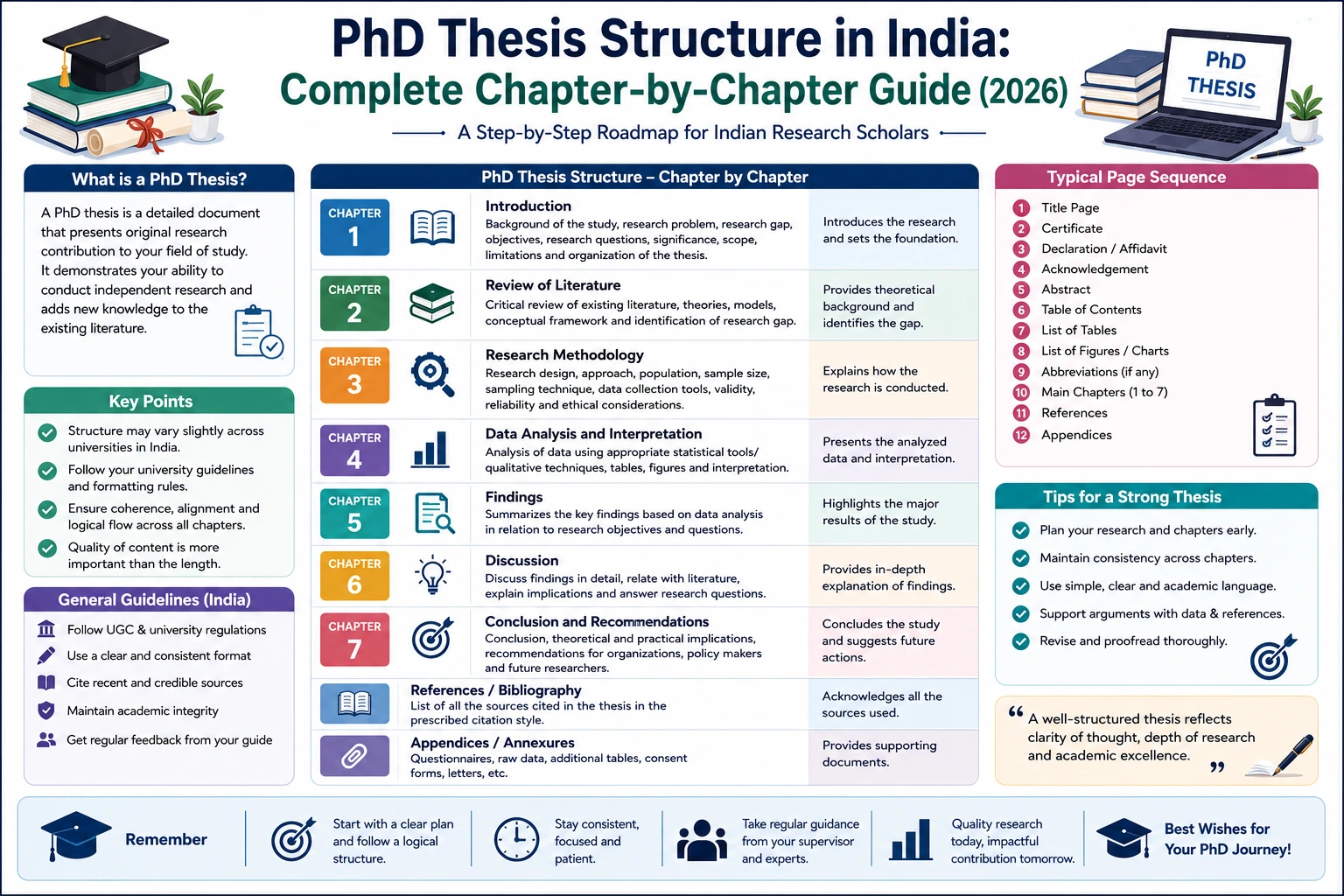
Writing a PhD thesis is one of the most significant academic milestones in a research scholar's journey. After spending several years conducting literature reviews, collecting data, analysing results, and developing original contributions to knowledge, presenting your research in a well-organised thesis is essential for successful evaluation.
One of the most common questions asked by doctoral scholars in India is:
"What is the standard structure of a PhD thesis?"
While universities such as IITs, IIMs, Central Universities, State Universities, NITs, and private institutions may have slightly different formatting guidelines, the overall chapter structure remains remarkably similar across most Indian universities following the University Grants Commission (UGC) regulations and institutional research guidelines.
A well-structured thesis does more than satisfy university requirements. It improves readability, demonstrates logical thinking, helps examiners evaluate your work efficiently, and showcases the originality of your research. Each chapter has a distinct purpose, and together they create a coherent narrative—from identifying the research problem to presenting findings and explaining their contribution to existing knowledge.
This comprehensive guide explains every chapter of a PhD thesis, including the front matter, core chapters, and back matter. You'll also learn practical writing tips, common mistakes to avoid, and recommendations for creating a thesis that meets academic standards in India.
Table of Contents
- What Is the Standard PhD Thesis Structure in India?
- Front Matter
- Chapter 1: Introduction
- Chapter 2: Literature Review
- Chapter 3: Research Methodology
- Chapter 4: Results and Analysis
- Chapter 5: Discussion
- Chapter 6: Conclusion and Recommendations
- Back Matter
- Formatting Tips
- Common Mistakes
- FAQs
What Is the Standard PhD Thesis Structure in India?
Although formatting requirements differ among universities, most PhD theses in India follow this general structure:
Front Matter
- Title Page
- Declaration
- Certificate
- Approval Page (where applicable)
- Acknowledgements
- Abstract
- Table of Contents
- List of Figures
- List of Tables
- List of Abbreviations
Main Chapters
- Chapter 1: Introduction
- Chapter 2: Literature Review
- Chapter 3: Research Methodology
- Chapter 4: Results and Analysis
- Chapter 5: Discussion
- Chapter 6: Conclusion and Recommendations
Back Matter
- References
- Appendices
- Publications (if required)
- Research Papers
- Copyright Permissions (where applicable)
Some universities combine the Results and Discussion chapters, while others require separate chapters depending on the discipline.
Front Matter
The front matter introduces your thesis and provides essential information before readers begin the main chapters.
Title Page
The title page should include:
- Thesis title
- Student's name
- Enrollment or registration number
- Degree name
- Department
- University name
- Supervisor's name
- Month and year of submission
Choose a title that is clear, specific, and accurately reflects your research.
Example:
"Artificial Intelligence Adoption and Customer Trust in Indian Retail Banking: An Empirical Study."
Declaration
The declaration confirms that the thesis is your original work and has not been submitted elsewhere for another degree.
Most universities provide a standard declaration format.
Certificate
This page is signed by the research supervisor, confirming that the research was conducted under their guidance.
Acknowledgements
The acknowledgements section allows you to thank individuals and organisations that supported your research.
Common acknowledgements include:
- Research supervisor
- Advisory committee
- University
- Funding agencies
- Participants
- Family members
Keep the tone professional and concise.
Abstract
The abstract summarizes the entire thesis.
It typically includes:
- Research problem
- Objectives
- Methodology
- Findings
- Contribution
For most Indian universities, the abstract ranges from 300 to 500 words, although requirements may vary.
Table of Contents
The table of contents lists all chapters, sections, and page numbers.
Use your word processor's automatic table generation feature to ensure consistency.
List of Figures and Tables
If your thesis contains figures, graphs, illustrations, or tables, include separate lists after the table of contents.
List of Abbreviations
Define all abbreviations used throughout the thesis.
For example:
- AI – Artificial Intelligence
- SEM – Structural Equation Modelling
- UGC – University Grants Commission
- SPSS – Statistical Package for the Social Sciences
Chapter 1: Introduction
The introduction chapter sets the foundation for the entire thesis.
It explains what the research is about, why it matters, and how the study will be conducted.
A typical introduction includes:
Background of the Study
Provide the context of your research topic.
Explain current trends, challenges, and developments.
Problem Statement
Clearly describe the problem your research addresses.
A strong problem statement demonstrates the need for the study.
Research Gap
Explain what previous research has overlooked.
The research gap justifies the originality of your study.
Research Objectives
State the specific objectives that guide the research.
Objectives should be clear, measurable, and achievable.
Research Questions
Develop research questions directly linked to the objectives.
These questions shape the methodology and analysis.
Research Hypotheses (if applicable)
Quantitative studies often include hypotheses that will be tested statistically.
Significance of the Study
Explain how the research contributes to:
- Academic knowledge
- Industry
- Policymakers
- Society
- Future researchers
Scope of the Study
Define the boundaries of the research.
Specify:
- Geographic area
- Time period
- Population
- Variables
Limitations
Briefly mention constraints that may affect the research.
Examples include:
- Time
- Budget
- Sample availability
Chapter Summary
Conclude the introduction by briefly explaining what readers can expect in the following chapters.
Chapter 2: Literature Review
The literature review demonstrates your understanding of existing research.
Rather than summarizing articles individually, critically evaluate previous studies.
Typical sections include:
Theoretical Review
Discuss the theories supporting your research.
Examples:
- Technology Acceptance Model
- Diffusion of Innovation Theory
- Resource-Based View
Conceptual Review
Define key concepts and variables.
Explain how they relate to one another.
Empirical Review
Review previous research findings.
Compare:
- Research methods
- Samples
- Results
- Limitations
Research Gap
Identify unanswered questions or limitations that justify your study.
Conceptual Framework
Present a visual model showing relationships among variables.
This framework often forms the basis for hypotheses and data analysis.
Chapter 3: Research Methodology
This chapter explains how the research was conducted and why the selected methods were appropriate.
A well-written methodology chapter demonstrates transparency and allows other researchers to understand—or replicate—your study.
Key sections typically include:
Research Philosophy
Where applicable, explain the philosophical stance guiding the study (such as positivism, interpretivism, pragmatism, or realism).
Research Approach
Describe whether your study follows a deductive, inductive, or abductive approach and justify your choice.
Research Design
Explain the overall design, such as:
- Descriptive
- Exploratory
- Explanatory
- Experimental
- Case study
Population and Sampling
Describe:
- Target population
- Sampling technique
- Sample size
- Sampling justification
Data Collection Methods
Explain whether data were collected through:
- Surveys
- Interviews
- Focus groups
- Observations
- Secondary sources
Data Analysis
Briefly introduce the analytical methods and software used, such as SPSS, R, NVivo, MAXQDA, Python, or Excel.
Validity, Reliability, and Ethics
Explain how you ensured data quality, instrument reliability, participant confidentiality, informed consent, and ethical compliance.
Conclude the chapter with a summary that transitions naturally into the results chapter.
Chapter 4: Results and Data Analysis
The Results and Data Analysis chapter presents the evidence collected during your research. Unlike the methodology chapter, which explains how the research was conducted, this chapter focuses on what the data revealed.
The objective is to present findings clearly, accurately, and objectively without interpreting their broader meaning in detail. Interpretation is typically reserved for the discussion chapter.
A well-structured results chapter generally includes:
Participant Profile
Begin by describing your sample.
For example:
- Age distribution
- Gender
- Educational qualifications
- Industry
- Years of experience
- Geographic location
Present demographic information using tables, charts, or graphs where appropriate.
Descriptive Statistics
Summarize the data using descriptive measures such as:
- Mean
- Median
- Mode
- Standard deviation
- Percentages
- Frequency distributions
These statistics help readers understand the characteristics of the dataset before moving to advanced analysis.
Hypothesis Testing
If your study is quantitative, report the findings of each hypothesis.
Common analytical techniques include:
- Correlation analysis
- Multiple regression
- Independent sample t-tests
- Paired t-tests
- ANOVA
- Chi-square tests
- Structural Equation Modelling (SEM)
Clearly state whether each hypothesis was accepted or rejected and present relevant statistical values in accordance with your university's preferred reporting style.
Qualitative Findings
For qualitative studies, organise findings into themes or categories.
For example:
- Theme 1: Leadership and organisational culture
- Theme 2: Employee motivation
- Theme 3: Barriers to technology adoption
Support each theme with representative participant quotations where appropriate.
Tables and Figures
Use visual elements only when they improve understanding.
Every table and figure should:
- Be numbered sequentially.
- Include a descriptive title.
- Be referenced in the text.
- Mention the data source if applicable.
Avoid duplicating the same information in both text and tables.
Chapter 5: Discussion
The discussion chapter explains what your findings mean and places them within the context of previous research.
This chapter demonstrates your ability to interpret evidence, compare results with existing literature, and explain the academic and practical implications of your work.
A typical discussion chapter includes:
Interpretation of Findings
Explain how your findings answer the research questions.
Discuss possible reasons behind the observed results rather than simply repeating statistical outputs.
Comparison with Previous Studies
Compare your findings with earlier research.
Consider questions such as:
- Do your results support previous studies?
- Do they contradict earlier findings?
- Why might differences exist?
Relating your findings to the literature strengthens the scholarly contribution of your thesis.
Theoretical Implications
Discuss how your research contributes to existing theories.
For example, explain whether your findings:
- Support established theories.
- Extend existing models.
- Challenge traditional assumptions.
- Introduce a new conceptual perspective.
Practical Implications
Explain how your findings can be applied by:
- Businesses
- Government agencies
- Educational institutions
- Healthcare organisations
- Policymakers
- Non-governmental organisations
Practical implications demonstrate the real-world relevance of your research.
Chapter 6: Conclusion and Recommendations
The conclusion chapter brings together the entire research journey.
It should not introduce new evidence. Instead, it synthesises the key findings and highlights the overall contribution of the study.
Typical sections include:
Summary of the Study
Briefly restate:
- Research problem
- Objectives
- Methodology
- Major findings
Keep this summary concise.
Conclusions
Present the final conclusions drawn from the research.
Each conclusion should be supported by evidence presented earlier in the thesis.
Contributions to Knowledge
One of the most important sections of a PhD thesis is explaining the original contribution to knowledge.
Examples include:
- Development of a new conceptual framework.
- Extension of an existing theory.
- Evidence from a previously under-researched population.
- Introduction of a new methodological approach.
- Practical recommendations for industry.
Clearly articulate how your work advances understanding within your discipline.
Recommendations
Offer recommendations based on your findings.
Recommendations may target:
- Policymakers
- Organisations
- Practitioners
- Educational institutions
- Future researchers
Ensure that every recommendation is grounded in the evidence collected during your study.
Limitations
Acknowledge any constraints that may affect the interpretation or generalisability of your findings.
Common limitations include:
- Limited sample size
- Restricted geographic coverage
- Time constraints
- Access to data
- Resource limitations
Present limitations honestly while reinforcing the value of the study.
Suggestions for Future Research
Identify areas where additional investigation is needed.
Examples include:
- Studying different populations.
- Applying alternative research methods.
- Conducting longitudinal studies.
- Testing the framework in other industries or countries.
Back Matter
The back matter contains supporting material that complements the main thesis.
References
List every source cited in the thesis using the referencing style prescribed by your university, such as:
- APA (7th edition)
- MLA
- Chicago
- Harvard
- IEEE
- Vancouver
Ensure that all in-text citations appear in the reference list and vice versa.
Appendices
Include supplementary materials that support the research but would interrupt the flow of the main text.
Common appendices include:
- Survey questionnaires
- Interview guides
- Consent forms
- Ethical approval letters
- Additional statistical outputs
- Coding frameworks
- Raw data excerpts
Each appendix should be clearly labelled and referenced within the thesis.
Publications (Where Required)
Some universities request a list of published or accepted journal articles arising from the doctoral research.
Include complete bibliographic details and publication status.
Formatting Tips for PhD Theses in India
Although each university publishes its own formatting guidelines, the following practices are commonly required:
- Use A4-size paper.
- Maintain consistent margins as specified by the university.
- Choose a readable font such as Times New Roman or Arial (often 12-point for body text).
- Use 1.5 or double line spacing, depending on institutional guidelines.
- Number pages consistently.
- Apply hierarchical heading styles throughout the document.
- Use automatic tables of contents and lists of figures/tables where possible.
- Ensure tables, figures, equations, and appendices are numbered consistently.
Always consult your university's thesis manual before final formatting.
Common Mistakes to Avoid
Many scholars lose valuable marks because of avoidable structural issues. Pay attention to these common mistakes.
Weak Chapter Transitions
Each chapter should flow naturally into the next. End every chapter with a brief summary and indicate how the following chapter builds on it.
Inconsistent Objectives
Research objectives introduced in Chapter 1 should align with the methodology, findings, discussion, and conclusion.
Repetition Across Chapters
Avoid repeating identical content in the introduction, literature review, discussion, and conclusion. Each chapter should have a distinct purpose.
Insufficient Justification
Explain not only what you did but also why each methodological and analytical decision was appropriate.
Ignoring University Guidelines
Formatting requirements vary across institutions. Always prioritise your university's official thesis manual over generic templates.
PhD Thesis Structure Checklist
Before submitting your thesis, review the following checklist:
- Front matter is complete and correctly formatted.
- Introduction clearly defines the research problem and objectives.
- Literature review critically evaluates previous research and identifies a research gap.
- Methodology justifies the research design and methods.
- Results are presented clearly with appropriate tables and figures.
- Discussion interprets findings in relation to the literature.
- Conclusion summarises the study and highlights contributions.
- Recommendations are evidence-based.
- References are complete and consistent.
- Appendices contain all supporting documents.
- Formatting complies with university guidelines.
Using a checklist before submission can help reduce revision requests and improve the overall quality of your thesis.
Frequently Asked Questions
How many chapters should a PhD thesis have in India?
Most Indian universities require five to seven main chapters, depending on the discipline and institutional guidelines. Some universities combine the results and discussion chapters, while others require them separately.
Can the thesis structure vary across universities?
Yes. While the overall structure is similar, universities may have different formatting requirements, chapter arrangements, and submission guidelines. Always follow your institution's official handbook.
Should every thesis include a conceptual framework?
Not necessarily. A conceptual framework is common in management, education, and social science research but may not be required in all disciplines.
Is it acceptable to combine the results and discussion chapters?
Yes. Many universities, especially in engineering and the natural sciences, allow or encourage combining these chapters. Follow your department's requirements.
What is the most important chapter of a PhD thesis?
Every chapter is important, but the literature review, methodology, and discussion are often considered critical because they demonstrate originality, academic rigor, and contribution to knowledge.
Conclusion
A well-structured PhD thesis is more than a collection of chapters—it is a coherent academic narrative that guides readers from the research problem to the study's contribution to knowledge. Each chapter has a distinct purpose, from establishing the context and reviewing existing literature to explaining the methodology, presenting findings, interpreting results, and drawing meaningful conclusions.
Understanding the standard thesis structure used by Indian universities can make the writing process more organised and less overwhelming. By planning each chapter carefully, maintaining logical flow, and ensuring consistency between your objectives, methodology, findings, and conclusions, you can produce a thesis that meets academic expectations and effectively communicates the value of your research.
Before submission, carefully review your university's formatting guidelines, proofread every chapter, verify references, and seek feedback from your supervisor. A well-presented thesis not only improves readability but also reflects the professionalism and quality of your research.
Call / WhatsApp: +91 96438 02216
Website:www.ThesisLikho.com