
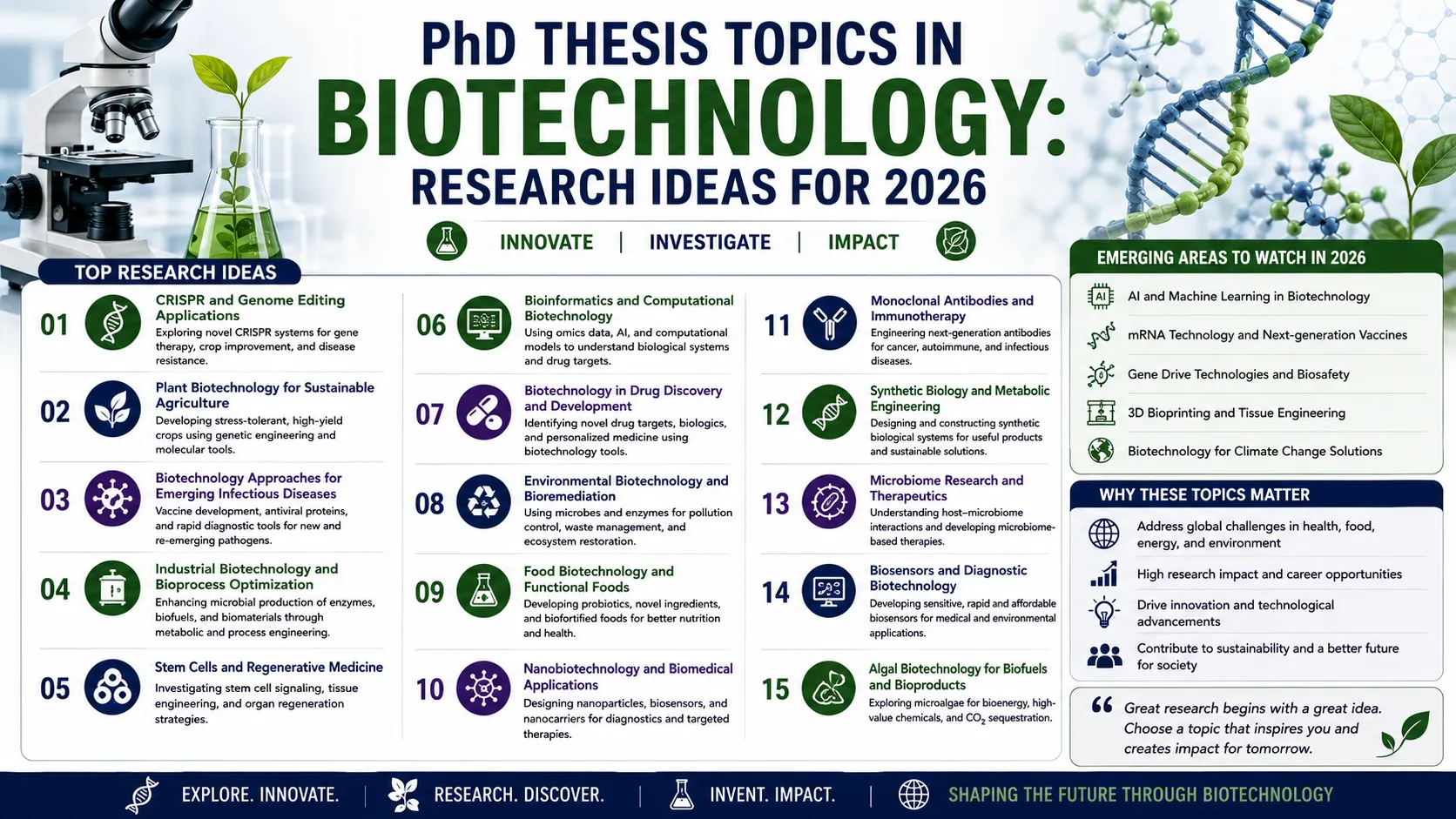
If you're a PhD Biotechnology scholar trying to lock down a thesis topic, you're working in a field that's genuinely crossed a maturity threshold in the past few years — CRISPR-based therapies have moved from experimental promise into clinically approved treatments, synthetic biology has shifted from proof-of-concept into an execution phase focused on real manufacturing capacity, and India's own regulatory framework for gene-edited organisms has been meaningfully simplified. This guide walks through PhD thesis topics in biotechnology research ideas for 2026, organized by category, along with the regulatory landscape and topic-validation steps every Indian biotechnology scholar needs before finalizing a direction.
This guide is written specifically for first-time PhD thesis writers in India who want topics grounded in real 2025–2026 scientific and regulatory developments — not generic biotechnology themes that have already been extensively studied.
Why Biotechnology Topic Selection Needs Extra Care
Biotechnology sits at a genuinely unusual intersection: it's one of the fastest-moving research fields right now, with gene-editing tools evolving essentially year to year, but it's also one of the most heavily regulated, involving environmental release rules, animal ethics committees, and human-participant biosafety review that most other PhD disciplines never encounter. Choosing among PhD thesis topics in biotechnology research ideas for 2026 means balancing genuine scientific novelty against real regulatory feasibility — a topic that sounds exciting scientifically can stall for months if the regulatory pathway it requires hasn't been mapped out from the start.
ThesisLikho's PhD-qualified experts, who've guided over 10,000 scholars through topic selection and thesis development, consistently see the same pattern trip up first-time biotechnology scholars: choosing a topic based on scientific interest alone, without checking what specific regulatory clearance it will require and how long that clearance realistically takes to secure.
Where the Field Actually Stands in 2026
A few developments worth anchoring your topic search to. Gene editing has crossed a genuine regulatory maturity threshold — CRISPR-derived therapies have moved from experimental promise into clinically approved treatments for conditions including sickle cell disease and certain rare skin disorders, strengthening both commercial investment and academic confidence in the technology's real-world viability. The field has moved decisively beyond basic CRISPR-Cas9 cutting into next-generation tools: base editing and prime editing enable precise, single-nucleotide genetic corrections without creating double-strand DNA breaks, and newer Cas enzyme variants have expanded what genetic sequences can be targeted and how precisely. In vivo delivery — administering gene-editing machinery directly into the body via viral vectors or lipid nanoparticles, rather than editing cells outside the body first — is a major, genuinely active research frontier, particularly for reaching tissues that have historically been difficult to target directly.
Synthetic biology is described in current industry analysis as having moved into an "execution phase," where genuine research advantage now comes from throughput, quality systems, and dependable manufacturing capacity rather than simply proving a concept works in principle. This reflects a broader shift toward treating engineered cells as programmable production platforms for biologics, engineered materials, and industrial biomanufacturing rather than purely academic curiosities. AI integration spans nearly every corner of the field now — generative approaches to novel drug and molecule design, multi-omics data integration for biomarker discovery, and AI-assisted screening of naturally occurring microbial variants to identify promising gene-editing targets far faster than traditional experimental screening alone.
AI's Growing Role in Biotechnology Research
Understanding exactly where AI fits into current biotechnology research helps you scope a genuinely specific thesis topic rather than a vague "AI in biotechnology" framing. AI-driven drug discovery platforms now propose novel candidate molecules and optimize existing ones computationally, meaningfully compressing timelines that traditionally took years of iterative lab work. Multi-omics integration — combining genomic, transcriptomic, proteomic, and clinical data through AI models — is becoming standard infrastructure for biomarker discovery and treatment-response prediction rather than a specialized add-on. In synthetic biology and microbial engineering specifically, machine learning is increasingly used to screen large numbers of naturally occurring microbial variants computationally, identifying organisms with desirable characteristics for industrial applications far more efficiently than conventional lab-based screening, and to design and optimize genetic circuits and metabolic pathways before physical construction.
A genuinely strong AI-and-biotechnology thesis topic combines a specific AI method with a specific biological system and application — "AI in biotechnology" alone isn't a real topic; "machine learning-based screening of microbial variants for optimized enzyme production in industrial fermentation" is.
Topic Selection Framework for Biotechnology PhD Scholars
Run any shortlisted topic through these five checks before finalizing it. First, scientific currency: is this genuinely tied to an active 2025–2026 research direction, not something that peaked several years ago? Second, regulatory feasibility: does this topic require GEAC or RCGM clearance for genetic engineering work, CPCSEA approval for animal studies, or ICMR-aligned ethics review for human-participant or human-derived material research — and is the realistic timeline for securing this clearance built into your plan? Third, specificity: can you state your exact research question, system, and technique in one sentence? Fourth, originality: has this exact combination already been extensively studied? Fifth, supervisor and infrastructure fit: does your department have the lab equipment, containment facilities, or computational resources this topic actually requires?
A topic that fails the regulatory feasibility check is one of the most common reasons biotechnology PhD timelines run into serious difficulty — genetic engineering and biosafety clearances in India can take anywhere from a few weeks to several months depending on the specific regulatory tier involved, and this needs to be planned for from day one.
What Is a Research Gap in Biotechnology Research?
A research gap in biotechnology research typically falls into a few recognizable categories. A methodological gap exists where an established biotechnology problem hasn't yet been approached using a newer technique — say, applying prime editing where earlier work relied on standard CRISPR-Cas9 cutting. A contextual gap exists where a technique validated internationally hasn't been tested in an Indian context — a specific crop variety, a locally prevalent disease strain, or an Indian population's specific genetic or microbial diversity. A translational gap exists where promising laboratory-stage work hasn't yet been tested for real-world scalability or manufacturing feasibility, which is particularly relevant given synthetic biology's current shift toward execution and manufacturing readiness. And a regulatory-pathway gap exists where a recent regulatory change — like the 2022 exemption for transgene-free genome-edited crops — creates genuinely new research opportunities that existing literature hasn't yet caught up to exploring.
For most first-time Indian biotechnology PhD scholars, contextual and regulatory-pathway gaps are often the most feasible starting points, since they're grounded in genuinely current, checkable developments and don't require inventing an entirely novel technique from scratch.
100+ PhD Biotechnology Thesis Topics by Category
Gene Editing and CRISPR-Based Research
- Base editing efficiency optimization for correcting single-nucleotide genetic disorders
- Prime editing applications for precise gene correction without double-strand breaks
- AAV-mediated in vivo CRISPR delivery for hard-to-target tissue applications
- Lipid nanoparticle formulation optimization for liver-targeted gene editing delivery
- Off-target effect assessment methodology for CRISPR-Cas9 genome editing
- CRISPR-Cas12/13-based diagnostic platform development for infectious disease detection
- Epigenome editing using catalytically inactive Cas proteins for gene expression modulation
- Multiplexed gene editing strategies for complex polygenic disease targets
- CRISPR-based crop improvement for drought tolerance in Indian staple crops
- Transgene-free genome editing of indigenous crop varieties using SDN-1/SDN-2 approaches
- Gene drive technology feasibility assessment for vector-borne disease control
- CRISPR-based correction of hemoglobinopathies relevant to the Indian population
Synthetic Biology and Metabolic Engineering
- Programmable microbial cell factory design for sustainable biochemical production
- Metabolic pathway engineering for enhanced biofuel production in engineered microbes
- Synthetic genetic circuit design for controlled gene expression in industrial fermentation
- Chassis organism optimization for scalable biomanufacturing applications
- Engineered microbial consortia for complex bioprocess coordination
- Cell-free synthetic biology systems for rapid prototyping of genetic circuits
- Biosensor development using engineered microorganisms for environmental monitoring
- Synthetic biology approaches for sustainable production of high-value natural compounds
- Adaptive laboratory evolution for improved industrial microbial strain performance
- Genetic circuit design for biocontainment of engineered organisms
Cell and Gene Therapy
- CAR-T cell engineering optimization for solid tumor targeting
- iPSC-derived cell therapy development for regenerative medicine applications
- Non-viral gene delivery vector development for safer gene therapy applications
- mRNA-based therapeutic platform optimization for protein replacement therapy
- Organoid-based disease modeling for personalized cell therapy development
- Immune response mitigation strategies for viral vector-based gene therapy
- Stem cell differentiation protocol optimization for tissue-specific therapeutic applications
- Ex vivo gene-edited cell therapy manufacturing process optimization
Bioinformatics and Computational Biology
- Machine learning-based protein structure prediction for novel drug target identification
- Multi-omics data integration framework for disease biomarker discovery
- AI-assisted genome annotation methodology for non-model organism research
- Computational drug repurposing framework using multi-omics disease signatures
- Machine learning-based prediction of CRISPR guide RNA efficiency and specificity
- Single-cell transcriptomics analysis framework for cellular heterogeneity characterization
- Network biology approaches for identifying disease-associated gene regulatory modules
- Computational pipeline development for microbiome data analysis and interpretation
- Deep learning-based prediction of protein-protein interaction networks
Agricultural and Plant Biotechnology
- Genome-edited crop development for enhanced nutritional content in staple foods
- Marker-assisted breeding integration with genomic selection for crop improvement
- Transgene-free stress-tolerance trait development in genome-edited rice varieties
- Plant synthetic biology approaches for enhanced photosynthetic efficiency
- Microbiome-based biofertilizer development for sustainable agriculture
- Genome editing for disease resistance in economically important Indian crops
- RNA interference-based pest resistance strategies for reduced pesticide dependency
- Plant tissue culture optimization for scalable propagation of genome-edited varieties
- Biofortification strategies using metabolic engineering for micronutrient enhancement
Industrial and Environmental Biotechnology
- Enzyme engineering for improved efficiency in industrial biocatalysis applications
- Bioremediation strategy development using engineered microorganisms for pollutant degradation
- Plastic-degrading enzyme optimization for sustainable waste management applications
- Biofuel production optimization using engineered algal or microbial systems
- Wastewater treatment enhancement using engineered microbial consortia
- Carbon capture and utilization strategies using engineered microorganisms
- Bioplastic production optimization using engineered microbial fermentation
- Biosurfactant production enhancement for sustainable industrial applications
Pharmaceutical Biotechnology
- Monoclonal antibody engineering for improved therapeutic efficacy and reduced immunogenicity
- Biosimilar development and comparative characterization methodology
- Vaccine antigen design optimization using computational and synthetic biology approaches
- Cell line engineering for improved recombinant protein production yield
- Continuous bioprocessing optimization for biopharmaceutical manufacturing
- Novel adjuvant development for enhanced vaccine immunogenicity
- Antibody-drug conjugate design optimization for targeted cancer therapy
Diagnostics and Biosensors
- CRISPR-based point-of-care diagnostic development for infectious disease detection
- Biosensor development for rapid detection of antimicrobial resistance markers
- Liquid biopsy biomarker development for early cancer detection
- Wearable biosensor development for continuous health monitoring applications
- Nanotechnology-integrated biosensor design for enhanced diagnostic sensitivity
- Multiplexed diagnostic platform development for simultaneous pathogen detection
- AI-integrated diagnostic biosensor development for improved accuracy and speed
Microbiome and Host-Microbe Interaction Research
- Gut microbiome modulation strategies for metabolic disease management
- Microbiome-based biomarker development for personalized nutrition applications
- Host-microbiome interaction characterization in disease pathogenesis
- Probiotic strain engineering for enhanced therapeutic functionality
- Microbiome transplantation methodology optimization for clinical applications
- Antimicrobial resistance gene tracking in environmental and clinical microbiomes
Stem Cell and Regenerative Medicine
- iPSC reprogramming efficiency optimization for personalized regenerative therapy
- Organ-on-chip technology development for disease modeling and drug testing
- 3D bioprinting optimization for tissue engineering applications
- Stem cell-derived organoid development for personalized medicine research
- Scaffold material optimization for enhanced tissue regeneration outcomes
- Stem cell therapy safety assessment methodology for clinical translation
Nanobiotechnology
- Nanoparticle-based targeted drug delivery system design for cancer therapy
- Nanomaterial-based gene delivery vector development for improved transfection efficiency
- Nanosensor development for ultra-sensitive biomarker detection
- Nanotechnology-enhanced vaccine delivery platform development
- Biocompatible nanomaterial development for regenerative medicine applications
Regulatory Science and Biosafety Research
- Comparative regulatory pathway analysis for genome-edited versus transgenic crops in India
- Biosafety risk assessment framework development for novel gene-edited organisms
- Public perception and awareness study of genome-edited food products in India
- Regulatory harmonization analysis for cell and gene therapy approval pathways
- Environmental risk assessment methodology for engineered microorganism release
- Intellectual property landscape analysis for CRISPR-based biotechnology innovations
Biotechnology Ethics and Policy
- Ethical framework development for germline gene editing research governance
- Informed consent process evaluation for gene therapy clinical trial participation
- Equity and access analysis for advanced cell and gene therapy availability in India
- Dual-use research of concern assessment framework for synthetic biology applications
- Public engagement strategy evaluation for controversial biotechnology applications
- Data privacy framework assessment for genomic and multi-omics research
- Benefit-sharing framework analysis for genetic resource utilization in biotechnology research
India's Regulatory Framework for Genetic Engineering Research
Understanding India's regulatory structure for genetic engineering research is essential before finalizing a topic in this space, since it directly determines your realistic timeline. India regulates genetically engineered organisms through a three-tier structure established under the Environment (Protection) Act, 1986. The Genetic Engineering Appraisal Committee, operating under the Ministry of Environment, Forest and Climate Change, is the apex regulatory body, and its clearance is mandatory for the environmental release of genetically modified organisms, including field trials and commercial cultivation. The Review Committee on Genetic Manipulation, functioning under the Department of Biotechnology, sits at the operational tier, reviewing confined field trials and ongoing recombinant DNA research before matters escalate to GEAC. The Institutional Biosafety Committee provides the most immediate, institution-level oversight for contained laboratory research, and is typically the first regulatory body any biotechnology PhD scholar working with genetically engineered material will need to engage with.
It's worth knowing that India doesn't currently have a single, unified biotechnology regulator — an earlier proposal to consolidate these separate bodies into one independent authority, the Biotechnology Regulatory Authority of India Bill introduced in 2013, lapsed and was never enacted. This means navigating multiple separate regulatory bodies remains a genuine, ongoing feature of doing genetic engineering research in India, worth factoring into your timeline planning from the start rather than assuming a single, streamlined approval process.
A Major Recent Regulatory Simplification Worth Knowing
This is genuinely important, current, and directly relevant if your topic involves any form of crop or plant gene editing. Following a March 2022 office memorandum from the Ministry of Environment, Forest and Climate Change, transgene-free genome-edited crops — specifically those falling into the SDN-1 and SDN-2 editing categories, meaning no foreign DNA is inserted into the final organism — are now exempt from RCGM and GEAC oversight entirely, requiring only Institutional Biosafety Committee clearance at the departmental level. This is a substantial, genuinely current regulatory simplification directly relevant to CRISPR-based crop improvement research specifically, since it means a transgene-free genome-edited crop trait can move through institutional-level approval considerably faster than a traditional transgenic approach requiring full RCGM and GEAC review.
If your thesis involves plant gene editing, understanding and explicitly leveraging this distinction — designing your specific editing approach to qualify for the simplified transgene-free pathway where scientifically appropriate — can meaningfully improve your project's realistic feasibility within a PhD timeline, and demonstrating this regulatory awareness in your topic proposal signals genuine, current field knowledge to your supervisor and committee.
Ethical and Biosafety Considerations
Beyond the genetic engineering-specific regulatory structure above, biotechnology research involving animals requires Institutional Animal Ethics Committee approval under CPCSEA guidelines, built around the Three Rs principle of replacement, reduction, and refinement. Research involving human participants or human-derived biological material requires Institutional Ethics Committee review aligned with ICMR's National Ethical Guidelines for Biomedical and Health Research, covering informed consent and data protection specifically. And for research involving genuinely novel or higher-risk applications — germline editing, gene drives, dual-use research with potential biosecurity implications — additional ethical review and, in some cases, specific national-level clearance may be required beyond standard institutional processes, worth confirming directly with your department for any topic touching these more sensitive areas.
Suggested Research Methodology by Topic Category
Different topic categories call for genuinely different methodological approaches. Gene editing and CRISPR-based topics typically require experimental molecular biology techniques (cloning, transfection, sequencing-based validation) combined with bioinformatics analysis for guide RNA design and off-target assessment. Synthetic biology and metabolic engineering topics commonly combine genetic circuit design, microbial culturing and fermentation, and computational modeling of metabolic pathways. Cell and gene therapy topics typically require cell culture-based experimental work, often combined with animal model validation where appropriate ethical clearance is secured. Bioinformatics and computational biology topics rely primarily on computational analysis of existing or newly generated sequencing and multi-omics datasets, requiring less wet-lab infrastructure but significant computational resources and programming skill. Agricultural and plant biotechnology topics combine plant tissue culture and genetic transformation techniques with field or greenhouse-based phenotypic evaluation. Regulatory science and policy topics typically use document analysis, stakeholder interviews, or comparative policy analysis rather than laboratory experimentation.
Two Realistic Case Studies
Case Study 1 — Transgene-Free Drought Tolerance in an Indigenous Crop Variety
Priya, a biotechnology PhD scholar, developed a CRISPR-based approach to enhance drought tolerance in an indigenous Indian rice variety, deliberately designing her editing strategy to fall within the SDN-1 transgene-free category rather than introducing foreign genetic material. This meant her project only required Institutional Biosafety Committee clearance rather than the considerably longer RCGM and GEAC review process a traditional transgenic approach would have needed. She explicitly highlighted this regulatory pathway advantage in her topic proposal, which her supervisor and department committee noted as a sign of genuine, current awareness of India's evolving genetic engineering regulatory landscape, and her project's timeline stayed realistic precisely because this regulatory planning happened before her topic was finalized, not after.
Case Study 2 — AI-Assisted Microbial Strain Screening for Industrial Enzyme Production
Rohit's thesis used machine learning to screen a large existing genomic database of microbial variants, identifying candidates with promising characteristics for industrial enzyme production, before validating the top computational candidates experimentally in the lab. Because his initial screening phase was entirely computational, requiring no immediate genetic engineering regulatory clearance, he was able to begin substantive work immediately while his subsequent wet-lab validation phase's Institutional Biosafety Committee approval was processed in parallel — a sequencing strategy that kept his overall timeline efficient by front-loading the parts of his research that didn't require regulatory clearance first.
Both cases illustrate the same principle: understanding your topic's exact regulatory pathway — and, where possible, structuring your research design to work with rather than against that pathway — is what keeps a biotechnology PhD timeline realistic.
If you'd like a deeper walkthrough of designing your actual methodology once your topic is finalized, our sibling guide on [Link: How to Design a Research Methodology for a PhD in Biotechnology] covers that groundwork in detail. And for guidance on the publication and viva stages that follow, our sibling guide on [Link: PhD in Microbiology: Publication and Viva Preparation Tips] covers principles that apply closely to biotechnology research as well.
Getting Supervisor Approval
Supervisors approve biotechnology thesis topics faster when scholars demonstrate they've already mapped out feasibility, not just scientific interest. Bring two or three shortlisted topics, each with the specific regulatory pathway (IBSC, RCGM, GEAC, CPCSEA, or ICMR-aligned ethics review, as applicable) already identified. Reference a specific, current development — the 2022 transgene-free crop exemption, a recent base or prime editing advance, or a specific AI-assisted screening approach — to show genuine, current groundwork. Be upfront about the lab infrastructure, containment facilities, or computational resources you'll need, and confirm your department can realistically support them. If your topic involves animal studies or human-derived material, have a rough ethics-approval timeline ready to discuss.
Common Mistakes When Choosing a Biotechnology Thesis Topic
- Ignoring regulatory pathway requirements until after the topic is finalized, causing months of avoidable delay
- Choosing a broad "CRISPR" or "AI in biotechnology" topic without narrowing to a specific technique, system, and application
- Missing the opportunity to leverage the 2022 transgene-free crop regulatory simplification when designing a plant gene-editing topic
- Underestimating containment or biosafety infrastructure requirements your department may not actually have
- Overlooking synthetic biology's current shift toward manufacturing and scalability, defaulting to a purely proof-of-concept framing that reviewers now consider less current
- Not accounting for the reality that India regulates genetic engineering through multiple separate bodies rather than one unified regulator, and underestimating the coordination this requires
Topic Validation Checklist
Before finalizing any topic, confirm the following:
- It's tied to a specific, current 2025–2026 biotechnology trend or regulatory development
- The regulatory pathway (IBSC, RCGM, GEAC, CPCSEA, or ICMR-aligned ethics review) is identified and its realistic timeline understood
- Your department has the lab, containment, or computational infrastructure this topic actually requires
- A preliminary literature scan confirms a genuine research gap
- Your research methodology matches your topic category and available resources
- Supervisor has reviewed and approved the direction, including the regulatory pathway
- You can state your research question, method, and expected outcome in one sentence
How Long Does a PhD Thesis Take Using This Approach?
Topic finalization for a biotechnology PhD, including regulatory-pathway mapping, typically takes four to six weeks — slightly longer than in less-regulated disciplines, given the need to confirm IBSC, RCGM, GEAC, or CPCSEA requirements upfront. From there, most Indian biotechnology PhD programs run four to six years overall, with experimental categories involving genetic engineering, animal studies, or cell therapy generally requiring longer timelines than computational or bioinformatics-focused categories, given the additional regulatory clearance and experimental iteration cycles involved.
If you need expert guidance with topic selection, research methodology, or thesis development, you can explore our PhD Thesis Assistance service, where our PhD-qualified experts help biotechnology scholars validate topics, plan regulatory pathways, and stay on track from proposal to final submission.
FAQs
What is phd thesis topics in biotechnology research ideas for 2026?
It refers to current, researchable PhD topic ideas across biotechnology sub-disciplines — including gene editing, synthetic biology, cell and gene therapy, bioinformatics, agricultural biotechnology, and nanobiotechnology — that reflect genuinely active 2025–2026 scientific developments and current Indian regulatory realities, rather than outdated or oversaturated research areas.
Why does choosing the right biotechnology PhD thesis topic matter?
Biotechnology research often requires regulatory clearance from bodies like GEAC, RCGM, or CPCSEA that can take weeks to months, and choosing a topic without understanding this upfront frequently causes significant, avoidable delays partway through the research.
How does topic choice affect a biotechnology PhD thesis?
Your topic determines which regulatory pathway you'll need, what lab or containment infrastructure your research depends on, and how original your literature review can realistically be — a poorly scoped topic often forces a mid-thesis pivot that costs significant time.
How long does it take to complete a PhD thesis using this approach?
Topic finalization with regulatory-pathway mapping typically takes four to six weeks. Overall biotechnology PhD completion in India commonly runs four to six years, with experimental categories involving genetic engineering or animal studies often taking longer than computational categories.
Is professional help available for phd thesis topics in biotechnology research ideas for 2026?
Yes. Many biotechnology PhD scholars work with experienced research mentors to validate topic feasibility, map out regulatory and ethics pathways, and align their chosen topic with current scientific trends — this is exactly the kind of support ThesisLikho's PhD-qualified experts provide.
Book a PhD Research Consultation: If you're weighing a few biotechnology topic ideas or want expert input on regulatory feasibility before committing years of work to one direction, ThesisLikho's PhD-qualified experts can help you validate your topic and plan your path forward. Book Your Consultation →