
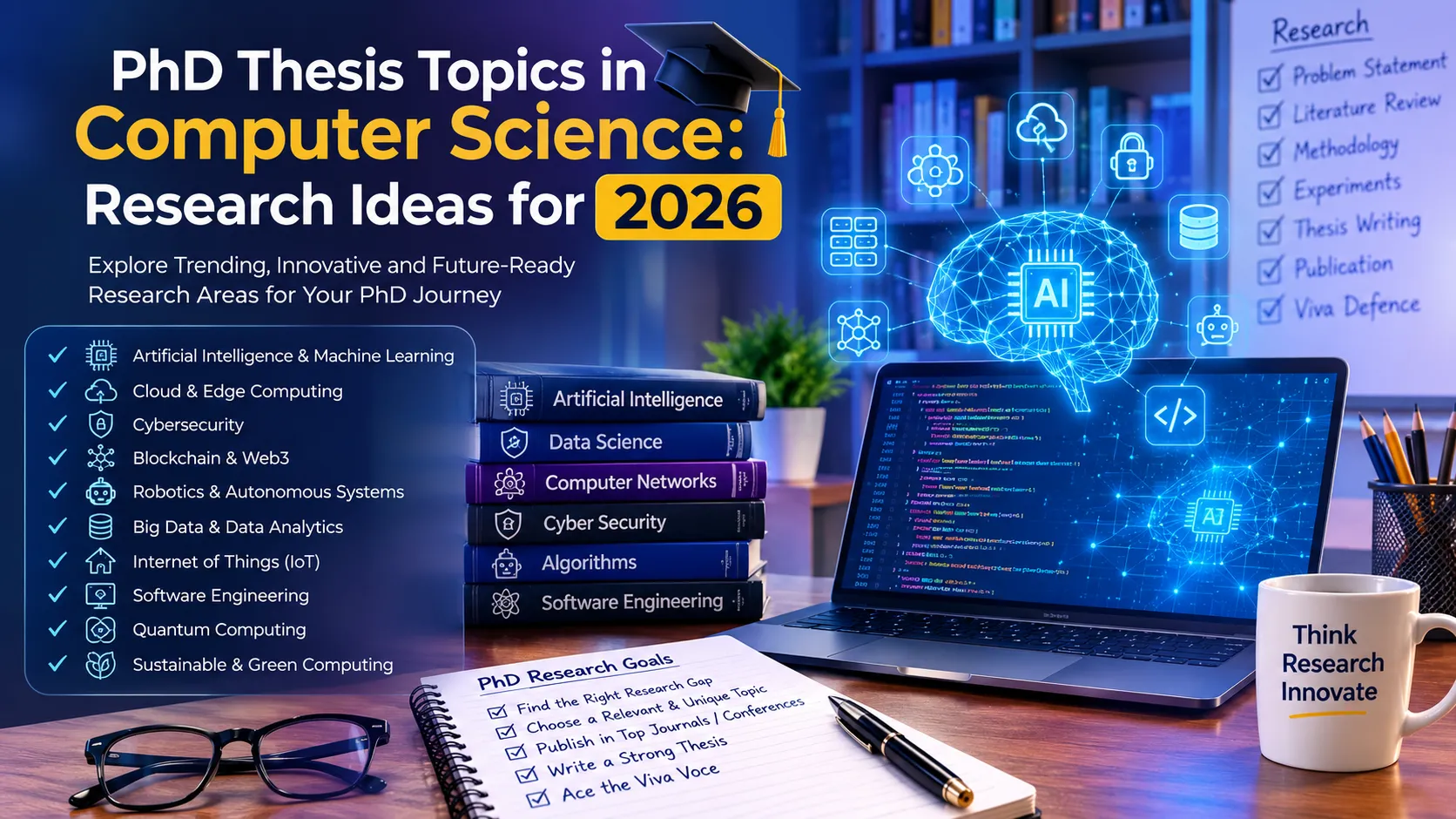
Computer science moves fast enough that a topic that felt current when you started your literature review can feel dated by the time you're drafting your synopsis — which makes finding genuinely current PhD thesis topics in computer science one of the harder, higher-stakes decisions in the entire doctoral process. The good news is that 2026 has an unusually rich set of live, well-documented research gaps, from AI agent benchmarking to the accelerating convergence of quantum computing and AI. This guide walks through research-ready directions across the major areas of computer science, grounded in current industry and academic signals rather than generic, evergreen topic lists — along with how to test any of them for genuine feasibility before you commit.
Why Topic Currency Matters More in Computer Science Than Almost Any Other Field
In most disciplines, a well-chosen topic stays relevant for the full length of a PhD registration. In computer science, an entire subfield's state of the art can shift meaningfully within a single year — a new model architecture, a new benchmark, or a new regulatory framework can make last year's framing feel outdated. This isn't a reason to avoid fast-moving areas; if anything, it's exactly where the richest, most citable research gaps currently sit. It does mean topic selection needs a slightly different lens than in slower-moving fields: alongside asking whether a gap is genuine, you need to ask whether the underlying technology or infrastructure your research depends on will still be accessible and relevant three to six years from now, which is the typical registration window under UGC norms.
How to Use This List
None of the directions below are meant to be lifted verbatim into a synopsis. Each is a starting point — a live area with a genuine, current gap — that still needs the narrowing every strong thesis topic requires: a specific dataset, population, architecture, or constraint that makes it answerable within your actual thesis length and compute budget. Scribbr's widely used dissertation-topic criteria are a useful check here: a strong topic should fit your program's requirements, genuinely interest you, and be both academically relevant — filling a real gap or contributing to active scholarly debate — and practically feasible given your time, data, and resource constraints . In computer science specifically, "feasible" almost always means asking a fourth question the other disciplines don't have to ask as urgently: will the compute, dataset, or platform this topic depends on still be accessible when you need it?
AI Agents and Agentic Systems
The IEEE Computer Society's 2026 Technology Predictions Report, produced by a committee of 54 global technology experts, identifies AI agents becoming standard in business environments — handling routine, repetitive work autonomously — as one of the defining trends of the year. Critically, the same report explicitly calls out AI agent benchmarking as an area where standards and best practices still need to be defined — meaning this isn't a settled area with established evaluation methodology, but a genuinely open one.
Research-ready directions include:
- Benchmarking frameworks for evaluating multi-agent system reliability in complex, real-world task environments rather than narrow, single-task benchmarks.
- Failure-mode taxonomies for autonomous AI agents — systematically cataloguing how and why agentic systems fail in production settings, an area with limited existing structured literature.
- Human-AI agent handoff protocols — studying how and when control should transfer between an autonomous agent and a human operator in high-stakes decision contexts.
- Coordination and communication protocols between multiple autonomous agents operating on shared tasks, an area where standardization is still actively being debated across the research community.
Large Language Models: Evaluation, Efficiency, and Reliability
LLM research remains one of the most active areas in computer science, but the genuinely open gaps have shifted from "can we build bigger models" toward reliability, efficiency, and evaluation — areas with far less settled methodology than model architecture itself.
- Hallucination detection and mitigation techniques for domain-specific LLM deployments (legal, medical, financial), where factual reliability matters more than general fluency.
- Energy and compute efficiency of LLM inference at scale — a growing concern given the IEEE report's parallel emphasis on AI-optimized, green high-performance computing as an academic research priority.
- Evaluation methodology for LLM-generated code and reasoning, an area where existing benchmarks are widely acknowledged to lag behind real-world deployment complexity.
- Retrieval-augmented generation reliability in low-resource-language settings, directly relevant to Indian-language NLP applications where training data is comparatively sparse.
Cybersecurity and Identity Resilience
The IEEE 2026 report specifically flags identity resilience as an area needing defined standards and best practices — a direct, citable signal that this is an active, unsettled research area rather than a mature one.
- Identity resilience frameworks for AI-mediated authentication systems, examining how identity verification holds up against increasingly sophisticated AI-generated deepfakes and synthetic identity attacks.
- Security implications of autonomous AI agents operating with delegated credentials — a genuinely new attack surface created directly by the rise of agentic AI systems covered above.
- Post-quantum cryptography migration strategies for legacy enterprise systems, an area with growing urgency as quantum computing capability advances.
- Zero-trust architecture effectiveness in hybrid cloud-edge environments, an increasingly common but under-studied deployment pattern in Indian enterprise IT.
Quantum Computing and Quantum-HPC-AI Convergence
The IEEE report names the tighter convergence of quantum computing, high-performance computing, and AI as a high-risk, high-reward "one to watch" for 2026 — precisely the kind of emerging, still-forming area that rewards early academic attention.
- Hybrid quantum-classical algorithms for optimization problems in specific applied domains (logistics, drug discovery, financial modeling) rather than purely theoretical quantum algorithm design.
- Benchmarking methodologies for near-term, noisy quantum hardware integrated into classical HPC pipelines.
- Practical barriers to quantum-AI convergence — a systematic study of where current hardware limitations most constrain real-world quantum-assisted machine learning.
Green and Energy-Efficient Computing
Sustainability-focused computing research has moved from a niche concern to an explicit academic research priority — the IEEE Computer Society specifically recommends academia prototype AI-optimized, green high-performance computing as a 2026 priority area .
- Energy-aware scheduling algorithms for large-scale AI training workloads across distributed data centers.
- Comparative energy-efficiency analysis of model compression techniques (quantization, pruning, distillation) for deployment on resource-constrained edge devices.
- Carbon-footprint accounting methodologies for AI research itself — a reflexive but increasingly demanded area of study as institutions face pressure to report the environmental cost of their own computing infrastructure.
Healthcare AI and Bio-AI Interfaces
The IEEE report specifically highlights adaptive bio-AI interfaces — systems that continuously sense and interpret human biological signals to adjust therapies in real time — as a defining 2026 trend, and calls on academia specifically to research and prototype engineering therapeutics .
- Real-time adaptive treatment algorithms using continuous biosignal monitoring for chronic condition management.
- Explainability requirements for clinical AI decision-support systems, an area where regulatory and ethical demands are outpacing current technical solutions.
- Data-sharing and privacy-preserving federated learning architectures for multi-institutional healthcare AI research — directly relevant given how difficult single-institution health data access typically is in India.
Edge Computing and the Internet of Things
Edge computing remains a durable, high-publication-potential area, particularly as AI workloads increasingly need to run outside centralized data centers.
- Resource-constrained model deployment strategies for real-time inference on IoT and edge devices with limited power and compute budgets.
- Latency-reliability tradeoffs in edge-cloud hybrid architectures for time-sensitive applications like autonomous systems or industrial monitoring.
- Security vulnerabilities specific to large-scale, heterogeneous IoT deployments, an area with abundant real-world incident data to analyze.
Blockchain and Decentralized Systems
While blockchain research has matured past its earlier hype cycle, genuine gaps remain in applied, domain-specific deployment rather than blockchain architecture itself.
- Blockchain-based provenance and verification systems for AI training data, addressing a growing demand for auditable AI supply chains.
- Scalability solutions for decentralized systems in resource-constrained environments, particularly relevant to Indian infrastructure contexts.
- Governance and consensus-mechanism design for domain-specific decentralized applications (supply chain, land records, academic credentialing).
- Interoperability standards between competing blockchain platforms, an unresolved practical barrier limiting real-world enterprise adoption despite growing institutional interest.
Human-Computer Interaction and Accessibility
HCI remains a strong, examiner-friendly area, especially where it intersects with the AI trends covered above.
- User trust and mental-model formation when interacting with autonomous AI agents, directly relevant to the agentic-systems trend covered earlier.
- Accessibility of AI-driven interfaces for users with disabilities, an area with real social relevance and comparatively limited existing empirical research in the Indian context specifically.
- Designing effective human-oversight interfaces for high-stakes automated decision systems.
- Cross-cultural usability of voice-and-language AI interfaces across India's linguistic diversity, an area where most existing HCI literature is skewed toward English-first design assumptions.
Choosing Among These Areas: A Quick Decision Framework
With nine clusters and two dozen-plus directions above, a few practical filters help narrow the field faster than reading through everything twice.
Start with what infrastructure you can actually sustain, not what excites you most. Some of the directions above (LLM fine-tuning, quantum-classical hybrid algorithms, large-scale training-workload analysis) require sustained, expensive compute access across your entire registration period, not just a one-time allocation. Others (HCI studies, benchmarking methodology, security vulnerability analysis, blockchain governance design) can be pursued with far more modest infrastructure. If you don't have a strong institutional GPU cluster or cloud-compute budget secured for the full length of your PhD, lean toward the second category.
Match the topic's novelty to your risk tolerance. Genuinely emerging areas — quantum-HPC-AI convergence, agentic-system failure taxonomies, identity resilience against AI-generated attacks — offer high novelty and strong publication potential precisely because so little settled methodology exists yet. That's also exactly what makes them harder: you may need to develop your own evaluation frameworks rather than adapting an established one. If your program or supervisor expects a more predictable trajectory, a slightly more mature area (edge computing security, healthcare AI explainability, accessibility-focused HCI) offers a clearer methodological path while still being current.
Consider data and ethics-clearance timelines. Healthcare AI and any topic involving human-subject data (HCI trust studies, accessibility research) typically require institutional ethics board approval, which can take weeks to months depending on your institution. Purely technical topics (algorithm design, benchmarking, systems architecture) generally don't carry this overhead, which matters if your timeline is tight.
Weigh publication and collaboration potential. Topics tied to areas with active, well-funded research communities — AI agents, LLM evaluation, cybersecurity — tend to have more venues actively seeking submissions and more potential collaborators or co-authors than niche areas, which can meaningfully ease the publication requirement most Indian universities still expect before thesis submission.
A Simple Framework to Test Any Topic Before You Commit
Before committing to any direction above, run it through three questions adapted from established research-topic viability criteria:
- Is there a genuine, current gap? Check recent literature reviews and dissertations in your specific area, and pay close attention to their stated "limitations" and "future research" sections — gaps are frequently stated explicitly there rather than needing to be inferred.
- Is it implementable with what you can actually access? Confirm compute access, dataset availability, and any required institutional partnerships before committing — this is the single most common reason ambitious CS topics stall.
- Will it still be relevant and researchable three to six years from now? In a field moving this fast, this question matters more than in most disciplines — anchor your topic to a stable underlying mechanism or problem rather than a specific tool, model, or platform that could be superseded or discontinued before you finish.
A Real Example: Avoiding a Feasibility Trap in a Fast-Moving Subfield
A scholar interested in studying hallucination rates in a specific, newly released LLM initially framed his entire thesis around that one model's behavior. His supervisor flagged an obvious risk: by the time his data collection and analysis were complete — likely eighteen months to two years later — that specific model would almost certainly be superseded, and its API might not even remain accessible at the same pricing or rate limits he'd planned around. He revised his framing to study hallucination-detection methodology as a generalizable evaluation technique, using several current models as his initial test cases rather than anchoring the entire contribution to one model's specific behavior. This preserved the currency and relevance of his topic while making the underlying contribution — the evaluation methodology itself — durable regardless of which specific models existed by the time he defended.
Originality, Similarity, and Why the Numbers Get Misunderstood
As you're refining any of these topics into a working literature review, it's worth understanding how similarity checking actually works, since it gets misunderstood often. Turnitin's own guidance is explicit that there is no single universal "acceptable" similarity percentage — the similarity score is simply matched words divided by total words, and is meant to guide contextual review rather than serve as an automatic plagiarism verdict; a separate, probabilistic AI-writing indicator is reported alongside it and is not the same measurement. That said, Indian scholars specifically need to keep the UGC's own regulatory bands in mind, since these operate independently of whatever a general similarity-checking guide says: under the UGC Plagiarism Regulations, 2018, up to 10% similarity requires no action, 10–40% requires revision, 40–60% triggers a one-year debarment from resubmission, and anything above 60% can mean cancellation of registration. Both facts are true and relevant at once — a similarity tool's general guidance about context, and India's specific regulatory thresholds, aren't in conflict, but they answer slightly different questions, and conflating them is a common, avoidable error.
For CS scholars specifically, one additional wrinkle is worth flagging: code, mathematical notation, and standard algorithmic descriptions frequently generate similarity matches simply because they use widely shared conventions and terminology, not because of actual copying. A high similarity score on a methods section describing a well-known algorithm is often expected and unproblematic — what matters, as Turnitin's own guidance stresses, is reviewing the actual matched content in context rather than reacting to the percentage alone.
Common Mistakes Specific to CS PhD Topics
- Anchoring an entire thesis to one specific tool, model, or platform rather than to the underlying, generalizable problem or mechanism — the fastest way for a CS topic to go stale mid-registration.
- Underestimating compute costs. Training or fine-tuning large models requires GPU access that can be expensive or difficult to secure consistently over a multi-year PhD; confirm sustained access, not just a one-time allocation, before committing to compute-heavy topics.
- Treating a benchmark result as a research question. "Applying model X to dataset Y" is a project, not a thesis-level contribution, unless it's paired with a genuine methodological or theoretical contribution about why or how it works.
- Ignoring reproducibility. CS research increasingly expects code and experimental setups to be shared and reproducible; a topic that can't realistically produce a reproducible pipeline within your timeline will face harder scrutiny at review and viva stage.
- Assuming a "novel architecture" claim is itself a contribution. Committees and reviewers increasingly expect a clear articulation of why a new architecture matters — what problem it solves that existing approaches don't — rather than novelty being treated as self-justifying.
- Underestimating dataset licensing and access restrictions. Several high-value datasets, particularly in healthcare and finance, come with licensing terms that restrict academic use, redistribution, or publication of results in ways that can quietly derail a thesis timeline if not checked before the topic is finalized.
If you'd like help evaluating whether a specific direction is genuinely feasible within your timeline and resources, our PhD thesis assistance service works with computer science scholars specifically at this topic-selection stage.
How Topic Choice Fits Into the Broader PhD Timeline
Topic selection in computer science isn't a decision you make once and set aside — it's typically reviewed by your Research Advisory Committee before formal registration, and it shapes every later stage, from what compute infrastructure you need to secure early to how your publication strategy takes shape. Most CS scholars spend their first year on coursework, topic finalization, and initial literature and feasibility checks; the next two to three years on core research, experimentation, and drafting; and the remainder on refinement, publication, and the examination cycle. Topics tied to a genuinely current, actively-researched area — like the ones in this guide — tend to keep this timeline on track precisely because there's a constant stream of new benchmarks, papers, and tools to engage with throughout your registration, rather than needing to manufacture relevance in your final year against an already-settled body of work.
FAQs
What are good PhD thesis topics in computer science for 2026?
The strongest current directions include AI agent benchmarking and reliability, LLM evaluation and efficiency, identity resilience and post-quantum cybersecurity, quantum-HPC-AI convergence, green and energy-efficient computing, and adaptive bio-AI interfaces in healthcare — each tied to specific, currently unsettled research gaps rather than settled ground.
Why does topic currency matter so much in a computer science PhD?
Because the field moves fast enough that a topic anchored to a specific tool or model can become outdated within the multi-year window of a PhD registration — anchoring to a stable underlying problem rather than a specific current technology protects your thesis's relevance over time.
How does topic choice affect a PhD thesis in computer science?
A well-chosen, feasible topic with sustained compute and data access keeps a thesis on track; a topic dependent on unstable infrastructure, a single soon-to-be-outdated tool, or unrealistic compute assumptions is one of the most common reasons a CS PhD stalls or requires significant reframing partway through.
How long does it take to complete a PhD thesis using this approach?
Under UGC norms, a PhD runs a minimum of three years and a maximum of six, including coursework; computer science scholars working on well-scoped, currently feasible topics tend to complete closer to the shorter end of that range, since late-stage infrastructure or relevance problems are one of the more common causes of delay in fast-moving technical fields.
Is professional help available for PhD thesis topics in computer science?
Yes. Experienced research mentors can help narrow a broad technical interest into a specific, feasible, currently relevant topic, and can help assess compute, data, and infrastructure feasibility before you commit — this is core to what services like ThesisLikho's PhD thesis assistance provide.
Choosing a topic built to stay relevant for your whole registration window is the foundation everything else in your PhD gets built on. If you'd like expert input on narrowing any of the directions above into a synopsis-ready topic, Book a PhD Research Consultation →