
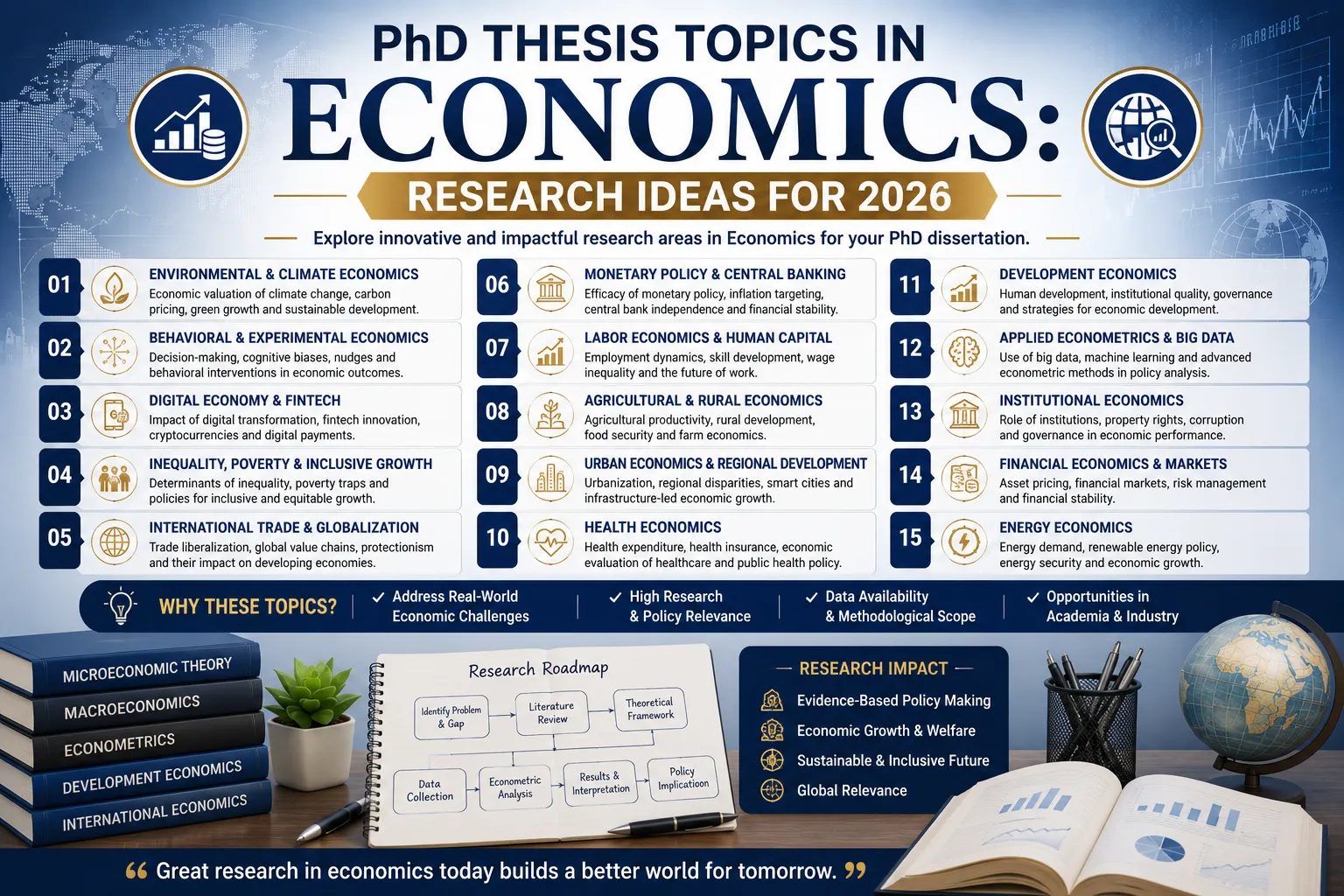
If you're a PhD Economics scholar trying to lock down a thesis topic, you're working in a field being reshaped in real time — AI's impact on labor markets, India's fast-expanding digital economy, and climate-linked economic risk have all become genuinely active, current research areas in just the past couple of years. This guide walks through PhD thesis topics in economics research ideas for 2026, organized by category, along with the data sources and topic-validation steps every Indian economics scholar needs before finalizing a direction.
This guide is written specifically for first-time PhD thesis writers in India who want topics that are current, researchable, and grounded in real 2025–2026 economic developments — not generic themes that have already been studied extensively.
Why Economics Thesis Topics Need to Track Real-Time Change
Economics research has always been tied to real-world events, but the pace of relevant change has picked up sharply. AI-driven automation is genuinely reshaping labor markets right now, India's digital economy and fintech sector are expanding fast enough that last year's data is already dated, and climate-linked economic risk has moved from a niche sub-field to something treated as a structural growth constraint by mainstream institutions. Choosing among PhD thesis topics in economics research ideas for 2026 means anchoring your research to developments that are genuinely active, not economic themes that peaked in relevance several years ago.
ThesisLikho's PhD-qualified experts, who've guided over 10,000 scholars through topic selection and thesis development, consistently see the same pattern: students who pick a topic tied to a live economic development — India's fintech and UPI expansion, AI's labor market effects, or green hydrogen investment in early-adopter states — get faster supervisor approval and write more original literature reviews than those who default to well-worn themes that have already been extensively covered.
Latest Trends Shaping 2026 Economics PhD Research
A few developments worth anchoring your topic search to: India's economy in 2026 continues to show strong resilience, driven by rapid digitalization, expanding fintech and UPI-based financial inclusion, production-linked incentive schemes attracting foreign investment, and significant green hydrogen and clean-energy investment concentrated in states like Gujarat, Rajasthan, and Tamil Nadu. At the same time, policymakers are actively managing the tension between inflation control and employment generation for a large youth population, while rural consumption patterns remain closely tied to monsoon performance and agricultural income.
Globally and within India, inequality is increasingly framed by researchers and institutions as a structural growth constraint rather than only an ethical or distributional concern — a shift that opens up genuinely current research angles connecting inequality to aggregate demand, human capital formation, and institutional stability. Climate economics has similarly moved from a niche sub-field to a mainstream research area, with growth, inequality, and financial-sector studies increasingly expected to account for climate constraints rather than treating them as a separate topic entirely.
Labor economics research is also shifting quickly, since the traditional model of stable, permanent employer-employee relationships no longer describes a large and growing share of the workforce. Gig and platform work, AI-driven automation, and evolving wage-employment dynamics are pushing researchers to update classic labor market models rather than simply applying them unchanged to today's economy.
AI and Digital Economy Trends in Economics Research
AI and digitalization now touch nearly every sub-field of economics research, and understanding exactly where creates room for a genuinely specific thesis topic rather than a vague "AI and the economy" title. Labor economists are studying how automation and AI adoption are reshaping employment patterns, wage structures, and skill demand across different sectors and regions. Public finance and development economists are examining how digital payment infrastructure like UPI is affecting financial inclusion, tax compliance, and informal-to-formal economic transitions. Behavioral economists are increasingly incorporating big data and digital transaction records into studies of consumer decision-making, moving beyond traditional survey-based approaches.
Nature Masterclasses' guidance on scientific writing offers a useful principle for framing any of these topics, even though it's written primarily for the natural sciences: a strong research paper needs a clear, specific research question and a deliberate narrative structure decided before writing begins, not one assembled loosely around a trendy term (Source: Nature Masterclasses). "AI and the economy" alone isn't a thesis topic — a specific economic mechanism, a specific sector or population, and a specific data source is.
Topic Selection Framework for Economics PhD Scholars
Run any shortlisted topic through these checks before finalizing it. First, currency: is this genuinely tied to an active 2025–2026 economic development, not something that peaked several years ago? Second, specificity: can you state your exact research question, variable relationships, and target population or sector in one sentence? Third, data feasibility: is the data you'll need — NSSO survey data, EPWRF time series, RBI or MoSPI datasets, or your own primary survey — realistically accessible within your program's timeline? Fourth, originality: has this exact angle, in this exact context, already been extensively studied? A quick search of ICSSR's NASSDOC thesis archive and recent journal literature is the fastest way to check. Fifth, supervisor and methodological fit: does this align with your supervisor's expertise, and do you have (or can you realistically build) the econometric skills your chosen approach requires?
A topic that fails the data feasibility check is one of the most common reasons economics PhD timelines run over, particularly since some Indian datasets require registration, application processes, or have known comparability issues across survey rounds that need to be understood before you commit to a longitudinal design.
What Is a Research Gap in Economics Research?
A research gap in economics typically falls into one of a few recognizable categories. A theoretical gap exists where an established economic model hasn't been tested or extended to account for a new phenomenon, such as gig work's effect on traditional labor supply models. A contextual gap exists where a relationship well-established internationally hasn't yet been tested specifically in an Indian context, state, or demographic. A data gap exists where new datasets — like recent NSSO rounds or newly available digital transaction records — make a previously unanswerable question testable for the first time. And a policy-timing gap exists where a recent policy change (a new PLI scheme, a fintech regulation, a green hydrogen mission target) hasn't yet been evaluated empirically simply because it's too recent for existing literature to have caught up.
For most first-time Indian economics PhD scholars, the contextual and policy-timing gaps are often the most feasible starting points, since they let you build on an established theoretical foundation while contributing genuinely original, current empirical evidence.
100+ PhD Economics Thesis Topics by Category
Digital Economy and Fintech : Impact of UPI expansion on financial inclusion among unbanked rural households in India; determinants of digital payment adoption among India's informal sector workers; fintech lending's effect on credit access for Indian MSMEs; the digital divide's impact on economic inequality across Indian states; cryptocurrency and digital asset regulation's effect on retail investor behavior in India; impact of e-commerce growth on traditional retail employment; central bank digital currency (e-Rupee) adoption and its macroeconomic implications; digital financial literacy's effect on household savings behavior; platform economy taxation challenges and revenue implications for Indian states; impact of digital lending apps on household debt patterns; blockchain technology's effect on transaction costs in Indian supply chains; fintech's role in reducing gender gaps in financial access.
AI, Automation, and Labor Economics: Impact of AI adoption on employment patterns in Indian manufacturing; automation's effect on wage structures across skill levels in Indian IT services; gig economy growth and its implications for traditional labor market models; AI-driven job displacement risk assessment across Indian industry sectors; reskilling program effectiveness for workers displaced by automation; impact of remote work adoption on regional labor market dynamics; algorithmic wage-setting in platform work and its effect on worker income stability; automation's differential impact on male versus female employment in manufacturing; AI adoption's effect on firm-level productivity among Indian SMEs; labor market effects of AI-driven customer service automation; skill-biased technological change and wage inequality in urban India; impact of platform work formalization on worker social security access.
Climate and Environmental Economics: Economic cost-benefit analysis of green hydrogen investment in early-adopter Indian states; climate risk's impact on agricultural income volatility in rain-dependent regions; carbon pricing mechanisms and their feasibility for Indian industrial sectors; renewable energy investment's effect on regional employment generation; climate change's impact on migration patterns from vulnerable Indian regions; green bond market development and investor demand in India; economic resilience of coastal communities to climate-related disasters; impact of extreme weather events on informal sector income; cost of climate adaptation infrastructure for Indian coastal cities; renewable energy subsidy effectiveness in accelerating clean energy adoption; climate-linked financial risk assessment for Indian banking institutions.
Development Economics and Poverty: Impact of direct benefit transfer schemes on rural poverty reduction; microfinance's effect on women's economic empowerment in rural India; migration's role in household income diversification and poverty reduction; impact of skill development programs on youth employment outcomes; rural-urban income convergence patterns in post-pandemic India; effectiveness of employment guarantee schemes on rural wage rates; impact of financial inclusion on small farmer income stability; education subsidy programs and their effect on human capital formation; impact of infrastructure investment on regional economic convergence; social protection program effectiveness during economic shocks; determinants of informal sector persistence in urban India.
Inequality and Labor Market Studies: Income inequality's impact on aggregate consumption demand in India; gender wage gap trends across formal and informal Indian labor markets; impact of education access on intergenerational income mobility; regional income disparity trends across Indian states post-liberalization; impact of minimum wage policy on informal sector employment; wealth inequality's effect on human capital investment decisions; caste-based labor market discrimination and wage outcomes; impact of urbanization on income inequality within Indian cities; occupational segregation and its effect on gender pay gaps; inequality's relationship with political and institutional stability in Indian states.
Behavioral Economics: Cognitive biases in retail investor decision-making in Indian equity markets; behavioral drivers of household savings behavior among Indian salaried professionals; anchoring bias in Indian consumer pricing perception; loss aversion's effect on insurance product adoption in India; behavioral nudges' effectiveness in improving tax compliance; social influence on financial decision-making among first-time Indian investors; present bias and its impact on retirement savings adequacy; behavioral factors influencing microfinance loan repayment rates; overconfidence bias among small business owners' investment decisions.
Public Economics and Fiscal Policy: Impact of GST reforms on state-level revenue collection and compliance; fiscal federalism challenges in India's centre-state revenue-sharing framework; public investment's effect on regional infrastructure development outcomes; tax buoyancy analysis for India's evolving indirect tax structure; impact of production-linked incentive schemes on industrial investment; subsidy rationalization's effect on fiscal deficit management; public debt sustainability analysis for Indian state governments; impact of disinvestment policy on public sector enterprise efficiency; fiscal policy's role in managing inflation-growth trade-offs.
International Trade and Global Economics: Impact of global supply chain diversification on Indian manufacturing exports; trade agreement effects on Indian agricultural export competitiveness; exchange rate volatility's impact on Indian export performance; impact of geopolitical tensions on India's trade diversification strategy; foreign direct investment patterns in India's high-value manufacturing sectors; impact of global commodity price volatility on India's trade balance; Make in India policy effectiveness in boosting manufacturing exports; regional trade agreement participation and its effect on Indian SME exports; impact of currency fluctuation on India's services export competitiveness.
Health Economics : Economic burden of non-communicable diseases on Indian households; health insurance penetration's effect on catastrophic health expenditure reduction; impact of public health infrastructure investment on regional health outcomes; economic cost analysis of mental health treatment gaps in India; telemedicine adoption's effect on healthcare access in rural India; impact of health worker migration on public healthcare system capacity; cost-effectiveness analysis of preventive versus curative healthcare spending; economic determinants of vaccination uptake in underserved regions; healthcare price inflation's impact on household consumption patterns.
Monetary Economics and Banking : Impact of monetary policy transmission on regional credit availability; non-performing asset trends and their effect on public sector bank lending; impact of interest rate changes on household consumption and savings behavior; digital banking adoption's effect on financial inclusion among rural households; impact of banking sector consolidation on credit access for MSMEs; inflation targeting framework effectiveness in India's post-pandemic recovery; impact of central bank digital currency pilots on monetary policy transmission; credit rationing patterns among small and marginal farmers.
Data Sources Every Indian Economics Scholar Should Know
Before finalizing any of the topics above, it's worth knowing where you'll actually get your data. The ICSSR Data Service, a joint initiative between the Indian Council of Social Science Research and India's Ministry of Statistics and Programme Implementation, hosts unit-level datasets from major national surveys, including NSSO employment and unemployment surveys, household consumer expenditure surveys, and the Annual Survey of Industries — registration is required, but the data itself is freely accessible to researchers. EPWRF India Time Series is another valuable resource, offering a long-running database with over 50,000 variables spanning 20 modules covering the Indian economy, often extending back to 1950 depending on data availability, which makes it particularly useful for macroeconomic and time-series research.
The National Sample Survey Office remains one of the oldest continuously running household survey programs in the developing world, but it's worth knowing that its data collection methodology has changed at points over the decades, which affects the direct comparability of estimates across different survey rounds — an important caveat if your topic involves a longitudinal design spanning multiple NSS rounds. Finally, NASSDOC, the National Social Science Documentation Centre under ICSSR, holds an archive of unpublished PhD theses in social sciences from Indian universities, which is genuinely useful both for literature review purposes and for confirming whether your specific topic angle has already been extensively covered by a previous scholar.
Two Practical Example Topics, Explained in Depth
A strong version of an AI-and-labor topic isn't simply "AI's impact on employment in India" but something more specific, like an examination of how AI adoption is affecting employment patterns and skill demand specifically within India's manufacturing sector, using recent NSSO employment survey rounds combined with firm-level adoption data. This works well because it's anchored to a genuinely current, still-unfolding economic shift, uses a data source (NSSO) that's realistically accessible to an Indian PhD scholar, and narrows "AI and labor" down to a specific sector where the research gap is checkable against existing literature.
A strong version of a climate-economics topic, similarly, isn't just "the economics of climate change" but something like a cost-benefit analysis of green hydrogen investment specifically in early-adopter states like Gujarat, Rajasthan, or Tamil Nadu, using EPWRF's regional economic time-series data alongside government investment disclosure figures. This ties directly to an active, still-developing policy area — India's National Green Hydrogen Mission — giving your literature review genuine novelty, since very little academic literature yet exists on a policy area this current, while still being feasible using secondary data you can realistically access.
Both examples illustrate the same principle: the strongest economics thesis topics combine a genuinely current economic development with a specific, checkable data source — not just a trending keyword.
If you'd like a deeper walkthrough of how to design the actual research approach for a topic like these, our sibling guide on How to Design a Research Methodology for a PhD in Economics covers econometric and data-analysis choices in more depth.
Suggested Research Methodology by Topic Category
Different topic categories call for genuinely different methodological approaches. Digital economy and fintech topics generally suit quantitative analysis using secondary transaction or survey data, often with panel regression or difference-in-differences designs where a policy change (like UPI rollout) can be used as a natural experiment. AI and labor economics topics typically call for panel data econometrics using NSSO employment rounds, sometimes combined with firm-level survey data for a mixed-method approach. Climate and environmental economics topics often use time-series or panel data analysis combined with cost-benefit modeling, drawing on EPWRF or government investment data. Development economics and poverty topics frequently use household-level survey data (NSSO or primary surveys) with regression or propensity-score matching approaches to assess program impact. Behavioral economics topics typically require primary survey or experimental data, since the cognitive and psychological variables involved usually aren't captured in existing secondary datasets. Public economics and fiscal policy topics generally rely on secondary government fiscal data with time-series or panel analysis. International trade topics commonly use trade flow data with gravity models or panel regression approaches.
Getting Supervisor Approval
Supervisors approve economics topics faster when scholars demonstrate they've already thought through data feasibility, not just theoretical interest. Bring two or three shortlisted topics, each with your intended data source already identified and, ideally, briefly explored to confirm it's genuinely accessible. Reference a specific, current development — India's green hydrogen mission, a recent NSSO survey round, or a specific fintech regulation — to show real groundwork rather than a general trend name. Be upfront about the econometric techniques your topic will require, and confirm honestly whether you already have those skills or will need to build them during your coursework phase. If your topic touches a still-evolving policy area, acknowledge that explicitly and explain how you'll handle any changes during your research window.
Common Mistakes When Choosing an Economics Thesis Topic
A common mistake is picking a topic that's already outdated, referencing pre-2023 digital adoption figures or pre-reform policy assumptions that have since shifted meaningfully. Another is confusing a trending keyword with a researchable topic — "AI and the economy" alone isn't a topic; a specific mechanism, sector, and data source is. Scholars also frequently underestimate data feasibility, choosing a topic that requires a dataset they haven't actually confirmed they can access, or that has known comparability issues they discover only after committing to a longitudinal design. Overloading a topic with too many variables — trying to study AI, climate risk, and inequality all in one thesis — is another recurring issue. Skipping a literature and thesis-archive scan (including NASSDOC) before finalizing a topic often leads to discovering, too late, that the exact angle has already been extensively covered. And finally, choosing an econometric approach because it "sounds more rigorous" rather than because it actually fits the research question and available data is a frequent, avoidable methodological misstep.
Topic Validation Checklist
Before finalizing any topic, confirm it's tied to a specific, current economic development rather than a general trend; that your research question, variables, and target population or sector are stated clearly in one sentence; that your intended data source (NSSO, EPWRF, RBI/MoSPI data, or a primary survey) is confirmed genuinely accessible within your timeline; that a preliminary scan of recent literature and the NASSDOC thesis archive shows a genuine gap rather than an oversaturated area; that your chosen methodology matches both your research question and your existing or buildable econometric skills; that your supervisor has reviewed and approved the direction; and that you can write a clear two-to-three sentence problem statement directly from the topic as stated.
How Long Does a PhD Thesis Take Using This Approach?
Topic finalization for an economics PhD, including data-source confirmation, typically takes three to five weeks when approached systematically — shortlisting options, checking data accessibility, and getting supervisor sign-off. From there, most Indian economics PhD programs run three to five years overall, with topics relying on readily available secondary data (NSSO, EPWRF) generally moving faster through the data collection phase than those requiring primary survey work or original data collection, which can add several additional months for design, fieldwork, and data cleaning.
If you need expert guidance with topic selection, research methodology, or thesis development, you can explore our PhD Thesis Assistance service, where our PhD-qualified experts help economics scholars validate topics, confirm data feasibility, and stay on track from proposal to final submission.
FAQs
What is phd thesis topics in economics research ideas for 2026?
It refers to current, researchable PhD topic ideas across economics sub-fields — including digital economy and fintech, AI and labor economics, climate economics, development economics, behavioral economics, and public finance — that reflect genuinely active 2025–2026 economic developments rather than outdated or oversaturated research areas.
Why does choosing the right economics PhD thesis topic matter?
Economics research dates quickly given how fast digital adoption, policy frameworks, and labor markets are shifting. A topic tied to an outdated development can undermine your literature review's relevance and originality from the start, while a current, well-scoped topic makes both your research process and supervisor approval smoother.
How does topic choice affect an economics PhD thesis?
Your topic determines your data accessibility, the econometric approach you'll need, and how original your literature review can genuinely be — a poorly scoped or outdated topic often forces a mid-thesis pivot that costs significant time, particularly once data limitations become apparent.
How long does it take to complete a PhD thesis using this approach?
Topic finalization with data-source confirmation typically takes three to five weeks. Overall economics PhD completion in India commonly runs three to five years, with secondary-data-based topics generally moving through data collection faster than those requiring original primary survey work.
Is professional help available for phd thesis topics in economics research ideas for 2026?
Yes. Many economics PhD scholars work with experienced research mentors to validate topic feasibility, confirm data source accessibility, and align their chosen topic with current economic developments — this is exactly the kind of support ThesisLikho's PhD-qualified experts provide.
Book a PhD Research Consultation: If you're weighing a few economics topic ideas or want expert input on data feasibility before committing months of work to one direction, ThesisLikho's PhD-qualified experts can help you validate your topic and plan your path forward. Book Your Consultation →