
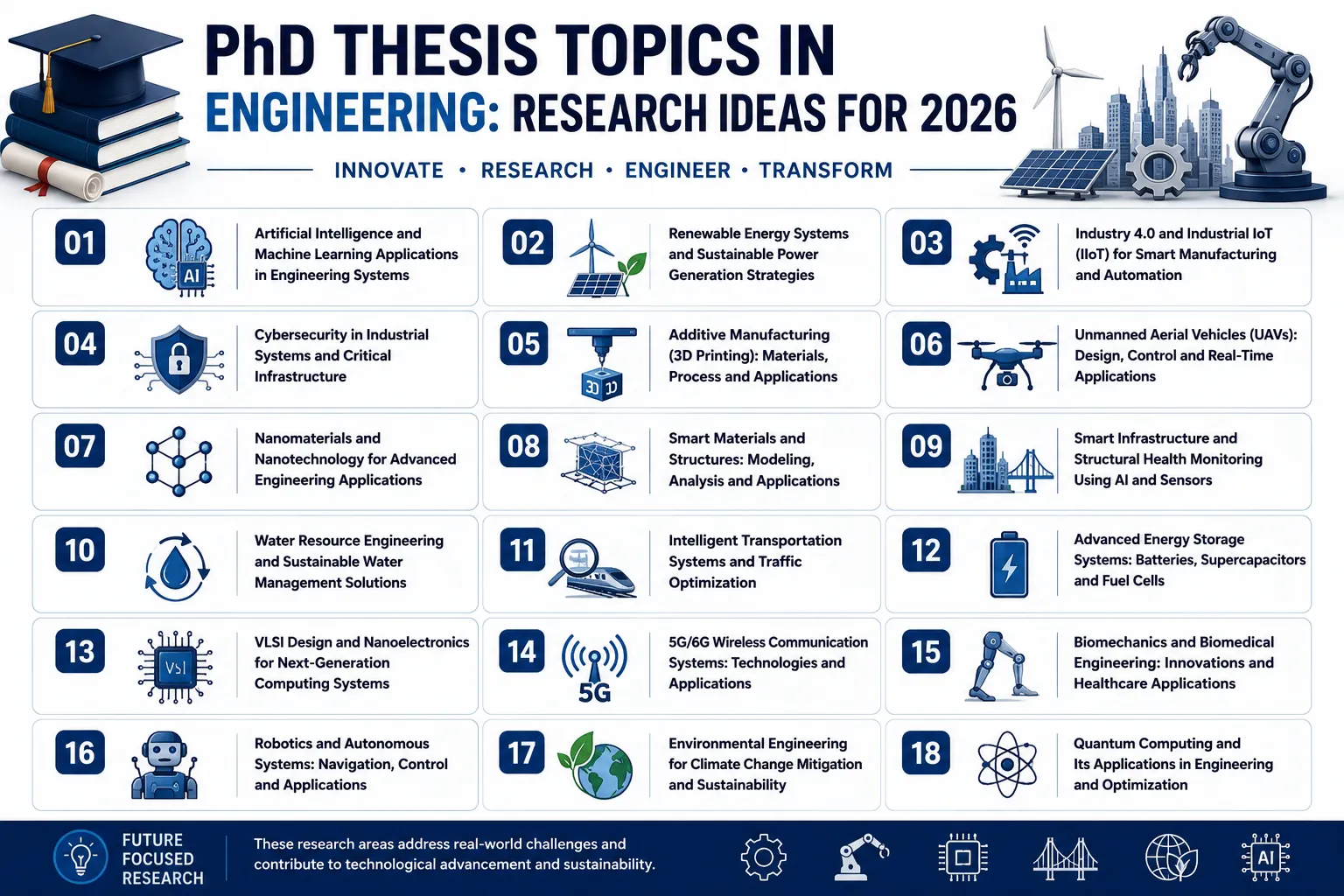
Engineering is broad enough that "PhD thesis topics in engineering" can mean sustainable concrete, EV battery thermal management, wireless power grids, or AI-assisted material discovery — genuinely different fields sharing only the name. That breadth makes finding a topic that's current, fundable, and defensible harder than it looks, especially since 2026's biggest shift isn't really any single new technology, but the fact that AI has become a cross-cutting layer over nearly every traditional engineering discipline rather than a separate track of its own. This guide walks through research-ready directions across mechanical, civil, electrical, and chemical engineering, along with how to narrow any of them into a topic specific enough for your committee to actually approve.
Why 2026 Is an Unusually Interdisciplinary Year for Engineering Research
If there's one thing worth understanding before picking a topic, it's this: AI is no longer a separate engineering discipline competing with mechanical, civil, or electrical engineering for research attention — it's increasingly embedded inside each of them. Structural health monitoring in civil engineering, generative CAD design in mechanical engineering, fault detection in electrical power grids, and process optimization in chemical engineering are all now routinely framed as AI applications within their home discipline, not as separate computer-science research. This has a direct, practical implication for topic selection: a strong 2026 engineering PhD topic increasingly pairs a traditional engineering problem with a specific data-driven or AI-assisted technique, rather than treating "traditional engineering" and "AI" as competing tracks.
There's also a broader push toward interdisciplinary blending as a marker of research sophistication — combining a mechanical system with IoT sensing, or a civil structure with a data-driven monitoring layer, is specifically flagged as demonstrating more advanced engineering thinking than a purely single-discipline project. This doesn't mean a traditional, single-discipline topic is automatically weaker — plenty of strong 2026 theses stay within one discipline's core methods — but it does mean that if you're drawn to a broad, well-established area, actively looking for a natural point of connection to a second discipline (sensing, data, or control systems, most commonly) is worth considering as a way to sharpen your contribution's distinctiveness.
If you haven't yet locked a specific, defensible topic within this landscape, our companion guide, How to Choose a Strong Thesis Topic Your Supervisor Will Approve, covers the narrowing process directly, and [Link: What Is a Research Gap and How to Identify One for Your Thesis] covers how to confirm your chosen angle is a genuine gap.
How to Use This List
None of the directions below should be copied directly into a synopsis. Each is a starting point that needs narrowing into a specific, testable contribution — a defined system, material, dataset, or performance metric that makes it answerable within your registration timeline. A useful rule repeated across current engineering-research guidance: a topic needs to specify the machine, system, material, model, performance metric, and application context to be thesis-ready — a broad heading like "robotics in manufacturing" or "renewable energy systems" is a subject area, not yet a research question.
Mechanical Engineering: Thermal, Manufacturing, and Robotics Directions
Mechanical engineering has an unusually dense, currently active set of PhD-ready directions heading into 2026, spanning thermal systems, manufacturing, and robotics.
- EV battery thermal management and cooling system design, comparing specific cooling architectures (liquid, air, phase-change material) under realistic charge-discharge cycles rather than idealized lab conditions.
- Additive manufacturing process optimization, examining how specific print parameters affect mechanical properties and defect rates for a defined material and application.
- AI-assisted predictive maintenance for rotating machinery, using vibration or thermal sensor data to predict failure ahead of scheduled maintenance windows, with a clearly defined accuracy and false-alarm-rate benchmark.
- Digital twin development for a specific mechanical system, evaluating how accurately a real-time digital model tracks and predicts the behavior of its physical counterpart under varying operating conditions.
- Lightweight composite material development for a specific structural application, balancing strength-to-weight ratio against manufacturing cost and scalability.
- Hydrogen energy system integration, examining storage, transport, or fuel-cell efficiency challenges specific to a defined deployment context.
- Tribology and wear-resistance optimization for high-load mechanical components, examining novel surface treatments or lubricant formulations under realistic operating cycles rather than idealized bench conditions.
Civil Engineering: Sustainable and Resilient Infrastructure
Sustainable infrastructure is consistently named as the single biggest civil engineering trend heading into 2026, driven by both funding priorities and genuine climate-adaptation urgency.
- Self-healing concrete using bacterial spores or microcapsule-based healing agents, evaluating healing efficiency and long-term durability compared to conventional concrete under realistic load and environmental conditions.
- Retrofitting strategies for coastal infrastructure facing rising sea levels, examining structural or material adaptations for a specific type of infrastructure (ports, seawalls, coastal roads) in a defined regional context.
- AI-driven structural health monitoring for bridges and critical infrastructure, using sensor data to detect early signs of degradation with a clearly defined detection-accuracy benchmark against manual inspection records.
- Climate-resilient urban drainage system design, modeling how specific design interventions perform under increasingly extreme rainfall patterns relevant to Indian urban contexts.
- Predictive maintenance modeling for road infrastructure, using traffic load and material-degradation data to forecast maintenance needs ahead of visible failure.
- Circular-economy approaches to construction and demolition waste, examining how recycled materials perform structurally compared to virgin materials in a specific application, an area with strong sustainability funding relevance.
Electrical Engineering: Grids, Power, and Wireless Systems
Electrical engineering research in 2026 is heavily oriented around the renewable-energy transition and the infrastructure needed to support it reliably.
- Smart grid stability and fault detection using AI-based monitoring, evaluating detection speed and accuracy against traditional protection schemes for a specific grid configuration.
- Microgrid design and control strategies for renewable-heavy, partially islanded power systems, particularly relevant to rural or infrastructure-constrained Indian contexts.
- Wireless power transfer efficiency optimization, examining a specific application (EV charging, industrial equipment, medical devices) and the tradeoffs between transfer distance, efficiency, and safety.
- Energy storage system integration for renewable-heavy grids, comparing battery chemistries or hybrid storage approaches for a defined grid-scale application.
- AI-enhanced load forecasting for power distribution networks, measuring forecasting accuracy improvements against traditional statistical methods under realistic demand variability.
- Fault-tolerant control strategies for renewable-integrated distribution networks, examining how quickly and reliably a system can isolate faults and reroute power without full outages.
Chemical Engineering: Process Optimization and Material Discovery
Chemical engineering is increasingly defined by the integration of machine learning into both process design and materials discovery, offering genuinely current, well-fundable directions.
- Machine-learning-assisted catalyst or material discovery for a specific industrial application, comparing predicted versus experimentally validated performance.
- Process optimization in refining or chemical manufacturing using AI-driven modeling, measuring efficiency or yield improvements against traditional process-control approaches.
- Green chemistry approaches to reducing hazardous byproducts in a specific industrial process, evaluating both environmental impact and economic feasibility.
- Membrane technology for water treatment and desalination, examining a specific membrane material's efficiency and fouling resistance under realistic operating conditions relevant to Indian water-scarcity contexts.
- Carbon capture process design and efficiency optimization, evaluating a specific capture technology's energy penalty and scalability for a defined industrial emission source.
Interdisciplinary and Mechatronics Directions
Deliberately blending two traditionally separate engineering disciplines is specifically flagged as a marker of advanced, modern engineering thinking, and it opens up directions that a purely single-discipline topic can't reach.
- IoT sensor integration for predictive maintenance in wind turbines, combining mechanical systems knowledge with electrical sensing and data-driven analysis in a single, coherent research design.
- Robotics integration in structural inspection, combining civil engineering's structural-monitoring needs with mechanical and electrical robotics design.
- Biomedical engineering applications combining materials science and control systems, such as adaptive prosthetics or wearable health-monitoring devices.
- Smart manufacturing systems combining industrial automation, IoT, and AI-driven quality control, an area sitting squarely at the mechanical-electrical-computer science intersection.
- Renewable-energy-powered desalination systems, combining chemical engineering's membrane processes with electrical engineering's renewable-power integration challenges — a genuinely cross-disciplinary direction with strong relevance to water-stressed coastal regions.
Simulation-Based Research Is a Legitimate, Full-Fledged Path
If you're worried that a lack of access to expensive lab equipment limits your options, it's worth knowing clearly that computational simulation is an established, respected methodology at PhD level, not a lesser substitute for physical prototyping. Building and testing physical prototypes is often expensive and time-consuming, and a substantial share of strong current engineering papers rely entirely on computational simulation — using tools like ANSYS for stress and thermal analysis, or MATLAB and Simulink for control-systems modeling. This means several of the directions above (digital twin development, structural health monitoring, thermal management, grid stability analysis) can be pursued rigorously through simulation alone, provided you clearly justify your simulation model's validity and, where possible, validate it against available experimental or field data.
That validation step is worth taking seriously rather than treating as a formality: a simulation-only thesis is strongest when it can point to at least some real-world data point — a published experimental result, a small-scale physical test, or field data from a partner organization — that its model successfully reproduces before being used to explore conditions that would be impractical or unsafe to test physically. Committees are generally comfortable with simulation-heavy methodology, but they do expect this validation logic to be explicit rather than assumed, since an unvalidated simulation model risks producing confident-looking results that don't actually reflect real-world behavior.
A Simple Framework to Narrow Any of These Into a Thesis-Ready Topic
Before committing to any direction above, run it through a quick specificity check: does your topic name the specific machine, system, or material involved; the specific model or method you'll apply to it; a clear, measurable performance metric; and a defined application context? A topic like "renewable energy systems" fails all four tests. A topic like "comparative thermal efficiency of phase-change-material battery cooling for two-wheeler EVs under Indian summer ambient conditions" passes all four, because it names the system (two-wheeler EV battery), the approach (phase-change-material cooling), the metric (thermal efficiency), and the context (Indian summer conditions).
It's also worth checking feasibility directly against your specific lab, software, and supervisor expertise — a topic requiring equipment your department doesn't have, or expertise outside your supervisor's background, adds avoidable risk on top of the research risk you're already taking on.
Choosing Among Disciplines and Directions: A Quick Decision Framework
With five discipline clusters and over twenty specific directions above, a few practical filters help narrow the field faster than reading through everything twice.
Start with your existing lab and software access, not just your interest. If your department has strong CFD or FEA simulation capability, thermal-systems or structural directions become far more feasible than if you'd need to source specialized physical testing equipment elsewhere. If your department has strong power-electronics lab infrastructure, grid and wireless-power directions become correspondingly more realistic.
Match interdisciplinary ambition to your supervisor's actual expertise. Combining mechanical and electrical engineering in a mechatronics-flavored topic can be genuinely stronger research, but only if your supervisor (or a co-supervisor) has real expertise across both sides — otherwise you risk being under-guided on whichever half falls outside their background.
Consider your data or field-testing access honestly. Structural health monitoring, predictive maintenance, and smart-grid topics are strongest when validated against real sensor or field data; if you don't have an institutional or industry partnership that can provide this, look for publicly available datasets or lean toward a well-justified simulation-based design instead of assuming access will materialize later.
Weigh publication and funding potential. Topics tied to actively funded priority areas — sustainable infrastructure, EV technology, renewable energy integration — tend to have more active journals and funding calls seeking submissions than more niche or purely theoretical mechanical-design topics, which can meaningfully ease both the publication requirement most universities expect and any need to secure research funding along the way.
A Real Example: From "Robotics in Manufacturing" to a Defensible Topic
A scholar interested broadly in "robotics in manufacturing" initially proposed exactly that as a working title — a genuinely current, fundable area, but far too broad to defend at synopsis stage, since it reads more like a subject heading than a research question. Working through the narrowing process, he identified a specific mechanism within that broad interest: robotic arm path-planning optimization for pick-and-place tasks in small-batch manufacturing, where changeover time between different product configurations is a major, underexplored bottleneck compared to the well-studied large-batch case. He then added a measurable metric — cycle-time reduction compared to a standard industrial path-planning algorithm — and a specific application context: small and medium-scale Indian manufacturing units, where budget constraints rule out the fully automated changeover systems common in larger facilities. What started as an unmanageable subject area became a specific, implementable, and measurable thesis question that his committee approved without requiring major revision.
Managing a Fast-Growing, Cross-Disciplinary Literature Review
Engineering research increasingly draws on literature from adjacent fields — a mechanical engineering thesis on predictive maintenance may need to engage with machine-learning literature just as much as mechanical-systems literature, and a civil engineering thesis on climate-resilient design may need to draw on both structural engineering and climate-science sources. Setting up a reference manager like Mendeley early, rather than partway through your reading, pays off considerably here: it lets you organize sources into topic-based collections spanning multiple disciplines, annotate PDFs directly, and automatically generate citations in your required format — a genuinely useful habit given how much cross-disciplinary, fast-moving literature a current engineering PhD typically needs to track and synthesize coherently.
What the PhD Process Actually Involves After Topic Selection
Choosing your topic is the beginning, not the end, of a structured process. Under UGC's Minimum Standards and Procedure for Award of PhD Degree Regulations, 2022, admission generally requires a master's degree with around 55% marks, and the programme runs a minimum of three years and a maximum of six years, including coursework. Once your Research Advisory Committee approves your topic, you'll typically register formally and work through your literature review, methodology, and experimental or simulation chapters under your supervisor's guidance. At submission, your thesis is evaluated by at least two external examiners, and UGC regulations require the full evaluation process, including the viva-voce, to be completed within six months of submission.
If you'd like support at any stage — from narrowing a topic like the ones above into a synopsis, to structuring your methodology or preparing for publication — our PhD thesis assistance service works specifically with engineering scholars navigating this exact process. And if you're already thinking ahead to how your methodology chapter should be structured, our companion guide, How to Design a Research Methodology for a PhD in Engineering, covers that stage directly.
In practical terms, most engineering PhD scholars spend their first year on coursework and topic finalization, including securing any needed lab access, software licenses, or industry data-sharing agreements. The middle two to three years are typically spent on core experimentation or simulation work, with results feeding into conference and journal submissions along the way rather than all at once at the end. The final stretch is dedicated to writing, refinement, and the examination cycle itself. Topics tied to genuinely current, actively funded priority areas tend to keep this timeline on track more reliably than niche or purely theoretical topics, simply because there's a steadier stream of relevant new literature, funding opportunities, and potential collaborators to draw on throughout the registration period.
Common Mistakes Specific to Engineering PhD Topics
- Choosing a subject heading instead of a research question. "Renewable energy systems" or "robotics in manufacturing" are areas, not questions — always name the specific system, method, metric, and context before treating a direction as thesis-ready.
- Assuming simulation-based research is a lesser fallback. Simulation is a legitimate, well-respected methodology at PhD level when properly validated — don't avoid a strong simulation-based topic simply because it lacks a physical prototype component.
- Ignoring equipment and software access when scoping a topic. A fascinating but infrastructure-mismatched topic — requiring lab equipment or specialized software your department doesn't have — adds avoidable risk regardless of how compelling the underlying research question is.
- Treating AI as a bolt-on rather than an integrated methodology. Simply adding "using machine learning" to a traditional engineering topic without a clear rationale for why a data-driven approach specifically improves on established methods reads as trend-chasing rather than genuine methodological contribution.
- Underestimating how much cross-disciplinary reading a modern engineering topic requires. Interdisciplinary and AI-layered topics often mean engaging seriously with literature from a second field — budget real time for this rather than assuming your home discipline's literature alone will suffice.
- Choosing a topic tied to a single, soon-to-be-outdated technology or standard. A topic anchored tightly to one specific commercial battery chemistry, one specific grid protocol, or one specific software version can lose relevance faster than a three-to-six-year registration window allows — anchor to the underlying engineering problem instead, using current technologies as test cases rather than as the entire framing.
- Overpromising on real-world validation. Proposing to validate a simulation against live industrial or field data without first confirming that a specific partner will actually provide that access is a common, avoidable source of delay — secure this in writing before finalizing your methodology, not after.
FAQs
What are good PhD thesis topics in engineering for 2026?
Strong current directions include AI-assisted predictive maintenance and digital twins in mechanical engineering, self-healing concrete and climate-resilient infrastructure in civil engineering, smart grid stability and wireless power transfer in electrical engineering, and machine-learning-assisted material discovery in chemical engineering — each offering a genuine, current research gap when narrowed to a specific system, metric, and context.
Why does choosing the right PhD engineering topic matter so much?
Because engineering topics can easily be scoped as an overly broad subject heading rather than an answerable research question, and because 2026's strongest topics increasingly require pairing a traditional engineering problem with a specific data-driven method — getting either the scope or the interdisciplinary pairing wrong can mean months of rework once a committee sends a synopsis back.
How does topic choice affect a PhD thesis in engineering?
A well-scoped, currently relevant topic with accessible lab or simulation resources keeps a thesis on track and improves publication potential; an overly broad or infrastructure-mismatched topic is one of the most common reasons a synopsis gets revised or a project stalls partway through implementation.
How long does it take to complete a PhD thesis using this approach?
Under UGC norms, a PhD runs a minimum of three years and a maximum of six, including coursework; a well-scoped, currently relevant, and appropriately resourced topic tends to keep scholars closer to the shorter end of that range.
Is professional help available for PhD thesis topics in engineering?
Yes. Experienced research mentors can help narrow a broad engineering interest into a specific, feasible, currently relevant topic, and can help assess lab, software, and data feasibility before you commit — this is core to what services like ThesisLikho's PhD thesis assistance provide.
Choosing a topic that's specific, current, and matched to your available resources is the foundation everything else in your PhD gets built on. If you'd like expert input on narrowing any of the directions above into a synopsis-ready topic, Book a PhD Research Consultation →